




Renewed energy market disruptions have triggered panic around the world, sending prices soaring as the Trump administration seeks to quell backlash against the effects of wars in the Middle East.
Gas prices in the United States have risen rapidly over the last week, now averaging $4.37 per gallon on Wednesday, up from $4.33 on Tuesday, $4.23 a week ago, and $4.07 a month ago, according to AAA. Exact prices vary widely from state to state, ranging from $6.04 per gallon in California to $3.75 per gallon in Indiana.
Brent Crude fell slightly over the past day but remained above $100, sitting at $100.33 per barrel as of Wednesday.
Tom Kloza, the chief energy adviser for Gulf Oil, warned of “staggering” changes coming to prices this week, saying the Great Lakes and Rocky Mountain states in particular should expect to see “huge increases.”
Diesel fuel has become especially volatile, spiking in recent weeks. Patrick De Haan, head of petroleum analysis at GasBuddy, noted some of the most drastic week-over-week diesel price jumps — a $0.82 jump in Fort Stewart, Georgia, and Moorhead, Minnesota, and a $0.75 jump in Athens, Georgia. He warned that the weekend could break a record.
“We may set a new 2026 high for average gas prices by the weekend,” he said in a post on X. “Currently $4.371/gal and climbing, previous high $4.566/gal. Diesel average at $6.315/gal and climbing, could hit $6.50/gal in the next 48 hours.”
The Trump administration has been adamant that any shock is temporary and will blow past soon. Energy Secretary Chris Wright told CNBC on Tuesday that the damage to the East-West pipeline would be repaired “very soon.”
“They’ve been very carefully assessing what the damage was, what needs to be done, and I think more clarity on that will come out very soon,” he said. “This will be a brief and temporary interruption. It will be measured in days.”
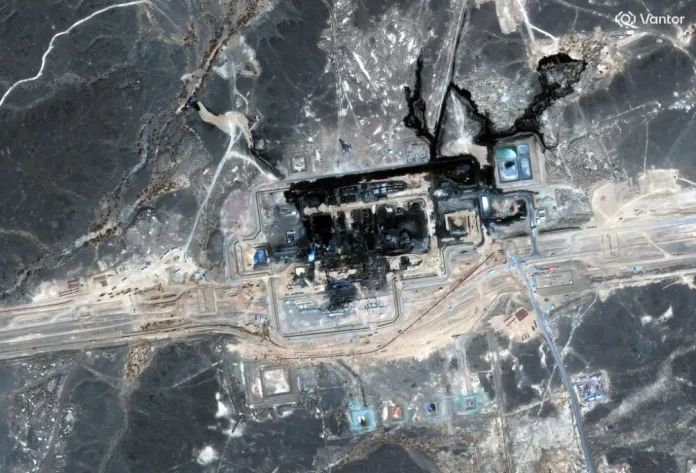
He’s largely alone in this view. Drone attacks on the East-West pipeline, blamed on militias in Iraq, hit multiple sensitive points along the 746-mile-long channel. Satellite images showed extensive damage to a pumping station near Medina and other vital parts of the line.
This satellite image provided by Vantor on Sunday, Sept. 13, 2026 shows the aftermath of the recent drone attack on the East-West pipeline in Saudi Arabia. (Satellite image ©2026 Vantor via AP)
" data-large-file="https://www.washingtonexaminer.com/.../09/AP26256645705597-e1789576862230.jpg?w=696" src="https://www.washingtonexaminer.com/wp-content/uploads/2026/09/AP26256645705597.jpg?w=696" alt="Pipeline damage" class="wp-image-4729711">
This satellite image provided by Vantor on Sunday, Sept. 13, 2026, shows the aftermath of the recent drone attack on the East-West pipeline in Saudi Arabia. (Satellite image ©2026 Vantor via AP)
While an exact figure hasn’t been given, sources cited by Reuters gave a likely timeline of up to six weeks. In the most telling piece of info, the outlet reported that Saudi Arabia informed European customers that some September-loading crude cargoes will be canceled, suggesting repairs will take at least the rest of the month.
The worst estimate came from Andy Lipow, president of Lipow Oil Associates, who told clients in a Monday note that it will take “months” to repair the pipeline.
Matt Smith, director of commodity research at Kpler, estimated that the global market could lose 120 million barrels of oil if the pipeline remained shut down for a month. It has a capacity of about 7 million barrels per month, and serves as the site of the majority of overland oil exports around the Strait of Hormuz.
The damaged pipeline was accompanied by a Houthi offensive that seized Yemen’s entire Red Sea coast, giving the group control over another critical world chokepoint. Fears of shutting down the Bab el Mandeb Strait were soothed by Houthi promises only to attack Saudi vessels.
The Trump administration’s other messaging strategy has been to outsource the blame to Ukraine, instead placing the onus on Kyiv’s long-range drone campaign targeting Russian refineries. On Sunday, Trump said he had spoken with Ukrainian President Volodymyr Zelensky to demand he stop Ukrainian strikes on oil refineries, given the impact on diesel oil prices, which hit a nationwide average of $6 per gallon for the first time in U.S. history on Friday. He then claimed the rise in diesel prices had “nothing” to do with the war with Iran.
“Zelensky has to do one thing: He has to stop knocking out diesel fuel in Russia. Let him go after targets, but not diesel fuel, because he’s causing a shortage of diesel fuel. This isn’t done by the Middle East. This is done by what’s happening with Russia and Ukraine,” Trump said.
“We spoke to Mr. Zelensky about it, there are plenty of other targets. Don’t hit diesel fuel, because that’s hurting the world,” he added.
The claim was greeted with widespread skepticism, especially as the timing of the price rises coincided with flare-ups in the fighting in the Middle East. However, De Haan gave some credence to this explanation, saying Ukrainian strikes on Russian refineries did contribute to the global oil shock, though they had their true effect only when combined with the Middle East disruptions.
INTERNATIONAL PROTESTS BREAK OUT OVER RISING OIL AND GAS COSTS
“Two things stacked,” he explained in a post on X. “Ukraine spent months tightening global supply even while prices held flat, so when Iran responded & shut the Strait there was no Middle East cushion left to absorb it. That combo broke it higher at the same time demand peaks- in the summer.”
“The producer ban of diesel exports from Russia started I believe July 2026, which was an escalation from the trader export ban that started last year. Complete bans of diesel exports when Russia producers >10% of global diesel is quite substantial,” De Haan added.
Continue reading...
[ H/T Washington Examiner ]