



NANO Nuclear Buys The One Thing You Can't Speed Up: A Fuel-Cycle License
Ask anyone in the nuclear business what holds up the "renaissance" and you won't hear much about reactor physics. You will hear about paperwork, fuel, and paperwork for fuel. The DOE's Deputy Secretary James Danly put it bluntly last week: "If we are going to have this nuclear renaissance, we are not going to be able to do it without fuel."
So it makes sense that the latest move from the NANO Nuclear (NNE), a company we have covered at length over the past year due to its leading position in the nuclear space, is a reactor-free one. This morning NANO and its subsidiary HALEU Energy Fuel signed a definitive agreement to buy the US nuclear fuel processing assets of Radnostix (formerly International Isotopes) and its subsidiary International Isotopes Fluorine Products.
The headline terms:
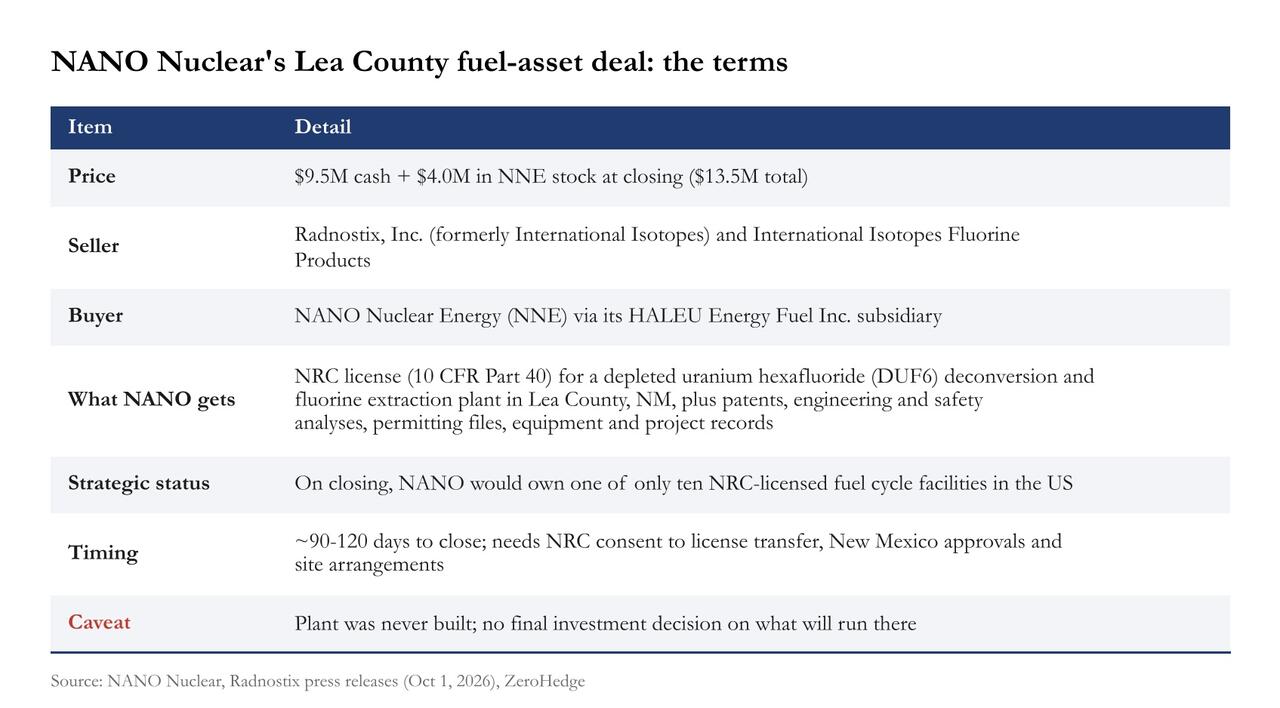
After rising 2.5% premarket, NNE stock is now lower on the day which is odd for a stock that jumped 13% on the similarly sized $13M Secured Transportation Services deal in May. That fits a market where, as Goldman's sector specialist put it in mid-September, "inbounds have been extremely light on the nuclear front" (we discussed this in "Uranium Term Prices Hit A Record... So Why Is Nuclear Getting Nuked?"). We would argue the market is underpricing this one.
The asset is the old International Isotopes Fluorine Extraction Process and Depleted Uranium Deconversion (FEP/DUP) project near Hobbs, NM. According to the NRC, the license was issued on October 2, 2012, with a 40-year term. It was the first commercial license of its kind in the US, and the facility was "not yet constructed."
The plant was designed to take the depleted UF6 "tails" left over from enrichment, convert them into stable uranium oxide for disposal, and recover the fluorine as high-purity fluoride products, including anhydrous hydrogen fluoride, which goes into semiconductor and solar manufacturing. Put differently, it turns nuclear waste into chip-fab chemicals, which is about as 2026 as a business plan gets.
Location matters more than anything else here. The site is about 30 miles from Urenco USA in Eunice, NM, which, per the World Nuclear Association, is the main US commercial enrichment plant (4.3M SWU/yr), with a multibillion-dollar expansion planned. Urenco produces tails continuously. The NRC lists its DUF6 storage authorization at up to 251 million kg, and Urenco's long-term tails plan currently points to a facility in the UK. A licensed deconversion site next door is the obvious alternative.
So why did the plant sit idle for 13 years? According to a Fission Chain write-up, the main obstacles were a condition in Urenco's own license that blocked it from using deconversion plants producing anhydrous HF (removed in 2025), plenty of cylinder storage space at Eunice, and no committed buyer. In short, there was a license and no customer. The Russian uranium import ban, whose waivers end in January 2028, plus the federal push for domestic enrichment, have since changed that.
The important line in NANO's release isn't about depleted uranium. It's this one: the existing license provides "a significantly more efficient regulatory pathway" to add other fuel-cycle processes through NRC license amendments rather than starting a new application from scratch. CEO James Walker said the deal gives NANO "multiple potential pathways to expand our domestic fuel cycle capabilities while preserving the flexibility to determine the development strategy."
Translation: NANO is paying $13.5M for a regulatory head start. Anyone who has watched an NRC fuel-cycle licensing proceeding (the Eunice license itself took years) knows the time saved is worth far more than the purchase price. That's especially true at a moment when, per the WNA, the US has one conversion plant (Metropolis, running at 50-70% of its 15,000 tU/yr license) and one commercial-scale enrichment plant.
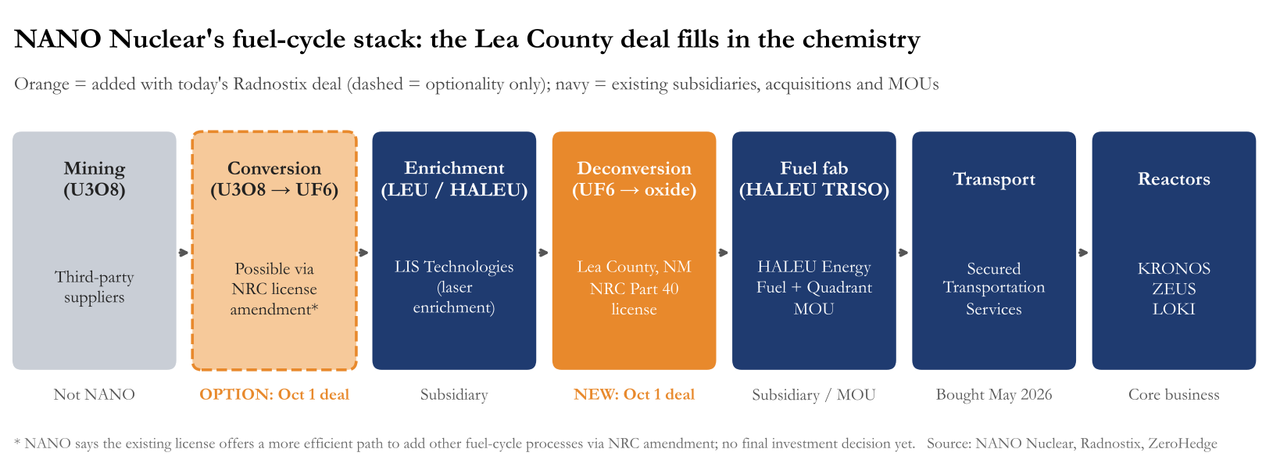
Readers who followed our September 5 piece should have seen this coming. When NANO signed its MOU with Enveniam, the lead project integrator for LIS Technologies' laser enrichment plant, one of the six workstreams listed was "conversion and deconversion." At the time we said NANO's vertical integration was moving beyond the "corporate slide deck." Four weeks later it has a licensed site for that workstream.
Source: NANO Nuclear, Radnostix, ZeroHedge
Laid out like this, the plan is clear. Since January NANO has put together, piece by piece:
The best argument for NANO spending on fuel instead of only on reactors comes from Goldman, which says nothing about NANO directly.
When the bank's clean energy strategist Brian Lee initiated on Standard Nuclear (STDN) at Buy in August, he described a TRISO fuel supplier with a capital-light model, "significant pricing power in the early-stages of TRISO fuel adoption," EBITDA margins reaching ~65% by 2030, and revenue going from under $20M in 2026 to over $1BN by 2030. All of this rests on Goldman's forecast of ~15GW of cumulative SMR deployment by 2035, up from zero today, which would require about 100 MTU of fuel. Goldman added that STDN's ability to fund growth without more external capital makes it "unique amongst peers tied to the growth of SMRs."
That is the gap NANO is trying to close: a reactor developer has to raise money until first power, while a fuel supplier can charge everyone along the way (think of it as a debt-free neocloud charging others for the privilege of using its compute until AI becomes profitable). Northland's Jeff Grampp made the same point after last month's WNA symposium in London. He cut his NNE target to $22 from $37 to reflect higher costs of capital and a slower 2030-35 buildout, and said he prefers fuel and supply-chain names "that make money now" (BWXT, LEU, EU, URG). If the market pays fuel-cycle multiples and NANO keeps acquiring fuel-cycle assets, the conclusion follows.
Goldman's view on the macro backdrop got stronger overnight. Commenting on the US-Korea package announced after Tuesday's close, which includes $120BN for eight large US reactors (six AP1000s, two APR1400s), Lee said it reinforces "a constructive long-term backdrop for nuclear deployment and the broader fuel cycle," and that it is "likely to further exacerbate the anticipated uranium supply deficit in the 2030 time frame" (full note available to pro subs). Eight gigawatt-scale reactors need conversion, enrichment and, eventually, tails handling. That's more UF6 moving through a supply chain with very little spare capacity.
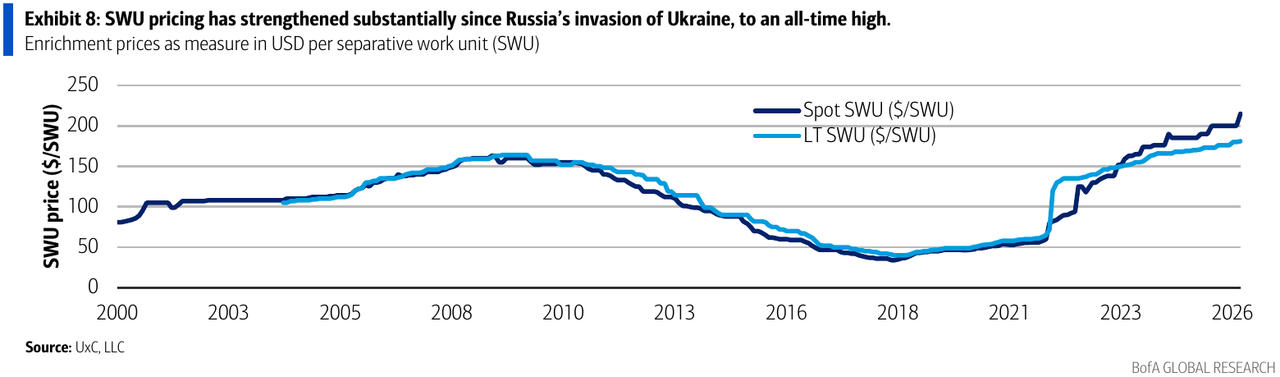
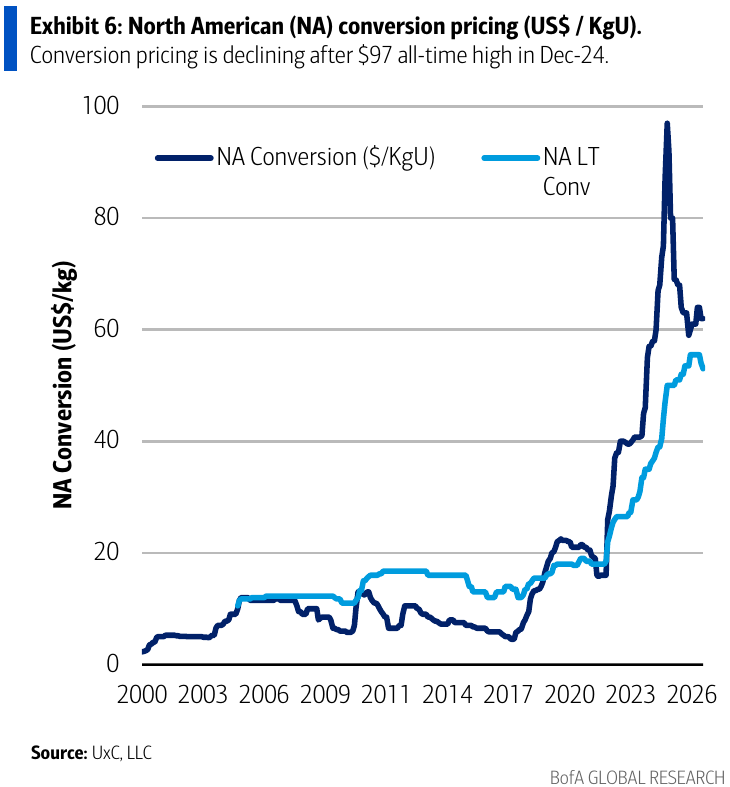
The prices already show it. BofA's charts from the WNA symposium show SWU prices at an all-time high and still rising, and North American conversion still at roughly 3x pre-2022 levels even after falling from the $97/kgU peak in December 2024:
Source: BofA Global Research, UxC
Source: BofA Global Research, UxC
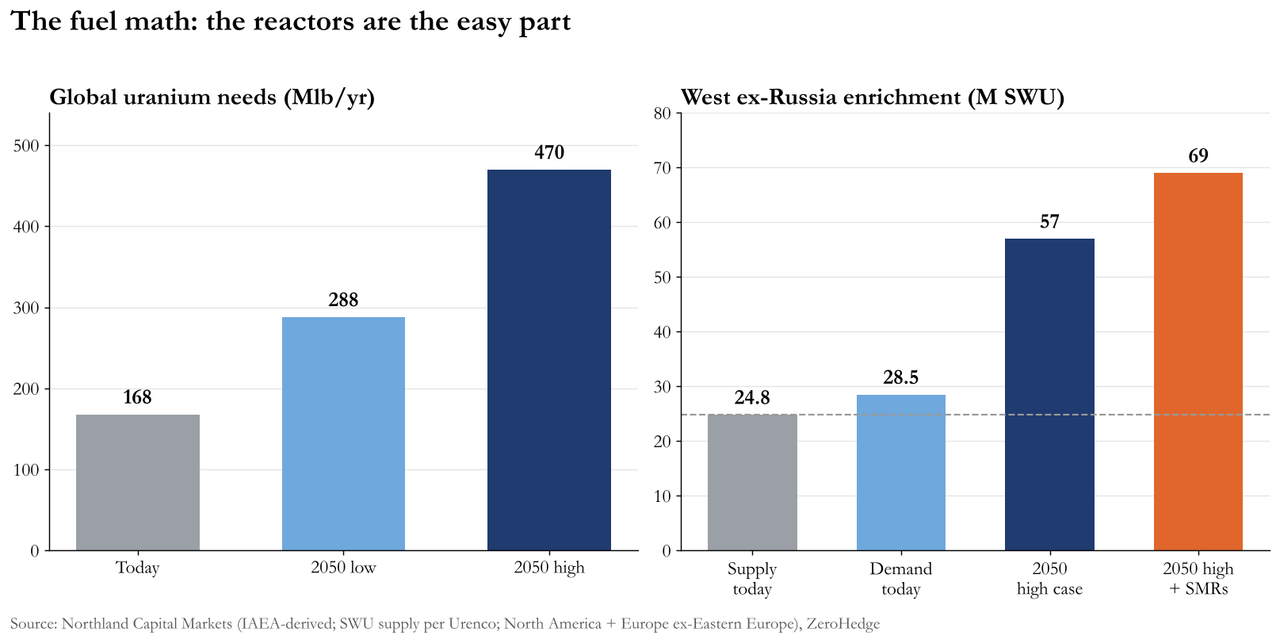
And the long-run math is worse. Northland's IAEA-based numbers show Western (ex-Russia) enrichment supply of 24.8M SWU against demand of 28.5M SWU today, which means the West is already short before a single SMR is built. In the 2050 high case with SMRs, demand rises to about 69M SWU:
Source: Northland Capital Markets (IAEA-derived), ZeroHedge
HALEU is the tightest part of all. Seaport notes Centrus is targeting 12 MT/yr of HALEU capacity with first new output in 2029, and that a single Oklo Aurora needs about 7 MT for its first core. That means America's flagship HALEU program can fuel about two reactors a year at the start. This is the main reason microreactor developers are moving down the fuel chain themselves.
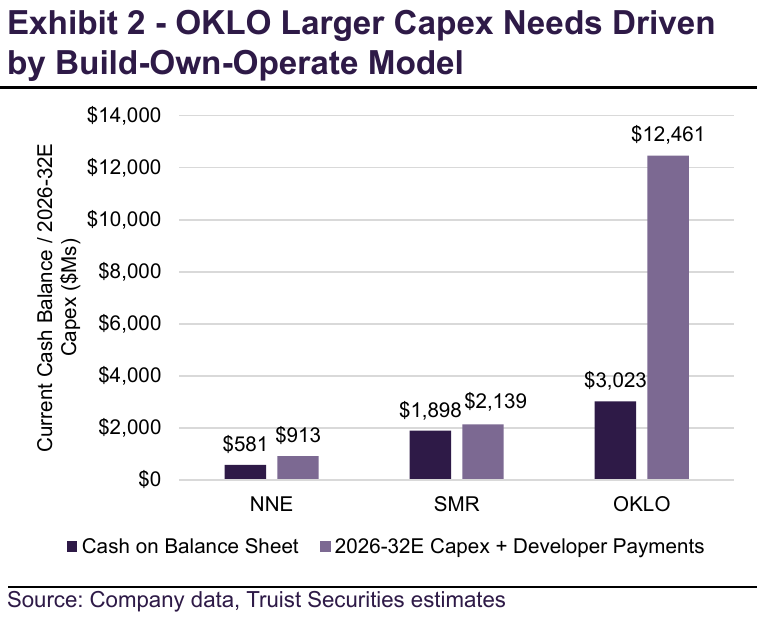
This is the obvious objection. Laser enrichment, fuel fabrication, a deconversion plant, a transport fleet, three reactor designs and a space reactor is a lot for a company with an ~$850M market cap (or maybe the market cap should be much bigger as the market doesn't see the big picture yet). On that, Truist has a useful chart. Comparing cash on hand with 2026-32E capex plus developer payments, NANO's gap is the smallest of the three listed SMR names: ~$581M of cash against ~$913M of needs, versus $3.0BN against $12.5BN for Oklo's build-own-operate model:
Source: Truist Securities (Sep 28, 2026)
At $13.5M, today's deal is about 2% of NANO's cash, and the $4M stock portion causes minimal dilution. The real cost is whatever NANO decides to build in Lea County, and since there is no FID yet, that figure doesn't exist. Bulls will call that optionality. Bears will say it's a blank check. Both have a point.
We've argued for years that modular, behind-the-meter reactors are the only real long-term answer to AI's power demand. But a reactor without fuel is a very expensive paperweight, or as NANO's own pitch put it in May, "what good is a fancy new car if there's no gas stations to fill it?" Over the past nine months NANO has been building the gas stations, plus the refinery, the tanker trucks and now a licensed site to handle the waste.
The 2012 license was worthless while there was no market for domestic fuel. Then came the Russian ban with its 2028 waiver cliff, $2.7BN of federal enrichment awards, record SWU prices, Urenco expanding 30 miles down the road, and an $120BN reactor package that, in Goldman's words, makes the 2030 fuel deficit worse. With all that, a 40-year NRC fuel-cycle license looks very cheap at $13.5M. NANO paid about the same for a trucking company.
Whether NANO can turn a dormant license into a working plant is the next question, and the 90-120 day closing period followed by the first NRC amendment filing will be the first real test. Strategically, the deal makes sense. NANO is positioning itself to be the company that supplies the fuel, not just another reactor developer waiting for it.
Tyler Durden Thu, 10/01/2026 - 12:40
Continue reading...
[ H/T ZeroHedge ]
Ask anyone in the nuclear business what holds up the "renaissance" and you won't hear much about reactor physics. You will hear about paperwork, fuel, and paperwork for fuel. The DOE's Deputy Secretary James Danly put it bluntly last week: "If we are going to have this nuclear renaissance, we are not going to be able to do it without fuel."
So it makes sense that the latest move from the NANO Nuclear (NNE), a company we have covered at length over the past year due to its leading position in the nuclear space, is a reactor-free one. This morning NANO and its subsidiary HALEU Energy Fuel signed a definitive agreement to buy the US nuclear fuel processing assets of Radnostix (formerly International Isotopes) and its subsidiary International Isotopes Fluorine Products.
The headline terms:
After rising 2.5% premarket, NNE stock is now lower on the day which is odd for a stock that jumped 13% on the similarly sized $13M Secured Transportation Services deal in May. That fits a market where, as Goldman's sector specialist put it in mid-September, "inbounds have been extremely light on the nuclear front" (we discussed this in "Uranium Term Prices Hit A Record... So Why Is Nuclear Getting Nuked?"). We would argue the market is underpricing this one.
What is NANO buying?
The asset is the old International Isotopes Fluorine Extraction Process and Depleted Uranium Deconversion (FEP/DUP) project near Hobbs, NM. According to the NRC, the license was issued on October 2, 2012, with a 40-year term. It was the first commercial license of its kind in the US, and the facility was "not yet constructed."
The plant was designed to take the depleted UF6 "tails" left over from enrichment, convert them into stable uranium oxide for disposal, and recover the fluorine as high-purity fluoride products, including anhydrous hydrogen fluoride, which goes into semiconductor and solar manufacturing. Put differently, it turns nuclear waste into chip-fab chemicals, which is about as 2026 as a business plan gets.
Location matters more than anything else here. The site is about 30 miles from Urenco USA in Eunice, NM, which, per the World Nuclear Association, is the main US commercial enrichment plant (4.3M SWU/yr), with a multibillion-dollar expansion planned. Urenco produces tails continuously. The NRC lists its DUF6 storage authorization at up to 251 million kg, and Urenco's long-term tails plan currently points to a facility in the UK. A licensed deconversion site next door is the obvious alternative.
So why did the plant sit idle for 13 years? According to a Fission Chain write-up, the main obstacles were a condition in Urenco's own license that blocked it from using deconversion plants producing anhydrous HF (removed in 2025), plenty of cylinder storage space at Eunice, and no committed buyer. In short, there was a license and no customer. The Russian uranium import ban, whose waivers end in January 2028, plus the federal push for domestic enrichment, have since changed that.
Why this matters more than the price suggests
The important line in NANO's release isn't about depleted uranium. It's this one: the existing license provides "a significantly more efficient regulatory pathway" to add other fuel-cycle processes through NRC license amendments rather than starting a new application from scratch. CEO James Walker said the deal gives NANO "multiple potential pathways to expand our domestic fuel cycle capabilities while preserving the flexibility to determine the development strategy."
Translation: NANO is paying $13.5M for a regulatory head start. Anyone who has watched an NRC fuel-cycle licensing proceeding (the Eunice license itself took years) knows the time saved is worth far more than the purchase price. That's especially true at a moment when, per the WNA, the US has one conversion plant (Metropolis, running at 50-70% of its 15,000 tU/yr license) and one commercial-scale enrichment plant.
Readers who followed our September 5 piece should have seen this coming. When NANO signed its MOU with Enveniam, the lead project integrator for LIS Technologies' laser enrichment plant, one of the six workstreams listed was "conversion and deconversion." At the time we said NANO's vertical integration was moving beyond the "corporate slide deck." Four weeks later it has a licensed site for that workstream.
Source: NANO Nuclear, Radnostix, ZeroHedge
Laid out like this, the plan is clear. Since January NANO has put together, piece by piece:
- Enrichment: LIS Technologies' laser enrichment, which founder Jay Yu has pitched as "significantly cheaper to operate as well as less capital intensive to deploy" (Feb 4, May 15), with Enveniam as integrator for the planned Tennessee plant.
- Fuel supply and fabrication: the HALEU Energy Fuel subsidiary (today's buyer), plus the Aug 18 MOU with Quadrant Nuclear Industries on domestic HALEU supply.
- Logistics: the HALEU transport package (Mar 16) and the $13M acquisition of Secured Transportation Services, which ran the largest single international HALEU shipment in NNSA history (1.7 MT from Japan) and turned NANO into a revenue-generating company.
- Fuel handling: Fortil's work on the KRONOS fuel handling and storage system (Jul 24).
- Reactors: KRONOS at UIUC, where the NRC has begun its technical review of the construction permit we flagged as "a defining moment" on Apr 2, along with ZEUS and the space-focused LOKI.
The sell side: fuel is where the money is
The best argument for NANO spending on fuel instead of only on reactors comes from Goldman, which says nothing about NANO directly.
When the bank's clean energy strategist Brian Lee initiated on Standard Nuclear (STDN) at Buy in August, he described a TRISO fuel supplier with a capital-light model, "significant pricing power in the early-stages of TRISO fuel adoption," EBITDA margins reaching ~65% by 2030, and revenue going from under $20M in 2026 to over $1BN by 2030. All of this rests on Goldman's forecast of ~15GW of cumulative SMR deployment by 2035, up from zero today, which would require about 100 MTU of fuel. Goldman added that STDN's ability to fund growth without more external capital makes it "unique amongst peers tied to the growth of SMRs."
That is the gap NANO is trying to close: a reactor developer has to raise money until first power, while a fuel supplier can charge everyone along the way (think of it as a debt-free neocloud charging others for the privilege of using its compute until AI becomes profitable). Northland's Jeff Grampp made the same point after last month's WNA symposium in London. He cut his NNE target to $22 from $37 to reflect higher costs of capital and a slower 2030-35 buildout, and said he prefers fuel and supply-chain names "that make money now" (BWXT, LEU, EU, URG). If the market pays fuel-cycle multiples and NANO keeps acquiring fuel-cycle assets, the conclusion follows.
Goldman's view on the macro backdrop got stronger overnight. Commenting on the US-Korea package announced after Tuesday's close, which includes $120BN for eight large US reactors (six AP1000s, two APR1400s), Lee said it reinforces "a constructive long-term backdrop for nuclear deployment and the broader fuel cycle," and that it is "likely to further exacerbate the anticipated uranium supply deficit in the 2030 time frame" (full note available to pro subs). Eight gigawatt-scale reactors need conversion, enrichment and, eventually, tails handling. That's more UF6 moving through a supply chain with very little spare capacity.
The prices already show it. BofA's charts from the WNA symposium show SWU prices at an all-time high and still rising, and North American conversion still at roughly 3x pre-2022 levels even after falling from the $97/kgU peak in December 2024:
Source: BofA Global Research, UxC
Source: BofA Global Research, UxC
And the long-run math is worse. Northland's IAEA-based numbers show Western (ex-Russia) enrichment supply of 24.8M SWU against demand of 28.5M SWU today, which means the West is already short before a single SMR is built. In the 2050 high case with SMRs, demand rises to about 69M SWU:
Source: Northland Capital Markets (IAEA-derived), ZeroHedge
HALEU is the tightest part of all. Seaport notes Centrus is targeting 12 MT/yr of HALEU capacity with first new output in 2029, and that a single Oklo Aurora needs about 7 MT for its first core. That means America's flagship HALEU program can fuel about two reactors a year at the start. This is the main reason microreactor developers are moving down the fuel chain themselves.
Can NANO afford to be a fuel company?
This is the obvious objection. Laser enrichment, fuel fabrication, a deconversion plant, a transport fleet, three reactor designs and a space reactor is a lot for a company with an ~$850M market cap (or maybe the market cap should be much bigger as the market doesn't see the big picture yet). On that, Truist has a useful chart. Comparing cash on hand with 2026-32E capex plus developer payments, NANO's gap is the smallest of the three listed SMR names: ~$581M of cash against ~$913M of needs, versus $3.0BN against $12.5BN for Oklo's build-own-operate model:
Source: Truist Securities (Sep 28, 2026)
At $13.5M, today's deal is about 2% of NANO's cash, and the $4M stock portion causes minimal dilution. The real cost is whatever NANO decides to build in Lea County, and since there is no FID yet, that figure doesn't exist. Bulls will call that optionality. Bears will say it's a blank check. Both have a point.
What could go wrong
- Licenses aren't plants. This one has been unused for 13 years. A Part 40 source-material license for deconversion is useful, but adding conversion, or anything that touches enriched material, means amendments, NRC review and possibly a different licensing basis. "More efficient" doesn't mean "fast."
- New Mexico. The deal needs approval from state officials. Lea County supports nuclear (it already hosts Urenco), but Santa Fe fought hard against Holtec's proposed interim spent fuel storage site in the same corner of the state. A deconversion plant is a very different animal, but expect the same activists to show up.
- Focus. Each new business line adds another place where something can go wrong. The base case for NANO is still KRONOS at UIUC, with construction targeted for late 2027 according to Roth (Buy). A delay there won't be offset by a fluorine plant.
- Sentiment. The market has been ignoring good nuclear news: term uranium is at a record ~$96/lb (UxC via TD Cowen), yet NLR is down 12% YTD while the AI ETF is up 25%, and Holtec pulled its IPO. NANO had 24% of float sold short as of May, so the stock can swing hard in either direction.
The big picture
We've argued for years that modular, behind-the-meter reactors are the only real long-term answer to AI's power demand. But a reactor without fuel is a very expensive paperweight, or as NANO's own pitch put it in May, "what good is a fancy new car if there's no gas stations to fill it?" Over the past nine months NANO has been building the gas stations, plus the refinery, the tanker trucks and now a licensed site to handle the waste.
The 2012 license was worthless while there was no market for domestic fuel. Then came the Russian ban with its 2028 waiver cliff, $2.7BN of federal enrichment awards, record SWU prices, Urenco expanding 30 miles down the road, and an $120BN reactor package that, in Goldman's words, makes the 2030 fuel deficit worse. With all that, a 40-year NRC fuel-cycle license looks very cheap at $13.5M. NANO paid about the same for a trucking company.
Whether NANO can turn a dormant license into a working plant is the next question, and the 90-120 day closing period followed by the first NRC amendment filing will be the first real test. Strategically, the deal makes sense. NANO is positioning itself to be the company that supplies the fuel, not just another reactor developer waiting for it.
Tyler Durden Thu, 10/01/2026 - 12:40
Continue reading...
[ H/T ZeroHedge ]