






Watch Live: SpaceX To Launch Google AI Chips Into Orbit In Push For Space-Based Data Centers
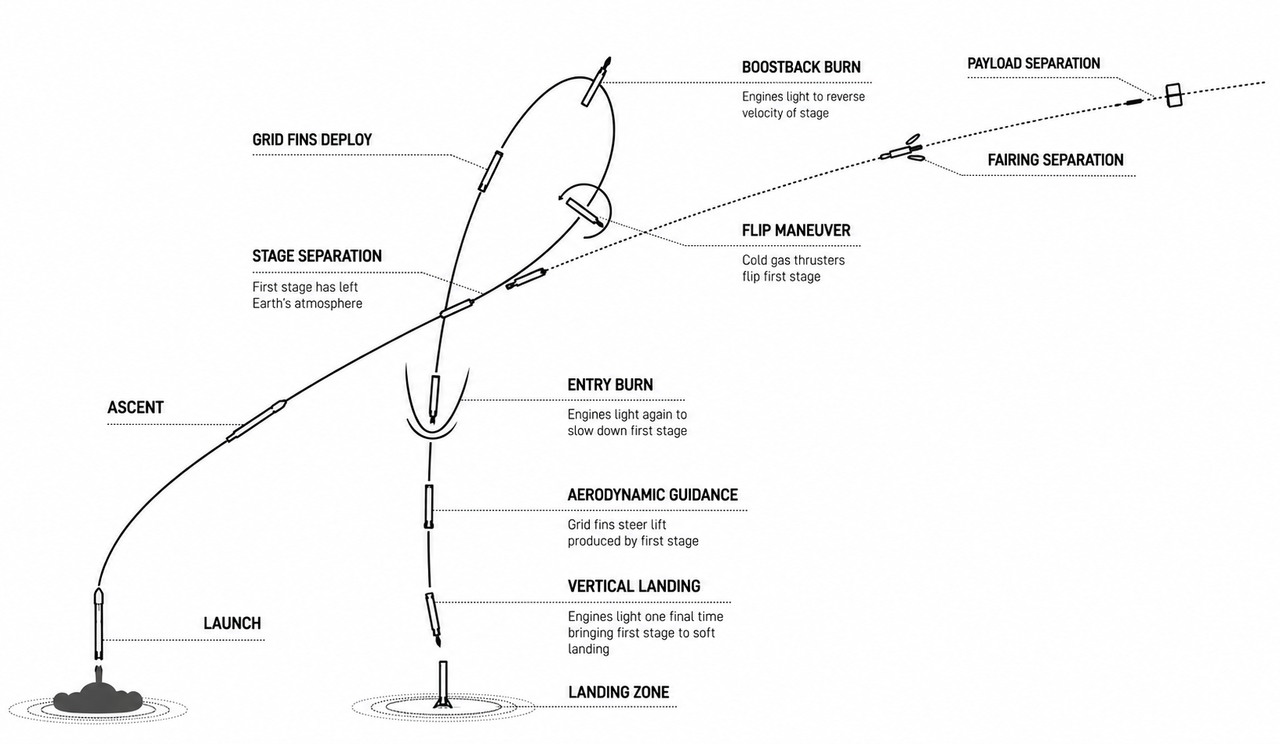
Specialized chips Google designed to run artificial intelligence workloads will be catapulted into low Earth orbit on Thursday afternoon atop a Falcon 9 rocket from California's Vandenberg Space Force Base, with hopes of making data centers in space a reality amid growing backlash on the ground that has sent many terrestrial projects into a tailspin.
The Falcon 9 launch, scheduled for 2:18 pm Eastern time as part of the Transporter-18 mission, will carry a solar-powered satellite prototype equipped with Google's tensor processing units. This is the first orbital test for Project Suncatcher, Alphabet's effort to deploy data center satellites in low Earth orbit, where power is abundant and regulation is nonexistent.
In a pre-launch announcement, Alphabet said Project Suncatcher is a means of "exploring whether space could one day host scalable machine learning infrastructure."
"In low Earth orbit, satellites can access near-constant sunlight, generating up to eight times more solar power than on Earth. Eventually, it could be possible to link together multiple constellations of satellites, allowing them to manage larger AI workloads while in orbit," the tech giant said.
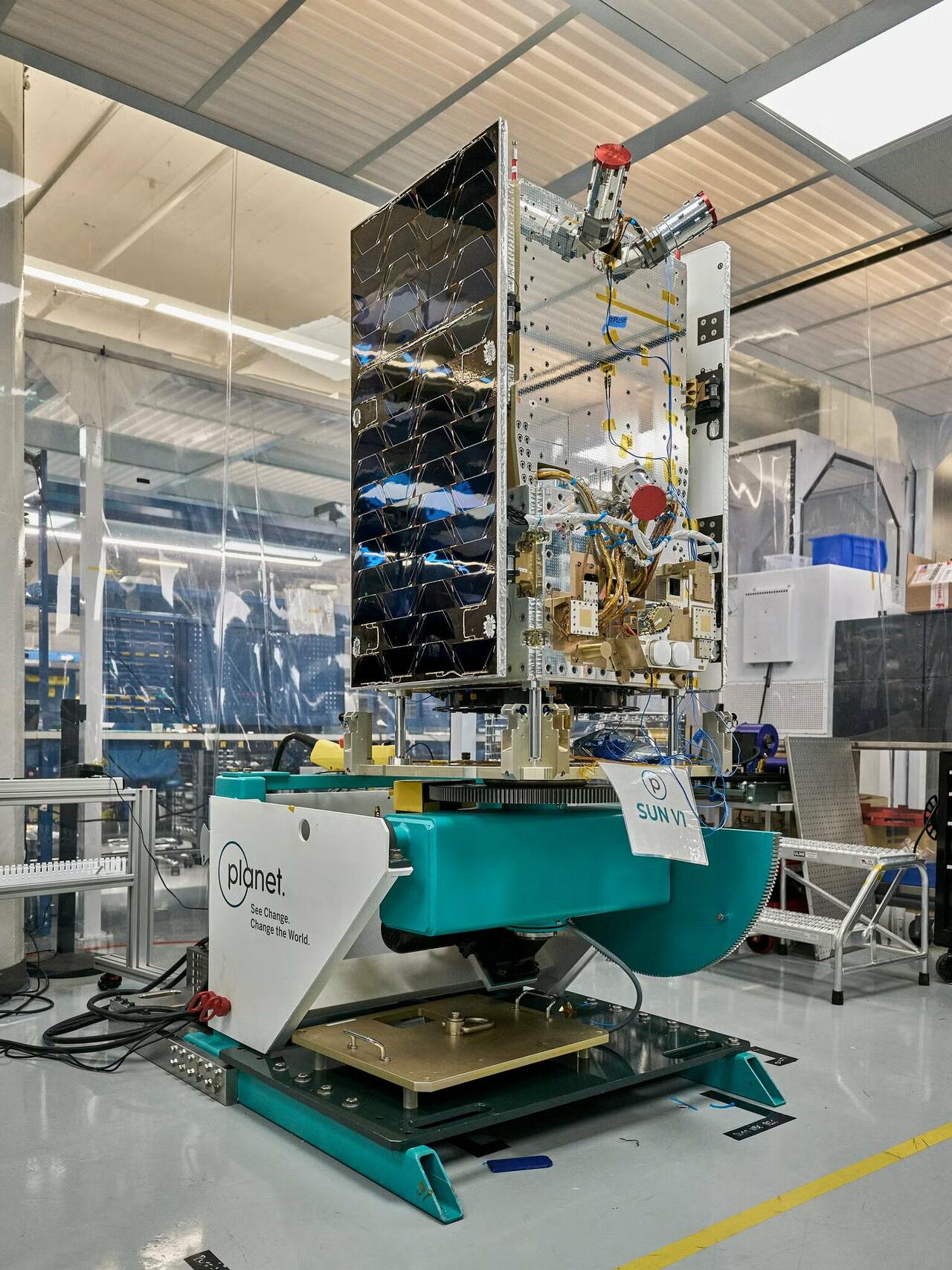
Alphabet has already tested its TPUs running AI workloads in a specialty lab at the University of California, Davis, but the real test of how its chips will perform in space is nearing and could mark the acceleration of a space-economy boom. The inflection point of the space economy has been the emergence of SpaceX and its rocket development, as well as its blockbuster IPO this summer.
Much of the space economy hinges on economics, as the commercialization of SpaceX's Starship appears to be getting closer and will drive launch costs even lower.
But as we previously highlighted, Deutsche Bank's research over the summer points to one major hurdle: orbital data centers still can't compete economically today with facilities on Earth, but that may eventually change at the end of the decade:
To set a baseline, DB's Edison Yu assumes upfront capex for 1 GW of AI compute on the ground is $38bn and requires $900mm in annual opex (power, maintenance, labor, etc…), translating into $42.5bn over 5 years (based on Epoch AI analysis). Of this amount, compute represents $21bn which carries over to orbital data centers at a 10% mark-up to account for overprovisioning in case of GPU failures. It is likely that GPU failures will not be addressed directly by maintenance but simply each satellite will just operate at lower power in the event of a failure. Therefore, the non compute costs for terrestrial are $21.5bn and ODC essentially has to break below this level post overprovisioning or $19.5bn to be at parity. Looking forward, DB assumes the cost of terrestrial increases going forward. To illustrate, NVIDIA's CEO Jensen Huang recently commented at GTC Taipei 2026 that a new 1 GW "AI factory" could approach $100bn in cost with roughly half being compute-related.
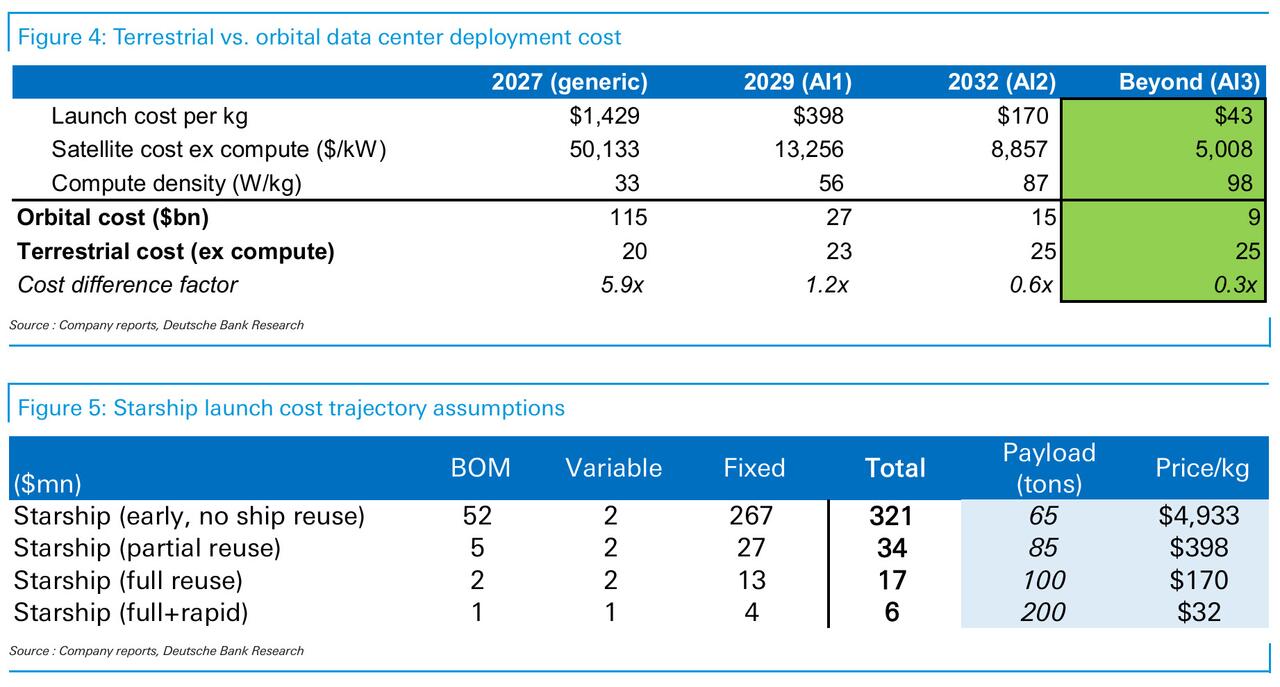
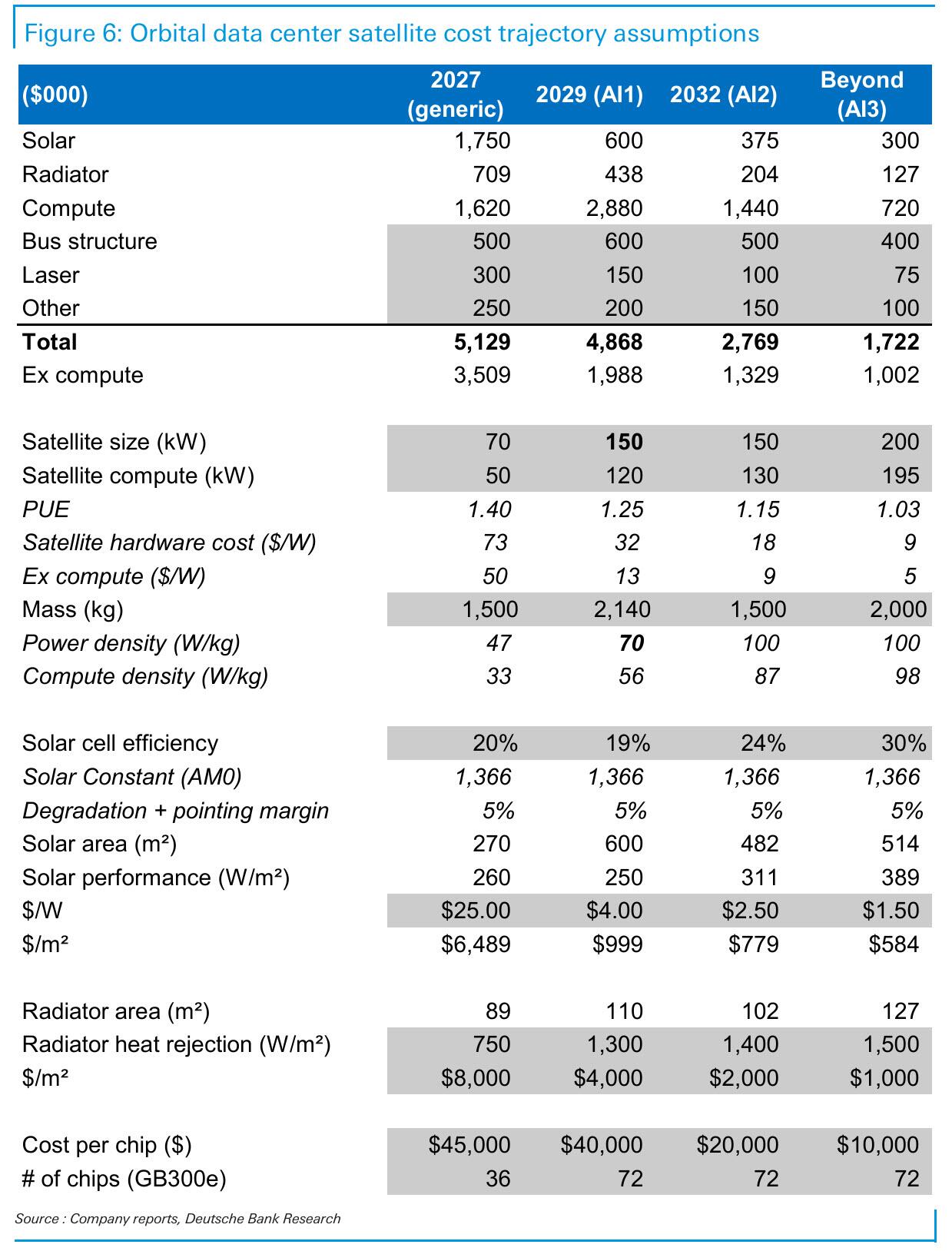
Using current SpaceX launch vehicles and satellite designs, DB estimates the near term cost of deploying a 1 GW space data center constellation would be 6x higher than terrestrial (ex-compute). This gap can narrow to 1.0-1.5x later by end of the decade and then eventually be cheaper in the early-mid 2030s. This reduction is primarily driven by Starship (rapid reusability) and aggressive optimization/scaling of the AI-series satellites (we also refresh the DB Orbital Data Center Model which goes deeper into the economic viability of launching AI infrastructure into orbit)


Even if orbital data centers become economically viable and cost-competitive with ground facilities, engineering challenges remain, such as managing temperature extremes and shielding chips from radiation.
Watch Rocket Launch Live:
Tyler Durden Thu, 10/01/2026 - 10:08
Continue reading...
[ H/T ZeroHedge ]
Specialized chips Google designed to run artificial intelligence workloads will be catapulted into low Earth orbit on Thursday afternoon atop a Falcon 9 rocket from California's Vandenberg Space Force Base, with hopes of making data centers in space a reality amid growing backlash on the ground that has sent many terrestrial projects into a tailspin.
The Falcon 9 launch, scheduled for 2:18 pm Eastern time as part of the Transporter-18 mission, will carry a solar-powered satellite prototype equipped with Google's tensor processing units. This is the first orbital test for Project Suncatcher, Alphabet's effort to deploy data center satellites in low Earth orbit, where power is abundant and regulation is nonexistent.
In a pre-launch announcement, Alphabet said Project Suncatcher is a means of "exploring whether space could one day host scalable machine learning infrastructure."
"In low Earth orbit, satellites can access near-constant sunlight, generating up to eight times more solar power than on Earth. Eventually, it could be possible to link together multiple constellations of satellites, allowing them to manage larger AI workloads while in orbit," the tech giant said.
Alphabet has already tested its TPUs running AI workloads in a specialty lab at the University of California, Davis, but the real test of how its chips will perform in space is nearing and could mark the acceleration of a space-economy boom. The inflection point of the space economy has been the emergence of SpaceX and its rocket development, as well as its blockbuster IPO this summer.
Much of the space economy hinges on economics, as the commercialization of SpaceX's Starship appears to be getting closer and will drive launch costs even lower.
But as we previously highlighted, Deutsche Bank's research over the summer points to one major hurdle: orbital data centers still can't compete economically today with facilities on Earth, but that may eventually change at the end of the decade:
To set a baseline, DB's Edison Yu assumes upfront capex for 1 GW of AI compute on the ground is $38bn and requires $900mm in annual opex (power, maintenance, labor, etc…), translating into $42.5bn over 5 years (based on Epoch AI analysis). Of this amount, compute represents $21bn which carries over to orbital data centers at a 10% mark-up to account for overprovisioning in case of GPU failures. It is likely that GPU failures will not be addressed directly by maintenance but simply each satellite will just operate at lower power in the event of a failure. Therefore, the non compute costs for terrestrial are $21.5bn and ODC essentially has to break below this level post overprovisioning or $19.5bn to be at parity. Looking forward, DB assumes the cost of terrestrial increases going forward. To illustrate, NVIDIA's CEO Jensen Huang recently commented at GTC Taipei 2026 that a new 1 GW "AI factory" could approach $100bn in cost with roughly half being compute-related.
Using current SpaceX launch vehicles and satellite designs, DB estimates the near term cost of deploying a 1 GW space data center constellation would be 6x higher than terrestrial (ex-compute). This gap can narrow to 1.0-1.5x later by end of the decade and then eventually be cheaper in the early-mid 2030s. This reduction is primarily driven by Starship (rapid reusability) and aggressive optimization/scaling of the AI-series satellites (we also refresh the DB Orbital Data Center Model which goes deeper into the economic viability of launching AI infrastructure into orbit)
Even if orbital data centers become economically viable and cost-competitive with ground facilities, engineering challenges remain, such as managing temperature extremes and shielding chips from radiation.
Watch Rocket Launch Live:
Tyler Durden Thu, 10/01/2026 - 10:08
Continue reading...
[ H/T ZeroHedge ]