





Director Peter Berg can’t shake the memory of Gene Hackman dangling from a steam valve wheel in 1972’s “The Poseidon Adventure.” Hackman’s character, a man of faith on a doomed cruise ship, sacrificed himself so that the remaining passengers could live.
That image, that heroism, never left the future filmmaker.
'I’m drawn to the emotion that is generated when human beings are in dire situations.'
“It stuck with me,” Berg tells Blaze Media. “Since ‘The Poseidon Adventure,’ I’ve been trying to make human stories surround by action.”
Something bigger
Berg’s film canon backs that up. He’s responsible for a crush of heroic tales, including “Lone Survivor” (2013), “Deepwater Horizon” (2016), “Patriots Day” (2016), and now “The Mosquito Bowl.”
The Netflix original, premiering in theaters today before its Nov. 25 streaming debut, follows four college football stars as they trade pigskins for rifles post-Pearl Harbor. The quartet (Ray Nicholson, Bill Skarsgård, Tom Francis, and Nicholas Galitzine) bond and bicker between battles, but they get a chance to flex their football skills in the titular bowl.
Berg previously directed 2004’s “Friday Night Lights,” also drawn from a book by author Buzz Bissinger (Berg’s cousin). The director leapt at the chance to helm the scribe’s fact-based tale.
“I could sense that, like with ‘Friday Night Lights,’ he was tapping into bigger themes than football or war,” Berg says. “I knew he was throwing a fastball with this book. His dad was a Marine in Okinawa. My dad was a Marine in Korea ... this was the kind of story I wanted to be a part of.”
'Inch by inch'
Berg commits to serious research before any film projects. For “The Mosquito Bowl,” he visited Okinawa and toured the battlefield that plays a key part in the film’s third act.
He marveled at “the slopes and the mountains that had to be fought over and the caves that had to be entered,” he says, as well as the furious nature of the battles. “I wasn’t aware of how incredibly violent it was, inch by inch, bullet by bullet, flame thrower by flame thrower, these two militaries just went at it.”
His film is unsparing on that front, assembling some of the most unsettling war images since “Saving Private Ryan.”
To attempt to grasp the scale of death and destruction, he visited the Cornerstone of Peace monument at Peace Memorial Park in Itoman, Okinawa, where more than 200,000 names of those who lost their lives in the battle are etched in stone.
“You can literally feel it as you move through Okinawa. I’m glad I went out there. It seared that into my soul,” he says.
Brotherhood and bravery
The veteran director started his career as an actor (“Chicago Hope,” “A Midnight Clear”) before moving behind the camera without sticking to any one genre. Still, the obvious through line in his work is courage, bravery, and sacrifice, the very DNA of “The Mosquito Bowl.”
“I’m drawn to the emotion that is generated when human beings are in dire situations,” he says. “It’s an opportunity to explore character, strength, perseverance, heroism, cowardly behavior, complicitous behavior ... under the umbrella of action and intensity. I’ve always been drawn to that. I don’ t know why.”
He’s more dialed in about football’s eternal appeal.
“Football’s just the perfect sport. It requires 11 men on the sides to all be operating in perfect unison together. It’s completely unpredictable ... there’s an element of danger, there’s incredible athleticism, and there’s a brotherhood. The brotherhood is incredibly inspiring, and the emotion is real ... it transcends our petty human differences and unites us all,” he says. “Football is the greatest thing that’s ever been invented, and we need more football.”
RELATED: Director finds faith in the wild with Brad Pitt’s ‘Heart of the Beast’
Head down
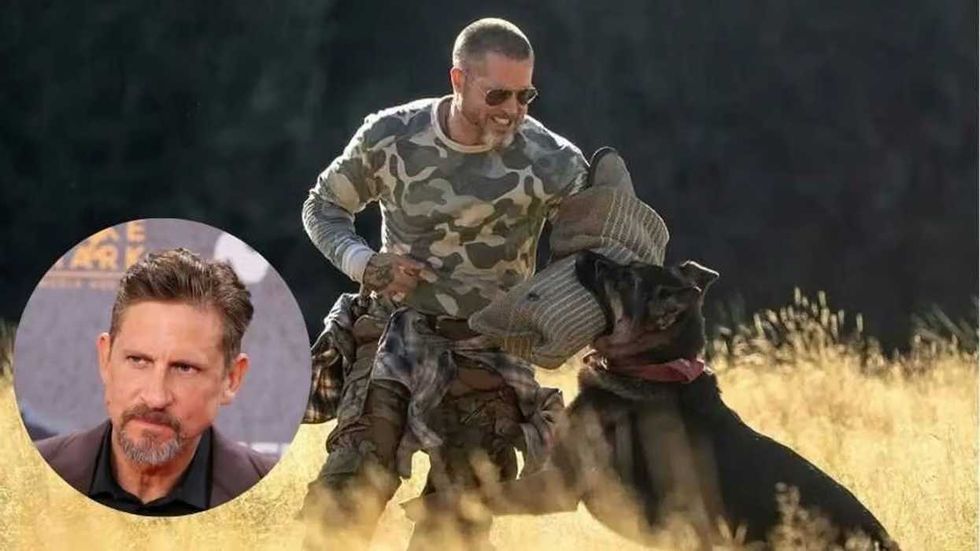
Berg has worked steadily for decades in Hollywood, including the occasional acting gig — don’t miss his inspirational cameo in “The Mosquito Bowl.” Unlike some of his peers, he doesn’t fear the rise of AI in La La Land.
“All you can do is control what you can control,” he says. “I’m not seeing AI coming at me right now as the death of my business. I’m seeing opportunities.”
His approach to an evolving industry hasn’t changed, something he advises to anyone eager to tell big-screen stories.
“You have to keep your head down and work,” he says. “Movies in theaters are doing very, very well right now. The [Paramount-Warner Bros.] merger is not going to change much. There’s still a lot of stuff being made.”
He’s even more optimistic about young filmmakers joining the business. Think 20-something director Curry Barker of “Obsession” fame, a movie that defied all Hollywood wisdom to earn more than $500 million worldwide. He’s delighted to note how rebel storyteller Nathan Fielder broke out via his documentary smash “You Can See Everything,” in theaters now.
“I think we’re just fine,” he says of Hollywood as 2027 nears.
Continue reading...
[H/T Blaze Media]


