





In professional football, there have always been coaches who win games, and coaches who win championships. Far rarer are the ones who become part of the country’s cultural furniture — figures so distinctive that decades later people still dress up as them, talk in their accents, and treat their scowls as a kind of civic inheritance. Mike Ditka, the former Chicago Bears tight end and coach who died on Oct. 9 at 86, was one of those. He was not the winningest coach in NFL history, nor the most tactically inventive. But he was by far the most iconic.
Born Michael Keller Ditka on Oct. 18, 1939, in Carnegie, Pennsylvania, and raised in nearby Aliquippa, he grew up in the steel-and-coal country that produced a disproportionate share of the league’s toughest players. A three-sport athlete in high school, he starred at the University of Pittsburgh, where he was a consensus All-American. Most scouts saw him as a linebacker. George Halas drafted him fifth overall in the 1961 NFL draft and decided to play him at tight end — a position then regarded as little more than an extra blocker who might catch a pass every now and then.
Ditka treated it as an opportunity to run people over after the catch. In his rookie season, he became the first tight end in league history to clear 1,000 receiving yards, won Offensive Rookie of the Year, and made the first of five straight Pro Bowls. He helped the Bears to the 1963 NFL championship, then finished his playing career with the Eagles and Cowboys. In 1988, he became the first tight end inducted into the Pro Football Hall of Fame. The position he redefined is now a central piece of nearly every modern offense, a receiving threat as much as a blocker. It’s not a stretch to say that without Ditka, we may have never had Rob Gronkowski and Travis Kelce.
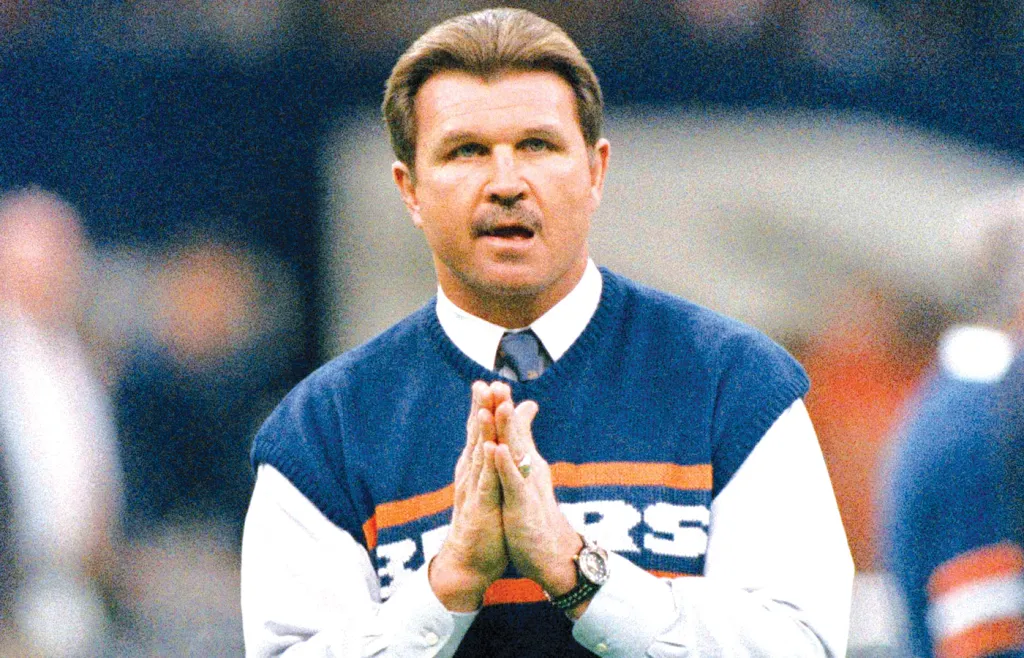
Chicago Bears head coach Mike Ditka strikes a prayerful pose as he watches the team workout, Jan. 26, 1986 in New Orleans before the start of NFL football’s Super Bowl XX. (AP Photo/Rob Kozloff)
" data-large-file="https://www.washingtonexaminer.com/wp-content/uploads/2026/10/Obit.102826.jpg?w=1024" height="658" width="1024" src="https://www.washingtonexaminer.com/wp-content/uploads/2026/10/Obit.102826.jpg?w=1024" alt="Chicago Bears head coach Mike Ditka strikes a prayerful pose as he watches the team workout, Jan. 26, 1986 in New Orleans before the start of NFL football's Super Bowl XX. (AP Photo/Rob Kozloff)" class="wp-image-4776889" srcset="https://www.washingtonexaminer.com/wp-content/uploads/2026/10/Obit.102826.jpg 1400w, https://www.washingtonexaminer.com/wp-content/uploads/2026/10/Obit.102826.jpg?resize=300,193 300w, https://www.washingtonexaminer.com/wp-content/uploads/2026/10/Obit.102826.jpg?resize=768,494 768w, https://www.washingtonexaminer.com/wp-content/uploads/2026/10/Obit.102826.jpg?resize=1024,658 1024w" sizes="(max-width: 1024px) 100vw, 1024px">
Chicago Bears head coach Mike Ditka strikes a prayerful pose as he watches the team workout, Jan. 26, 1986 in New Orleans before the start of NFL football’s Super Bowl XX. (AP Photo/Rob Kozloff)
After a successful run as an assistant under Tom Landry in Dallas, Ditka returned to Chicago as head coach in 1982. The franchise he inherited was respectable but unthreatening. A few successful drafts and a running back known as Walter Payton would change that. The 1985 Bears went 15-1, fielded a defense that still functions as the sport’s measuring stick, and destroyed the New England Patriots in Super Bowl XX. The team’s swagger, captured in the Super Bowl Shuffle and in Ditka’s sideline intensity, made the ’85 Bears one of the most memorable teams in NFL history. Ditka was named Coach of the Year; he won the award again in 1988 after returning to the sideline almost immediately following a heart attack midseason. Over 11 seasons in Chicago, he compiled a 106-62 record, second only to Halas in franchise history, and six division titles. He later coached three seasons in New Orleans. Only one other man, Tom Flores, has ever won a Super Bowl as a player, an assistant coach, and a head coach.
BILL BELICHICK AT NORTH CAROLINA — WHAT (AND HOW) IS HE DOING?
What separated Ditka from other successful coaches was the degree to which he became part of not just American sports culture but American popular culture. The mustache, the aviator sunglasses, the sweater vest, the permanent look of someone who had just been flagged for a bogus holding penalty — these became shorthand for a certain kind of Reagan-era American swagger. The Saturday Night Live “Superfans” sketches of the early 1990s fixed this image in place. The characters did not merely root for the Bears. They treated Ditka as a weather system and a moral standard. “Da Bears!” entered the national vocabulary, and so did the idea that somewhere in Chicago there was a coach who would have preferred to settle arguments by lining people up and having them fight it out. Fans have continued dressing as him for Halloween, for tailgates, and for no particular reason at all, 30 and 40 years later. Few coaches in any sport have enjoyed that kind of afterlife. He also became a pitchman, a restaurant namesake, and a recurring presence in the broader culture, the rare football figure who outgrew the sport without ever seeming to leave it.
He remained, to the end, recognizably himself in public: blunt, occasionally volcanic, and allergic to euphemism. Asked once why he wanted to live to 150, he answered that there were still a few people he hadn’t made mad yet, and he wanted to get them. And yet, despite the bluster, he could also be riotously funny, as anyone who remembers his post-coaching career as a broadcaster (as I do) will recall. It might be that for this reason—for his sui generis synthesis of “I’m gonna chew your teeth out” toughness, “but I’m also gonna make you laugh while I do it”— to this very day in Chicago, as Pardon the Interruption’s Michael Wilbon recently recounted, even though Michael Jordan passed through the Windy City, in Chicago there’s still only one “Mike.” I don’t know about you, but I can’t think of higher praise than that.
Daniel Ross Goodman (@DanRossGoodman) is a Washington Examiner contributing writer and teaches theology and religious studies at St. John’s University. His next book, Dante’s Guide to Life: How The Divine Comedy Can Change Our Fortunes, Our World, and Ourselves, will be published this fall by Angelico Press.
Continue reading...
[ H/T Washington Examiner ]