





“Medicare for all” is an oddly honest name for a socialized healthcare system. A single-payer system, after all, can work only if you compel everyone to be part of the “all.”
Progressives are endlessly telling us how much Americans love the idea of socializing the healthcare insurance system. Which is only true if you lie to them about it.
You will recall that Barack Obama’s most infamous lie was to claim that the Affordable Health Care Act [sic] wouldn’t force anyone to surrender existing insurance plans. “If you like your healthcare plan, you can keep it,” wasn’t a throwaway line. It existed to diffuse one of the leading concerns of voters. Obama used the phrase at least 37 times — and Democrats made the claims hundreds of more times.
The president later risibly lamented that he may have misled people, but his legislation would have stalled without the lie.
Of course, after Obamacare passed, around 4 million people lost their plans that didn’t meet the minimum standards created by Obamacare, which was not only about laying the ground for a single-payer plan but a tool of social coercion, as Little Sisters of the Poor would find out.
We also later found that the White House knew anywhere between 40%–67% of individual plans would likely lose their grandfather status.
Today, progressives know that 100% of private insurance holders in the United States will lose their plans under Medicare for All. And still, Democrats in the media let the plan’s proponents lie with impunity.
Abdul el Sayed, the Democratic Party candidate in Michigan and one of the leading proponents of socialized medicine, was recently interviewed by NBC News’s Kristen Welker.
Here’s how it went:
WELKER: Well, let’s talk about some of what you want to do if you do in fact win. You have talked about supporting “Medicare for all.” In your vision of “Medicare for all,” does private insurance still exist?
EL SAYED: If people want redundant care, absolutely. I don’t want to take anything away. This is about what we offer to people. What “Medicare for all” is guaranteed health insurance from cradle to the moment you pass away, God willing at 120 years old after a long, healthy life.
You’ll notice that the question and answer are both highly misleading. Welker asks whether “private insurance” would “exist,” which it probably would for rich people. In turn, el Sayed is allowed to contend that it would exist but only to offer “redundant care,” rather than being forced to explicitly say that every American would be coerced into a state-run program.
El Sayed then offers some typical talking points, before Welker follows up with: “Under your vision of Medicare for All, can people keep their healthcare plan if they like their healthcare plan?”
“Yes,” el Sayed says. “That healthcare plan has to decide that they’re going to continue to keep those people.”
This is preposterous. Why would healthcare insurance companies continue offering plans when they are already being forced into another plan by the government?
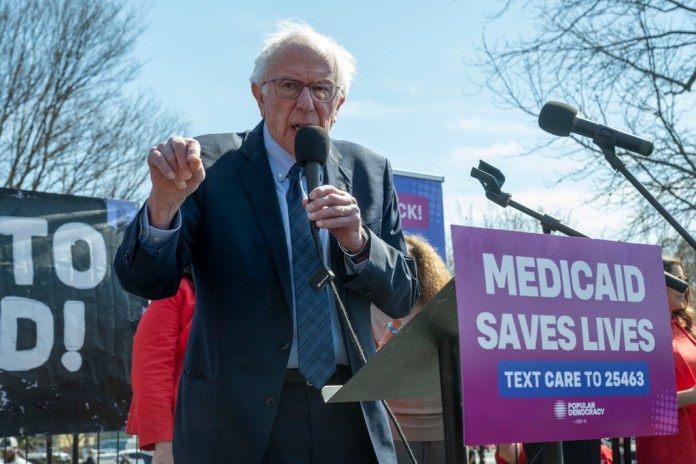
Under any standard single-payer Medicare for All Act-type proposal, like the one offered by Sen. Bernie Sanders (I-VT), which el Sayed supports, you cannot keep your private or employer-sponsored health insurance for basic care. In countries with similar systems, the wealthy purchase supplemental insurance, or flee to get better care in the United States, but everyone loses their basic plans.
Yet, Welker just moves on. “Let’s talk about the broader Democratic agenda … ”
There is a good reason why el Sayed is compelled to lie. Progressives and the media keep telling us about the incredible popularity of “Medicare for all.”
“Most Americans support switch to Medicare for all health insurance” is a recent headline from Reuters. The piece is based on a poll conducted by the health-policy research firm Kaiser Family Foundation.
Anyone taking a dive into the survey will find that most Americans probably have no idea what “Medicare for all” entails. And when they are confronted with the most basic realities of the plan, the results dramatically change.
First, Kaiser asks Americans whether, “generally speaking,” they favor “federal government doing more to help provide health insurance for more Americans.” Unsurprisingly, 79% agree. This is the equivalent of asking Americans whether they want the government to do more to “help the poor” or “educate children.”
When Kaiser asks participants whether they favor “having a national health plan, sometimes called Medicare-for-all, in which all Americans would get their insurance from a single government plan,” support drops to 66%.
And when Kaiser asks participants whether they are in favor of “Medicare for all” if it “eliminated private insurance companies,” the support drops to 52%. (What the poll should have asked is whether people would be in favor if it “eliminated your private insurance.”)
When Kaiser asks participants whether they would still be in favor of “Medicare for all” if it required “most Americans to pay more in taxes,” the support drops to 32%. Estimates for Sanders’s plan, for example, come in from around $30 trillion–$50 trillion over a decade — almost surely underestimating the cost. There aren’t enough rich people to tax to cover even a fraction of the cost.
When Kaiser asks participants whether they would favor “Medicare for all” if it might “lead to delays in people getting some medical tests and treatments” — an inevitability in every government-run health insurance plan — support drops to 24%.
Yet, one outlet after outlet keeps trying to convince us that Americans love the idea.
“Medicare for All support soars to 66 percent in 6 years” – The Hill
“Americans are warming to a healthcare idea that once seemed politically impossible” – Fast Company
“National poll shows unprecedented support for Medicare for All” – MS Now
“‘Medicare for All’ support surges” – Axios
“‘Medicare for all’ suddenly popular on campaign trail even in deep-red states” – ABC News
And so on.
That last headline, by the way, was from a 2017 story about the alleged popularity of “Medicare for all.” The claim is nothing new. That story was based on another Kaiser poll that found 62% of Americans had a positive reaction to the term “Medicare for all” — only 4 points fewer than today. But when pollsters referred to it as a “national health plan,” support fell to 57%. When it referred to it as a “single payer health insurance system,” the support fell to 48%.
What would those numbers look like if Kaiser had asked participants straightforward questions about hiking taxes or rationing? It’s quite likely they would look very similar to the numbers we see today.
DR. OZ CLAIMS $1.5 BILLION FRAUD SAVINGS FROM MEDICAID-OBAMACARE DOUBLE ENROLLMENT
We call this “burying in the lede” in journalism. Though things can change, right now, probably a quarter of Americans, even in an era where they are far more open to big government solutions, like the idea of “Medicare for all” as it would actually exist in the world.
If people loved it, of course, they wouldn’t have to be forced to participate.
Continue reading...
[ H/T Washington Examiner ]