






PHILADELPHIA — What stuck with Sen. Dave McCormick (R-PA) was the binders.
On the campaign trail, the Pittsburgh Republican kept asking small-business owners the same question: What’s standing in the way of your growth? If you have 10 employees, what would it take to get to 20?
At a cosmetology school in Lancaster, the owner answered by reaching under her desk. She pulled out a binder, then another, then another. There were eight or 10 in all, every one of them filled with the regulations and compliance work she had to keep up with to run a school that teaches people how to cut hair.
“She said, ‘This is one of the biggest problems I have, and it’s getting worse,'” McCormick said. “So I was like, ‘What can we do?'”
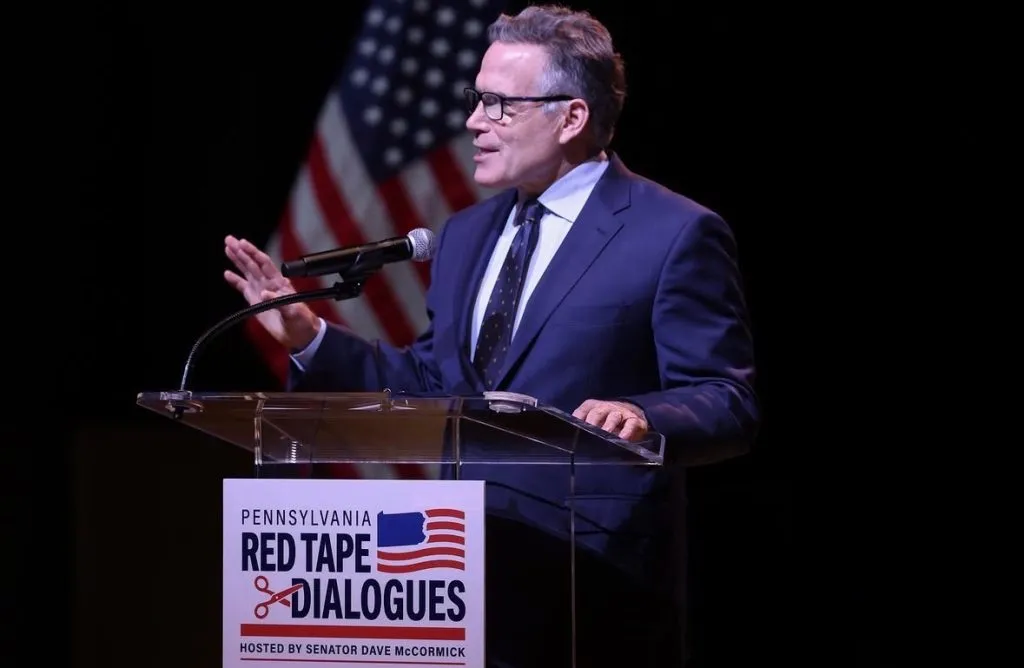
His answer was the Pennsylvania Red Tape Dialogues, held at Temple University on Oct. 15. For a full day, about 100 business leaders, most of them CEOs and many from small firms, sat in the same room as the federal, state, and local officials who write and enforce the rules they live under.
The problem isn’t limited to one level of government, McCormick said. “It’s not just a federal problem, it’s the state problem and the local problem.”
He took the format from his years in business, including his time as a McKinsey consultant in Pittsburgh. He watched companies split employees into teams by process. The teams brainstormed ways to cut costs and burdens, then took their ideas to the CEO for a quick round of yes or no.
“All of a sudden you had all this stuff that it’s like rust that had built up in the system and you’d clean it out in one day by just making smart decisions,” he said.
So his team set up 10 working groups of about 10 people each. They covered industries ranging from agriculture and dairy to defense and advanced manufacturing, as well as independent healthcare and elder care. Some fixes would take legislation. Others would take an executive order or a rule change at a federal department. And some, he said, “you may be able to change overnight.” Invitees sent in about 300 ideas in all.
McCormick insisted the event wasn’t about pitting business against government. Officials from Gov. Josh Shapiro’s (D-PA) administration, regional federal agencies, and the Philadelphia mayor’s office were invited, and Temple President John Fry moderated the closing panel.
The Democratic governor’s office came to show what it had already done. Ben Kirsch, Pennsylvania’s chief transformation and opportunity officer, told the crowd that the Shapiro administration’s permit reform system had cut the average wait for a permit to two days, down from six.
“It’s not different sides of the table,” McCormick said. “We want good regulation that protects consumers, protects safety, protects the environment. Nobody wants to not have appropriate protection, but we just need to do it in a way that’s far less burdensome.”
The trouble, he said, is that government has no process for taking rules away. New officials arrive and add regulations, and the rules pile up “where it becomes this complete ball of yarn that makes it impossible to get things done.”
That’s why he brought in Doug Ducey for a fireside chat. As governor of Arizona from 2015 to 2023, Ducey stopped the state from issuing new regulations and either scrapped or rewrote more than 3,100 existing ones.
Three of the first ideas McCormick’s office drew from the sessions are mundane, which is precisely the point: make things easier and simpler.
The first two deal with the same headache at different levels of government. Licensed childcare centers in Pennsylvania report the same staff, family, and compliance information to at least three different databases. McCormick’s office will look at how the state Department of Human Services could end that duplication. The centers also report duplicate information on children to at least three federal programs, and the office will look at how Washington could eliminate that duplication, too.
The third idea came from small defense contractors. Federal law already sets a goal of paying small businesses within 15 days of receiving a proper invoice. Participants said the Department of War isn’t reliably meeting that goal, and McCormick’s team plans to look at ways to fix the late payments.
“We received approximately 300 ideas from the event my team is working through,” McCormick said. “But some of the commonsense ideas involve simplifying how rural health providers hire and train doctors, making it easier to deliver Pennsylvania products to other states, and enabling different agencies to talk to one another to cut down on duplicative paperwork. The goal is to enable businesses to spend less time on bureaucracy so they can spend more time fueling our economy.”
He has promised participants detailed memos for each of the 10 areas within 60 days. Each memo will say which ideas the state will act on, which will go to federal agencies, which will require legislation he would introduce, and which won’t work. His office also says it will publicly track which recommendations get implemented.
IN PENNSYLVANIA COAL COUNTRY, FOLLOW THE CLIMATE MONEY
“If this works the way I think it’ll work, this is something that I’m going to start to do on a regular basis,” he said.
The real measure will be in Lancaster: whether that stack of binders under the cosmetology school owner’s desk ever gets any shorter.
Continue reading...
[ H/T Washington Examiner ]