



Masa Passes The Hat: SoftBank Seeks $100 Billion From The Gulf After Maxing Out Junk Bonds, Margin Loans And Japanese Retail
The scramble for AI cash is on (or rather, accelerating).
Just hours after the FT reported that OpenAI's annualized revenue is roughly $20 billion lower than the figure that had been making the rounds previously, the same paper reported that Masayoshi Son is trying to raise up to $100 billion from Gulf investors, and has spent recent weeks holding talks with senior figures in the UAE. That would be roughly the size of the original Vision Fund, which is either a sign of ambition or of how much more money the AI trade now needs just to stand still. Clearly, in a world of $1.5 trillion in 2027 capex, the answer is the latter.
Regular readers will not be surprised: we have been warning that the AI buildout runs on debt since exactly one year ago today, and SoftBank, which has committed some $65 billion to OpenAI, has spent most of 2026 as the poster child for that thesis. Over the past nine months Son has tapped bridge loans, margin loans on Arm and OpenAI shares, Japanese retail savers and, most recently, the largest junk bond on record. Now that the usual spigots have been opened all the way, it's time to call the sovereigns.
Below we walk through what Son is pitching to Abu Dhabi, how the money machine got here, why Thursday's OpenAI revenue "clarification" matters so much for SoftBank's balance sheet, and why the Gulf has quietly become the AI trade's lender of last resort.
According to the FT, the new money would go into a vehicle that buys companies and then uses AI and other advanced technology to run them more efficiently: a private-equity roll-up with a robotics twist. Roze, SoftBank's robotics and physical AI unit, which Son hopes to take public at a lofty valuation (press reports have floated $100 billion), is expected to play a central role. The people cautioned that there is no guarantee the talks succeed, and SoftBank declined to comment.
The playbook is familiar. Saudi Arabia's PIF and the UAE's Mubadala anchored the first $100 billion Vision Fund in 2017; per the FT, that fund has generated about $29 billion in cumulative investment gains through June, while Vision Fund 2 (backed primarily by SoftBank itself, and home to the OpenAI stake) is up $20.5 billion. Not exactly WeWork, but not exactly the "information revolution" either for a fund that took nearly a decade to get there.
What is new is the timing. Just this week, OpenAI itself was shopping a $30 billion round to a group of UAE sovereign funds led by MGX (alongside BlackRock) at a $1.4 trillion pre-money valuation set by OpenAI itself. Which means that in the span of four days, both the biggest AI lab and its biggest backer have shown up at the same Abu Dhabi door with their hands out. Back in February, when OpenAI's record $110 billion round closed without a Gulf name on the cap table, we asked the obvious question:
Now we know: it was waiting to be asked.
It's not the first time the emirate has come to the rescue of the AI trade, either. Last December, as Oracle CDS blew out and Blue Owl walked away from Oracle, it was Abu Dhabi that may have delivered the Santa Rally when OpenAI went to sovereign wealth funds for up to $100 billion (a dependence we explored at length in "Dollar Supremacy Strategy Or All-Time Grift? American AI Imperialism's Reliance On The Middle East"). Abu Dhabi, through MGX and G42, has become one of the world's biggest AI spenders, as the FT notes. The difference this time is that there is now a war next door, Brent is above $100, and Gulf petrodollars are being asked to fund two of the biggest AI fundraises of the year at once.
To appreciate why Son needs the Gulf, look at what he has already done this year. The chart below tallies the headline size of every major facility SoftBank has lined up in 2026 to fund its AI ambitions (some refinance others, so this is not a cumulative total, but you get the idea):
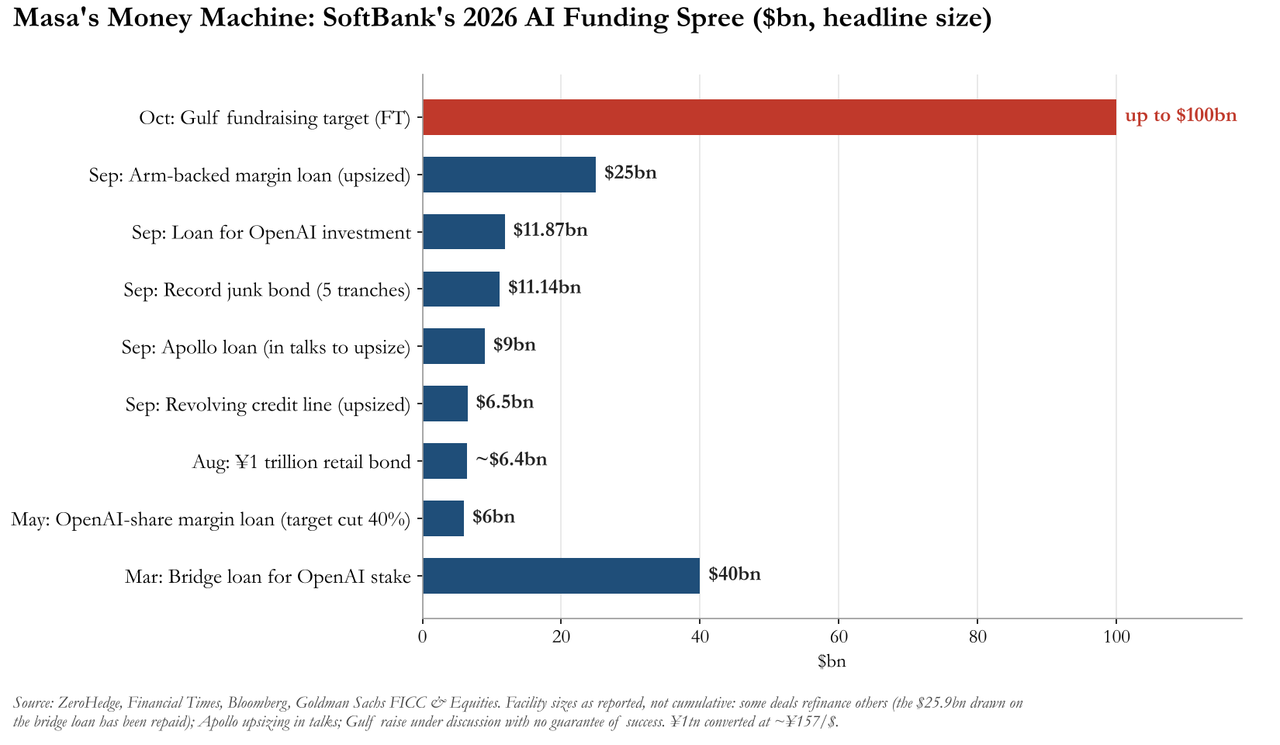
In March, days after SoftBank's CFO warned that its loan-to-value ratio may temporarily exceed the 25% ceiling (to which we responded "chatbots gonna take down masa son"), it lined up a record $40 billion bridge loan for the OpenAI stake. In May, SoftBank had to cut the target for its OpenAI-backed margin loan by 40% to $6 billion,p and by June even the downsized loan had stalled, as lenders balked at taking private OpenAI shares as collateral. Then came a ¥1 trillion bond sold to Japanese retail investors at a 4.75% coupon, an Arm-backed margin loan upsized to $25 billion, a $6.5 billion credit line, an $11.87 billion loan and talks with Apollo to upsize another to $9 billion.
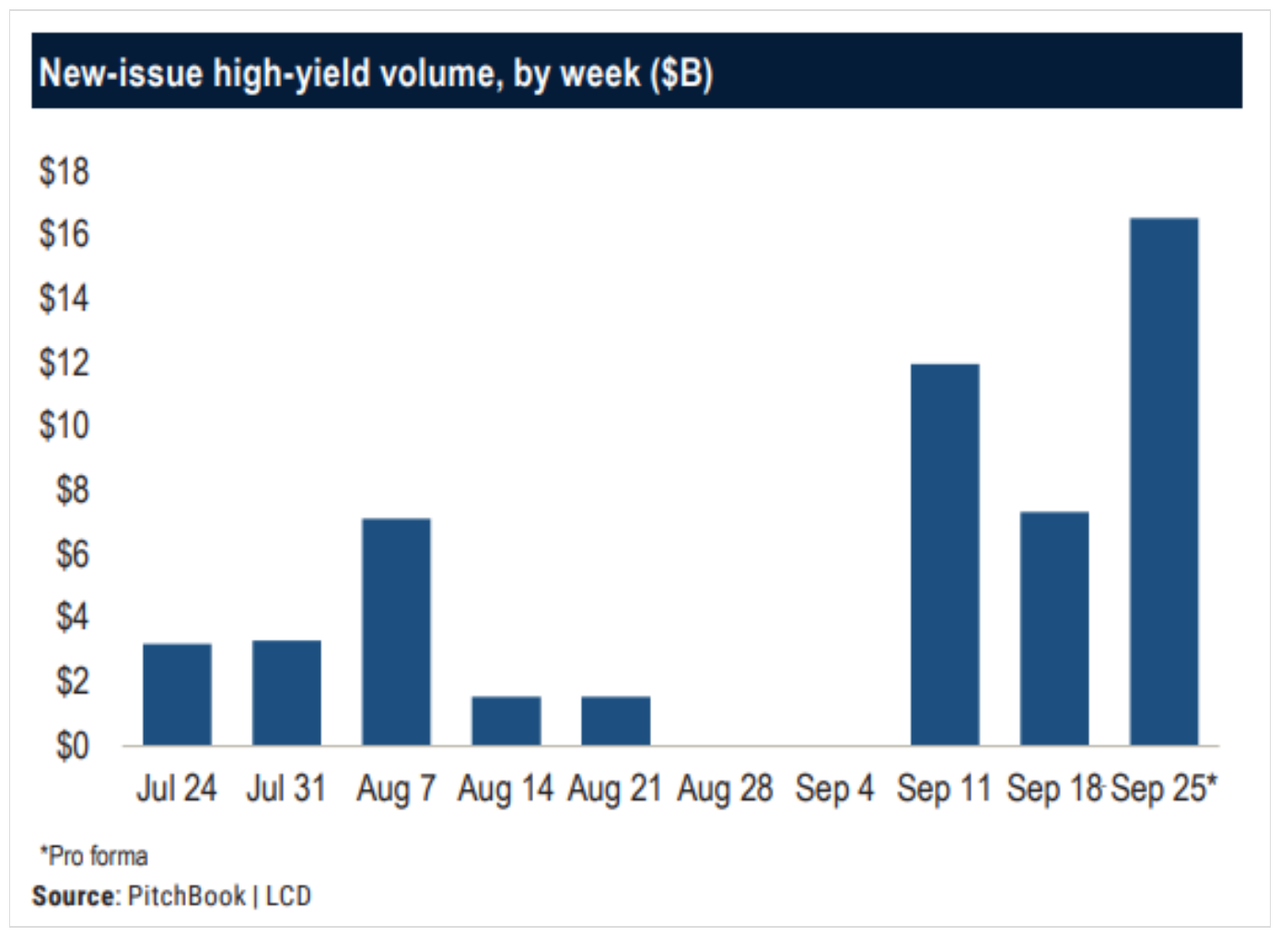
And then, the grand finale: a five-tranche, $11 billion-plus junk bond to fund the next OpenAI check, which the FT says paid yields as high as 9.75%. Goldman's credit sales desk confirmed in Adam Crook's latest AI issuance pulsecheck (available to pro subs) that the $11.14 billion deal was the largest non-investment grade bond sale on record, and it single-handedly made the week of Sept 25 the biggest for new HY issuance in Goldman's chart, which goes back to late July (chart source PitchBook LCD via Goldman):
Naturally, we called this one back in January, when the WSJ first reported that Son was in talks to pour another $30 billion into OpenAI:
Nine months later, SoftBank is the biggest junk issuer in history, so we'll allow ourselves a modest victory lap. The credit market got the message too: within a week of the jumbo deal, SoftBank's 5Y CDS had blown out to the widest levels since the Iran war began, as we flagged in real time:
Put differently, when you have already pledged your crown jewel (Arm), your largest asset (OpenAI), Japanese retail savers and the high-yield market's patience, the only pocket left is a sovereign one.
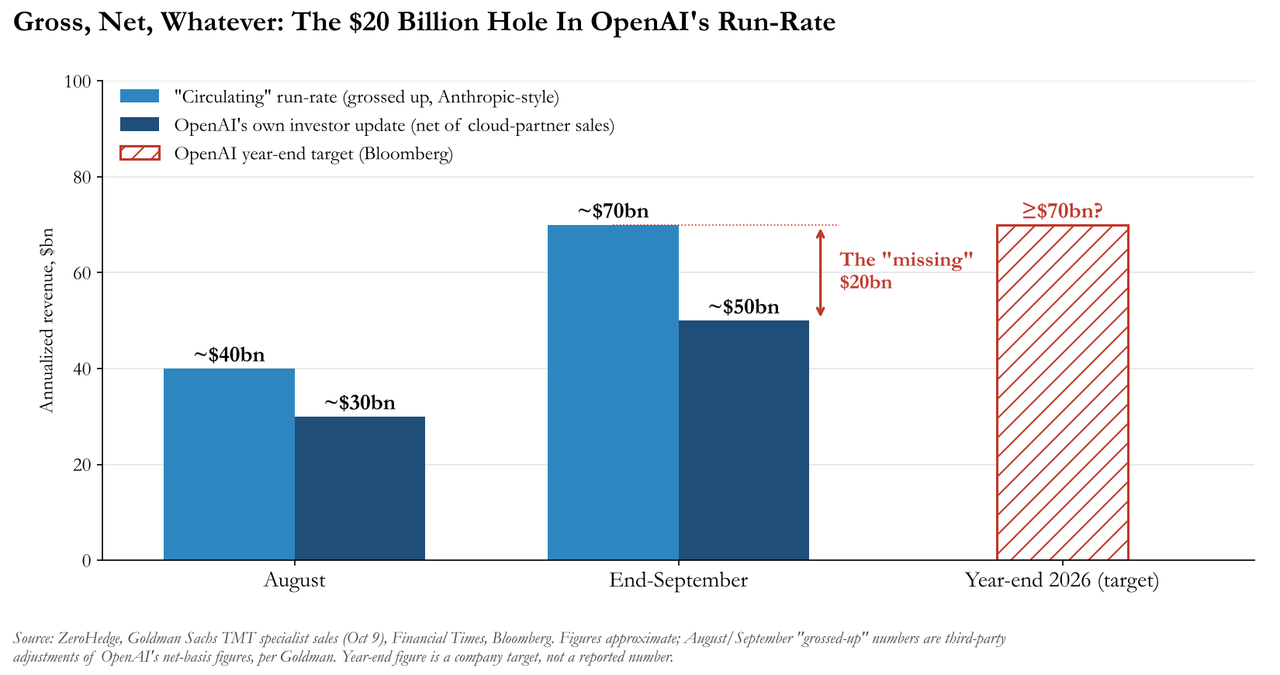
Which brings us to why the timing of the Gulf push is so delicate. On Thursday afternoon the FT reported that OpenAI had told investors its annualized revenue was approaching $50 billion at the end of September, far short of the ~$70 billion figure that had been circulating since Dev Day. Nasdaq promptly tumbled more than 1%, Oracle slid 5-6%, and SoftBank's Tokyo-listed shares fell 5% on Friday. They are still up 25% this year, but have now dropped more than 30% from their June peak, when SoftBank briefly became Japan's most valuable company.
According to Goldman's TMT specialist sales team (available to pro subs), the gap is mostly a matter of accounting rather than collapsing demand: OpenAI reports revenue net of what flows through its cloud partners, while Anthropic reports something closer to gross. Investors who "grossed up" OpenAI to compare the two arrived at roughly $40 billion in August and $70 billion in September; on OpenAI's own net basis, the progression was more like $30 billion to $50 billion. That is still around 70% growth, Goldman notes, just not the growth everyone had priced in. Goldman's desk said it caught a heavy wave of long-only and hedge fund supply in megacap tech after the headline, over $1 billion in net selling of semis, AI and megacaps.
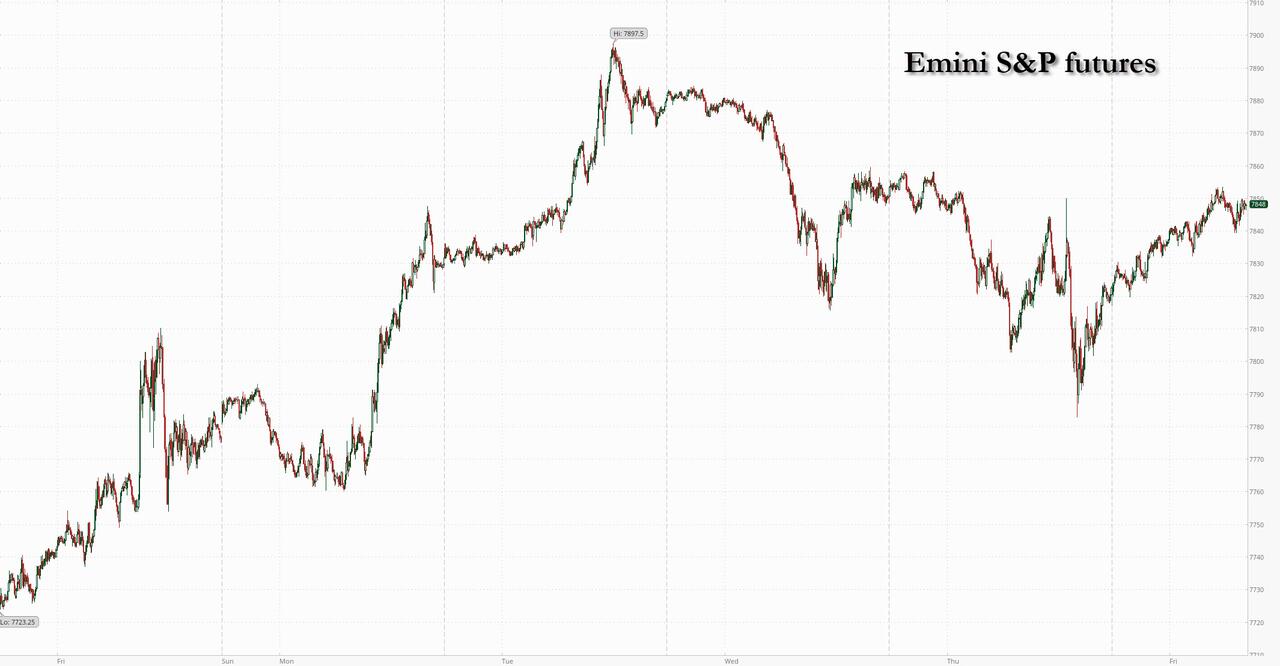
On Friday morning, right on schedule, came the spin: Bloomberg reported that OpenAI now expects to hit or top $70 billion of annualized revenue by year-end, and blamed the confusion on differences in how OpenAI and Anthropic calculate revenue. Futures bounced, and Goldman's TMT desk filed it under the whiplash sentiment swings that have become a defining feature of AI investing this year. So the $70 billion number didn't disappear; it was just moved three months into the future. Which, considering OpenAI is on the hook for some $1.5 trillion in compute commitments, is not quite the reassurance it was meant to be.
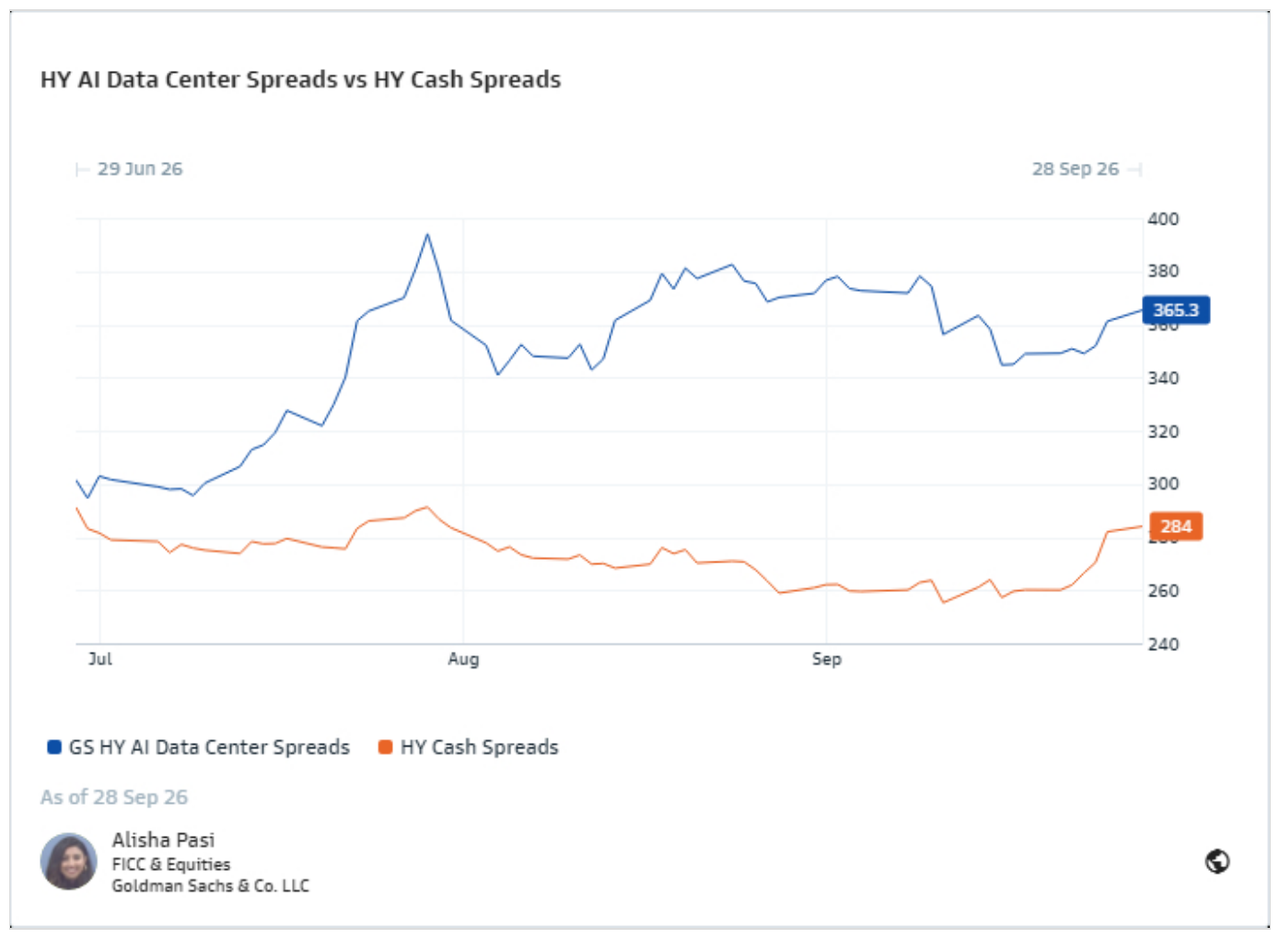
The credit market, for its part, did not bounce. Per the same Goldman TMT note, Oracle's 5Y CDS closed at a record 261bp on Thursday (up 36% in a month) and Broadcom's printed a record 136bp, as nearly $500 billion of 2026 AI-related borrowing gets repriced (more on that in this morning's "The Crowding Out Effect Is Immense"). Goldman's credit sales desk also tracks the gap between HY AI data center bonds and the broader HY market, which was already near 80bp by late September:
Why does a $20 billion gap in a private company's revenue matter so much to SoftBank? Because the private company is the collateral. The FT notes that SoftBank's capacity to borrow is tied to the valuations on its balance sheet: net asset value stood at ¥72.3 trillion at the end of June, and its loan-to-value ratio was a comfortable-looking 13%, well below the 25% ceiling it targets in normal operations. Senior SoftBank people insist that short-term swings in OpenAI's valuation will not change investment plans.
Maybe. But consider the math from the Goldman desk. Back in September, when SoftBank was ripping on AGI hopes, Goldman's Asia/EMEA desk argued that SoftBank's discount to NAV was too wide, noting that OpenAI, marked at the $852 billion valuation of its last priced round, accounts for roughly 20% of SoftBank's NAV and the vast majority of its unlisted assets. The desk's bull case rested on two things: OpenAI being re-marked closer to Anthropic's valuation, and SoftBank monetizing its "other" assets, such as Roze (at a mooted $100 billion) and SB Energy. The desk added that SoftBank was trading at a discount that, by its math, was "much wilder than it looks."
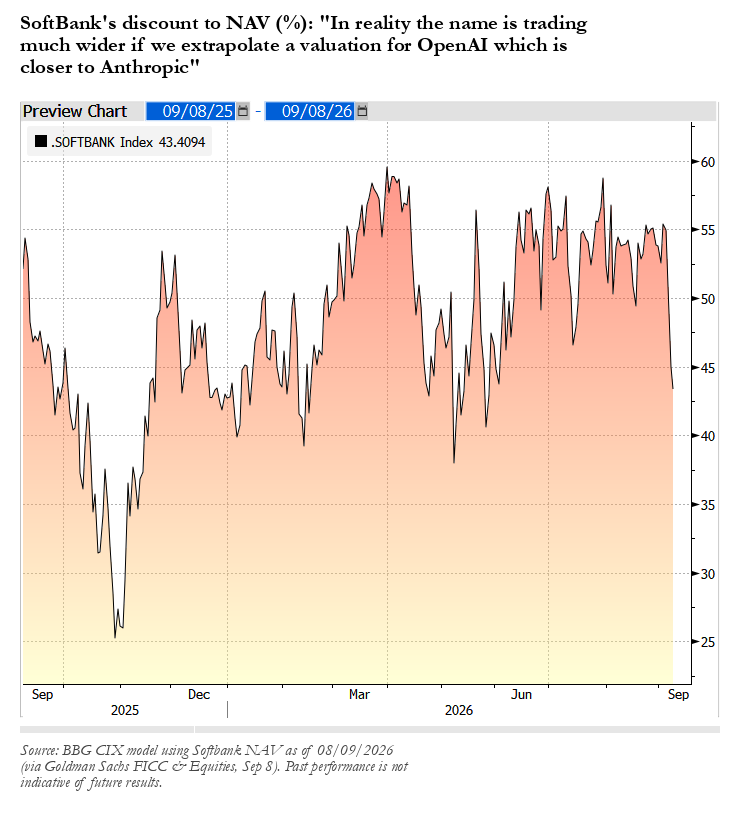
A month later, the scorecard is not encouraging. SB Energy delayed its IPO amid an investor revolt, OpenAI's own IPO has been pushed into 2027, and instead of a re-rating toward Anthropic, OpenAI just had to explain why its revenue was a fifth smaller than everyone thought (or, depending on which day you ask, or which bullish spin master is explaining, exactly as big as everyone thought). The two catalysts for closing the NAV discount have turned into the two reasons it might widen. As one Asia-based analyst warned the FT, if OpenAI's valuation falls, "A contagion effect . . . could get quite bad, quite quickly."
And that is where the Gulf comes in. A sovereign-funded vehicle that buys real companies and bolts robots onto them gives SoftBank two things it badly needs: fresh equity that does not sit on its own balance sheet (and therefore does not touch the LTV), and a shop window for Roze ahead of any listing. For the Gulf, it is another way to diversify away from oil, which, with Hormuz still a mess, is either brilliant timing or a reminder of how long that diversification is taking.
Son has always argued that the skeptics will look foolish, and sometimes (well just once, with Alibaba) he has been spectacularly right. But this is what late-cycle financing looks like: the most aggressive investor in the AI trade has worked his way down the capital structure from equity to bridge loans to margin loans to retail bonds to record junk, and is now asking sovereigns for another Vision Fund-sized check, in the same week that OpenAI is asking the same sovereigns for $30 billion and its revenue disclosure is being "clarified" in real time.
The bulls will say Gulf money removes the funding risk. We would counter that it proves it exists. When the marginal buyer of the AI trade is no longer the market but a handful of petro-states (just like German retail banks and Japanese pension funds were the last sources of capital just before Lehman collapsed), the price of AI risk is being set by geopolitics, not cash flows, and with Brent above $100 and Iran next door, that is not the hedge the bulls think it is. If the Gulf says yes, the circle just gets bigger; if it says no, SoftBank's CDS has a lot further to go.
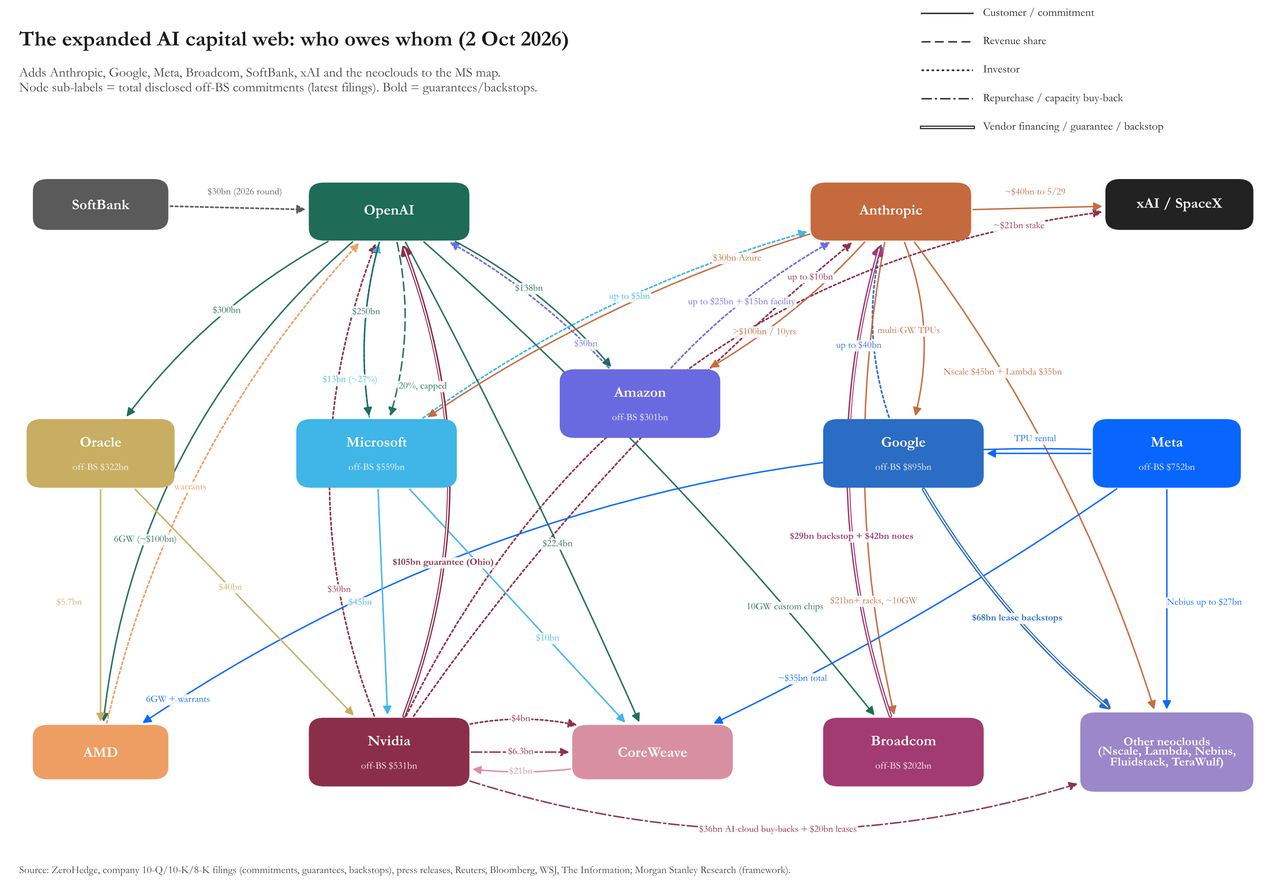
Either way, here is who now owes whom in the biggest circular financing diagram ever seen, with a new sovereign-sized node about to be added:
Much more in the full Goldman AI Issuance Pulsecheck, and "GS TMT Spec Sales" notes, available to pro subs.
Tyler Durden Fri, 10/09/2026 - 09:50
Continue reading...
[ H/T ZeroHedge ]
The scramble for AI cash is on (or rather, accelerating).
Just hours after the FT reported that OpenAI's annualized revenue is roughly $20 billion lower than the figure that had been making the rounds previously, the same paper reported that Masayoshi Son is trying to raise up to $100 billion from Gulf investors, and has spent recent weeks holding talks with senior figures in the UAE. That would be roughly the size of the original Vision Fund, which is either a sign of ambition or of how much more money the AI trade now needs just to stand still. Clearly, in a world of $1.5 trillion in 2027 capex, the answer is the latter.
Regular readers will not be surprised: we have been warning that the AI buildout runs on debt since exactly one year ago today, and SoftBank, which has committed some $65 billion to OpenAI, has spent most of 2026 as the poster child for that thesis. Over the past nine months Son has tapped bridge loans, margin loans on Arm and OpenAI shares, Japanese retail savers and, most recently, the largest junk bond on record. Now that the usual spigots have been opened all the way, it's time to call the sovereigns.
Below we walk through what Son is pitching to Abu Dhabi, how the money machine got here, why Thursday's OpenAI revenue "clarification" matters so much for SoftBank's balance sheet, and why the Gulf has quietly become the AI trade's lender of last resort.
"What Happened To Abu Dhabi?"
According to the FT, the new money would go into a vehicle that buys companies and then uses AI and other advanced technology to run them more efficiently: a private-equity roll-up with a robotics twist. Roze, SoftBank's robotics and physical AI unit, which Son hopes to take public at a lofty valuation (press reports have floated $100 billion), is expected to play a central role. The people cautioned that there is no guarantee the talks succeed, and SoftBank declined to comment.
The playbook is familiar. Saudi Arabia's PIF and the UAE's Mubadala anchored the first $100 billion Vision Fund in 2017; per the FT, that fund has generated about $29 billion in cumulative investment gains through June, while Vision Fund 2 (backed primarily by SoftBank itself, and home to the OpenAI stake) is up $20.5 billion. Not exactly WeWork, but not exactly the "information revolution" either for a fund that took nearly a decade to get there.
What is new is the timing. Just this week, OpenAI itself was shopping a $30 billion round to a group of UAE sovereign funds led by MGX (alongside BlackRock) at a $1.4 trillion pre-money valuation set by OpenAI itself. Which means that in the span of four days, both the biggest AI lab and its biggest backer have shown up at the same Abu Dhabi door with their hands out. Back in February, when OpenAI's record $110 billion round closed without a Gulf name on the cap table, we asked the obvious question:
Now we know: it was waiting to be asked.
It's not the first time the emirate has come to the rescue of the AI trade, either. Last December, as Oracle CDS blew out and Blue Owl walked away from Oracle, it was Abu Dhabi that may have delivered the Santa Rally when OpenAI went to sovereign wealth funds for up to $100 billion (a dependence we explored at length in "Dollar Supremacy Strategy Or All-Time Grift? American AI Imperialism's Reliance On The Middle East"). Abu Dhabi, through MGX and G42, has become one of the world's biggest AI spenders, as the FT notes. The difference this time is that there is now a war next door, Brent is above $100, and Gulf petrodollars are being asked to fund two of the biggest AI fundraises of the year at once.
Masa's Money Machine
To appreciate why Son needs the Gulf, look at what he has already done this year. The chart below tallies the headline size of every major facility SoftBank has lined up in 2026 to fund its AI ambitions (some refinance others, so this is not a cumulative total, but you get the idea):
In March, days after SoftBank's CFO warned that its loan-to-value ratio may temporarily exceed the 25% ceiling (to which we responded "chatbots gonna take down masa son"), it lined up a record $40 billion bridge loan for the OpenAI stake. In May, SoftBank had to cut the target for its OpenAI-backed margin loan by 40% to $6 billion,p and by June even the downsized loan had stalled, as lenders balked at taking private OpenAI shares as collateral. Then came a ¥1 trillion bond sold to Japanese retail investors at a 4.75% coupon, an Arm-backed margin loan upsized to $25 billion, a $6.5 billion credit line, an $11.87 billion loan and talks with Apollo to upsize another to $9 billion.
And then, the grand finale: a five-tranche, $11 billion-plus junk bond to fund the next OpenAI check, which the FT says paid yields as high as 9.75%. Goldman's credit sales desk confirmed in Adam Crook's latest AI issuance pulsecheck (available to pro subs) that the $11.14 billion deal was the largest non-investment grade bond sale on record, and it single-handedly made the week of Sept 25 the biggest for new HY issuance in Goldman's chart, which goes back to late July (chart source PitchBook LCD via Goldman):
Naturally, we called this one back in January, when the WSJ first reported that Son was in talks to pour another $30 billion into OpenAI:
Nine months later, SoftBank is the biggest junk issuer in history, so we'll allow ourselves a modest victory lap. The credit market got the message too: within a week of the jumbo deal, SoftBank's 5Y CDS had blown out to the widest levels since the Iran war began, as we flagged in real time:
Put differently, when you have already pledged your crown jewel (Arm), your largest asset (OpenAI), Japanese retail savers and the high-yield market's patience, the only pocket left is a sovereign one.
The $20 Billion Hole
Which brings us to why the timing of the Gulf push is so delicate. On Thursday afternoon the FT reported that OpenAI had told investors its annualized revenue was approaching $50 billion at the end of September, far short of the ~$70 billion figure that had been circulating since Dev Day. Nasdaq promptly tumbled more than 1%, Oracle slid 5-6%, and SoftBank's Tokyo-listed shares fell 5% on Friday. They are still up 25% this year, but have now dropped more than 30% from their June peak, when SoftBank briefly became Japan's most valuable company.
According to Goldman's TMT specialist sales team (available to pro subs), the gap is mostly a matter of accounting rather than collapsing demand: OpenAI reports revenue net of what flows through its cloud partners, while Anthropic reports something closer to gross. Investors who "grossed up" OpenAI to compare the two arrived at roughly $40 billion in August and $70 billion in September; on OpenAI's own net basis, the progression was more like $30 billion to $50 billion. That is still around 70% growth, Goldman notes, just not the growth everyone had priced in. Goldman's desk said it caught a heavy wave of long-only and hedge fund supply in megacap tech after the headline, over $1 billion in net selling of semis, AI and megacaps.
On Friday morning, right on schedule, came the spin: Bloomberg reported that OpenAI now expects to hit or top $70 billion of annualized revenue by year-end, and blamed the confusion on differences in how OpenAI and Anthropic calculate revenue. Futures bounced, and Goldman's TMT desk filed it under the whiplash sentiment swings that have become a defining feature of AI investing this year. So the $70 billion number didn't disappear; it was just moved three months into the future. Which, considering OpenAI is on the hook for some $1.5 trillion in compute commitments, is not quite the reassurance it was meant to be.
The credit market, for its part, did not bounce. Per the same Goldman TMT note, Oracle's 5Y CDS closed at a record 261bp on Thursday (up 36% in a month) and Broadcom's printed a record 136bp, as nearly $500 billion of 2026 AI-related borrowing gets repriced (more on that in this morning's "The Crowding Out Effect Is Immense"). Goldman's credit sales desk also tracks the gap between HY AI data center bonds and the broader HY market, which was already near 80bp by late September:
Collateral Damage
Why does a $20 billion gap in a private company's revenue matter so much to SoftBank? Because the private company is the collateral. The FT notes that SoftBank's capacity to borrow is tied to the valuations on its balance sheet: net asset value stood at ¥72.3 trillion at the end of June, and its loan-to-value ratio was a comfortable-looking 13%, well below the 25% ceiling it targets in normal operations. Senior SoftBank people insist that short-term swings in OpenAI's valuation will not change investment plans.
Maybe. But consider the math from the Goldman desk. Back in September, when SoftBank was ripping on AGI hopes, Goldman's Asia/EMEA desk argued that SoftBank's discount to NAV was too wide, noting that OpenAI, marked at the $852 billion valuation of its last priced round, accounts for roughly 20% of SoftBank's NAV and the vast majority of its unlisted assets. The desk's bull case rested on two things: OpenAI being re-marked closer to Anthropic's valuation, and SoftBank monetizing its "other" assets, such as Roze (at a mooted $100 billion) and SB Energy. The desk added that SoftBank was trading at a discount that, by its math, was "much wilder than it looks."
A month later, the scorecard is not encouraging. SB Energy delayed its IPO amid an investor revolt, OpenAI's own IPO has been pushed into 2027, and instead of a re-rating toward Anthropic, OpenAI just had to explain why its revenue was a fifth smaller than everyone thought (or, depending on which day you ask, or which bullish spin master is explaining, exactly as big as everyone thought). The two catalysts for closing the NAV discount have turned into the two reasons it might widen. As one Asia-based analyst warned the FT, if OpenAI's valuation falls, "A contagion effect . . . could get quite bad, quite quickly."
And that is where the Gulf comes in. A sovereign-funded vehicle that buys real companies and bolts robots onto them gives SoftBank two things it badly needs: fresh equity that does not sit on its own balance sheet (and therefore does not touch the LTV), and a shop window for Roze ahead of any listing. For the Gulf, it is another way to diversify away from oil, which, with Hormuz still a mess, is either brilliant timing or a reminder of how long that diversification is taking.
Bottom Line
Son has always argued that the skeptics will look foolish, and sometimes (well just once, with Alibaba) he has been spectacularly right. But this is what late-cycle financing looks like: the most aggressive investor in the AI trade has worked his way down the capital structure from equity to bridge loans to margin loans to retail bonds to record junk, and is now asking sovereigns for another Vision Fund-sized check, in the same week that OpenAI is asking the same sovereigns for $30 billion and its revenue disclosure is being "clarified" in real time.
The bulls will say Gulf money removes the funding risk. We would counter that it proves it exists. When the marginal buyer of the AI trade is no longer the market but a handful of petro-states (just like German retail banks and Japanese pension funds were the last sources of capital just before Lehman collapsed), the price of AI risk is being set by geopolitics, not cash flows, and with Brent above $100 and Iran next door, that is not the hedge the bulls think it is. If the Gulf says yes, the circle just gets bigger; if it says no, SoftBank's CDS has a lot further to go.
Either way, here is who now owes whom in the biggest circular financing diagram ever seen, with a new sovereign-sized node about to be added:
Much more in the full Goldman AI Issuance Pulsecheck, and "GS TMT Spec Sales" notes, available to pro subs.
Tyler Durden Fri, 10/09/2026 - 09:50
Continue reading...
[ H/T ZeroHedge ]