







Maryland and Virginia are among the top contenders to host the new Space Academy, a planned institution announced in August aiming to match the prestige of the storied Naval, Army, and Air Force academies.
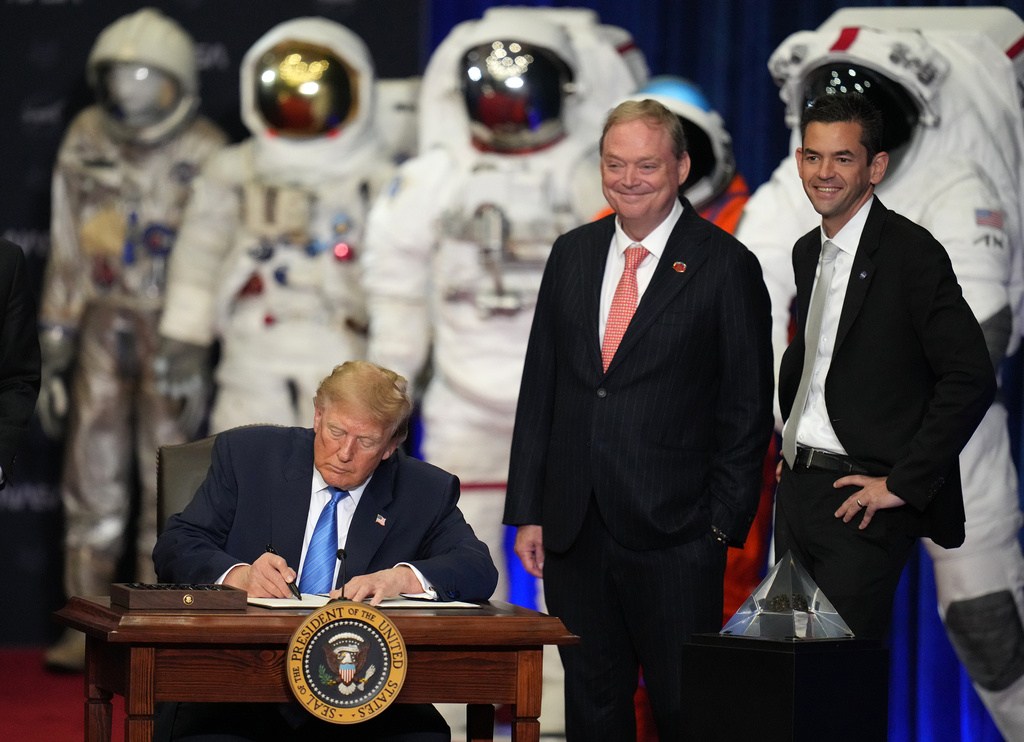
President Donald Trump prided his establishment of the Space Force, the first new branch of the U.S. military since the Air Force was established in 1947, as one of the seminal accomplishments of his first term. He has since sought to develop the new branch, and on Aug. 28, signed executive order 14423 at Johnson Space Center in Houston, Texas, establishing a Presidential Commission on the U.S. Space Academy, an exploratory committee led by NASA head Jared Isaacman.
NASA published the Request for Information in September, allowing each state to submit one request for the institution to be located at a site of its choice. The original Oct. 26 deadline was extended, and the final deadline for submissions closed on Monday.
A total of 15 states put in bids — Alabama, Arizona, California, Colorado, Florida, Indiana, Louisiana, Maryland, Nevada, Ohio, Pennsylvania, Tennessee, Texas, Virginia, and West Virginia. Of these, Virginia, Maryland, Alabama, Texas, and Florida are viewed as the most likely candidates, due to either structural favorability or their connections to NASA.
Gov. Abigail Spanberger (D-VA) pitched a 600-acre site in Hampton, Virginia, located at NASA Langley Research Center and Fort Monroe. Part of the pitch was that the area was best structurally equipped to handle a new institution, given the close proximity of Virginia Tech, the University of Virginia, and other major schools.
Gov. Wes Moore (D-MD) was among the most assertive in his statement, pitching Maryland as the rightful home of the new academy and proposing an interim location at the University of Maryland, followed by a permanent location near the Goddard Space Flight Center in Greenbelt, Maryland. The location would position students within one hour of the Pentagon, NASA’s headquarters, Johns Hopkins Applied Physics Laboratory, NOAA Satellite Operations Control Center, and the National Security Agency.
“The U.S. Space Academy belongs in Maryland. Period,” Moore said. “We have the talent, the resources, and the assets, as well as a prime location in the heart of the space enterprise. Maryland has the best assets in the country to welcome the Space Academy, and we’ll continue to make critical investments to lead the nation in advanced aerospace technology.”
Fresh off her Senate victory, Sen. Ashley Moody (R-FL) argued that Florida was the best pick due to its historical connections with the spaceflight industry.
“Placing the new U.S. Space Academy in Florida simply makes sense,” she said in a statement. “Our Space Coast has been the nation’s gateway to the stars since the beginning of the U.S. space program—placing the academy here means its students have a front-row seat to the new innovations coming out of both NASA and the private sector, giving them connections and experience they can’t get anywhere else. Why spend years and millions of dollars replicating what we’ve already built here? The U.S. Space Academy belongs in Florida.”
The state of Florida pitched an interim campus at the University of Central Florida, with a permanent 1,000-acre site at the Kennedy Space Center.
Alabama proposed Huntsville, nicknamed “Rocket City,” as a natural choice, given its historical role in the U.S. aerospace industry and housing locations of prominent facilities such as the NASA Marshall Space Flight Center, Space Camp, Redstone Arsenal, and incoming Space Command headquarters.
“Alabama helped send America to [the] moon, and we are ready to help prepare the Americans who will take us even further,” Gov. Kay Ivey (D-AL) said in a statement. “With Space Command Headquarters soon coming to Huntsville, NASA’s Marshall Space Flight Center, Space Camp and generations of aerospace expertise, Alabama brings an exceptional foundation to this competition. We are making a strong case for the United States Space Academy to call the Rocket City home.”
Texas’s submission puts the institution in the Houston area and NASA’s Johnson Space Center, where the executive order was signed, beginning the race.
“Texas is the home of America’s human spaceflight program,” Gov. Greg Abbott (R-TX) said in a statement. “No state can match what Texas brings to this mission. NASA’s Johnson Space Center, world-class universities, a premier commercial space industry, major military installations, and an unmatched aerospace workforce give Texas every asset the United States Space Academy requires.”
PENNSYLVANIA BIDS FOR US SPACE ACADEMY WITH ‘THE STRENGTH AND THE PRIDE OF PITTSBURGH’
The Space Academy will be structurally different than the other branch academies — it was described in Trump’s executive order as a NASA-led federal academy, rather than a military service academy. The institution will train scientists and astronauts alongside military officers, blurring the lines between civilian and military.
The executive order establishing the commission said the academy would be “dedicated to combining rigorous technical education with leadership development, discipline, and a durable commitment to public service. The Space Academy will develop a professional corps of civically grounded leaders prepared to advance American interests within the space domain.”
Continue reading...
[ H/T Washington Examiner ]