






The two parties’ presidential lineups look a lot like those of the 2015-16 cycle — in reverse.
Republicans emerged from the 2014 midterm elections with large congressional majorities (247 House members and 54 senators). Democrats have emerged from this year’s midterm elections with even larger ones (259 House members and 56 senators).
But Democrats then, like Republicans now, had a much smaller field of prospective presidential candidates. Two figures in President Barack Obama’s party towered over the others in visibility and popularity — his vice president, Joe Biden, and his first-term secretary of state, Hillary Clinton.
Recent vice presidents had won the presidency or come close, among them Richard Nixon, Hubert Humphrey, George H.W. Bush, and Al Gore. No former secretary of state had won the presidency since James Buchanan in 1856. Yet Obama favored Clinton over Biden.
One reason may have been age. Clinton would have been 69 at the outset of the next presidential term, while Biden would have been 74. That didn’t prevent Biden from becoming the consensus choice for the nomination four years later. Sen. Bernie Sanders (I-VT), who was 75 by the next inauguration, was even older. He entered the primaries from stage left, winning 22 primaries and caucuses and holding Clinton to a 55%-43% advantage in votes cast for the nomination.
Today’s Republican field looks as small as the Democratic field did at the same point in that cycle. It, too, includes a vice president and a secretary of state, with room for a third candidate who is no one’s idea of a Washington insider.
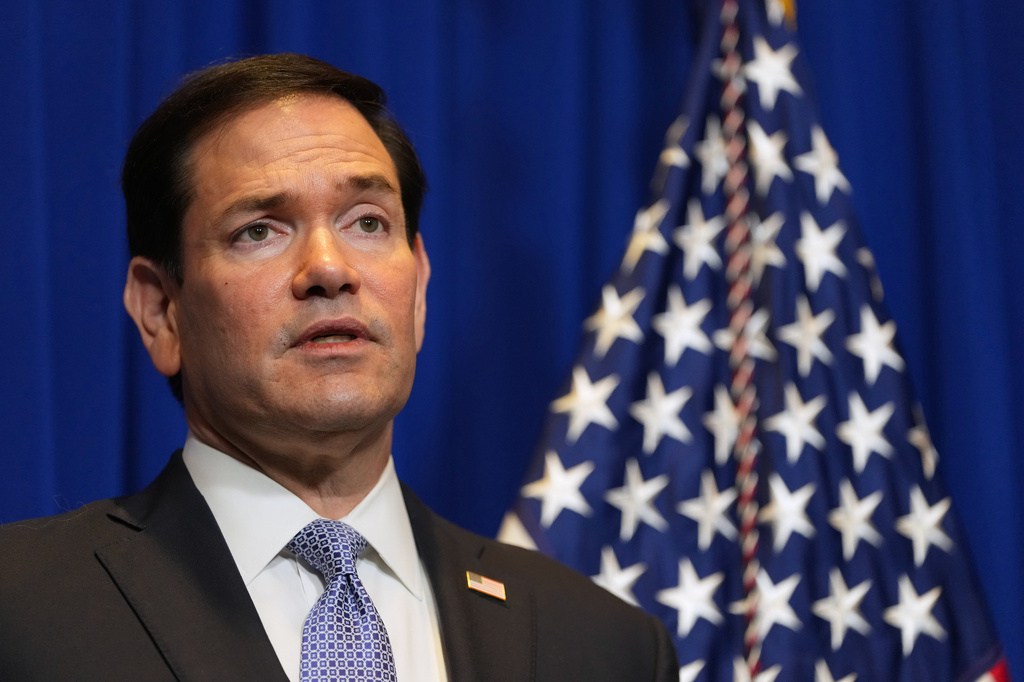
Vice President JD Vance is in his first term, while Biden was in his second, and Vance’s two years in the Senate pale beside Biden’s 36. But Vance has the advantage of youth. He will be just 44 on Inauguration Day in 2029. Like Clinton, Secretary of State Marco Rubio served in the Senate — 14 years in his case, eight in hers. If elected in 2028, he would take the presidential oath at the mature but hardly elderly age of 57.
Rubio’s statement that he won’t run if Vance does can be read as an attempt to avoid turmoil in the Trump administration — a predictably unattainable goal. In the two weeks since the election, Vance has attributed the Republican rout solely to military action against Iran, which Rubio has supported. President Donald Trump, in turn, has publicly ordered Vance to give his full attention to exposing Democratic corruption in large cities.
Trump’s favor may shift, and it may count for less than it once did. The Republican polling firm Echelon Insights reports that 56% of Republicans see themselves as party-first and only 36% as Trump-first. Another 51% say it is time to “move beyond the Trump approach.”
The RealClearPolitics average of seven polls on the Republican nomination this fall shows Vance leading Rubio by a less-than-overwhelming margin, 37% to 28%. Outgoing Gov. Ron DeSantis (R-FL) draws 10%.
DeSantis’s record of policy success in Florida, the only one of the 10 largest states to remain safely Republican this year, could make him a serious contender. He would be just 50 on Inauguration Day in 2029.
Meanwhile, Democrats, still giddy over their success, could field as many presidential candidates as the 10 Republicans who competed in the 2016 caucuses and primaries. That Republican field included senators from Florida, Kentucky, and Texas; current and former governors from Arkansas, Florida, New Jersey, and Ohio; a pediatric surgeon from Maryland; a former tech CEO from California; and a real estate developer and reality TV host from New York.
Trump won that crowded contest despite taking positions on trade, war, and economic policy far outside those of previous Republican presidents. By the time he won an outright majority in any state, 36 states had already voted.
The Democratic field now taking shape looks something like that Republican field. The RealClearPolitics average of recent polls shows measurable support for 10 candidates. They include governors from California, Illinois, Kentucky, and Pennsylvania, senators from Arizona, Georgia, and New Jersey, a House member from New York, a former transportation secretary, and former Vice President Kamala Harris, the party’s 2024 nominee.
They range widely in age and experience. If Harris took the presidential oath in January 2029, she would be the eighth-oldest person to do so for the first time. Just days would separate her from Zachary Taylor and George H.W. Bush. Only William Henry Harrison, Buchanan, Ronald Reagan, Trump, and Biden were older than all three when they first took office. At the other end of the list, either Sen. Jon Ossoff (D-GA), at 41, or Rep. Alexandria Ocasio-Cortez (D-NY), at 39, would be the youngest president ever.
The field could grow or shrink. Someone whose candidacy seems as improbable as Trump’s did a dozen years ago could enter the race and win.
America’s two political parties have retained their basic characters across centuries. The Republican Party has always centered on people who see themselves, and whom others see, as typical Americans. In a nation that has always been culturally diverse, they have never made up a majority on their own.
The Democratic Party has always been a coalition of outsiders, people who see themselves, and whom others see, as outside the American mainstream. If they hold together, they can form a majority.
When Democrats lack a dominant leader — and Obama, nearly 10 years out of office, no longer seems to play that role — the danger is that the party’s disparate constituencies will extract concessions that help candidates win the nomination but cost them votes in the general election.
Transgender advocates’ demand for sex-change surgery for prisoners, which Harris docilely endorsed on camera, wounded her candidacy in 2024, perhaps fatally. Other demands from the period Ocasio-Cortez called “Woke 1” included defunding the police, admitting all otherwise illegal immigrants who claim asylum, allowing biological men in girls’ sports and women’s prisons, and requiring masks. Endorsing such demands may help candidates win support in the spring 2028 primaries but prove disastrous in the general election.
Democrats will have a hard time balancing public demands for “affordability” with calls for more public spending from teachers unions and victims’ groups. Continued demands for racial quotas and preferences in hiring and political districting may also seem beside the point. The country elected a black president in 2008, and voters just elected a black Democratic senator in Mississippi and a black Republican governor in Florida.
In days of yore, local Democratic bosses could grant concessions on some issues and mollify those whose demands they rejected. Today, the very existence of single-issue groups — and their payrolls — depends on wresting concessions from the party on unpopular issues. Popular positions usually don’t need paid advocates.
As analysts have noted, most voters in the electorate that gave Democrats large majorities still view the party unfavorably. In the midterm elections, voters could use Democrats as a check on an increasingly disconnected Trump without giving the party full control of the government. In 2028, Democrats will ask for just that, while voters will likely see little risk of Republicans winning the presidency and both chambers of Congress, as they did in 2016 and 2024.
That’s why Brookings scholars Elaine Kamarck and William Galston, who have been giving Democrats good advice for more than 30 years, write that “the midterms say little about who will win in 2028” and “do not conclusively show which kind of Democrat would be more electable at the national level in 2028.”
NEW CHALLENGES FOR BOTH PARTIES
Democrats are fortunate that their majorities are large enough to limit the leverage of the Democratic Socialists of America and other leftists in setting policy. But the left has a cheering section in the press and among affluent college graduates, who lately have been the party’s largest constituency. Both groups will likely push the party leftward.
None of this is set in stone. Choices yet to be made and events yet to occur will shape the outcome, as they did 10 years ago. Democrats have an opportunity to present an attractive face, but they have flubbed such opportunities before. Republicans, for all their drubbing this year, still have assets that Trump, busy redesigning the White House complex and cleaning the Lincolm Memorial Reflecting Pool, has left undeployed.
Continue reading...
[ H/T Washington Examiner ]