




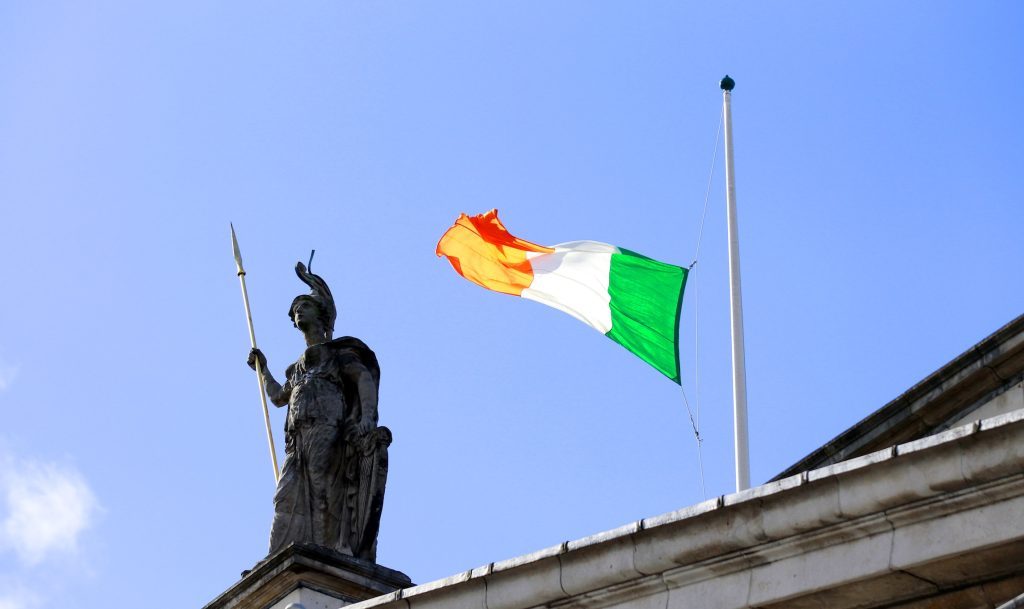
Ireland welcomed international officials to Dublin this week for a gathering devoted to combating antisemitism. According to the chairman of the Jewish Representative Council of Ireland, one hotel responded to the planned gathering by asking a revealing question: Would the Israel Defense Forces be involved?
The question had nothing to do with the event.
The attendees were Jewish community leaders, diplomats, civil servants and government officials. They were not soldiers. They were coming together through the Special Envoys and Coordinators Combating Antisemitism Conference to discuss the growing hatred directed at Jews around the world.
Still, Maurice Cohen, chairman of the Jewish Representative Council of Ireland, told me that the general manager of Dublin’s Herbert Park Hotel asked whether the IDF would be involved.
“I was completely taken aback,” Cohen said. “I said, ‘What would the IDF have to do with a conference on antisemitism?’”
According to Cohen, he and an event organizer met with hotel representatives on May 7 after receiving written confirmation that approximately 70 rooms were being held for participants. During the meeting, they discussed the gathering and who would attend.
Cohen said the manager’s demeanor changed as he explained the event. She then raised the IDF and said she would need to consult the hotel’s owners before determining whether the hotel could accommodate the gathering.
The following day, organizers received an email stating that the hotel could not host their “event,” Cohen said. When they subsequently asked whether the approximately 70 rooms remained available, they were told those had also been released.
The hotel reportedly claimed that the rooms had been released one week before the May 7 meeting. Cohen questioned why management would hold that meeting without mentioning that the reservations were already gone.
“To my mind, that excuse was a retrospective excuse,” he said.
The international conference itself was not canceled. It proceeded elsewhere in Dublin. The issue is that a hotel allegedly rejected the related event and room block after learning who the guests were and asking what connection they had to Israel’s military.
When I contacted the Herbert Park Hotel directly, I spoke with a hotel manager and asked about Cohen’s account, the rejected event, and the approximately 70 rooms. The response was two words: “No comment.”
That answer leaves the central questions unresolved. Why was the IDF raised during a discussion about a civilian gathering devoted to antisemitism? Why was the event rejected? Why were the rooms subsequently declared unavailable? The hotel had an opportunity to explain or dispute the allegations. It chose silence.
Israel’s ambassador to the United Nations, Danny Danon, understood the significance.
“If the reports from Dublin are accurate, this is a disgraceful example of the very antisemitism the conference was organized to combat,” Danon told me.
Antisemitism does not always announce itself through a swastika or an act of physical violence. Sometimes it appears as suspicion directed at Jews simply because they are Jewish. It appears when Jewish identity is treated as evidence of political allegiance, or when Jewish guests are expected to account for the actions of a foreign government before they are welcomed into an ordinary hotel.
That is what makes the alleged IDF question so important. Jewish community representatives should not have to prove that they are unconnected to Israel’s military before attending an event in Ireland. No other ethnic or religious group should be required to pass a political test before securing accommodations.
Ireland’s 2022 census recorded just over 2,200 Jewish residents, although Cohen believes the true community may be nearly twice that size because not everyone identifies their religion in the census. Even by that higher estimate, this is a remarkably small community carrying a disproportionate burden.
The Jewish Representative Council of Ireland documented 143 self-reported antisemitic incidents between July 2025 and January 2026. Cohen said its continued monitoring found a similar number during the first six months of 2026. Ireland has no official state mechanism dedicated specifically to tracking antisemitic incidents, meaning the documented cases may represent only part of the problem.
Cohen described the atmosphere as “ambient antisemitism.”
“It’s all around us,” he said. “If you say you’re Israeli, you may not get into certain places. The narrative is so one-sided.”
Ireland’s Department of Foreign Affairs and Trade responded after I asked whether the government condemned the hotel’s reported actions and whether further action was being considered. The department said responsibility for domestic racism, discrimination and antisemitism rests with the Department of Justice, Home Affairs and Migration.
It also noted that the Irish government hosted a reception for conference attendees and remains committed to combating antisemitism.
“It would be totally unacceptable if it were found that participants in a conference were discriminated against on grounds of religion or any other grounds,” a department spokesperson said.
That is an important statement. It must now be matched by clarity and accountability. Governments cannot celebrate international gatherings against antisemitism while alleged discrimination against their participants goes unanswered outside the reception hall.
This incident should serve as a warning because it captures how antisemitism often operates today. Jews are told they are welcome until their Jewish identity becomes visible, until Israel enters the conversation, or until someone decides their presence might be controversial.
ISRAEL WILL NOT SURRENDER ITS FUTURE TO HAMAS. ITS UN AMBASSADOR JUST REMINDED THE WORLD WHY
“Seventy rooms had been booked. Seventy people had been welcomed as guests,” Cohen said in Dublin. “The only thing that changed was what they were understood to be.”
That is the heart of this story. A welcome that disappears once people are understood to be Jewish was never a welcome at all.
Ariella Noveck is a journalist specializing in antisemitism and Middle East affairs, with extensive experience covering Jewish communities worldwide. She can be followed on X and Instagram @AriellaNoveck
Continue reading...
[ H/T Washington Examiner ]