






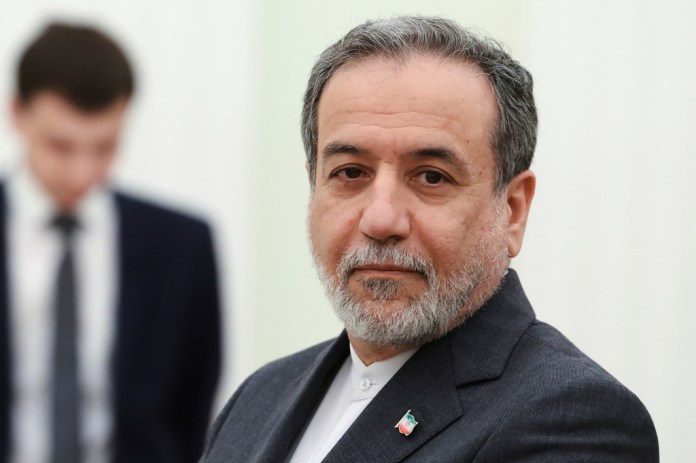
Iranian Foreign Minister Abbas Araghchi warned that Iran was prepared for a “doomsday war” after President Donald Trump rejected its ceasefire offer.
Trump publicly confirmed that he rejected an Iranian ceasefire offer on Saturday, one that offered a halt on attacks on Strait of Hormuz shipping and a resumption of nuclear talks in return for the lifting of the U.S. naval blockade. In an appearance on NBC News’s Meet the Press, Araghchi was asked about a report from the Wall Street Journal claiming that Trump may seek a return to intensive bombing after the midterm elections. In response to the two developments, Araghchi said Iran was confident in its position in the case of a resumption of the war.
“We are fully prepared for the war to be resumed. We stand firm in the face of any new aggression, even if it comes to a doomsday war,” he said.
In the same breath, however, Araghchi left the door open for an olive branch.
“At the same time, we stand ready for diplomacy. It is up to President Trump to choose,” he said.
Araghchi boosted his argument by pointing to the U.S.’s shifting public objectives in the conflict, claiming that a next round of fighting would continue into a stalemate.
Trump, Araghchi said, “wanted unconditional surrender in the previous war in two days. And now it’s eight months that they are fighting with no results. A new aggression would be certainly the same. We are fully prepared for that.”
Notably, the Iranian foreign minister also admitted Iranian missteps in the war, saying, “We have learned our lesson from the two previous wars, and we have corrected our tactics. We have changed our tactics, and we are fully prepared to do that.”
While politically remaining a stalemate, Iran suffered one of the most lopsided casualty ratios in modern history in the war so far.
The Iranian foreign minister also portrayed the ceasefire offer as a supreme act of benevolence, arguing that there was no reason to return to diplomacy from Iran’s view.
“But to be honest with you, we have no reason to come back to diplomacy and engage with this administration once again, because of how they’ve behaved in the past two years,” he said, recounting all the previous instances during which hostilities broke out in the middle of negotiations.
“But I’m still trying diplomacy because I think we shouldn’t miss any chance for peace. We don’t care about, you know, U.S. midterm elections. We don’t care about any other things. We care about our national interests,” Araghchi said.
Araghchi also revealed that Tehran wasn’t sure about Trump’s response. Despite his public rejection on Saturday, the U.S. apparently still hadn’t communicated its rejection to Iran.
The facts of the conflict were disputed throughout the interview. Araghchi claimed the Memorandum of Understanding collapsed in July because the U.S. attacked first, though it’s been established that the deal fell apart because of renewed Iranian attacks against shipping in the Strait of Hormuz — an action that reportedly came from a clandestine effort within hardliner circles of the Islamic Revolutionary Guard Corps that enraged President Masoud Pezeshkian.
“We didn’t violate the deal; they violated the deal first. But if they had their story, and they think that we had violated the deal, why did they bomb us? They could have activated paragraph 12 of the MOU, which is for, you know, dispute settlement. Why did they start the war again?” he said.
The war with Iran has remained in a stalemate, though the U.S. has made progress in getting more oil through the Strait of Hormuz. This progress was partially offset by Yemen’s Houthis, an Iranian ally, seizing the Red Sea coast earlier this month.
TRUMP CONFIRMS HE REJECTED IRAN’S PEACE PROPOSAL
Despite the stalemate, Trump has been determined to follow through with the conflict for the time being. He justified his rejection of Iran’s ceasefire offer on the grounds that the U.S. was winning and the deal wasn’t favorable enough.
“We’re winning tremendously,” he said on Saturday. “We have total control of the Hormuz Strait. Massive amounts of oil are coming out of the Hormuz Strait. Last night, we had 29 ships come out. They want to make a deal, and I think that’s fine. I like making a deal too, but I’m not — that deal would not be acceptable.”
Continue reading...
[ H/T Washington Examiner ]