







"Interplanetary Shockwave" Detected?
Space weather website SolarHam reported that an "interplanetary shockwave" was detected Saturday morning as a coronal mass ejection (CME) struck Earth's geomagnetic field.
"A very impressive spike in plasma density was noted in solar wind data, along with an impressive strength (Bt) and a Bz component that is swinging wildly between north and south. NOAA/SWPC have already added a moderate (G2) storm watch for the hours ahead and Strong (G3) conditions may also be possible," SolarHam wrote in the update.
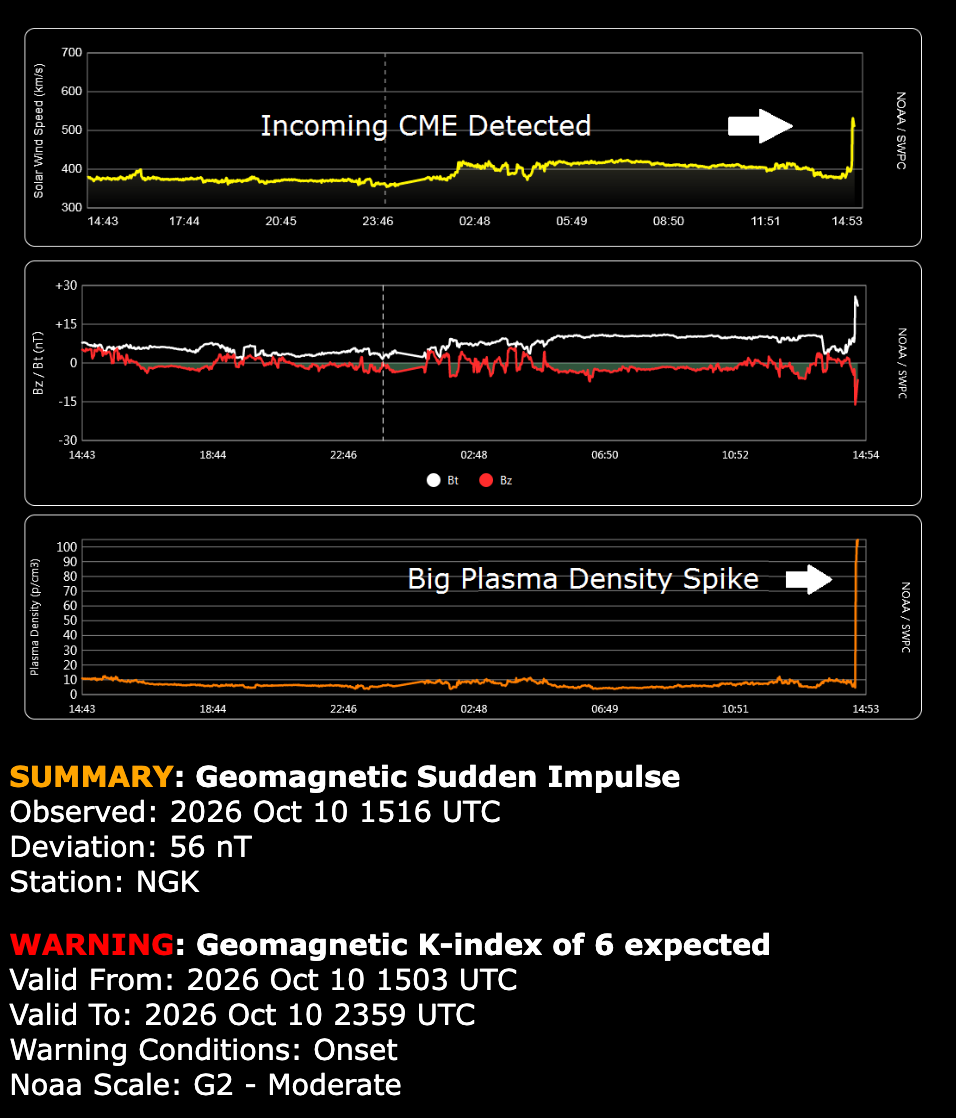
Via SpaceWeatherNews
A CME is a massive eruption of plasma, or electrically charged gas, and magnetic fields from the Sun's outer atmosphere, called the corona.
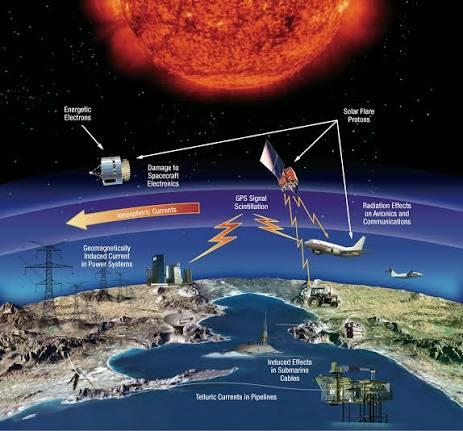
Possible impacts on Earth:
SpaceWeatherLive reports that a radio blackout is already in progress:
*Developing...

Tyler Durden Sat, 10/10/2026 - 22:45
Continue reading...
[ H/T ZeroHedge ]
Space weather website SolarHam reported that an "interplanetary shockwave" was detected Saturday morning as a coronal mass ejection (CME) struck Earth's geomagnetic field.
"A very impressive spike in plasma density was noted in solar wind data, along with an impressive strength (Bt) and a Bz component that is swinging wildly between north and south. NOAA/SWPC have already added a moderate (G2) storm watch for the hours ahead and Strong (G3) conditions may also be possible," SolarHam wrote in the update.
Via SpaceWeatherNews
A CME is a massive eruption of plasma, or electrically charged gas, and magnetic fields from the Sun's outer atmosphere, called the corona.
Possible impacts on Earth:
- Brighter auroras, sometimes visible much farther south than usual.
- Disruptions to GPS, radio communications, and satellites.
- Stress on electrical grids, potentially causing blackouts during extreme storms.
SpaceWeatherLive reports that a radio blackout is already in progress:
*Developing...
Tyler Durden Sat, 10/10/2026 - 22:45
Continue reading...
[ H/T ZeroHedge ]