



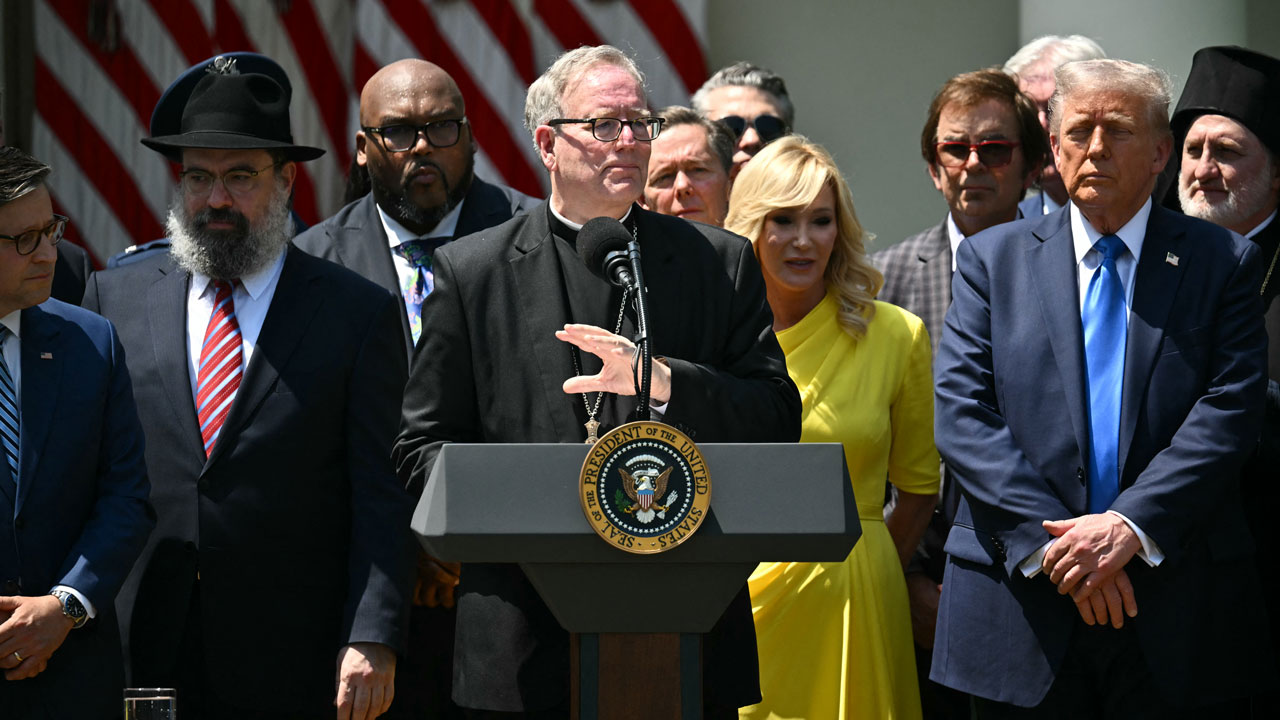
Over the past year and a half, the Trump administration has racked up a long list of wins it credits to faith-driven advocacy: a new White House Faith Office, a Religious Liberty Commission, conscience protections for health care workers who object to abortion or sex-rejecting procedures, an expansion of school choice that lets parents direct public dollars toward religious classrooms, a federal task force created specifically to investigate anti-Christian bias inside the government, and more.
The newest entry, and a consequential one, came last week. President Donald Trump nominated Cissie Graham Lynch, granddaughter of Billy Graham, to serve as ambassador at large for international religious freedom, and named Catholic Bishop Robert Barron, evangelical pastor Andrew Brunson, and former Domestic Policy Council Director Joe Grogan to the U.S. Commission on International Religious Freedom. Together, these appointments give USCIRF its full nine-member bipartisan complement.
These appointments are in a category of their own. Domestic wins, however hard-fought, operate inside a system with backstops. Abroad, there is often no comparable guarantee. A Christian in Nigeria, a house-church pastor in China, a Catholic priest in Nicaragua—these people of faith do not get to appeal to courts that will hear their cases fairly, and the stakes are sometimes simply survival. The domestic list of achievements is long because our system mostly works, however imperfectly, the way it’s supposed to. But in many other countries, it has either stopped working or has never worked at all.
That distinction is also why these appointments do not just concern people of faith. Protecting religious freedom, the capacity to hold and live out a conviction free of coercion, is a defense of what makes a person a person.
The Commission on International Religious Freedom’s nine seats are split by law: three presidential appointees, three chosen by Senate leadership, three by House leadership. This division is a reminder that America’s first freedom must always be insulated from partisanship or power plays. A look at leadership in recent years confirms this. Sam Brownback, who served as ambassador during Trump’s first term, was a Catholic convert who championed Uyghur Muslims, Nigerian Christians, Baha’is in Iran, and persecuted believers of every faith. Rashad Hussain served as the first Muslim ambassador under President Joe Biden; David Saperstein, the first rabbi to hold the post, served under President Barack Obama. The latest nomination and appointments promise to continue this tradition.
Graham Lynch is not simply from a famous family. She spent over a decade with Samaritan’s Purse. That work put her on the ground in disaster zones and conflict areas, giving her a practitioner’s sense of what persecution and deprivation actually look like.
Brunson has also known captivity. He spent two years in a Turkish prison on fabricated charges.
For his part, Barron has watched crises unfold in real time and used his media platform Word on Fire to advocate for the persecuted in Nigeria, where thousands of Christians have been murdered by jihadist militias, a toll severe enough that the administration designated Nigeria a Country of Particular Concern and ordered strikes against the IS-linked terrorists responsible.
Since his release, Brunson has become a tireless advocate for other prisoners of conscience, partnering with groups like Open Doors and Voice of the Martyrs to minister to persecuted Christians across the Muslim world and recounting his ordeal in his book God’s Hostage.
Grogan offers a seasoned hand for turning the findings of a report into real policy action.
As director of the Domestic Policy Council, he helped steer through the Office of Management and Budget’s review of the 2019 Department of Health and Human Services rule enforcing federal conscience-protection laws for health care workers, exactly the kind of follow-through the Commission on International Religious Freedom’s recommendations will need.
From Daniel Ortega’s Nicaragua to Xi Jinping’s China, the states cracking down on churches are the same ones cracking down on the press, on assembly, on dissent of every kind.
Congress created the Commission on International Religious Freedom in 1998 because it recognized that persecution of religion is often the leading indicator of what a regime will do to every other human right within its reach, and that American engagement on it has real stabilizing value in regions that would otherwise export instability, extremism, and refugees back toward us.
The nation will publicly express its gratitude to the commission later this fall. On Nov. 19, the Religious Freedom Institute will honor two of the office’s founding architects, former Reps. Frank Wolf and Chris Smith, with its Defender of Religious Freedom Award at Washington National Cathedral.
Wolf wrote the International Religious Freedom Act of 1998 that created both the ambassador’s post and the Commission on International Religious Freedom; Smith authored the 2016 amendments (named after Wolf) that strengthened it. That two of the men who built this apparatus are being celebrated says something about how far the country has come in institutionalizing the defense of religious freedom and the protection of the persecuted, and how much work remains to make sure that apparatus continues for generations to come.
Filling these posts reaffirms American leadership on a question that is more urgent, not less, in an age when the tools for finding and punishing religious believers are powerful, and when the price of getting it wrong is measured in lives. That’s worth celebrating, whether or not you’ve ever set foot in a church.
We publish a variety of perspectives. Nothing written here is to be construed as representing the views of the Daily Signal.
Continue reading...
[ H/T The Daily Signal ]