




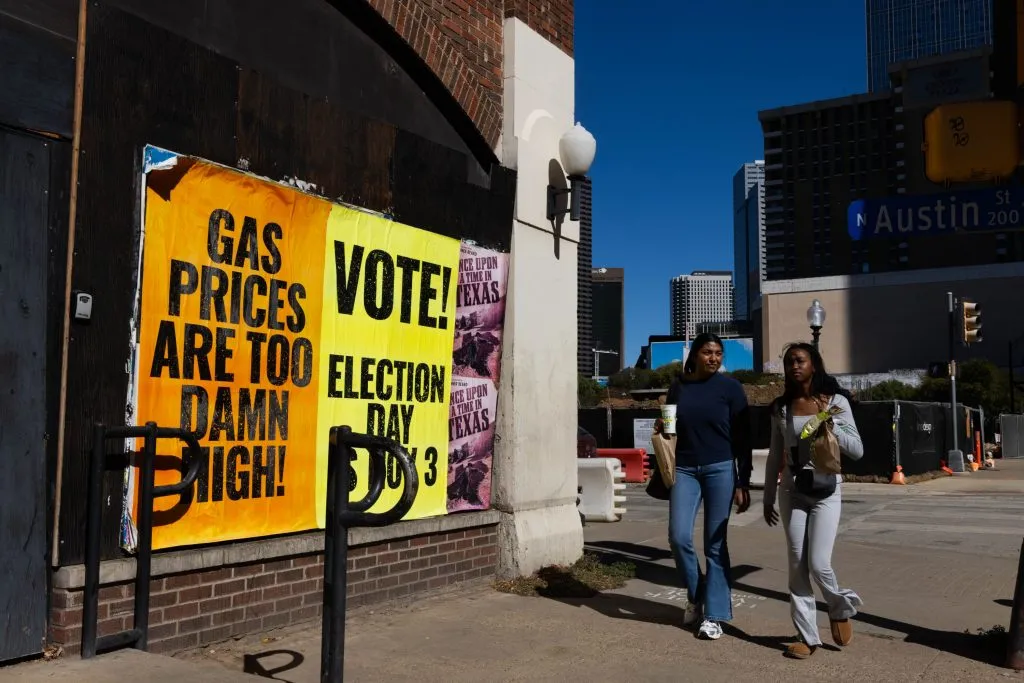
Since Democrats swept the midterm elections, gas and diesel prices have fallen, giving drivers the relief that the Trump administration had been promising for months.
Affordability was widely viewed as voters’ top priority when casting their ballots earlier this month, as families and businesses have been squeezed by surging prices at the pump and other high living costs.
Prices now falling in the weeks after the election raises the question of why the markets did not turn before the midterm elections, when Republicans paid a high price for voter discontent with gas prices.
GASOLINE PRICES FALL TO LOWEST LEVEL SINCE MARCH
The answer is complicated.
Tensions in the Middle East
One factor in the recent decline in prices is that tensions with Iran have not ramped up after the midterm elections, contrary to oil market investor expectations.
The war in Iran has been the primary driver behind high gasoline, diesel, and fuel oil prices, as the conflict in the Middle East crimped the global fuel supply chain.
Starting in February, the war stalled the transit of oil and gas through the Strait of Hormuz. The key trading waterway typically sees about 20% of the world’s oil trade pass through.
Fewer exports of crude and crude products through the strait, combined with a significant loss in refining capacity in the Middle East, sent oil markets into a supply deficit and put upward pressure on prices.
While the fate of the war in Iran remains uncertain, flows through the Strait of Hormuz have been rising for several months, reaching more than 80% of pre-war levels in October, according to the International Energy Agency.
As those supplies grew, oil and gasoline prices started to see some relief.
However, as the midterm elections approached, tensions remained high.
“Leading up to the midterms, there was some pretty strong rhetoric coming out of the U.S. administration that Iran is going to face a ramp-up in strikes from the U.S. post midterm election,” Susan Bell, senior vice president of Downstream Research with Rystad Energy, told the Washington Examiner. “And that hasn’t happened.”
She explained that traders were prepared for escalation in the Middle East that would likely further hamper the supply of crude.
As there has been no significant escalation between the United States and Iran in the weeks since, many of those fears have subsided, and traders appear more confident in the supply.
As oil prices have fallen by more than $20 in the last two weeks, gas prices have declined in turn. The national average prices for gasoline dropped below $4 per gallon this month for the first time since July, and diesel prices have also fallen below $6 per gallon.
Some political commentators have suggested the timing of the price drop was meant to influence the election results. Bell threw cold water on that idea, pointing to the liquidity of oil markets.
“It’s not all U.S. producers that are participating in this market,” Bell said, adding that she believed “it would be very difficult for the market to be managed to the point that prices are artificially kept high in the lead-up to the midterms.
“I don’t think that it’s possible,” Bell said. “There are just far too many market participants, and far too many market participants that are responsible for the profitability of their own book.”
Seasonal demand
GasBuddy analyst Patrick De Haan told the Washington Examiner that gasoline prices have been on a steady decline since Sept. 24 due not only to geopolitical factors, but also seasonal ones.
“Prices didn’t just magically start dropping after the election,” De Haan said. “Generally every election since 2012, gas prices have declined in the 30 days ahead of the election.”
De Haan explained that seasonal factors heavily influence prices, noting that summer demand has ended and fewer people are driving.
“Americans just don’t drive as much as the weather gets colder,” De Haan said. “People store their RVs, their boats, their motorcycles. So aside from driving to school and work, there’s less consumption.”
He also said that in September, refineries begin to switch from their summer blend to the less expensive winter blend. Refineries are also winding down their fall maintenance season and ramping up fuel output.
“Gas prices go down every fall because the seasonal factors are pretty strong, and just like they’re going down now in the fall, they will spring back up in the spring for the opposite reasons,” he said.
The Trump administration’s actions
Over the last several months, the Trump administration has attempted to lower gasoline and diesel prices in the U.S. through a number of policy actions.
This includes authorizing the release of 172 million barrels from the Strategic Petroleum Reserve, easing fuel economy standards, waiving the Jones Act, issuing waivers on sanctioned Russian oil, expanding access to tax-exempt dyed diesel, and encouraging state-level gas tax exemptions.
Bell told the Washington Examiner that she did not think exempting dyed diesel from tax penalties had a meaningful impact on diesel prices.
“When diesel is over $6 a gallon, the tax exemption is so small, it’s just – it’s a pea on a pumpkin,” she said.
Similarly, Bell said that, while the administration unveiled a deal to import Russian oil, the product has struggled to reach U.S. markets.
“That’s had no impact on prices because nobody is willing to touch those cargos,” she said.
The Trump administration last week granted an additional 90-day extension to its waiver on the Jones Act, a law that requires all goods transported between U.S. ports to be moved by ships that are U.S.-built, -flagged, and -crewed. It is the longest waiver in the law’s history.
De Haan, earlier this month, told the Washington Examiner that, of all the measures the administration has taken, he believes the waiver of the Jones Act is the most influential on prices.
“If it wasn’t for the Jones Act waiver, I would say that gas prices and diesel would be quite a bit more elevated,” De Haan said.
Where are prices headed
While there may be some price relief at the pumps, many experts are warning drivers not to get too comfortable.
Hunter Kornfiend, an analyst with Rapidan Energy Group, said that the markets are “definitely not out of the woods yet.”
He explained that his organization has been expecting further escalation in the Middle East since the election, which would push prices back up. But there are several factors at play.
Intensified attacks from Ukraine on Russian refineries, changing heating demand in Europe, increased tanker attacks in the Strait of Hormuz, or new strikes from the Iranian-backed Houthis could all put upward pressure on oil prices, and also gasoline and diesel.
Until tensions fully subside, Bell told the Washington Examiner, there is little to be done domestically to further bring prices down.
“Domestically, you would have to institute some pretty drastic policies to disconnect U.S. domestic prices from the rest of the world,” Bell said, pointing to policies such as an oil export ban.
TRUMP DOE TO LOAN NEARLY $3 BILLION FOR WYOMING POWER LINE PROJECT IN BID TO LOWER PRICES
However, while that might bring down prices of products such as diesel in the short term, she warned, it would force refineries to cut the amount of crude that they process, limiting supply and sending diesel prices back up.
“There’s very little in the short term,” Bell said.
Continue reading...
[ H/T Washington Examiner ]