





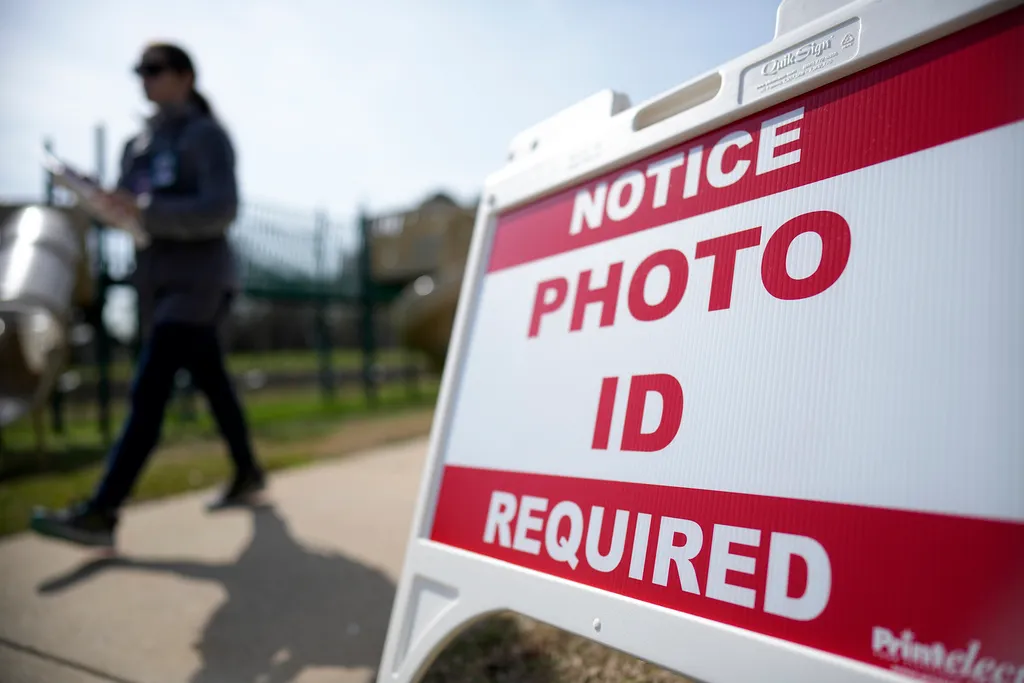
Voters in six states will soon decide whether to impose or expand voter identification requirements, including rules requiring mail voters to provide part of a driver’s license or Social Security number.
The measures in Arizona, California, Colorado, Nevada, North Carolina, and Ohio vary in scope. Some would create new requirements, while others would place rules already operating under state law into state constitutions, making them harder for lawmakers to undo in the future.
FILE – Sasha Dix holds his, “I voted,” sticker after voting at T.C. Roberson High School on Election Day, Nov. 5, 2024, in Asheville, N.C. (AP Photo/Kathy Kmonicek, File)
" data-large-file="https://www.washingtonexaminer.com/wp-content/uploads/2026/10/AP26085727233120.jpg?w=1024" src="https://www.washingtonexaminer.com/wp-content/uploads/2026/10/AP26085727233120.jpg?w=1024" alt="An "I voted" sticker." class="wp-image-4778299" srcset="https://www.washingtonexaminer.com/wp-content/uploads/2026/10/AP26085727233120.jpg 1024w, https://www.washingtonexaminer.com/wp-content/uploads/2026/10/AP26085727233120.jpg?resize=300,200 300w, https://www.washingtonexaminer.com/wp-content/uploads/2026/10/AP26085727233120.jpg?resize=768,512 768w" sizes="auto, (max-width: 1024px) 100vw, 1024px">
Sasha Dix holds his, “I voted,” sticker after voting at T.C. Roberson High School on Election Day, Nov. 5, 2024, in Asheville, North Carolina. (AP Photo/Kathy Kmonicek, File)
The ballot questions also carry on the unfinished business of the Republican-led federal election-security agenda after Congress failed to enact the SAVE America Act.
SAVE America Act failure looms over state ballot measures
The Safeguard American Voter Eligibility Act, known as the SAVE America Act, would have required documentary proof of citizenship to register for federal elections and photo identification when casting a ballot.
Republicans in the House passed the legislation in February. The measure did not become law after it failed in the Senate. The Senate rejected a 48-50 motion in June involving a related SAVE Act amendment, and senators later failed to overcome a 53-47 cloture vote on another amendment.
That left Republicans without a uniform federal voter-ID and citizenship-verification standard before the midterm elections, after which their chances to pass one are likely to diminish even further. The state amendments represent chances for states to pass parts of the president’s agenda that Congress could not.
John Shu, a constitutional law expert and former official in both Bush administrations, told the Washington Examiner that state-level measures could face a more comfortable reception if challenged later in court because the states, rather than the federal government, would be setting the rules.
“I think that for the states, the courts are going to feel a little more comfortable with it because it’s the states that are making the decision, not the federal government,” Shu said, pointing to long-standing disagreements among lawyers over whether state or federal power is more controlling on election matters like voter ID laws.
Shu said a national law would still have faced significant legal challenges if its language left room for competing interpretations.
“The more complicated the legislation is written, the more holes it’s likely to have that are open to legal challenge,” he said.
California would create a statewide voter ID system but faces headwinds, per polling
California Proposition 39 would require voters to provide government-issued identification when voting in person and to select a government-issued identification number when registering to vote by mail, a move that proponents see as necessary for election security.
If passed, mail voters would have to place the last four digits of that number on the ballot envelope. Election officials would compare it with the voter’s registration record, and a mismatch could prevent the ballot from being counted.
The California ballot summary says the measure also would require annual reports on the percentage of registered voters whose citizenship status has been verified. The state would provide a voter identification card at no cost, and the state auditor would review compliance every odd-numbered year.
California generally does not require voters to show identification at the polls. Mail voters simply sign their ballot envelopes, and election officials compare those signatures with signatures on file.
The state’s legislative analyst said about 13 million of the roughly 16 million Californians who voted in the November 2024 presidential election voted by mail. Proposition 39 could create annual state and local costs ranging from tens of millions of dollars to the low hundreds of millions of dollars.
The measure faces an uphill battle despite heavy interest in it, including by Airbnb co-founder Joe Gebbia, who has given at least $8 million to the voter ID campaign.
A Citrin-Politico poll found that 51% of likely voters planned to vote against Proposition 39, while 42% supported it and 7% were undecided. A September survey by the [URL='https://www.ppic.org/publication/ppic-statewide-survey-californians-and-their-government-september-2026/']Public Policy Institute of California[/URL] found 55% opposed and 43% in favor.
Colorado would add identification numbers to mail ballots
Colorado Amendment 84 would require voters to include their signature and the last four digits of a Social Security number, Colorado driver’s license number, Colorado identification-card number, or another qualifying REAL ID number on the envelope used to return a mail ballot in federal and statewide elections.
The Colorado ballot text says the requirement would be added to the state’s existing signature-verification process.
If the information were missing or did not match the voter-registration database, the county clerk would notify the voter and explain how to correct the problem. The Colorado Blue Book says voters could provide an identification document, passport, military ID, or tribal photo ID.
Colorado automatically sends mail ballots to registered voters. The state’s analysis says 92% of ballots cast in 2024 were mail ballots. Amendment 84 would need at least 55% approval.
Nevada would require a second vote on its Question 7
Nevada Question 7 would require voters to present photo ID when voting in person.
Mail voters would have to provide the last four digits of a Nevada driver’s license number, the last four digits of a Social Security number, or a voter-registration number provided by the county clerk.
The Nevada Constitution contains the proposed language and says the amendment would take effect Nov. 24, 2026, if voters approve it again.
Nevada voters approved Question 7 in 2024, but constitutional amendments must pass in two successive general elections. The November vote is the second and final approval required for the amendment to take effect.
Arizona measure includes several election changes
Arizona Proposition 144 would require all voters, including those voting by mail, to show government-issued identification in each election.
The Arizona publicity pamphlet says the amendment would limit acceptable proof of identity to government-issued documents and allow voters to have their ballots tabulated at their voting location on Election Day.
The measure would also prohibit foreign nationals from contributing or spending money to influence Arizona elections, require the legislature to fund implementation, and create a new standard for courts reviewing election laws under the Arizona Constitution.
North Carolina would extend photo ID to every voting method
North Carolina’s “Constitutional Amendment to Require Photo ID for Voting” would expand the state’s existing photo ID rules to cover every voting method.
State voters already must show photo identification when voting in person. Mail voters must submit a copy of an acceptable photo ID or complete an exception form.
The proposed constitutional amendment would extend the requirement to all voters, regardless of how they cast their ballots.
The North Carolina General Assembly’s summary says the amendment would require “all voters, not just those presenting to vote in person,” to present photo identification before voting.
The state’s voter ID guidance says county boards can issue free voter photo ID cards to registered voters. The amendment would elevate North Carolina’s existing photo ID framework into the constitution and apply it more clearly to absentee voting.
Ohio would constitutionalize photo ID rules
Ohio Issue 3 would require voters to present an approved government-issued photo ID. The amendment would apply to in-person voting and other methods, including voting by mail.
The certified Ohio ballot language lists an unexpired Ohio driver’s license or state ID card, a U.S. passport or passport card, or a military, Ohio National Guard, or Department of Veterans Affairs identification card as acceptable forms of ID.
The amendment also would allow state law to create an alternative identity-verification process for voters with a sincere religious objection to being photographed.
Ohio already requires photo identification for in-person voting. Voters without an acceptable ID may cast a provisional ballot and provide identification to their county board within four days after Election Day. The current absentee-ballot form allows voters to provide identification information or a copy of an approved photo ID.
In absence of SAVE Act, state measures turn voter ID into a barometer for the rest of the nation
The six proposals share a common goal, which is using government-issued identification or identification numbers to provide an additional way to verify that a ballot belongs to an eligible voter.
The state votes will also measure how much momentum remains behind the federal SAVE America Act after Congress failed to enact it. Republicans who could not secure a national standard are asking voters in six states to approve pieces of that broader election-security agenda directly.
Shu said the results could give lawmakers in states that have not put voter ID on the ballot a useful read on the issue’s political prospects, though he noted that the outcome would vary from state to state.
2026 MIDTERM ELECTIONS LIVE UPDATES: LATEST NEWS, RESULTS, AND ANALYSIS
But Shu cautioned that while other states could trend toward deciding voter ID measures by ballot questions in the future, the state-by-state strategy would likely not carry over to every state in the union.
“There are just certain states where it’ll never pass,” he said, pointing to California, New York, Massachusetts, and Illinois.
Continue reading...
[ H/T Washington Examiner ]