








Got Wood? These Are The World's Biggest Lumber Producers
From home construction and renovations to furniture and shipping pallets, lumber is one of the world’s most widely used building materials.
This graphic ranks the world’s biggest lumber producers by sawnwood output in 2024, using data from the UN Food and Agriculture Organization.
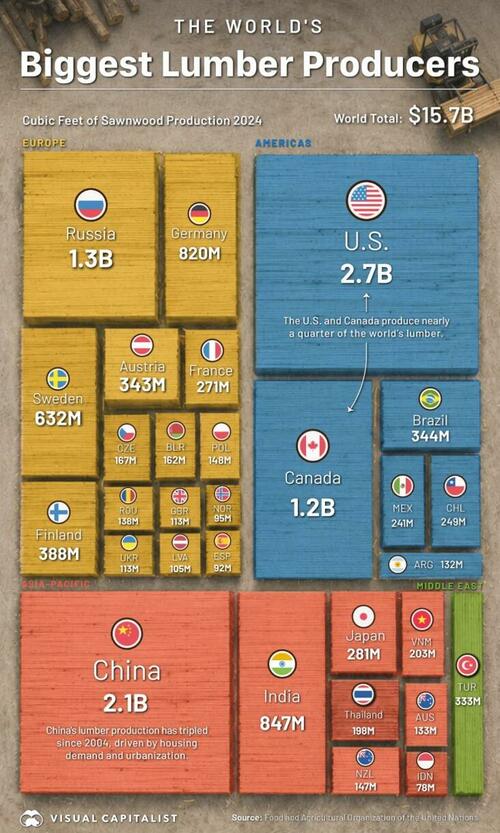
The United States produced roughly 2.7 billion cubic feet of lumber in 2024, making it the world’s largest producer.
China ranked second with 2.1 billion cubic feet, followed by Russia and Canada. India rounded out the top five with nearly 847 million cubic feet.
Together, the top five producers account for more than half of global lumber output. Their scale reflects extensive forest resources, large sawmill industries, and steady demand from construction and manufacturing.
Europe has a deep bench of major lumber producers, with Germany, Sweden, and Finland leading the region. Sweden and Finland benefit from extensive managed forests and export-oriented sawmill industries, while Germany’s timber resources support its construction and manufacturing sectors.
Austria and France also rank among the world’s top 15, underscoring Europe’s importance to the global lumber supply.
Although the United States remains the world’s largest producer, China has recorded some of the fastest long-term growth.
Since 2004, the country’s lumber production has more than tripled as rapid urbanization fueled demand for housing, commercial buildings, and infrastructure. China has also become the world’s largest processor and consumer of wood products, supplying everything from furniture to engineered wood used in manufacturing.
Lumber demand is closely tied to housing construction, infrastructure spending, and manufacturing activity. As countries continue investing in new buildings and industrial capacity, a relatively small group of producers will remain central to the global wood supply.
To learn more about this topic, check out this graphic on the world’s 4.1 billion hectares of forest by region.
Tyler Durden Thu, 07/30/2026 - 04:15
Continue reading...
[ H/T ZeroHedge ]
From home construction and renovations to furniture and shipping pallets, lumber is one of the world’s most widely used building materials.
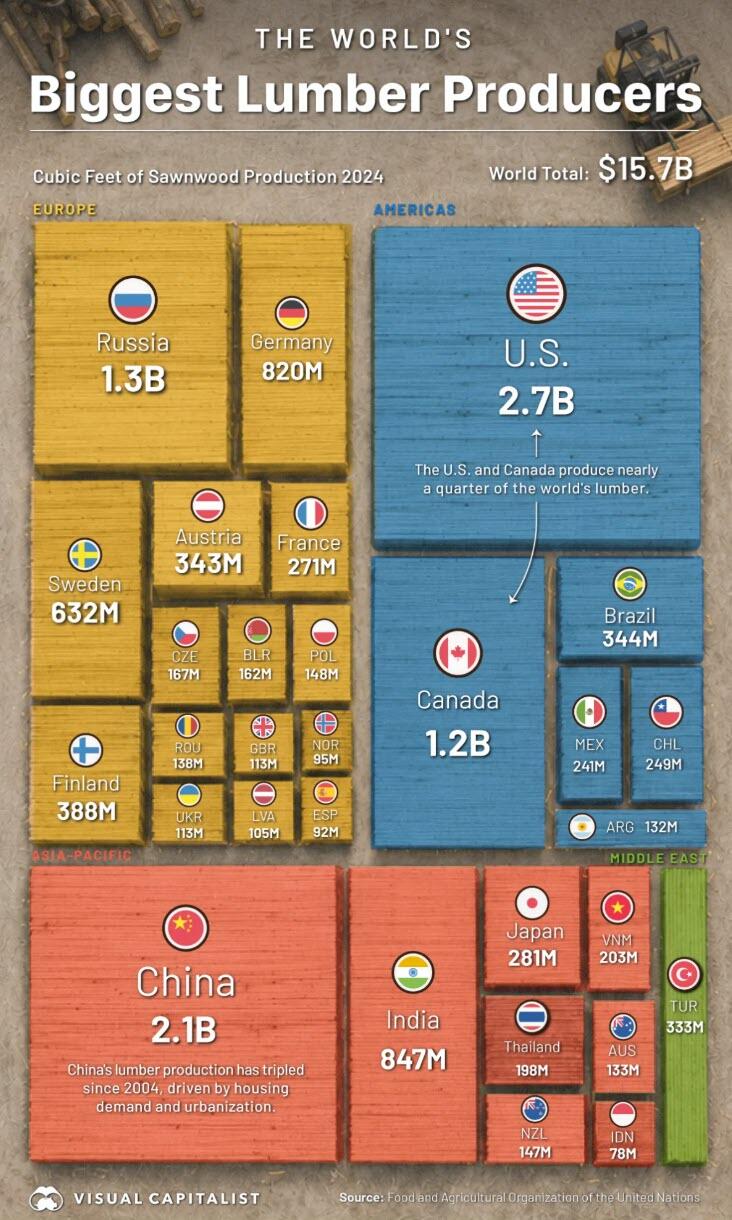
This graphic ranks the world’s biggest lumber producers by sawnwood output in 2024, using data from the UN Food and Agriculture Organization.
The World’s Top 30 Lumber Producers
The United States produced roughly 2.7 billion cubic feet of lumber in 2024, making it the world’s largest producer.
| Rank | Country | Cubic Feet (2024) | Global Share |
|---|---|---|---|
| 1 |  U.S. U.S. | 2.7B | 17.0% |
| 2 |  China China | 2.1B | 13.7% |
| 3 |  Russia Russia | 1.3B | 8.4% |
| 4 |  Canada Canada | 1.2B | 7.9% |
| 5 |  India India | 847M | 5.4% |
| 6 |  Germany Germany | 820M | 5.2% |
| 7 |  Sweden Sweden | 632M | 4.0% |
| 8 |  Finland Finland | 388M | 2.5% |
| 9 |  Brazil Brazil | 344M | 2.2% |
| 10 |  Austria Austria | 343M | 2.2% |
| 11 |  Türkiye Türkiye | 333M | 2.1% |
| 12 |  Japan Japan | 281M | 1.8% |
| 13 |  France France | 271M | 1.7% |
| 14 |  Chile Chile | 249M | 1.6% |
| 15 |  Mexico Mexico | 241M | 1.5% |
| 16 |  Vietnam Vietnam | 203M | 1.3% |
| 17 |  Thailand Thailand | 198M | 1.3% |
| 18 |  Czechia Czechia | 167M | 1.1% |
| 19 |  Belarus Belarus | 162M | 1.0% |
| 20 |  Poland Poland | 148M | 0.9% |
| 21 |  New Zealand New Zealand | 147M | 0.9% |
| 22 |  Romania Romania | 138M | 0.9% |
| 23 |  Australia Australia | 133M | 0.8% |
| 24 |  Argentina Argentina | 132M | 0.8% |
| 25 |  Ukraine Ukraine | 113M | 0.7% |
| 26 |  UK UK | 113M | 0.7% |
| 27 |  Latvia Latvia | 105M | 0.7% |
| 28 |  Norway Norway | 95M | 0.6% |
| 29 |  Spain Spain | 92M | 0.6% |
| 30 |  Indonesia Indonesia | 78M | 0.5% |
| -- |  World total World total | $15.7B (Market Value) | 100% |
China ranked second with 2.1 billion cubic feet, followed by Russia and Canada. India rounded out the top five with nearly 847 million cubic feet.
Together, the top five producers account for more than half of global lumber output. Their scale reflects extensive forest resources, large sawmill industries, and steady demand from construction and manufacturing.
Europe has a deep bench of major lumber producers, with Germany, Sweden, and Finland leading the region. Sweden and Finland benefit from extensive managed forests and export-oriented sawmill industries, while Germany’s timber resources support its construction and manufacturing sectors.
Austria and France also rank among the world’s top 15, underscoring Europe’s importance to the global lumber supply.
China’s Lumber Industry Has Tripled Since 2004
Although the United States remains the world’s largest producer, China has recorded some of the fastest long-term growth.
Since 2004, the country’s lumber production has more than tripled as rapid urbanization fueled demand for housing, commercial buildings, and infrastructure. China has also become the world’s largest processor and consumer of wood products, supplying everything from furniture to engineered wood used in manufacturing.
A Critical Global Building Material
Lumber demand is closely tied to housing construction, infrastructure spending, and manufacturing activity. As countries continue investing in new buildings and industrial capacity, a relatively small group of producers will remain central to the global wood supply.
To learn more about this topic, check out this graphic on the world’s 4.1 billion hectares of forest by region.
Tyler Durden Thu, 07/30/2026 - 04:15
Continue reading...
[ H/T ZeroHedge ]