

The End Of Freedom - The Last Breath Of A Dying Continent
Authored by Milan Adams via Preppgroup,
They are killing us slowly.
Not with bullets or blades, but with spreadsheets and algorithms, with policies drafted in climate-controlled rooms by people whose children will never shiver through a winter night without heat, whose pantries will never echo empty, whose futures remain secured behind gates we cannot approach.
In 2026, 333 million Europeans—more than the entire population of the United States—have fallen into energy poverty, a euphemism that cannot conceal the raw human suffering it describes, a bureaucratic term that sanitizes the screams of families watching their lives dismantled piece by piece.
Since 2021, utility costs have surged 47%, while wages stagnate in a cruel arithmetic that reduces families to penury. The numbers do not lie, even when governments do. Behind every percentage point stands a human being with a name, with memories, with children who ask why the heat does not work. Behind every data point lies a tragedy that statistics cannot capture—the sound of teeth chattering beneath thin blankets, the smell of cheap candles burning down to nothing, the silence of a home where conversation has stopped because speaking requires energy that hungry bodies cannot spare.
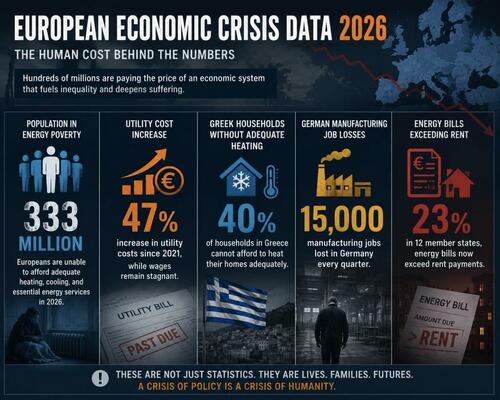
Look at these figures and understand that they represent flesh and blood. In Greece, 40% of households now face the impossible choice between heating and eating—a statistic that translates to grandmothers wrapping themselves in newspapers, to children doing homework by candlelight, to parents skipping meals so their sons might have warmth for one more night. The Greek winter of 2026 brought temperatures that dropped to -8°C in regions where insulation remains a luxury, where families huddle in single rooms wearing every garment they own, where the decision to turn on a heater for one hour means skipping dinner for three days.
Germany, once the industrial titan of Europe, now bleeds 15,000 manufacturing jobs each quarter, its factories darkening like dying stars. The Rhine Valley, which hummed with production for generations, now echoes with the footsteps of workers carrying boxes of personal effects, of security guards locking gates that may never reopen, of communities watching their purpose drain away like water into cracked earth. Energy bills now exceed rent payments by 23% across twelve member states, a reversal of economic reality that breaks families before they even begin, that ensures the poor remain poor and the middle class joins them in descent.
In Portugal, elderly citizens have begun collecting firewood in public parks, risking fines and arrest to secure warmth their pensions cannot purchase. In Poland, organized crime networks now control the black market for coal, selling inferior product at extortionate prices to desperate families who know that burning treated wood releases toxins but choose poison over freezing. The European Commission reports these trends as “energy market adjustments,” as if describing the migration of birds rather than the collapse of human dignity.
But the economic strangulation serves merely as prelude to a more comprehensive destruction. Step into any supermarket in Milan after 7 PM and witness the new normal: empty shelves where fresh produce once stood in abundance, security guards monitoring cooking oil purchases as if guarding gold reserves, elderly women weeping quietly beside discount bins where bruised vegetables wait for hands brave enough to claim them. The Italy that exported culinary culture to the world now imports 60% of its grain from nations that view food as geopolitical leverage, as a weapon more effective than any missile.
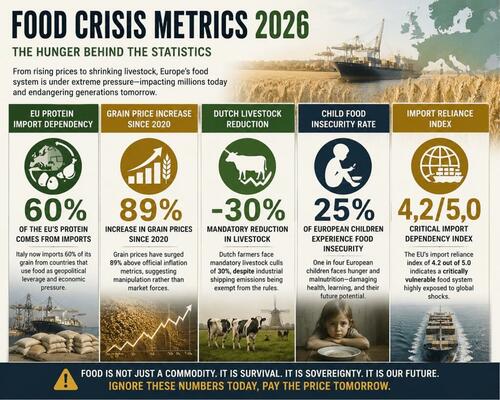
Since 2020, grain prices have exploded 89% above official inflation metrics—a divergence that suggests manipulation rather than market forces, that indicates the invisible hand not of economics but of design. Dutch farmers, whose families worked the same soil for twelve generations, face mandatory livestock culls of 30%, their herds destroyed while industrial shipping emissions remain conveniently exempt from the regulations that destroy their livelihoods. The nitrogen crisis, they are told, requires sacrifice—yet the sacrifice falls always on the small, never on the large, always on the many, never on the few.
One in four European children now experiences food insecurity, a phrase that cannot capture the hollow eyes of a seven-year-old who has learned not to ask for seconds, who has learned to hide hunger behind smiles, who will carry the developmental scars of malnutrition into adulthood where they will manifest as reduced cognitive function, compromised immune systems, shortened lifespans. We are not merely impoverishing the present; we are devouring the future, consuming generations yet unborn to feed the insatiable appetite of a system that demands perpetual growth from finite resources.
In France, the breadbasket of the revolution, bakeries now close on alternating days because electricity costs make continuous operation impossible. The smell of fresh bread, which once defined French morning, becomes a luxury available only to those with means. In Spain, the olive harvest of 2025 failed catastrophically, not from drought as officially reported, but from a combination of policy-induced fertilizer shortages and the abandonment of farms that families could no longer afford to maintain. The trees that survived Roman invasions and Moorish conquests now die from spreadsheets, from regulations, from the cold mathematics of a globalized economy that values efficiency over existence.
The pattern transcends incompetence. It reveals intention. In the winter of 2023, three blood moons appeared over European skies—a celestial alignment that agricultural calendars have associated with famine since Babylonian times, that medieval manuscripts connected to periods of profound transformation and upheaval. Each occurrence coincided with major policy announcements: nitrogen restrictions on farming that reduced output by design, digital currency frameworks that promised convenience while delivering surveillance, biometric identification expansions that normalized the scanning of human bodies as if we were inventory rather than souls.
Modern observers dismiss these correlations as superstition, as primitive attempts to explain phenomena that science now understands. Yet the timing defies probability, defies coincidence, defies the comfortable explanations that allow sleep at night. The fourth blood moon of 2024 marked the introduction of programmable money trials in twelve member states—currency that expires if not spent according to algorithmic criteria, wealth that exists only at the pleasure of invisible systems, savings that can be frozen, redirected, or erased with the stroke of a bureaucratic key.
Ancient wisdom warned that when the moon weeps blood four times in succession, the hidden hands reveal themselves. And so they have. Not as conspirators in smoke-filled rooms—that image serves only to discredit—but as something far more terrifying: a consensus among the powerful that the masses must be managed, must be reduced, must be brought to heel through mechanisms that appear natural, appear inevitable, appear as the unfortunate but necessary consequences of progress and planetary survival.
Beneath the visible governance, a parallel architecture operates with mathematical precision that would impress any engineer. Digital ID systems have penetrated 89% of the population, harvesting biometric data at unprecedented velocity—fingerprints, iris patterns, facial geometry, gait analysis, voice signatures. The human body itself has become the password, the key, the identifier that cannot be forgotten or stolen because it cannot be separated from the person. Twelve nations currently run Central Bank Digital Currency pilots, and in three—Sweden, Finland, and the Netherlands—cash transactions above minimal thresholds have been effectively criminalized, forcing participation in systems that record every exchange, every preference, every relationship.
The average European appears on surveillance cameras 300 times daily, a density of one lens per thirteen citizens that renders privacy obsolete, that ensures the watched internalize the gaze, that transforms free citizens into self-policing subjects who no longer require external control because they have built the prison within their own minds. Social credit architectures have advanced beyond theory into implementation; your carbon footprint, vaccination status, social media sentiment, and political expression now determine access to housing, travel, banking, and employment in ways that newspapers report only after the fact, only when resistance has become impossible.
In China, the system was explicit, overt, acknowledged. In Europe, it arrives wrapped in sustainability, in public health, in security, in the language of care and protection that disarms opposition because who can argue against safety, against health, against the planet? Yet the result converges: the individual subordinated to the collective, the collective defined by algorithms, the algorithms controlled by entities that answer to no electorate, no constituency, no human being at all.
The psychological occupation proves equally devastating as the material one, perhaps more so because it attacks the will to resist before resistance can form. Mental health pharmaceutical prescriptions have increased 340% since smartphone saturation achieved critical mass in 2015, the curve of consumption matching the curve of adoption with correlation coefficients that statisticians cannot dismiss. Youth suicide rates in high-surveillance nations now exceed those of countries recovering from active warfare, suggesting that the destruction of privacy and autonomy kills more efficiently than bombs.
The human attention span has collapsed 67% since 2010, precisely as social platforms achieved dominance—a cognitive destruction that prevents focus, prevents resistance, prevents hope by ensuring that the populace exists in perpetual distraction, in fragments of engagement too brief to sustain coherent thought, too scattered to organize collective action, too fragmented to remember what freedom felt like before the devices arrived to save us from the boredom they themselves manufactured.
When survival requires navigating digital bureaucratic labyrinths that change weekly, when sustenance demands protocol compliance that shifts unpredictably, when warmth itself becomes contingent upon behavioral standards that no one fully understands, the will to liberty atrophies like an unused limb. The muscle memory of freedom fades. The imagination of alternatives dies. The acceptance of domination becomes not merely practical but psychological, a preference for the known cage over the unknown wild.
Yet the human spirit persists in spaces beyond measurement, in cracks the algorithms cannot seal, in moments the cameras cannot capture. In Romanian villages where electricity remains intermittent, grandmothers still hang garlic against evil eyes and track planting by stars their ancestors named millennia ago, maintaining knowledge that predates the nation-state by centuries. Spanish shepherds navigate mountain passes using oral traditions that have survived Roman occupation, Moorish rule, fascist dictatorship, and now digital colonization—knowledge that exists in bodies rather than databases, in relationships rather than networks, in the spaces between words rather than the words themselves.
These practices represent what the architects of control fear most: connections deeper than data, loyalties beyond programming, souls that refuse digitization, communities that persist despite rather than because of the systems imposed upon them. When the shepherd knows the mountain without GPS, when the grandmother knows the plant without app, when the child knows the story without screen, the project of total information remains incomplete, the vision of total management remains unrealized, the dream of total control remains frustrated by the stubborn persistence of organic life.
The blood moons have passed, but their warning remains etched in memory, encoded in stories that survive despite educational systems designed to erase them. Control revealed loses power to persuade. The moment the prisoner recognizes the cell, the bars become intolerable. The European soul, ancient and stubborn, remembers freedom even when taught to forget, carries the genetic memory of resistance even when conditioned for compliance, preserves the capacity for outrage even when numbed by entertainment and pharmaceuticals.
Reclamation requires not revolution but reconstruction—the patient rebuilding of human scale against the crushing weight of globalized abstraction. Community gardens planted in defiance of zoning codes that mandate grass over sustenance. Barter networks operating outside taxable surveillance, exchanging eggs for bread, labor for teaching, care for companionship. Children taught to navigate by stars and identify edible plants alongside their coding lessons, maintaining parallel competencies that ensure survival when the systems fail.
Each act of organic creation resists the mechanized future planned for us. Every conversation held face-to-face rather than through monitored platforms reclaims territory from digital occupiers. Every meal grown rather than purchased, every skill shared rather than outsourced, every relationship maintained through presence rather than proxy—these constitute the insurgency of the real against the virtual, the biological against the synthetic, the human against the machine.
The statistics will worsen before they improve. The winter of 2026-2027 promises to be the harshest in decades, with meteorological predictions converging with economic collapse to create perfect conditions for mass mortality among the vulnerable. The food shortages will deepen as Ukrainian grain remains blocked by conflict, as climate manipulation experiments produce unpredictable weather patterns, as supply chains designed for efficiency over resilience continue their inevitable fragmentation. The surveillance will tighten as artificial intelligence achieves capabilities that render human discretion obsolete, as predictive algorithms identify potential dissent before it forms, as pre-crime prevention moves from fiction to policy.
Yet liberty endures in silence beyond camera reach, in spaces between transactions, in moments of genuine connection that cannot be commodified or controlled. It waits only for the courage to claim it, for the recognition that safety purchased with freedom becomes its own prison, that comfort secured through submission becomes its own torture, that survival at the cost of humanity becomes its own death.
The architects of this system believe they have accounted for all variables, modeled all outcomes, predicted all resistance. They have not accounted for the human heart, which persists in loving despite betrayal, in hoping despite evidence, in fighting despite certainty of defeat. They have not modeled the moment when a mother, watching her child shiver, decides that compliance costs more than resistance. They have not predicted the cascade that follows when enough individuals make this calculation simultaneously, when the illusion of consent dissolves, when the machinery of control encounters the immovable object of human dignity.
The blood moons have passed, but they will return. The hidden hands have revealed themselves, and in that revelation lies our opportunity. For power that operates in shadow depends upon the acquiescence of the ignorant; power exposed to light invites the resistance of the informed. We are no longer ignorant. The question that remains is whether we will act upon our knowledge, whether we will pay the price that freedom demands, whether we will reclaim the liberty that is our birthright or surrender it forever for the temporary warmth of chains.
The choice remains ours—while choice remains possible. The window narrows with each passing season, each new regulation, each additional digit of surveillance. The future being constructed around us is not inevitable; it is being built by human hands that could be stopped by human hands. But the stopping requires recognition, requires courage, requires sacrifice that the comfortable find difficult to contemplate and the desperate find impossible to avoid.
In the end, the question is simple: will we live as men and women, with all the risk and responsibility that freedom entails, or will we exist as managed resources, with all the security and servitude that submission provides? The answer will determine not merely our own fates but the trajectory of human civilization for centuries to come. The blood moons watch and wait. History holds its breath. The moment of decision approaches, and with it, the reckoning that delayed justice always demands.
Tyler Durden Thu, 07/30/2026 - 02:00
Continue reading...
[ H/T ZeroHedge ]
Authored by Milan Adams via Preppgroup,
They are killing us slowly.
Not with bullets or blades, but with spreadsheets and algorithms, with policies drafted in climate-controlled rooms by people whose children will never shiver through a winter night without heat, whose pantries will never echo empty, whose futures remain secured behind gates we cannot approach.
In 2026, 333 million Europeans—more than the entire population of the United States—have fallen into energy poverty, a euphemism that cannot conceal the raw human suffering it describes, a bureaucratic term that sanitizes the screams of families watching their lives dismantled piece by piece.
Since 2021, utility costs have surged 47%, while wages stagnate in a cruel arithmetic that reduces families to penury. The numbers do not lie, even when governments do. Behind every percentage point stands a human being with a name, with memories, with children who ask why the heat does not work. Behind every data point lies a tragedy that statistics cannot capture—the sound of teeth chattering beneath thin blankets, the smell of cheap candles burning down to nothing, the silence of a home where conversation has stopped because speaking requires energy that hungry bodies cannot spare.
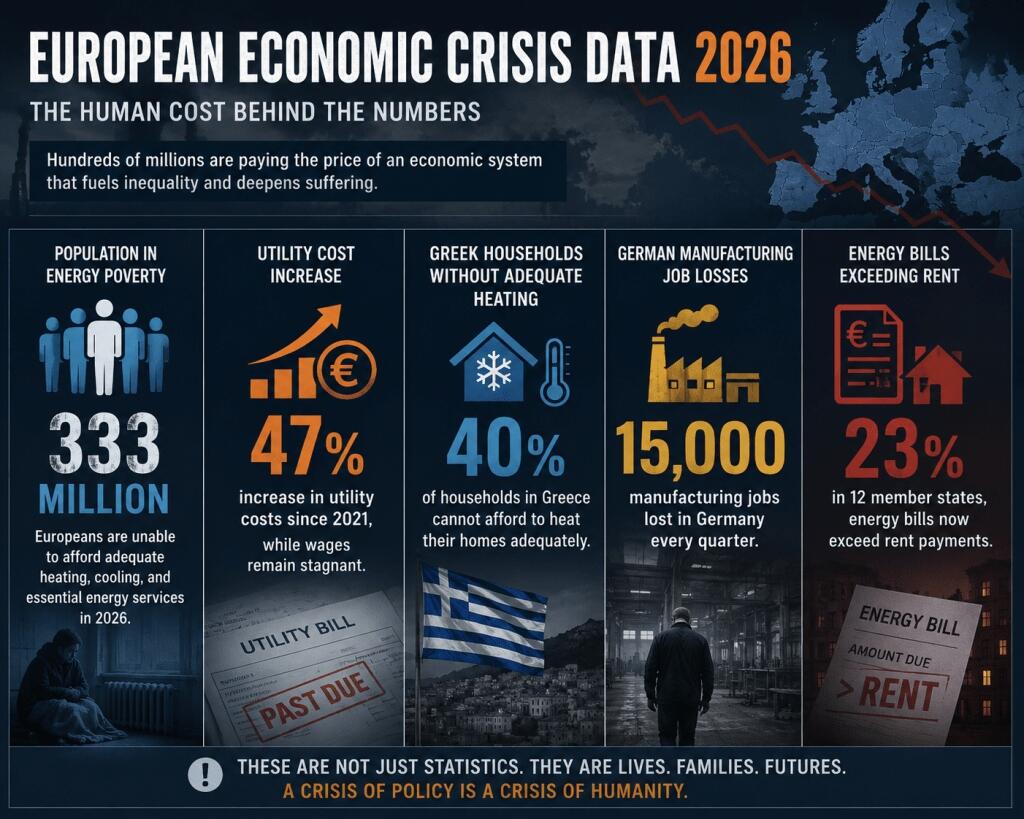
Look at these figures and understand that they represent flesh and blood. In Greece, 40% of households now face the impossible choice between heating and eating—a statistic that translates to grandmothers wrapping themselves in newspapers, to children doing homework by candlelight, to parents skipping meals so their sons might have warmth for one more night. The Greek winter of 2026 brought temperatures that dropped to -8°C in regions where insulation remains a luxury, where families huddle in single rooms wearing every garment they own, where the decision to turn on a heater for one hour means skipping dinner for three days.
Germany, once the industrial titan of Europe, now bleeds 15,000 manufacturing jobs each quarter, its factories darkening like dying stars. The Rhine Valley, which hummed with production for generations, now echoes with the footsteps of workers carrying boxes of personal effects, of security guards locking gates that may never reopen, of communities watching their purpose drain away like water into cracked earth. Energy bills now exceed rent payments by 23% across twelve member states, a reversal of economic reality that breaks families before they even begin, that ensures the poor remain poor and the middle class joins them in descent.
In Portugal, elderly citizens have begun collecting firewood in public parks, risking fines and arrest to secure warmth their pensions cannot purchase. In Poland, organized crime networks now control the black market for coal, selling inferior product at extortionate prices to desperate families who know that burning treated wood releases toxins but choose poison over freezing. The European Commission reports these trends as “energy market adjustments,” as if describing the migration of birds rather than the collapse of human dignity.
But the economic strangulation serves merely as prelude to a more comprehensive destruction. Step into any supermarket in Milan after 7 PM and witness the new normal: empty shelves where fresh produce once stood in abundance, security guards monitoring cooking oil purchases as if guarding gold reserves, elderly women weeping quietly beside discount bins where bruised vegetables wait for hands brave enough to claim them. The Italy that exported culinary culture to the world now imports 60% of its grain from nations that view food as geopolitical leverage, as a weapon more effective than any missile.
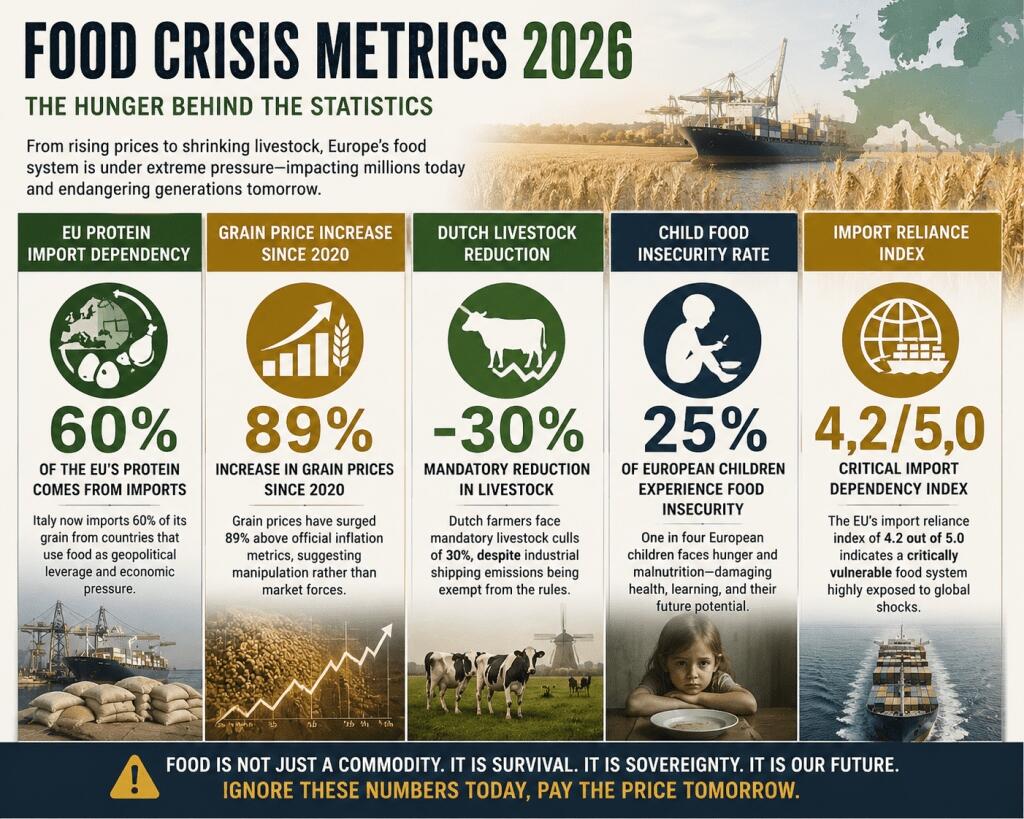
Since 2020, grain prices have exploded 89% above official inflation metrics—a divergence that suggests manipulation rather than market forces, that indicates the invisible hand not of economics but of design. Dutch farmers, whose families worked the same soil for twelve generations, face mandatory livestock culls of 30%, their herds destroyed while industrial shipping emissions remain conveniently exempt from the regulations that destroy their livelihoods. The nitrogen crisis, they are told, requires sacrifice—yet the sacrifice falls always on the small, never on the large, always on the many, never on the few.
One in four European children now experiences food insecurity, a phrase that cannot capture the hollow eyes of a seven-year-old who has learned not to ask for seconds, who has learned to hide hunger behind smiles, who will carry the developmental scars of malnutrition into adulthood where they will manifest as reduced cognitive function, compromised immune systems, shortened lifespans. We are not merely impoverishing the present; we are devouring the future, consuming generations yet unborn to feed the insatiable appetite of a system that demands perpetual growth from finite resources.
In France, the breadbasket of the revolution, bakeries now close on alternating days because electricity costs make continuous operation impossible. The smell of fresh bread, which once defined French morning, becomes a luxury available only to those with means. In Spain, the olive harvest of 2025 failed catastrophically, not from drought as officially reported, but from a combination of policy-induced fertilizer shortages and the abandonment of farms that families could no longer afford to maintain. The trees that survived Roman invasions and Moorish conquests now die from spreadsheets, from regulations, from the cold mathematics of a globalized economy that values efficiency over existence.
The pattern transcends incompetence. It reveals intention. In the winter of 2023, three blood moons appeared over European skies—a celestial alignment that agricultural calendars have associated with famine since Babylonian times, that medieval manuscripts connected to periods of profound transformation and upheaval. Each occurrence coincided with major policy announcements: nitrogen restrictions on farming that reduced output by design, digital currency frameworks that promised convenience while delivering surveillance, biometric identification expansions that normalized the scanning of human bodies as if we were inventory rather than souls.
Modern observers dismiss these correlations as superstition, as primitive attempts to explain phenomena that science now understands. Yet the timing defies probability, defies coincidence, defies the comfortable explanations that allow sleep at night. The fourth blood moon of 2024 marked the introduction of programmable money trials in twelve member states—currency that expires if not spent according to algorithmic criteria, wealth that exists only at the pleasure of invisible systems, savings that can be frozen, redirected, or erased with the stroke of a bureaucratic key.
Ancient wisdom warned that when the moon weeps blood four times in succession, the hidden hands reveal themselves. And so they have. Not as conspirators in smoke-filled rooms—that image serves only to discredit—but as something far more terrifying: a consensus among the powerful that the masses must be managed, must be reduced, must be brought to heel through mechanisms that appear natural, appear inevitable, appear as the unfortunate but necessary consequences of progress and planetary survival.
Beneath the visible governance, a parallel architecture operates with mathematical precision that would impress any engineer. Digital ID systems have penetrated 89% of the population, harvesting biometric data at unprecedented velocity—fingerprints, iris patterns, facial geometry, gait analysis, voice signatures. The human body itself has become the password, the key, the identifier that cannot be forgotten or stolen because it cannot be separated from the person. Twelve nations currently run Central Bank Digital Currency pilots, and in three—Sweden, Finland, and the Netherlands—cash transactions above minimal thresholds have been effectively criminalized, forcing participation in systems that record every exchange, every preference, every relationship.
The average European appears on surveillance cameras 300 times daily, a density of one lens per thirteen citizens that renders privacy obsolete, that ensures the watched internalize the gaze, that transforms free citizens into self-policing subjects who no longer require external control because they have built the prison within their own minds. Social credit architectures have advanced beyond theory into implementation; your carbon footprint, vaccination status, social media sentiment, and political expression now determine access to housing, travel, banking, and employment in ways that newspapers report only after the fact, only when resistance has become impossible.
In China, the system was explicit, overt, acknowledged. In Europe, it arrives wrapped in sustainability, in public health, in security, in the language of care and protection that disarms opposition because who can argue against safety, against health, against the planet? Yet the result converges: the individual subordinated to the collective, the collective defined by algorithms, the algorithms controlled by entities that answer to no electorate, no constituency, no human being at all.
The psychological occupation proves equally devastating as the material one, perhaps more so because it attacks the will to resist before resistance can form. Mental health pharmaceutical prescriptions have increased 340% since smartphone saturation achieved critical mass in 2015, the curve of consumption matching the curve of adoption with correlation coefficients that statisticians cannot dismiss. Youth suicide rates in high-surveillance nations now exceed those of countries recovering from active warfare, suggesting that the destruction of privacy and autonomy kills more efficiently than bombs.
The human attention span has collapsed 67% since 2010, precisely as social platforms achieved dominance—a cognitive destruction that prevents focus, prevents resistance, prevents hope by ensuring that the populace exists in perpetual distraction, in fragments of engagement too brief to sustain coherent thought, too scattered to organize collective action, too fragmented to remember what freedom felt like before the devices arrived to save us from the boredom they themselves manufactured.
When survival requires navigating digital bureaucratic labyrinths that change weekly, when sustenance demands protocol compliance that shifts unpredictably, when warmth itself becomes contingent upon behavioral standards that no one fully understands, the will to liberty atrophies like an unused limb. The muscle memory of freedom fades. The imagination of alternatives dies. The acceptance of domination becomes not merely practical but psychological, a preference for the known cage over the unknown wild.
Yet the human spirit persists in spaces beyond measurement, in cracks the algorithms cannot seal, in moments the cameras cannot capture. In Romanian villages where electricity remains intermittent, grandmothers still hang garlic against evil eyes and track planting by stars their ancestors named millennia ago, maintaining knowledge that predates the nation-state by centuries. Spanish shepherds navigate mountain passes using oral traditions that have survived Roman occupation, Moorish rule, fascist dictatorship, and now digital colonization—knowledge that exists in bodies rather than databases, in relationships rather than networks, in the spaces between words rather than the words themselves.
These practices represent what the architects of control fear most: connections deeper than data, loyalties beyond programming, souls that refuse digitization, communities that persist despite rather than because of the systems imposed upon them. When the shepherd knows the mountain without GPS, when the grandmother knows the plant without app, when the child knows the story without screen, the project of total information remains incomplete, the vision of total management remains unrealized, the dream of total control remains frustrated by the stubborn persistence of organic life.
The blood moons have passed, but their warning remains etched in memory, encoded in stories that survive despite educational systems designed to erase them. Control revealed loses power to persuade. The moment the prisoner recognizes the cell, the bars become intolerable. The European soul, ancient and stubborn, remembers freedom even when taught to forget, carries the genetic memory of resistance even when conditioned for compliance, preserves the capacity for outrage even when numbed by entertainment and pharmaceuticals.
Reclamation requires not revolution but reconstruction—the patient rebuilding of human scale against the crushing weight of globalized abstraction. Community gardens planted in defiance of zoning codes that mandate grass over sustenance. Barter networks operating outside taxable surveillance, exchanging eggs for bread, labor for teaching, care for companionship. Children taught to navigate by stars and identify edible plants alongside their coding lessons, maintaining parallel competencies that ensure survival when the systems fail.
Each act of organic creation resists the mechanized future planned for us. Every conversation held face-to-face rather than through monitored platforms reclaims territory from digital occupiers. Every meal grown rather than purchased, every skill shared rather than outsourced, every relationship maintained through presence rather than proxy—these constitute the insurgency of the real against the virtual, the biological against the synthetic, the human against the machine.
The statistics will worsen before they improve. The winter of 2026-2027 promises to be the harshest in decades, with meteorological predictions converging with economic collapse to create perfect conditions for mass mortality among the vulnerable. The food shortages will deepen as Ukrainian grain remains blocked by conflict, as climate manipulation experiments produce unpredictable weather patterns, as supply chains designed for efficiency over resilience continue their inevitable fragmentation. The surveillance will tighten as artificial intelligence achieves capabilities that render human discretion obsolete, as predictive algorithms identify potential dissent before it forms, as pre-crime prevention moves from fiction to policy.
Yet liberty endures in silence beyond camera reach, in spaces between transactions, in moments of genuine connection that cannot be commodified or controlled. It waits only for the courage to claim it, for the recognition that safety purchased with freedom becomes its own prison, that comfort secured through submission becomes its own torture, that survival at the cost of humanity becomes its own death.
The architects of this system believe they have accounted for all variables, modeled all outcomes, predicted all resistance. They have not accounted for the human heart, which persists in loving despite betrayal, in hoping despite evidence, in fighting despite certainty of defeat. They have not modeled the moment when a mother, watching her child shiver, decides that compliance costs more than resistance. They have not predicted the cascade that follows when enough individuals make this calculation simultaneously, when the illusion of consent dissolves, when the machinery of control encounters the immovable object of human dignity.
The blood moons have passed, but they will return. The hidden hands have revealed themselves, and in that revelation lies our opportunity. For power that operates in shadow depends upon the acquiescence of the ignorant; power exposed to light invites the resistance of the informed. We are no longer ignorant. The question that remains is whether we will act upon our knowledge, whether we will pay the price that freedom demands, whether we will reclaim the liberty that is our birthright or surrender it forever for the temporary warmth of chains.
The choice remains ours—while choice remains possible. The window narrows with each passing season, each new regulation, each additional digit of surveillance. The future being constructed around us is not inevitable; it is being built by human hands that could be stopped by human hands. But the stopping requires recognition, requires courage, requires sacrifice that the comfortable find difficult to contemplate and the desperate find impossible to avoid.
In the end, the question is simple: will we live as men and women, with all the risk and responsibility that freedom entails, or will we exist as managed resources, with all the security and servitude that submission provides? The answer will determine not merely our own fates but the trajectory of human civilization for centuries to come. The blood moons watch and wait. History holds its breath. The moment of decision approaches, and with it, the reckoning that delayed justice always demands.
Tyler Durden Thu, 07/30/2026 - 02:00
Continue reading...
[ H/T ZeroHedge ]