


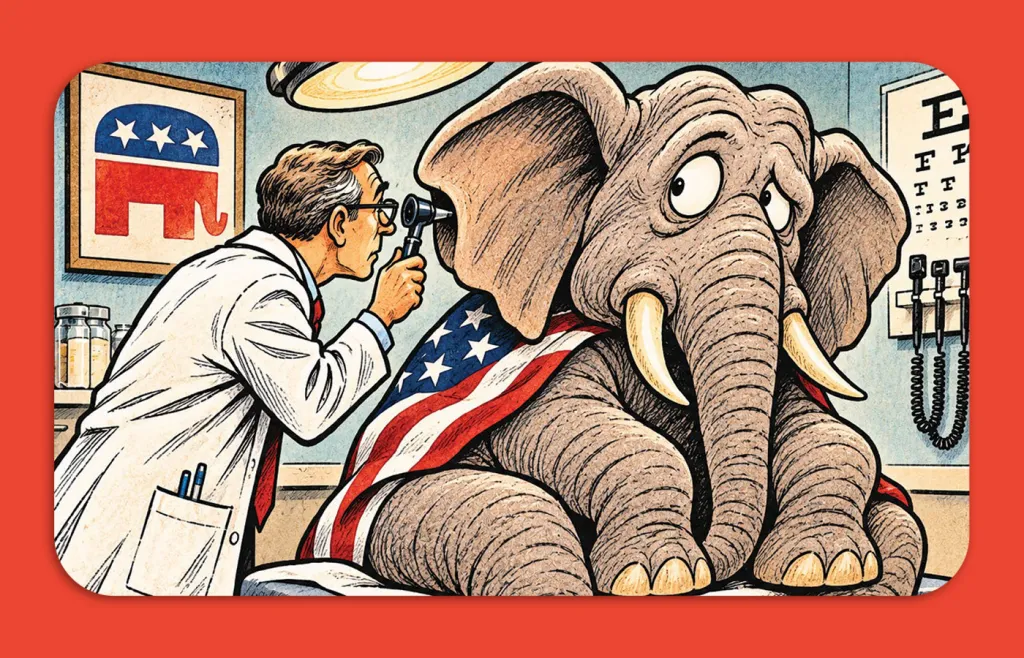
Voters went to the polls on Nov. 3. It was as if Republicans had returned from the doctor with news no one wanted, but some suspected. The patient has serious hearing loss, and its vision has deteriorated. Judging by the party’s initial reactions to the results, it is also in the advanced stages of denial, which is the one condition that makes all the others harder to treat.
None of this came on suddenly. In recent years, criticism has often gone unheard, and disagreement has been treated as disloyalty. Principles the party once recited from memory become hard to recognize whenever they get in the way. The good news is that this kind of hearing loss is reversible. The vision problem is tougher because treatment begins with admitting you can’t see.
Democrats took both chambers of Congress. At press time, they had secured at least 259 House seats, their largest majority since the early 1990s, with four races still outstanding. Republicans lost all over the map, including in districts long held as “safe.”
The consultants have begun their own postmortem: Turnout was off, the message didn’t land, the candidates were weak, the media were unfair, and they needed more money for media buys. (That last one is a consultant favorite, for reasons that need no elaboration.) Some of it is true. But the mechanics of a campaign explain how a candidate lost. They don’t fully explain why a party did. Before Republicans spend another fortune explaining themselves to voters, they might try listening to what voters already said with the votes cast, or the ones that were not.
(Washington Examiner illustration)
" data-large-file="https://www.washingtonexaminer.com/...6/11/Feat.ElephantExamRoom1.120226.jpg?w=1024" height="658" width="1024" src="https://www.washingtonexaminer.com/...6/11/Feat.ElephantExamRoom1.120226.jpg?w=1024" alt="GOP audit republican party examination" class="wp-image-4815294" srcset="https://www.washingtonexaminer.com/wp-content/uploads/2026/11/Feat.ElephantExamRoom1.120226.jpg 1400w, https://www.washingtonexaminer.com/...t.ElephantExamRoom1.120226.jpg?resize=300,193 300w, https://www.washingtonexaminer.com/...t.ElephantExamRoom1.120226.jpg?resize=768,494 768w, https://www.washingtonexaminer.com/....ElephantExamRoom1.120226.jpg?resize=1024,658 1024w" sizes="(max-width: 1024px) 100vw, 1024px">
(Washington Examiner illustration)
Republicans will spend months debating whether the party needs different candidates, different policies, or a different message. Those debates are necessary, but they leave a more fundamental question unanswered: What principles should bind Republicans even when following them is politically inconvenient? Voters did not suddenly agree on a new political philosophy, and Republicans would be foolish to assume they did. But what voters said, as best I can read it, is that Republicans have grown comfortable with the distance between the principles they profess and the policies they defend. Fiscal restraint, constitutional limits, free enterprise, and personal accountability stop meaning much if they apply only when the other party holds power. The party needs to recover the nerve to judge its leaders by its principles instead of quietly adjusting its principles to fit its leaders.
When 99% of counties clear their throats
Reuters looked at roughly 2,100 counties where most votes had been counted by the morning after the election. Republican vote share was down from President Donald Trump’s 2024 performance in 99% of them, by about 9 percentage points on average. When a doctor gets a reading like that, he doesn’t blame the thermometer.
As of Nov. 24, Democrats led the national House vote by about 14 points, the largest margin for either party since 1974, the midterm year that followed Watergate. Republicans old enough to remember that year won’t need the comparison explained.
The details are worse than the top line. In 2024, according to the Associated Press’s survey of more than 100,000 voters, those under 30 split almost evenly between Trump and Kamala Harris. This year, about 7 in 10 backed Democratic House candidates. Across 64 majority-Hispanic counties with Senate contests, Reuters found Republican vote share down an average of 14 points from 2024. Moderates went nearly two-thirds Democratic, and many worried that Congress was doing too little to check presidential power. Some of those voters weren’t only voting against Republicans. They were voting for a Congress that would push back on a president.
Then there is my home state. Utah is not a place where Republicans are used to worrying. County canvasses show we lost 16 seats in the state House and, with them, the two-thirds supermajority, plus two seats in the state Senate. The statewide congressional vote moved roughly 30 points toward Democrats compared with 2022. A swing of this magnitude deserves serious introspection and correction.
The usual caveats apply, and I’ll state them once. A midterm electorate is not a presidential one. County data can’t tell us which voters switched. Redistricting muddies comparisons, Utah included. Economic pressures, the Iran war, and a taste for divided government surely played a part. But none of those explanations absolves Republicans of responsibility for their own decisions. When the same symptom shows up everywhere from swing suburbs to Utah legislative districts, you are no longer looking at unrelated local ailments. You are looking at a serious condition.
When the leader becomes larger than the party
President Donald Trump did not invent the frustrations that reshaped Republican politics — he found them. For years, working people watched factories close, and jobs leave while political leaders recited statistics that bore little resemblance to life on Main Street. Trump heard that anger when much of the party had stopped listening, and he questioned assumptions about trade, immigration, foreign policy, and the establishment that Republican leaders had long since stopped questioning.
A party should be free to change its mind. But it should also be able to articulate why, and the answer should involve evidence and argument rather than the preferences of the person at the top. That is the danger when a leader grows larger than his party. The question shifts, slowly, from “Is this consistent with what we believe?” to “Is this consistent with what he wants?” Previously nonnegotiable principles become negotiable, and policy disagreements turn into loyalty tests.
Consider how far Republican positions on tariffs, executive power, federal spending, and trade have traveled. Some of that movement is honest. But honest reassessment comes with an explanation. If a policy once seemed dangerous because it concentrated power in Washington, what changed? Was the principle wrong, or did the policy become acceptable because a Republican president wanted it?
Trump’s accomplishments and mistakes both deserve a fair hearing. But every president leaves office, and the party has to keep enough independent judgment to govern after he does.
Public service and growing portfolios
A September report by Gallup indicated that 89% of adults believed corruption was widespread in government, the highest figure in the 20 years Gallup has asked, including 83% of Republicans. People can’t agree on what to call the soda in their refrigerators, but 9 in 10 agree on this. Perhaps we should listen. A Brennan Center survey found that 97 % of registered voters consider officials using their positions for personal gain a form of corruption. Polls measure perception, not prove guilt. Perception on that scale is still a political fact.
Demanding integrity from the other side is easy. In Washington, it is practically a hobby. The harder test comes when one of our own is under scrutiny, and conservatives’ sermons on stewardship of the public trust shouldn’t come with a party exemption.
The party of fiscal restraint has misplaced its calculator
For generations, Republicans have introduced themselves as the party of fiscal responsibility. In fairness, the claim was never entirely accurate. President Ronald Reagan preached restraint while running large deficits, and our habit of saying one thing about money and doing another did not begin in 2016.
Republicans are reliably appalled by federal spending, particularly when Democrats propose it. Yet Republican presidents and Congresses have cut taxes and raised spending without cutting anything to cover the difference. Tax cuts can spur investment, and spending can serve real purposes. Neither one repeals arithmetic.
A family that spends more than it earns year after year, blames the previous homeowners, and expects the bank to admire its financial discipline will find itself looking for a new place to call home. Fiscal responsibility means choices, including about programs Republican voters like, and borrowing isn’t free. Every dollar of interest is a dollar that could have gone to a public priority or stayed with the taxpayer who earned it.
Limited government, provided our person is in charge
In 2025, Trump invoked the International Emergency Economic Powers Act to impose sweeping tariffs, arguing that foreign trade practices and persistent trade deficits justified emergency action. In February, the Supreme Court ruled that the statute did not authorize the president to impose tariffs. The Constitution gives Congress the power to regulate foreign commerce and impose duties. Congress may delegate specified authority, but an emergency statute is not a blank check, and treating it as one is exactly what conservatives used to warn against.
For decades we argued that Washington had accumulated too much power. Then executive orders, emergency declarations, and expansive readings of presidential authority started looking much more attractive once they served Republican ends. Presidents have real duties, but none of them license a president to expand his power because Congress is slow or the goal is popular.
In a recent essay on Edmund Burke, Thomas Paine, and George Mason, I proposed a simple test: Would we defend this use of power if our opponents were using it? If your answer changes with the name on the office door, your position was never about the Constitution.
James Madison expected ambition to counteract ambition. The Founding Fathers didn’t build a system that works only if we manage to elect a sufficiently trustworthy president — they built one that works because we don’t have to. Republican representatives should reclaim Congress’s authority over trade, spending, and oversight, even when exercising it inconveniences a president they support. Especially then.
Free enterprise with a tariff attached
Reagan-era conservatives believed individuals and businesses usually make better economic decisions than the government does. Trump made the party face grievances that theory too often disregarded. Manufacturing towns suffered real losses, and families were told that cheaper imports were progress while the industries that held their towns together disappeared.
Those losses are real, but they don’t justify every remedy offered. Tariffs can shield some industries while raising costs for manufacturers who depend on imported materials and for households buying finished goods. In April, the Budget Lab at Yale University reported that the 2025 tariffs brought in substantial customs revenue while prices of imported consumer goods rose, with evidence consistent with tariffs contributing to higher prices, though other economic changes made precise attribution difficult. Some of those duties may also have to be refunded after the Supreme Court’s ruling, which is an awkward thing to have to say about a revenue source.
So what is an intervention meant to accomplish? What will it cost, and how will we know whether it worked? Conservatives used to warn against Washington picking winners and losers. The warning doesn’t expire when the one doing the picking is a Republican.
Cost of living was at the center of this election. The AP Voter Poll found that economic pressure weighed heavily on lower-income households, and voters earning less than $50,000 shifted toward Democratic candidates compared with 2024. Republicans can fairly point out that inflation built up under both parties. But voters don’t experience the economy as a list of causes. They experience it at the grocery store or when a young couple learns that a modest starter home requires a down payment roughly the size of a small town’s budget.
Reagan’s confidence that America’s best years were ahead is worth recovering, though 2026 is not 1984. Young people have heard a great deal about the American dream. What they want to know is whether the door is still open.
The Republican inheritance is worth recovering
The Republican Party’s history is worth celebrating, though some chapters deserve criticism. It was founded to oppose the spread of slavery and became the party of Abraham Lincoln, the Union, emancipation, and the Reconstruction amendments. President Theodore Roosevelt took on concentrated economic power and protected the nation’s wild places. President Dwight Eisenhower built highways and worried about the budget, which is not a bad description of governing. Reagan spoke of liberty, initiative, and confidence in the future. They disagreed about plenty, but each understood that a party has to stand for something larger than the ambitions of whoever happens to be leading it.
Mason set a demanding standard in Virginia’s 1776 Declaration of Rights. Free government, he wrote, depends on justice, moderation, temperance, frugality, virtue, and “a frequent recurrence to fundamental principles.” Quoting principles at a campaign rally costs nothing. Mason’s test is whether they still guide you once they start costing something.
My years in local and state government have taught me how much community life rests on a few people doing unglamorous work: serving on commissions, coaching teams, showing up to meetings almost no one else attends. Self-government takes more than agreeing with a leader or cheering for a cause. It takes judgment, restraint, and a willingness to accept obligations when they’re inconvenient, which is when they matter most.
The responsibility begins with us
It would be convenient to blame national leadership and leave it there. It would also be wrong. Parties are shaped by elected officials, donors, activists, media figures, and voters, and each of them decides what conduct to reward.
Look at what we tolerate. We ask politicians to be honest and then reward them for exaggerating. We rediscover the Constitution’s limits on the presidency when Democrats govern and misplace them when Republicans do. Fixing those habits requires looking at ourselves, which may explain why it happens so rarely.
The test is not complicated, though passing it may be. Congress should reclaim its authority over major tariffs, exercise meaningful oversight of executive power, and adopt budgets that confront spending rather than disguise it. Republican lawmakers should be willing to identify spending they would actually reduce, including programs their own constituents favor, and demand evidence that policies are working. None of this requires abandoning conservatism. It requires practicing it, even when doing so carries a political cost.
The officeholder who stays quiet when he disagrees, the donor who rewards obedience, and the voter who excuses on his own side what he’d condemn in the other all help decide what the party becomes. We must test policies against the principles we claim to hold, expect officials to own their decisions, and after a defeat this size, keep enough humility to admit that some of our positions need revision.
The prognosis is up to us
Parties have recovered from worse. What 2026 established is that the word “Republican” on a ballot guarantees nothing.
HAVE AMERICANS FORGOTTEN HOW TO ARGUE?
Treating this defeat as a messaging problem would waste the evidence. Better advertising can’t permanently hide the gap between what a party says and what it does. Republicans need standards that hold no matter who occupies the White House and officials willing to say so when a policy has failed. The election delivered an unwelcome finding: Some of the party’s most serious problems may be of its own making.
A hearing aid can help a patient hear. It cannot make him listen.
State Rep. Jason E. Thompson serves District 3 in the Utah House of Representatives.
Continue reading...
[ H/T Washington Examiner ]