





Futures Flat As Oil Rebounds After Trump's "Energy Ceasefire" Unravels, Memory Stocks Slide
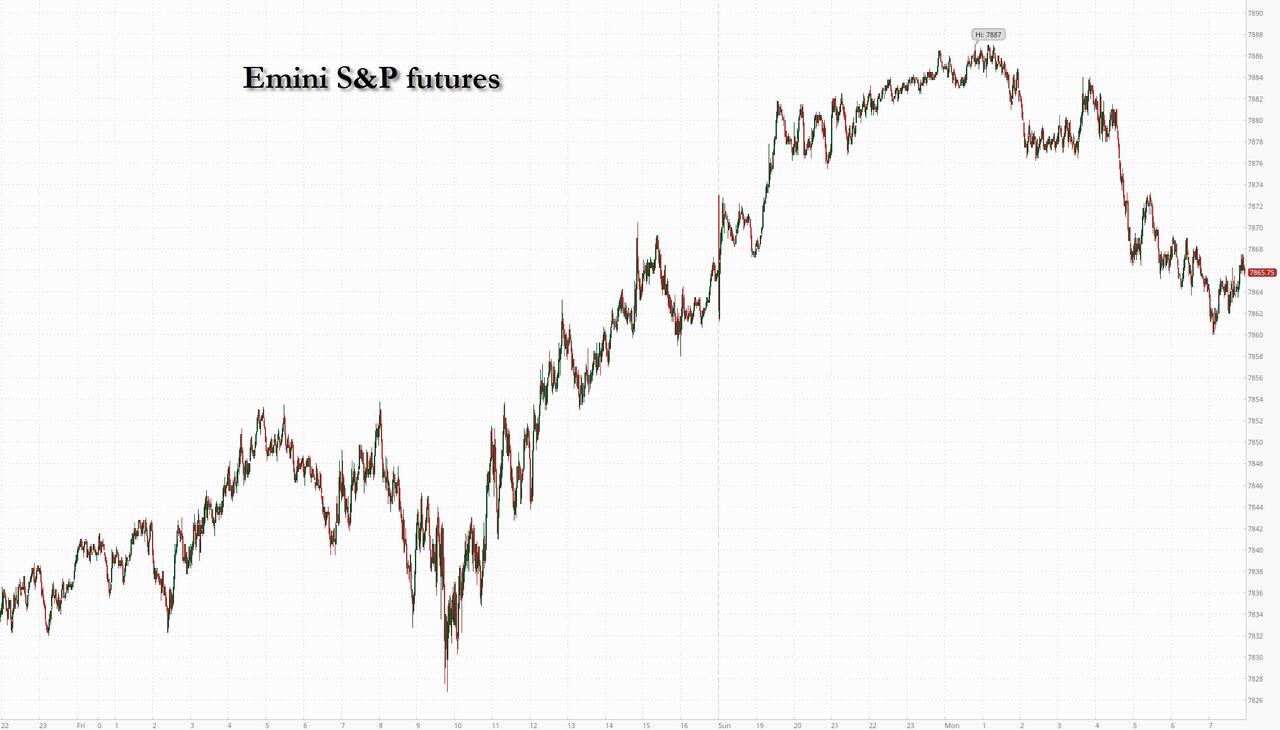
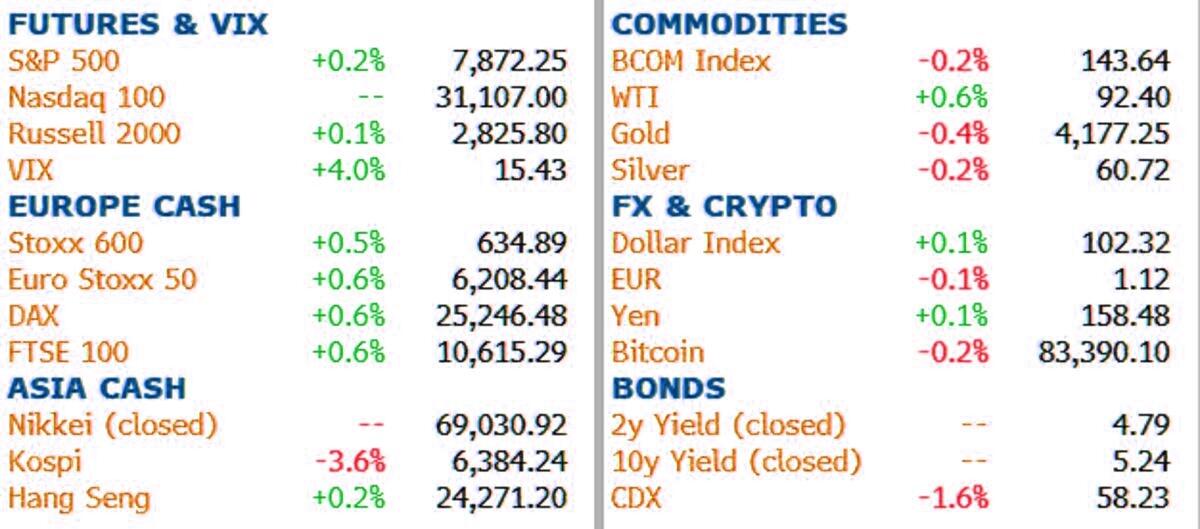
US futures are flat, with S&P contracts clinging to small gains and the Nasdaq slipping into the red as memory stocks slide, after a weekend of contradictory geopolitical headlines whipsawed oil (see below). As of 8:00am ET, S&P futures were 0.1% higher at 7,865 while Nasdaq futures were down 0.1%. Dow futures are up about 0.1%. That follows a Friday session in which the S&P rose 0.6% to cap a 1.2% weekly gain (after a record close on Wednesday) and the Dow jumped 0.8%. In premarket trading, Meta leads the Mag 7 higher (+1.8%) while memory names slide, with Micron down 2.1% after Samsung and SK Hynix tumbled more than 4% in Seoul with buyback quotas now largely completed; T-Mobile rebounded 1.1% on a Raymond James upgrade after Friday's SpaceX-spectrum puke, CCC Intelligent jumps 8.3% on buyout talks with GTCR and Elliott and IREN rises 5% on a reported cloud deal with Anthropic. The day's driver is oil (again), and the market can't decide which war to price: WTI is up 1.2% at $93.00 and Brent is at session highs, above $106 having traded in a $102.33-$106.17 range, as Iran insists Hormuz stays shut until all seven of its conditions are met and Trump mulls joining Saudi strikes on the Houthis. There is no cash Treasury trading today for the Columbus Day holiday; Treasury futures drift lower led by the ultras, implying slight bear steepening, while bunds and gilts are higher (10Y gilt yield down 4bps to 5.41%, bund down 2bps to 3.46%) as diesel prices fall following US efforts to release Russian fuel to the market. The Bloomberg dollar index is steady with the Swiss franc the weakest G10 currency and the pound outperforming ahead of PM Burnham's speech on EU ties, while India's rupee jumped more than 1% after the RBI's strongest support measures since the 2013 taper tantrum. In commodities, spot gold slipped to a $4,168 low, silver is near $60.70, copper extends Friday's rebound as Chinese buyers return from Golden Week, Dutch TTF is firmer at up to €82.90/MWh and US natgas is down 2.5% to $3.14. Bitcoin reversed from a peak of $84,260 to trade near $83,300. There is no US economic data today; Fed speaker slate includes Hammack (12:10pm). The US cash bond market is closed for Columbus Day; stock markets are open.
In premarket trading, Meta shares outperform Magnificent 7 peers, with the cohort helping boost stock futures: Meta Platforms (META) +1.6%, Microsoft (MSFT) +0.4%, Alphabet (GOOGL) -0.2%, Amazon (AMZN) -0.2%, Apple (AAPL) +0.2%, Nvidia (NVDA) -0.2%, Tesla (TSLA) little changed
In other corporate news, Amazon is in negotiations to acquire Decart AI, a startup whose software makes it easier for developers to switch between different AI chips, in a deal that could be valued at around $7 billion, the WSJ reported (because when compute is scarce, the next best thing is buying the switchboard). Nvidia is in talks to acquire or deepen its investment in Reflection AI, a developer of open-weight models the Trump administration hopes will rival cheap Chinese alternatives, per the FT. Broadcom CEO Hock Tan said capital will be the biggest constraint facing the company as AI development continues. HSBC will phase out fixed-pay allowances for senior staff in favor of bonuses. Suzhou Dongshan Precision Manufacturing has started gauging investor interest for a Hong Kong listing that may raise $2 billion to $3 billion. Bambusa Therapeutics filed for an IPO and OPay filed for an NYSE IPO that could be up to $500 million, per IFR. TotalEnergies and KKR will add 700 MW of renewables to their US JV, Uber invested in Croatian robotaxi startup Verne, and Tata's TML CV raised its offer for Iveco to €14.40 a share, declaring it best and final. Hon Hai and FII shares dropped after the US ITC opened a Section 337 probe into AI server power-supply makers.
Trump's surprise Russia-Ukraine "energy ceasefire" (which Moscow has yet to confirm, and which Zelensky says Russia ignored within hours by hitting a power plant) initially knocked Brent toward $102, but repeated Houthi strikes on Riyadh's main airport and another tanker hit in the Strait of Hormuz sent crude right back up; as a result Brent is back above $106 while cash Treasuries are closed for Columbus Day with the 10Y last at 5.24%, a whisker from its highest level since 2002.
Oil, according to Bloomberg's Jan-Patrick Barnert, "looks to be trading Washington's midterm calendar rather than the latest Houthi attacks on Saudi Arabia", with equities overnight "taking the cheaper barrel and asking few questions." The cheaper barrel didn't last: after Trump declared an energy truce that Zelensky said was "news to me", Kyiv said Russia struck a thermal power plant in Kharkiv, the Kremlin said it has nothing to say yet, and Riyadh's King Khalid airport was hit again a day after an attack that killed 12 people including an American. Meanwhile, tankers keep catching fire in Hormuz, with the IRGC saying a third tanker since Saturday hit a sea mine. Brent has round-tripped from $102 to $105.50 and the level to watch, per Bloomberg, is $100.
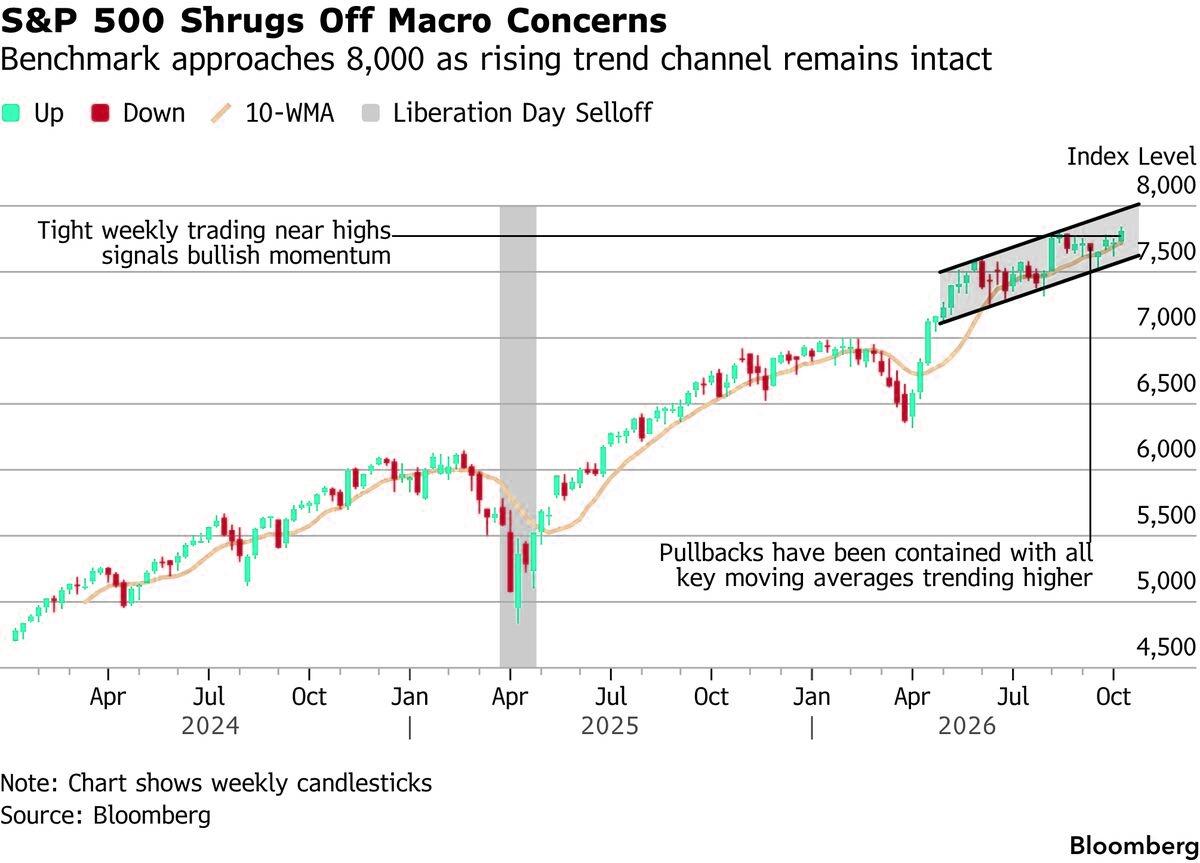
And yet, markets keep doing what they're not supposed to: the S&P is within 1% of an all-time high and closing in on 8,000 even as the 10Y hit 5.36% last Wednesday, its highest intraday level since 2002 (more in "Diesel And Yields"). Underneath, the picture is far uglier: per Goldman's Lee Coppersmith, the median S&P stock is now 16% below its own high and breadth is the weakest since the Dot-Com Bubble, while Bloomberg flags that 57% of the S&P is in a bear market. Over the past month the S&P is up 2% while its equal-weighted version is down 0.6% (Nomura's McElligott explains why the index is blind to the carnage beneath it).
The S&P 500 is approaching 8,000 as its rising trend channel remains intact, with pullbacks contained and all key moving averages trending higher.
“A lot is at stake” for earnings, given recent volatility on a number of fronts, said JPMorgan strategist Mislav Matejka, who thinks the season will reassure the market.
“Growth should stay healthy, especially for earnings, recession risk remains low, and inflation momentum should moderate into 2027. This combination of resilient growth and easing inflation points to more of a ‘Goldilocks’ backdrop,” wrote Goldman strategists including Christian Mueller-Glissmann, who shifted back to overweight equities over three months and overweight bonds over 12 months.
“It is very important for investors to continue to be positioned in the AI trade. It is still the main source of earnings growth with continued upward revisions in earnings,” said Yiping Liao, a portfolio manager at Templeton Global Investments, who nonetheless said investors should be “selective and risk aware.”
The season gets underway tomorrow, when Goldman Sachs, JPMorgan, Wells Fargo and Citigroup report, with Bank of America and Morgan Stanley following on Wednesday. Bloomberg Intelligence expects earnings growth at major US banks to slow from the second quarter as capital-markets activity has moderated. In AI, results from ASML and TSMC this week will give more clues about the sustainability of the AI spending boom, while Nvidia, AMD and Marvell will be in focus as the Open Compute Project Global Summit kicks off today in San Jose, with keynotes from AMD's Lisa Su and Nvidia's Ian Buck. Outside of earnings, Wednesday's CPI report is the key test: a hotter-than-expected reading risks extending the bond selloff and putting renewed pressure on equity valuations.
“Double-digit earnings growth has so far helped offset the negative impact of higher rates,” said Vincent Juvyns, chief investment strategist at ING in Brussels. “The earnings season will be important in determining whether the bull market has further room to run.”
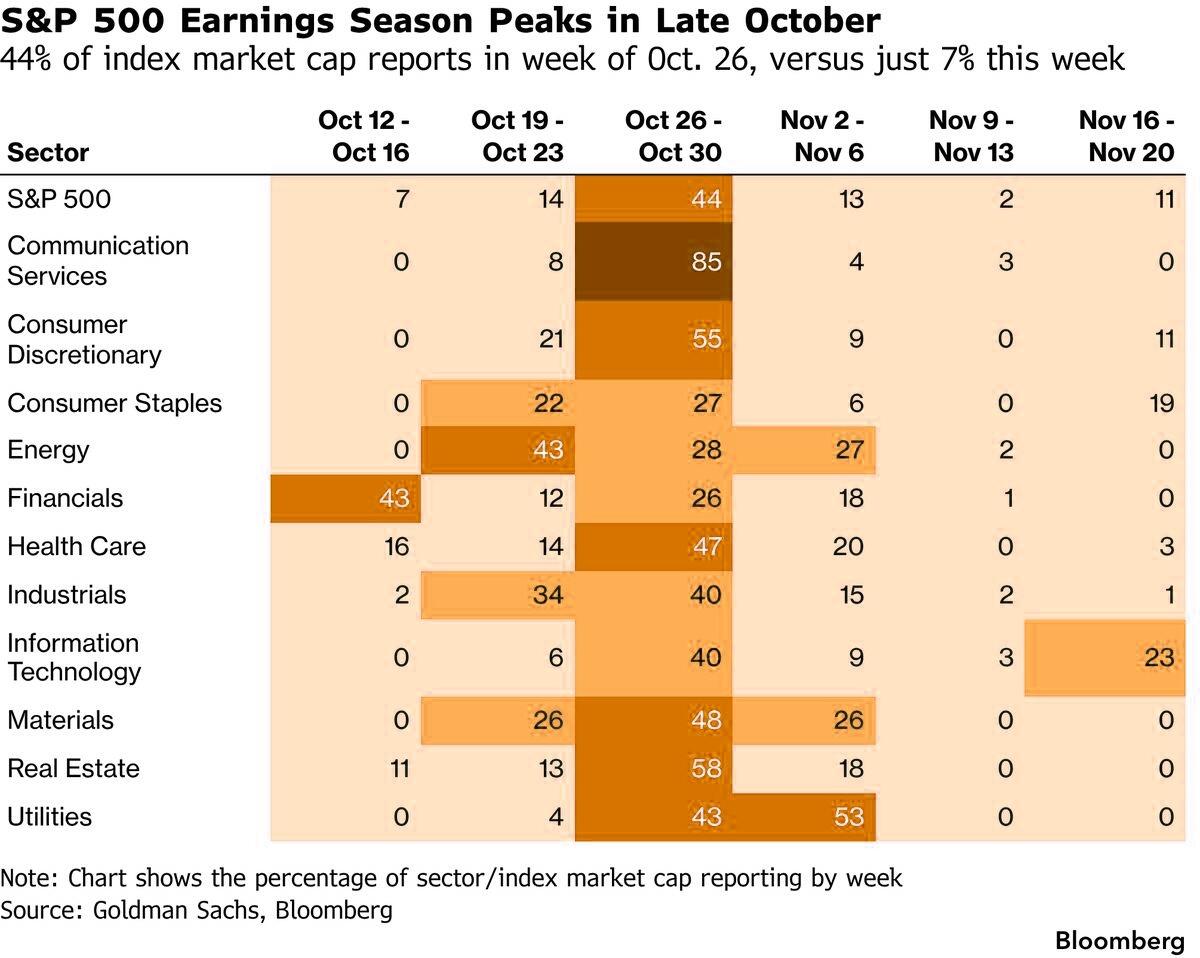
Note that this week is only the appetizer: 44% of index market cap reports in the week of Oct. 26, versus just 7% this week.
JPM's Market Intel desk under Andrew Tyler reiterates its Tactically Bullish view into earnings, calling Thursday's 3.4% OpenAI-driven Semis drop "an accounting misinterpretation" and arguing that with the SOX ~20% off its July lows and ~15% below its June highs, Semis can climb this latest wall of worry as Hynix and Samsung point to ongoing thematic strength. Still, the desk concedes "the market feels shakier than its index levels suggest" given poor breadth, high bond yields and AI doubts. FactSet has Q3 at 29.6% EPS growth on 12.4% revenue growth, with all 11 sectors expected to grow both for only the second time in history. On CPI, JPM's Feroli sees headline +0.55% M/M and core +0.18%, a print that should keep the market from re-pricing an October hike; the desk flags clients who see the 10Y on "an unstoppable trajectory to 5.50%", a level JPM calls "anathema for stocks." Positioning Intel notes HFs bought US banks for a second straight week (+2z), while Semis were the most net sold industry in North America (-1.5z) and European positioning has slid to roughly the 13th percentile.
Goldman's desks are similarly split between a strong tape and a nervous crowd. In London, Rich Privorotsky notes speculators are "heavily short bonds and Russell, long Nasdaq. We know where the pain trade lies," adding that "perhaps measured escalation around $100 oil is something markets can live with." Coppersmith writes that "there is clearly a lot more risk aversion beneath the surface than SPX would suggest," but that absent another meaningful move higher in oil and rates, "the path of least resistance still looks higher." Brian Garrett's index vol colleague goes further: "it feels like there is a higher probability of VIX >25 than there is of SPX -2%." And John Flood sees "the perfect recipe for the S&P 500 to pierce through 8k in short order": robust corporate demand (GS sees buybacks of $1.7 trillion in 2027 vs $1.5 trillion this year), negative sentiment and low HF net exposure. Meanwhile, Goldman's commodity team raised its Dec 2026 Brent forecast to $90 from $85, noting the timespreads risk premium is just over $20 and that "risks to our price forecast remain significantly tilted to the upside on net, especially near-term" (more on the near-record oil risk premium here).
The diesel crunch is now driving policy. Russia's Deputy PM Novak said Moscow has started lifting diesel export restrictions immediately and is ready to supply additional volumes to the US as early as October, Canada said it will maximize oil and diesel exports to the US, and the US authorized an emergency exchange of up to 4 million barrels from the SPR to address storm-related disruptions. The backlash was bipartisan: Republican Senator Tillis warned Trump's Russian diesel deal may be illegal, while Reuters reported Washington threatened to cut intelligence sharing and weapons support unless Kyiv halted refinery strikes. Trump, for his part, said refiners and retailers need to begin dropping prices (with gas prices steering the midterms, that is hardly a surprise).
In Europe, the bond stress is easing but not gone: the Franco-German 10Y spread tightened 3.7bps last week to 137bps and the 2Y spread came in 14.6bps, but GS flags that French bonds resumed declines as investors lose faith in Paris' ability to get a grip on its debt. Lawmakers formally begin debating the draft budget tomorrow, with the final vote scheduled for October 20, while a new poll shows Le Pen and Mélenchon would reach the French presidential runoff. In Berlin, Germany's fragile government was plunged deeper into turmoil after Labor Minister and SPD co-leader Baerbel Bas abruptly resigned.
In Europe, the Stoxx 600 rises 0.5% to 634.66, with falling oil prices boosting sentiment before the third-quarter earnings season begins in earnest, with 415 members up and 167 down. Banks and insurance are the biggest gainers while media and chemicals are the worst performers. Autos are in focus after the EU capped Chinese hybrid imports at 350,000 a year from as soon as December 1, with Renault up 3.2% and Stellantis up 2.5%. Per JPM, Spain and Italy lead while France lags, and Defense, Ceasefire and Power plays are among the top D1 baskets. Here are the biggest European movers:
Asian stocks were mixed in thin, holiday-hit trading with Japan closed for Sports Day, as chip heavyweights dragged the regional benchmark lower. Korea's Kospi tumbled 3.6% to 6,384, closing just above its 200DMA, as it played catch-up to last week's global chip selloff after a long holiday weekend; SK Hynix fell 4.5% and Samsung 4.4%, the Kosdaq slid 4.83% and foreigners sold $1.5 billion, a five-day net selling streak (turnover in Korea has collapsed 70% from its late-May peak). A North Korean ballistic missile launch didn't help. Apple's Asian suppliers fell after a report the company cut component orders for the iPhone 18 Pro and Pro Max (confirming our article on soft iPhone 18 Pro demand), and Chinese and Taiwanese AI server power-supply makers slid on the ITC probe. Elsewhere, Australia's ASX 200 rose 0.8%, the Hang Seng added 0.2% and the CSI 300 fell 0.7%, while Chinese automakers including BYD climbed on the EU hybrid deal and Geely jumped as much as 6.2% on plans to launch in Canada. Indonesia's JCI fell 1.9% to its lowest since July. China's September passenger vehicle sales fell 24% Y/Y and the NDRC vowed to step up countercyclical support.
In FX, the Bloomberg Dollar Spot Index steadied as geopolitical tensions saw the dollar edge higher against most G-10 peers; the DXY holds at the upper end of a 102.10-102.37 range. The Swiss franc leads G10 losses, with USD/CHF up 0.4% to 0.8330, while EUR/USD slips 0.1% to 1.1184 (speculative euro shorts are the largest since 2020, per CFTC data cited by Newsquawk) and USD/JPY rises 0.2% to 158.61. The pound is the slight outperformer ahead of PM Burnham's speech on improving relations with the EU. In EM, India's rupee strengthened the most in six months after the RBI took its strongest measures to bolster the currency since the 2013 taper tantrum, even as Indian 10Y yields jumped 10bps to 7.40%, and Korea's won hit a two-year high.
In rates, cash Treasuries are closed for Columbus Day, and Treasury futures drift lower, led by the ultra-long bond contracts implying a slight bear steepening move: ultras are down around 4 ticks, with the front-end and belly 1 to 2 ticks lower. The 10Y last traded at 5.238% on Friday, after falling 3.3bps on the week. Bunds found support over the London session from a drop in diesel prices, following US efforts to release Russian fuel to the market; the 10Y bund yield is down 2bps at 3.46% and the 10Y gilt yield down 4bps at 5.41%, although gilts have since pared their gains on the bounce in energy. The IG dollar issuance slate is empty, but dealers expect around $30 billion this week, the majority from US banks once earnings are out (it is hard to blame CFOs for not rushing to lock in 24-year-high funding costs). Fed's Hammack speaks at NABE today; she said recently that "this does not look like an economy that has restraint."
In commodities, WTI is up 0.8% at $92.56 (in a $89.61-$93.13 range) and Brent December is up 0.8% at $105.57 after swinging between $102.33 and $106.17, as Houthi attacks on Saudi Arabia and Trump's suggestion the US could join Saudi strikes offset the initial selloff on the energy truce. Saudi Energy Minister Prince Abdulaziz said the kingdom's ability to supply energy remains resilient and that it is looking to expand pipeline capacity to destinations outside the Gulf to 10 million b/d within two to three years; Persian Gulf crude exports continue to flow at rates close to pre-war levels. OPEC's Secretary General sees oil demand growth of 400k b/d this year, while BP is restarting its Na Kika and Thunder Horse platforms in the Gulf of Mexico after Hurricane Isaias. Dutch TTF rose to a €82.90/MWh high from €80.63, spot gold fell to $4,168/oz from $4,217 as Fed tightening expectations weigh, spot silver pared gains to $60.66 from $61.45, and 3M LME copper trades toward the top of a $14,554.55-$14,660/t range on the return of Chinese buyers.
There is no US economic data today; Fed speaker slate includes Hammack (12:10pm). The US cash bond market is closed for Columbus Day; stock markets are open. There are no major pre-market earnings; the Open Compute Project Global Summit kicks off in San Jose and the IMF/World Bank annual meetings run in Bangkok through October 18. Watch luxury names including Capri and Tapestry later today as LVMH reports after the European close.
Market Snapshot
Top Overnight News
A more detailed look at global markets courtesy of Newsquawk
APAC stocks were mixed after geopolitical headlines dominated weekend newsflow and amid thinned conditions to start the week due to Sports Day in Japan and the quasi-holiday stateside for Columbus Day. ASX 200 was led higher by gains in key local industries with outperformance in mining, materials, financials, resources and tech, while telecoms, real estate, energy and the consumer sectors lagged. KOSPI suffered amid pressure in the tech heavyweights, while sentiment was also not helped by North Korea's latest missile launch, which prompted South Korea to convene an emergency meeting. Hang Seng and Shanghai Comp were mixed after the PBoC's improved liquidity efforts, while China also released draft rules establishing nationwide requirements for automotive parts remanufacturing and recently agreed to halve hybrid car exports to the EU in a landmark deal.
Top Asian News
European bourses are firmer across the board, initially on the hopes of a Russia-Ukraine energy ceasefire. US President Trump announced an energy ceasefire between the two sides; however, Axios later reported that Trump’s announcement was pre-emptive but expects both sides to agree to the ceasefire. To add, Ukrainian President Zelensky said Russia attacked Ukraine despite Trump’s announcement. Sectors highlight the positive bias. Banks top the sector pile, with Utilities and Insurance following closely behind. On the other hand, Media is the laggard, closely followed by Chemicals and Travel & Leisure. As the start of the Paris Motor Show gets underway today, the EU announced that China has agreed to limit imports of its hybrid vehicle to 350k/yr, with a 6% annual increase for the second year of application and will apply for four years. This follows the trade talks between the two sides last week, in which hybrid vehicle imports were in focus. European autos continue to benefit from last week’s announcement (Stellantis +2.5%, Volkswagen +1.1%). US equity futures are also firmer, with the Q3 earnings season set to get underway this week, starting with big US banks. For the sector as a whole, earnings are seen rising 3.0% Y/Y (vs 1.3% in Q2).
Top European News
FX
Central Banks
Fixed Income
Commodities
Trade/Tariffs
Geopolitics: Middle East
Geopolitics: Ukraine
Geopolitics: Other
Crypto
US Event Calendar
Central Bank Speakers
DB's Jim Reid concludes the overnight wrap
I have a new iPhone to play with today but for once its not my own. For the first time in recorded history my wife will have a superior model to mine as for her birthday today I have upgraded her but have decided for now to hold fire on my upgrade! It will be totally wasted on her as she is to technology what I am to artistic swimming. If it weren't for the camera option she'd be content with an old Nokia 3310, and not even know snake was on there or have any interest in it if she knew!
This week's game of snake will involve navigating the latest complex geopolitical news and the US inflation data, with September CPI on Wednesday and PPI on Thursday, the final readings before the Fed's October 28 meeting, alongside a broader US activity pulse from retail sales (Thursday) and industrial production (Friday). After Columbus Day today where US bond markets will be closed but equities open, Q3 US earnings season also gets properly under way tomorrow, led by the big US banks, while across the globe ASML (Wednesday) and TSMC (Thursday) should provide another useful read on the AI capex cycle. Elsewhere, China has September inflation and trade data on Wednesday, UK monthly GDP is due Thursday, and the IMF/World Bank meetings run through the week, with the IMF's latest World Economic Outlook out tomorrow and a long list of central-bank speakers.
The big geopolitical/energy story over the weekend is the continued complexity of the Middle East and Russia/Ukraine conflicts. Trump announced yesterday that Russia and Ukraine had agreed to an immediate "energy ceasefire", but overnight developments underline how fragile that claim is. Zelenskyy said Ukraine supports a ceasefire if Russia does too and is awaiting details from Washington, while Moscow had still not publicly confirmed it. Zelenskyy also said Russia subsequently struck a thermal power plant in Kharkiv and other Ukrainian energy infrastructure. So for now this looks more like an untested US proposal than a functioning ceasefire, particularly after a similar arrangement last month failed to endure.
The proposed ceasefire is closely linked to the extraordinary US pivot on Russian diesel. Ukrainian refinery strikes had forced Moscow to restrict fuel exports, tightening an already constrained products market. Trump's deal with Putin would allow around 13.5 million barrels of Russian diesel back into global markets this month via a temporary US sanctions waiver, potentially including the first US imports since March 2022. Zelenskyy has criticised the move, while Reuters reported that Washington threatened to cut intelligence sharing and weapons procurement support unless Kyiv halted refinery strikes. Russian barrels returning would be bearish for diesel cracks, but the overnight strikes make the ceasefire increasingly uncertain and highlight strains between Washington and Kyiv.
Meanwhile, Middle East energy risk has moved sharply in the other direction. Riyadh's King Khalid International Airport was hit again on Sunday after repeated attacks over the past week. Saudi Arabia said the latest strike killed one person and injured 11, after Saturday's attack killed 12 and wounded more than 300. The escalation comes as Saudi-backed Yemeni government forces counter recent Houthi gains near Bab el-Mandeb, the crucial Red Sea shipping chokepoint. Repeated strikes disrupting flights in Riyadh also underline how difficult the Houthi threat may be for Saudi Arabia to suppress.
That leaves a meaningful risk of wider regional escalation. Saudi Arabia has intensified air strikes in Yemen, while Trump said the US "may" join strikes against the Houthis after an American was among those killed on Saturday. Overnight, Iran denied directing the Houthis and its foreign minister urged diplomacy with Saudi Arabia, but there is little sign yet of de-escalation. Washington has so far limited support to intelligence sharing while Riyadh seeks more direct US help and air-defence support. So even if a Russia/Ukraine ceasefire and Russian diesel waiver ease pressure on refined products, attacks on Riyadh and fighting around Bab el-Mandeb leave an upside tail risk for oil and shipping costs, alongside continuing Strait of Hormuz disruption.
With all of that newsflow, this morning Brent is -1.32% at $102.34/bbl with other markets quiet given that Japan's cash equity markets are closed and US bond markets are going to be shut for the holiday. The KOSPI (-2.68%) is the weakest performer as trading resumes following a prolonged holiday weekend. Chinese equities are also under modest pressure, with the CSI 300 (-0.15%) and Shanghai Composite (-0.12%) edging lower. In contrast, the S&P/ASX 200 (+0.78%) is leading gains across the region, while the Hang Seng (+0.12%) is slightly higher. S&P 500 (+0.33%), Nasdaq 100 (+0.44%) and Stoxx (+0.61%) futures are all higher.
Going onto more detail on the week ahead, the main event is US CPI on Wednesday. Our economists expect headline CPI to rise +0.57% MoM in September, up from +0.40% in August, largely because seasonally adjusted motor-fuel prices are expected to jump 9.6%. That would lift headline inflation to around 3.64% YoY. The core picture should be much softer: our economists expect +0.16% MoM, down from +0.29%, taking the annual rate down a couple of basis points to 2.39%. Within core, they expect goods prices to be unchanged, with lower used-car and medical-care commodity prices offset by firmer recreation and IT goods. On services, last month's jump in wireless prices should roll off, although higher jet-fuel costs should support airfares. The contrast between a fuel-driven headline acceleration and a softer underlying core print will clearly be important for the Fed, particularly given recent messaging that further tightening may be needed but is not urgent.
The inflation story does not end there. PPI follows on Thursday and import prices on Friday, both important for mapping the CPI details into core PCE. These are the last inflation data Fed officials will see before the October FOMC meeting. Our economists' ex-ante estimate is for core PCE (released on October 29th, the day after the FOMC) to rise around +0.21% MoM, leaving the annual rate roughly steady at 3.0%. If they are close to our economists' forecasts, the team thinks the Fed can remain on hold on October 28 and wait for more information before December. Chair Warsh's fireside chat with IMF Managing Director Georgieva on Thursday evening will therefore be particularly interesting, as it is the final Fed appearance before the communications blackout. On activity, our economists expect total September retail sales to be unchanged (Thursday) and industrial production to rise +0.2% MoM (Friday). The Fed's Beige Book is also out Wednesday. Today is Columbus Day, so US bond markets are closed although equities remain open.
Earnings season is another important part of the week. JPMorgan, Goldman Sachs, Wells Fargo and Citigroup report tomorrow, followed by Bank of America, Morgan Stanley and BlackRock on Wednesday. ASML reports Wednesday and TSMC on Thursday. Our US equity strategists expect S&P 500 earnings growth to remain at a record 34% YoY in Q3, versus consensus at 27%. Their view is that consensus is again embedding too much of a slowdown, leaving scope for another quarter of above-average beats. See their piece here. In Europe, our equity strategists expect earnings growth to reach 25% in Q3, 5 pp above consensus (their full preview is here). So it should be a very strong earnings season on both sides of the Atlantic and indeed across the globe.
Recapping last week now and markets seemed to be on high alert throughout, but ultimately put in a decent performance as the financial stress around the Eurozone began to moderate, albeit not in a straight line. For instance, the Franco-German 2yr spread came down -14.6bps to 52bps. Moreover, the 10yr spread also tightened -3.7bps over the week to 137bps. That went alongside stabilisation for global bonds more broadly after the relentless selloff of recent weeks. For instance, the 10yr Treasury yield fell -3.3bps on the week to 5.24% (+1.2bps Friday), although it did hit its highest intraday level since 2002 on Wednesday, at 5.36%. However, the 10yr bund yield still edged +1.9bps higher on the week to 3.48%.
That backdrop helped global equities recover in aggregate, though the performance was varied on the two sides of the Atlantic. In the US, we even saw the S&P 500 hit another record on Wednesday, with a weekly gain of +1.15% (+0.59% Friday). Over in Europe by contrast, the STOXX 600 was little changed (+0.03%) on the week despite a +0.97% recovery on Friday. And there were some continued points of stress, with France's CAC 40 down 1.19% (+0.95% Friday), marking its 8th weekly decline in the last 9. Meanwhile, European banks also fell back, with the STOXX Banks index down -2.46% (+0.51% Friday).
As all that was happening, the lack of any clear progress between the US and Iran kept oil prices elevated. So Brent crude ended the week up +2.42% (+0.42% Friday) at $104.72/bbl, whilst European natural gas rose by +8.93% to €81.40/MWh, its highest weekly close since 2022. That went alongside gains for other commodities, including gold, which rose +1.28% last week, and copper, which rose +2.18%.
Tyler Durden Mon, 10/12/2026 - 08:32
Continue reading...
[ H/T ZeroHedge ]
US futures are flat, with S&P contracts clinging to small gains and the Nasdaq slipping into the red as memory stocks slide, after a weekend of contradictory geopolitical headlines whipsawed oil (see below). As of 8:00am ET, S&P futures were 0.1% higher at 7,865 while Nasdaq futures were down 0.1%. Dow futures are up about 0.1%. That follows a Friday session in which the S&P rose 0.6% to cap a 1.2% weekly gain (after a record close on Wednesday) and the Dow jumped 0.8%. In premarket trading, Meta leads the Mag 7 higher (+1.8%) while memory names slide, with Micron down 2.1% after Samsung and SK Hynix tumbled more than 4% in Seoul with buyback quotas now largely completed; T-Mobile rebounded 1.1% on a Raymond James upgrade after Friday's SpaceX-spectrum puke, CCC Intelligent jumps 8.3% on buyout talks with GTCR and Elliott and IREN rises 5% on a reported cloud deal with Anthropic. The day's driver is oil (again), and the market can't decide which war to price: WTI is up 1.2% at $93.00 and Brent is at session highs, above $106 having traded in a $102.33-$106.17 range, as Iran insists Hormuz stays shut until all seven of its conditions are met and Trump mulls joining Saudi strikes on the Houthis. There is no cash Treasury trading today for the Columbus Day holiday; Treasury futures drift lower led by the ultras, implying slight bear steepening, while bunds and gilts are higher (10Y gilt yield down 4bps to 5.41%, bund down 2bps to 3.46%) as diesel prices fall following US efforts to release Russian fuel to the market. The Bloomberg dollar index is steady with the Swiss franc the weakest G10 currency and the pound outperforming ahead of PM Burnham's speech on EU ties, while India's rupee jumped more than 1% after the RBI's strongest support measures since the 2013 taper tantrum. In commodities, spot gold slipped to a $4,168 low, silver is near $60.70, copper extends Friday's rebound as Chinese buyers return from Golden Week, Dutch TTF is firmer at up to €82.90/MWh and US natgas is down 2.5% to $3.14. Bitcoin reversed from a peak of $84,260 to trade near $83,300. There is no US economic data today; Fed speaker slate includes Hammack (12:10pm). The US cash bond market is closed for Columbus Day; stock markets are open.
In premarket trading, Meta shares outperform Magnificent 7 peers, with the cohort helping boost stock futures: Meta Platforms (META) +1.6%, Microsoft (MSFT) +0.4%, Alphabet (GOOGL) -0.2%, Amazon (AMZN) -0.2%, Apple (AAPL) +0.2%, Nvidia (NVDA) -0.2%, Tesla (TSLA) little changed
- Adobe (ADBE) slips 2.6% after Wells Fargo Securities downgraded the maker of software for creative professionals by two notches to underweight.
- AST SpaceMobile (ASTS) rises 4.4% after Deutsche Bank upgraded the satellite broadband operator to buy, seeing a buying opportunity in the wake of recent weakness.
- Biogen (BIIB) gains 4.1% as JPMorgan upgrades to overweight ahead of an increasingly compelling catalyst path in 2027.
- Bristol Myers (BMY) rises 4.4% after the drugmaker said a late-stage trial of a lower dose of its drug candidate for lung disease met its primary endpoint.
- CCC Intelligent Solutions (CCC) rises 11% as GTCR and Elliott Investment Management are said to be in advanced talks to acquire the car-insurance software provider.
- First Solar (FSLR) climbs 2.7% after Truist Securities upgraded the alternative energy company to buy, seeing “a stronger backdrop for pricing into the 2030s.”
- First Tracks Biotherapeutics (TRAX) gains 16% after the drug developer gave topline results from an early-stage trial of its experimental therapy for celiac disease.
- Hub Group (HUBG) gains 3.8% after Baird analyst Daniel Moore raised the recommendation on the transportation company to outperform, writing that the stock’s risk-reward profile has grown increasingly attractive.
- Iren (IREN) rises 3.8% as the Information reports that the crypto miner-turned-AI server provider has entered a multiyear cloud deal with Anthropic.
- Manhattan Associates (MANH) rises 3.5% after Morgan Stanley upgraded the software company to overweight, seeing it as a potential AI winner.
- Salesforce (CRM) climbs 4.1% after BofA Global Research raised the recommendation on the software company to buy, pointing to tailwinds from AI adoption.
- Tyler Technologies (TYL) gains 2.5% after Wells Fargo Securities upgraded the software company to overweight from equal-weight, seeing fading headwinds.
In other corporate news, Amazon is in negotiations to acquire Decart AI, a startup whose software makes it easier for developers to switch between different AI chips, in a deal that could be valued at around $7 billion, the WSJ reported (because when compute is scarce, the next best thing is buying the switchboard). Nvidia is in talks to acquire or deepen its investment in Reflection AI, a developer of open-weight models the Trump administration hopes will rival cheap Chinese alternatives, per the FT. Broadcom CEO Hock Tan said capital will be the biggest constraint facing the company as AI development continues. HSBC will phase out fixed-pay allowances for senior staff in favor of bonuses. Suzhou Dongshan Precision Manufacturing has started gauging investor interest for a Hong Kong listing that may raise $2 billion to $3 billion. Bambusa Therapeutics filed for an IPO and OPay filed for an NYSE IPO that could be up to $500 million, per IFR. TotalEnergies and KKR will add 700 MW of renewables to their US JV, Uber invested in Croatian robotaxi startup Verne, and Tata's TML CV raised its offer for Iveco to €14.40 a share, declaring it best and final. Hon Hai and FII shares dropped after the US ITC opened a Section 337 probe into AI server power-supply makers.
Trump's surprise Russia-Ukraine "energy ceasefire" (which Moscow has yet to confirm, and which Zelensky says Russia ignored within hours by hitting a power plant) initially knocked Brent toward $102, but repeated Houthi strikes on Riyadh's main airport and another tanker hit in the Strait of Hormuz sent crude right back up; as a result Brent is back above $106 while cash Treasuries are closed for Columbus Day with the 10Y last at 5.24%, a whisker from its highest level since 2002.
Oil, according to Bloomberg's Jan-Patrick Barnert, "looks to be trading Washington's midterm calendar rather than the latest Houthi attacks on Saudi Arabia", with equities overnight "taking the cheaper barrel and asking few questions." The cheaper barrel didn't last: after Trump declared an energy truce that Zelensky said was "news to me", Kyiv said Russia struck a thermal power plant in Kharkiv, the Kremlin said it has nothing to say yet, and Riyadh's King Khalid airport was hit again a day after an attack that killed 12 people including an American. Meanwhile, tankers keep catching fire in Hormuz, with the IRGC saying a third tanker since Saturday hit a sea mine. Brent has round-tripped from $102 to $105.50 and the level to watch, per Bloomberg, is $100.
And yet, markets keep doing what they're not supposed to: the S&P is within 1% of an all-time high and closing in on 8,000 even as the 10Y hit 5.36% last Wednesday, its highest intraday level since 2002 (more in "Diesel And Yields"). Underneath, the picture is far uglier: per Goldman's Lee Coppersmith, the median S&P stock is now 16% below its own high and breadth is the weakest since the Dot-Com Bubble, while Bloomberg flags that 57% of the S&P is in a bear market. Over the past month the S&P is up 2% while its equal-weighted version is down 0.6% (Nomura's McElligott explains why the index is blind to the carnage beneath it).
The S&P 500 is approaching 8,000 as its rising trend channel remains intact, with pullbacks contained and all key moving averages trending higher.
“A lot is at stake” for earnings, given recent volatility on a number of fronts, said JPMorgan strategist Mislav Matejka, who thinks the season will reassure the market.
“Growth should stay healthy, especially for earnings, recession risk remains low, and inflation momentum should moderate into 2027. This combination of resilient growth and easing inflation points to more of a ‘Goldilocks’ backdrop,” wrote Goldman strategists including Christian Mueller-Glissmann, who shifted back to overweight equities over three months and overweight bonds over 12 months.
“It is very important for investors to continue to be positioned in the AI trade. It is still the main source of earnings growth with continued upward revisions in earnings,” said Yiping Liao, a portfolio manager at Templeton Global Investments, who nonetheless said investors should be “selective and risk aware.”
The season gets underway tomorrow, when Goldman Sachs, JPMorgan, Wells Fargo and Citigroup report, with Bank of America and Morgan Stanley following on Wednesday. Bloomberg Intelligence expects earnings growth at major US banks to slow from the second quarter as capital-markets activity has moderated. In AI, results from ASML and TSMC this week will give more clues about the sustainability of the AI spending boom, while Nvidia, AMD and Marvell will be in focus as the Open Compute Project Global Summit kicks off today in San Jose, with keynotes from AMD's Lisa Su and Nvidia's Ian Buck. Outside of earnings, Wednesday's CPI report is the key test: a hotter-than-expected reading risks extending the bond selloff and putting renewed pressure on equity valuations.
“Double-digit earnings growth has so far helped offset the negative impact of higher rates,” said Vincent Juvyns, chief investment strategist at ING in Brussels. “The earnings season will be important in determining whether the bull market has further room to run.”
Note that this week is only the appetizer: 44% of index market cap reports in the week of Oct. 26, versus just 7% this week.
JPM's Market Intel desk under Andrew Tyler reiterates its Tactically Bullish view into earnings, calling Thursday's 3.4% OpenAI-driven Semis drop "an accounting misinterpretation" and arguing that with the SOX ~20% off its July lows and ~15% below its June highs, Semis can climb this latest wall of worry as Hynix and Samsung point to ongoing thematic strength. Still, the desk concedes "the market feels shakier than its index levels suggest" given poor breadth, high bond yields and AI doubts. FactSet has Q3 at 29.6% EPS growth on 12.4% revenue growth, with all 11 sectors expected to grow both for only the second time in history. On CPI, JPM's Feroli sees headline +0.55% M/M and core +0.18%, a print that should keep the market from re-pricing an October hike; the desk flags clients who see the 10Y on "an unstoppable trajectory to 5.50%", a level JPM calls "anathema for stocks." Positioning Intel notes HFs bought US banks for a second straight week (+2z), while Semis were the most net sold industry in North America (-1.5z) and European positioning has slid to roughly the 13th percentile.
Goldman's desks are similarly split between a strong tape and a nervous crowd. In London, Rich Privorotsky notes speculators are "heavily short bonds and Russell, long Nasdaq. We know where the pain trade lies," adding that "perhaps measured escalation around $100 oil is something markets can live with." Coppersmith writes that "there is clearly a lot more risk aversion beneath the surface than SPX would suggest," but that absent another meaningful move higher in oil and rates, "the path of least resistance still looks higher." Brian Garrett's index vol colleague goes further: "it feels like there is a higher probability of VIX >25 than there is of SPX -2%." And John Flood sees "the perfect recipe for the S&P 500 to pierce through 8k in short order": robust corporate demand (GS sees buybacks of $1.7 trillion in 2027 vs $1.5 trillion this year), negative sentiment and low HF net exposure. Meanwhile, Goldman's commodity team raised its Dec 2026 Brent forecast to $90 from $85, noting the timespreads risk premium is just over $20 and that "risks to our price forecast remain significantly tilted to the upside on net, especially near-term" (more on the near-record oil risk premium here).
The diesel crunch is now driving policy. Russia's Deputy PM Novak said Moscow has started lifting diesel export restrictions immediately and is ready to supply additional volumes to the US as early as October, Canada said it will maximize oil and diesel exports to the US, and the US authorized an emergency exchange of up to 4 million barrels from the SPR to address storm-related disruptions. The backlash was bipartisan: Republican Senator Tillis warned Trump's Russian diesel deal may be illegal, while Reuters reported Washington threatened to cut intelligence sharing and weapons support unless Kyiv halted refinery strikes. Trump, for his part, said refiners and retailers need to begin dropping prices (with gas prices steering the midterms, that is hardly a surprise).
In Europe, the bond stress is easing but not gone: the Franco-German 10Y spread tightened 3.7bps last week to 137bps and the 2Y spread came in 14.6bps, but GS flags that French bonds resumed declines as investors lose faith in Paris' ability to get a grip on its debt. Lawmakers formally begin debating the draft budget tomorrow, with the final vote scheduled for October 20, while a new poll shows Le Pen and Mélenchon would reach the French presidential runoff. In Berlin, Germany's fragile government was plunged deeper into turmoil after Labor Minister and SPD co-leader Baerbel Bas abruptly resigned.
In Europe, the Stoxx 600 rises 0.5% to 634.66, with falling oil prices boosting sentiment before the third-quarter earnings season begins in earnest, with 415 members up and 167 down. Banks and insurance are the biggest gainers while media and chemicals are the worst performers. Autos are in focus after the EU capped Chinese hybrid imports at 350,000 a year from as soon as December 1, with Renault up 3.2% and Stellantis up 2.5%. Per JPM, Spain and Italy lead while France lags, and Defense, Ceasefire and Power plays are among the top D1 baskets. Here are the biggest European movers:
- Nordex shares rise as much as 4.5% after the wind turbine company comfortably beat order expectations in the third quarter, according to analysts.
- Inwit shares rise as much as 5% in Milan after Reuters reported that the Italian tower operator’s major shareholders are exploring a potential take-private deal and arranging financing for a possible transaction.
- Scatec shares rise as much as 4.6% after analysts at DNB Carnegie raised their price target and earnings estimates on the Norwegian renewable energy company.
- Aroundtown shares fall as much as 3.9% after Goldman Sachs downgraded the German property firm to sell from neutral, seeing higher finance costs pressuring earnings.
- Informa shares fall as much as 4% after a deadly weekend attack on Saudi Arabia’s main airport cast doubt on the events operator’s upcoming exhibitions in the country.
- Hays shares fall as much as 12% after a trading update from the recruitment firm flagged weakness in permanent hiring.
- Hacksaw slumps as much as 30%, the most on record, after the Swedish online gambling and gaming company says third-quarter total revenue growth was below its historical growth pace.
Asian stocks were mixed in thin, holiday-hit trading with Japan closed for Sports Day, as chip heavyweights dragged the regional benchmark lower. Korea's Kospi tumbled 3.6% to 6,384, closing just above its 200DMA, as it played catch-up to last week's global chip selloff after a long holiday weekend; SK Hynix fell 4.5% and Samsung 4.4%, the Kosdaq slid 4.83% and foreigners sold $1.5 billion, a five-day net selling streak (turnover in Korea has collapsed 70% from its late-May peak). A North Korean ballistic missile launch didn't help. Apple's Asian suppliers fell after a report the company cut component orders for the iPhone 18 Pro and Pro Max (confirming our article on soft iPhone 18 Pro demand), and Chinese and Taiwanese AI server power-supply makers slid on the ITC probe. Elsewhere, Australia's ASX 200 rose 0.8%, the Hang Seng added 0.2% and the CSI 300 fell 0.7%, while Chinese automakers including BYD climbed on the EU hybrid deal and Geely jumped as much as 6.2% on plans to launch in Canada. Indonesia's JCI fell 1.9% to its lowest since July. China's September passenger vehicle sales fell 24% Y/Y and the NDRC vowed to step up countercyclical support.
In FX, the Bloomberg Dollar Spot Index steadied as geopolitical tensions saw the dollar edge higher against most G-10 peers; the DXY holds at the upper end of a 102.10-102.37 range. The Swiss franc leads G10 losses, with USD/CHF up 0.4% to 0.8330, while EUR/USD slips 0.1% to 1.1184 (speculative euro shorts are the largest since 2020, per CFTC data cited by Newsquawk) and USD/JPY rises 0.2% to 158.61. The pound is the slight outperformer ahead of PM Burnham's speech on improving relations with the EU. In EM, India's rupee strengthened the most in six months after the RBI took its strongest measures to bolster the currency since the 2013 taper tantrum, even as Indian 10Y yields jumped 10bps to 7.40%, and Korea's won hit a two-year high.
In rates, cash Treasuries are closed for Columbus Day, and Treasury futures drift lower, led by the ultra-long bond contracts implying a slight bear steepening move: ultras are down around 4 ticks, with the front-end and belly 1 to 2 ticks lower. The 10Y last traded at 5.238% on Friday, after falling 3.3bps on the week. Bunds found support over the London session from a drop in diesel prices, following US efforts to release Russian fuel to the market; the 10Y bund yield is down 2bps at 3.46% and the 10Y gilt yield down 4bps at 5.41%, although gilts have since pared their gains on the bounce in energy. The IG dollar issuance slate is empty, but dealers expect around $30 billion this week, the majority from US banks once earnings are out (it is hard to blame CFOs for not rushing to lock in 24-year-high funding costs). Fed's Hammack speaks at NABE today; she said recently that "this does not look like an economy that has restraint."
In commodities, WTI is up 0.8% at $92.56 (in a $89.61-$93.13 range) and Brent December is up 0.8% at $105.57 after swinging between $102.33 and $106.17, as Houthi attacks on Saudi Arabia and Trump's suggestion the US could join Saudi strikes offset the initial selloff on the energy truce. Saudi Energy Minister Prince Abdulaziz said the kingdom's ability to supply energy remains resilient and that it is looking to expand pipeline capacity to destinations outside the Gulf to 10 million b/d within two to three years; Persian Gulf crude exports continue to flow at rates close to pre-war levels. OPEC's Secretary General sees oil demand growth of 400k b/d this year, while BP is restarting its Na Kika and Thunder Horse platforms in the Gulf of Mexico after Hurricane Isaias. Dutch TTF rose to a €82.90/MWh high from €80.63, spot gold fell to $4,168/oz from $4,217 as Fed tightening expectations weigh, spot silver pared gains to $60.66 from $61.45, and 3M LME copper trades toward the top of a $14,554.55-$14,660/t range on the return of Chinese buyers.
There is no US economic data today; Fed speaker slate includes Hammack (12:10pm). The US cash bond market is closed for Columbus Day; stock markets are open. There are no major pre-market earnings; the Open Compute Project Global Summit kicks off in San Jose and the IMF/World Bank annual meetings run in Bangkok through October 18. Watch luxury names including Capri and Tapestry later today as LVMH reports after the European close.
Market Snapshot
Top Overnight News
- Deadly Houthi attacks on the Saudi capital’s main airport over the weekend raised the risk of a wider war that may draw in the US. More missiles and drones were intercepted overnight. BBG
- The United States' response to Iran's seven conditions in a proposal to reopen the strategic Strait of Hormuz was "insufficient", Iran's security chief, Mohsen Rezaei, was quoted by state media on Sunday as saying. RTRS
- Oil swung after US President Donald Trump said Kyiv and Moscow had agreed to an “energy ceasefire,” while in the Middle East, Saudi Arabia suffered its deadliest strikes since the Iran war began. BBG
- Ukraine will continue to respond with long-range strikes against Russia unless Moscow agrees to an energy ceasefire that still hasn’t happened, President Volodymyr Zelenskyy said on Monday. BBG
- Saudi Arabia is looking at ways to expand its oil pipeline capacity to destinations outside the Persian Gulf to 10 million barrels a day within two to three years, said Energy Minister Prince Abdulaziz bin Salman. BBG
- US Senators reportedly demanded that President Trump reverse the Russian fuel imports deal, while Republican Senator Tillis warned that Trump’s Russian diesel deal may be illegal and put American lives at risk. Newsquawk
- The EU will cap imports of Chinese hybrid vehicles at 350,000 a year starting as soon as Dec. 1, with the limit rising 6% annually from the second year, according to a document seen by Bloomberg. The effect is likely to be more restrictive for Chinese automakers than tariffs, BI said. BBG
- China passenger vehicle sales tumbled 28% Y/Y in Sept, the largest so far this year and a sign that the domestic market remains under pressure. Nikkei
- Nvidia is in talks to acquire or deepen its investment in US start-up Reflection AI, a developer of open-weight models that President Donald Trump’s administration hopes will rival cheap Chinese alternatives, people with direct knowledge of the matter said. FT
- Amazon is in talks to acquire artificial-intelligence startup Decart in a deal that could be valued at around $7 billion. San Francisco-based Decart’s software makes it easier for developers to switch between different AI chips, a capability that is becoming increasingly important as companies race to secure more computing power. WSJ
- Broadcom CEO Hock Tan said on Monday that capital will be the biggest constraint facing the company as AI development continues. RTRS
- Nato members should prepare a robust response for a possible deadly Russian “hybrid” attack, Poland’s foreign minister has said, as concern grows about Moscow’s escalating sabotage campaign on European soil. FT
- France’s bonds resumed declines. Investors are losing faith in its ability to get a grip on its debt and growing increasingly concerned about the risk of contagion.
- Germany’s fragile government was plunged deeper into turmoil on Monday after the labor minister and co-chair of the junior coalition partner abruptly resigned from both her posts. BBG
- Bond markets are starting to do some of the lifting for central banks around the world by pushing up borrowing costs themselves, potentially reducing the number of benchmark interest-rate hikes needed to get inflation under control. BBG
- India’s consumer prices rose 5.54% Y/Y in September, vs est. +5.58%, the highest in almost two years and backing RBI tightening. BBG
- Robert E. Hall and Michael Woodford won the Nobel Prize in Economics for their work on stabilization. BBG
- Goldman raised its Dec 2026 Brent forecast to $90/bbl from $85 and still sees Brent averaging $80 in 2027; in an upside scenario where Gulf output stays 5mb/d below February levels, Brent could average around $125 in 2027. GIR
- JPM's Feroli sees September headline CPI at +0.55% M/M (3.6% Y/Y) and core at +0.18% (2.4% Y/Y), enough to keep the bond market from re-pricing an October hike. JPM
A more detailed look at global markets courtesy of Newsquawk
APAC stocks were mixed after geopolitical headlines dominated weekend newsflow and amid thinned conditions to start the week due to Sports Day in Japan and the quasi-holiday stateside for Columbus Day. ASX 200 was led higher by gains in key local industries with outperformance in mining, materials, financials, resources and tech, while telecoms, real estate, energy and the consumer sectors lagged. KOSPI suffered amid pressure in the tech heavyweights, while sentiment was also not helped by North Korea's latest missile launch, which prompted South Korea to convene an emergency meeting. Hang Seng and Shanghai Comp were mixed after the PBoC's improved liquidity efforts, while China also released draft rules establishing nationwide requirements for automotive parts remanufacturing and recently agreed to halve hybrid car exports to the EU in a landmark deal.
Top Asian News
- China will launch an employment initiative aimed at adapting workers' skills to the development of AI.
- China released draft rules establishing nationwide requirements for automotive parts remanufacturing, including standards for sourcing used components, product quality, traceability and market oversight.
- China proposed banning fully concealed car door handles and requiring physical controls for certain safety-critical functions as regulators seek to strengthen oversight of vehicle design and product testing. Rules would prohibit foldable and flexible vehicle display screens and require additional safety assessments for a range of innovative designs, while the proposal noted some manufacturers launched products without sufficient testing.
- China is to cut VAT export tax rebate rate on NEVs to 9% (from 13%), effective April 1st 2027.
- China's passenger vehicle sales fell 24% Y/Y to 1.7mln units in September, while new energy vehicle sales declined 12% Y/Y to 1.1mln units.
European bourses are firmer across the board, initially on the hopes of a Russia-Ukraine energy ceasefire. US President Trump announced an energy ceasefire between the two sides; however, Axios later reported that Trump’s announcement was pre-emptive but expects both sides to agree to the ceasefire. To add, Ukrainian President Zelensky said Russia attacked Ukraine despite Trump’s announcement. Sectors highlight the positive bias. Banks top the sector pile, with Utilities and Insurance following closely behind. On the other hand, Media is the laggard, closely followed by Chemicals and Travel & Leisure. As the start of the Paris Motor Show gets underway today, the EU announced that China has agreed to limit imports of its hybrid vehicle to 350k/yr, with a 6% annual increase for the second year of application and will apply for four years. This follows the trade talks between the two sides last week, in which hybrid vehicle imports were in focus. European autos continue to benefit from last week’s announcement (Stellantis +2.5%, Volkswagen +1.1%). US equity futures are also firmer, with the Q3 earnings season set to get underway this week, starting with big US banks. For the sector as a whole, earnings are seen rising 3.0% Y/Y (vs 1.3% in Q2).
Top European News
- UK Chancellor Healey plans short-term Budget giveaways to limit fiscal pressure and is due to unveil further support for energy costs this winter when the Budget is announced later this month.
- UK Chancellor Healey ruled out lowering the mansion tax threshold to GBP 1.5mln.
- S&P affirmed the UK on Friday at AA; Outlook Stable.
- EU leaders will discuss a scaled-back budget at their meeting in Brussels in the week ahead, after Ireland presented a compromise plan for the next seven-year budget that would cut EUR 160bln from the European Commission's proposed EUR 2tln figure.
- Germany, and allies, have informed European Council President Costa that cohesion and agriculture funding will "definitely" need to be cut in the next budget draft, Politico reported citing sources.
FX
- G10s are broadly lower against the USD this morning. GBP leads vs peers, whilst the Swiss Franc is the underperformer. Focus has been on geopolitics, which has been on two fronts. Starting in the Middle East, the Houthis launched a deadly attack on an airport in Saudi’s capital, which could see the US enter on this front. Over in Russia-Ukraine, President Trump announced an “energy ceasefire”, which caught both Ukraine and Russia by surprise. Russia continued its strikes on Ukraine over the weekend. Speaking on the deal, President Zelensky said that he had found out about it through the media, though mentioned that he is ready to sign ceasefire guarantees. Russia has yet to respond.
- Given the aforementioned geopolitical updates, DXY is a touch firmer this morning, currently holding at the upper end of a 102.10 to 102.37 range. Aside from that, the docket is exceptionally thin, with newsflow also likely to remain light on account of Columbus Day. Attention for the week will remain solely on US CPI on Wednesday, which will be a key report heading into the October confab. Whilst money markets assign only a 20% chance of a hike this month, it could help strengthen tightening bets for later in the year.
- GBP is the slight outperformer this morning, ahead of PM Burnham’s speech today, where he is expected to speak on improving the UK’s relationship with the EU. Any progress to improving relations with the bloc could likely be seen as a positive for domestic growth, but will be clouded by what specifically the UK must cough up to strike a deal with the EU.
- The EUR is under mild pressure this morning, in continuation of the action seen last week (speculative net-short position hit its largest since 2020, via CFTC). Downside which was facilitated by ongoing French fiscal woes; the next point of friction will be on October 13th, when lawmakers will formally begin debate on the draft budget. The final vote is scheduled for 20th October.
Central Banks
- NBP's Wnorowski said they could raise the base rate at the November MPC meeting and awaiting updated staff projections.
- BoK Governor Shin affirmed inflation is seen remaining above target for some time and noted that chip strength is supporting faster than expected growth. Shin reiterated that timing and pace of further hikes will be data-dependent.
Fixed Income
- A firmer start to the week for fixed income, on account of the pressure seen in the energy space on steps towards an energy ceasefire between Russia and Ukraine, while in the Middle East Iran acknowledged that some of the seven points have been met, but not all.
- Action which leaves Bunds higher by about 20 ticks, off highs in 121.02 to 121.29 confines, with a pullback seen on recent energy gains. Energy aside, the bloc is focused on ongoing budget deliberations, with Politico reporting that Germany is to push for cuts to agriculture and cohesion, two of the most high-profile funding points.
- Elsewhere, we await the briefing by Chancellor Merz at 12:30BST, where he is expected to outline the changes CDU is making following the poor performance in September’s regional elections. Performance that significantly increased the scrutiny around and pressure on the Chancellor.
- Gilts opened higher by just under 30 ticks, broadly in line with the lead from peers at the time. Upside was a function of the discussed energy moves, and also increased commentary around EU-UK relations ahead of PM Burnham’s update to the House of Commons this afternoon. However, despite peaking at 84.17 with gains of 50 ticks, the benchmark has waned on a bounce in energy and on increased focus around the budget, as the fiscal task Chancellor Healey faces is significant.
- Finally, USTs spent the morning with modest gains but have now slipped to modest losses. In narrow c. 10 tick confines on account of the partial US holiday, which sees cash trade closed.
Commodities
- WTI Nov and Brent Dec futures were initially firmer early doors, supported by renewed Houthi attacks on Saudi Arabia and Trump's suggestion that the US could join Saudi strikes against Yemen. On diplomacy, Iran said the US had accepted some of Tehran's seven conditions, although the response remains insufficient, while exchanges continue through intermediaries. Nonetheless, Tehran reiterated that Hormuz will not reopen until its seven conditions are met, while warning of retaliation against any attack on Kharg Island. The complex reversed opening gains overnight amid Trump's announcement of a potential Russia-Ukraine energy ceasefire and a diesel deal with Moscow, with neither confirmed.
- Since then, prices have risen back into the green after Ukrainian President Zelensky suggested Russia had violated Trump's energy ceasefire. Thereafter, reports Saudi dealing with further strikes in the region, have kept benchmarks afloat.
- WTI currently holds at the upper end of a USD 89.61/bbl to USD 93.13/bbl range (vs Friday's USD 90.01-92.17/bbl range), while Brent sits at the upper end of a USD 102.33/bbl to 106.17/bbl range.
- Dutch TTF is firmer amid continued Middle Eastern supply concerns heading into colder weather in the Western Hemisphere, with TTF extending gains to a EUR 82.90/MWh high from EUR 80.63/MWh lows.
- Precious metals are softer, with spot gold pressured despite a slightly weaker DXY, as expectations of further Fed tightening remain a headwind, while diplomatic developments limit haven demand. Spot gold fell to a USD 4,168/oz low from USD 4,217/oz (vs Friday's USD 4,131-4,208/oz range), while spot silver has pared earlier gains, declining to USD 60.66/oz from USD 61.45/oz highs.
- Base metals are firmer, with copper extending Friday's rebound following the return of Chinese buyers after the National Day holiday. The complex also benefits from China's pledge for further policy support, although broader trade concerns remain. 3M LME copper trades towards the top end of a USD 14,554.55-14,660.00/t range.
- US President Trump said refiners and retailers need to begin dropping prices.
- US authorised an emergency exchange of up to 4mln barrels from the Strategic Petroleum Reserve to address storm-related disruptions.
- Saudi Arabia's Energy Minister signed three energy cooperation MoUs with Kuwait, Qatar and Egypt. It was separately reported that oil executives withdrew from the Riyadh energy congress following missile strikes on the airport. In further comments, the Saudi Energy Ministry said they expect that it will take 2-3 years to increase oil pipeline capacity to 10mln BPD.
- OPEC Secretary General said oil demand growth is expected at 400k BPD this year.
- BP (BP/ LN) is working to restart production at its Na Kika and Thunder Horse platforms in the Gulf of Mexico after shutting output due to Hurricane Isaias.
- IEA urged member countries to accelerate pledged diesel releases and consider supplying additional volumes as global markets tighten.
- Russia’s Deputy PM Novak said Russia has started lifting diesel export restrictions immediately, and that exports are set to increase further in November and December as refineries return to operation following maintenance, TASS reported. Novak added that Russia is ready to supply additional volumes of diesel fuel to the US market, as well as to all its partners, as early as October.
- Canadian PM Carney's office said Carney spoke with US President Trump and that Canada will maximise exports of oil and diesel to the US, with exports to the US yielding over 1mln bpd of diesel.
- China's Agricultural Ministry expects lower corn consumption in 2026-27, with corn consumption now seen at 306.9mln tonnes vs. 311.7mln tonnes in the previous forecast.
Trade/Tariffs
- China's NDRC vowed to step up countercyclical support and prepare additional high-impact policy tools as it seeks to achieve this year's economic goals.
- EU Commission Official said the EU has agreed to limit China hybrid imports to 350k/year, with a 6% annually for the second year of application and will apply for four years.
Geopolitics: Middle East
- US President Trump said he was considering whether the US should join Saudi strikes against Yemen's Houthis, following another attack on the Saudi capital's airport.
- US reportedly accepted some of Tehran’s seven conditions in a response conveyed via the Qatari intermediary, but Iran deems this insufficient, while it reaffirmed that the only way to reopen the Hormuz is to fulfil all seven conditions simultaneously and in a single stage, according to Iranian journalist Ghaderi. This was later confirmed by the Iranian Major General Rezaei.
- US military said it had disabled a commercial cargo vessel in the Gulf of Oman after the crew ignored warnings and attempted to breach the naval blockade against Iran.
- UKMTO announced that a tanker transiting outbound in the Strait of Hormuz was struck by an unidentified projectile, resulting in damage to the vessel.
- IRGC navy said a violating supertanker struck a sea mine in the southern Strait of Hormuz, which caused a fire and was the third tanker since Saturday to hit naval mines, while it warned that vessels disabling navigation and identification systems in the Strait of Hormuz will be treated as "hostile targets" and will face harsh, decisive action.
- Iranian Foreign Ministry spokesperson Baghaei said exchanges of messages with the US continue through intermediaries, while Tehran is still reviewing US positions and will respond via intermediaries once the review is complete.
- Iran's Supreme National Security Council Secretary Rezaei said Iran is fully prepared and will demonstrate new capabilities if war resumes, while he added that US assets in the UAE and around the Strait of Hormuz are highly valuable but have not been placed on Iran's target list to date. Furthermore, he warned that renewed conflict would see many regional undersea cables, data centres, AI facilities and other sites destroyed, assets he valued at more than USD 2tln.
- Iranian Deputy Foreign Minister Gharibabadi said Iran is in a state of war and that no commercial vessel may transit the Strait of Hormuz without prior coordination with Tehran, with the waterway a national security red line. Gharibabadi also stated that Iran is seeking to register with the IMO an agreement with Oman on transit routes, but noted that registration would not guarantee the strait’s reopening, while he added that reopening depends on the US fulfilling its prior commitments.
- Iranian MP Khezrian warned that any attack on Kharg Island will trigger a decisive response by Iran's armed forces at the source of the attack, adding that retaliation will not be limited to US bases, Defapress reported.
- Iranian Foreign Minister Araghchi held a call with Saudi Arabia's Foreign Minister bin Farhan and stressed that Iran is ready to provide any assistance to help start dialogue between Saudi Arabia and Yemen and to help achieve a political solution.
- Saudi Arabia said 12 people were killed and more than 300 injured in an attack targeting King Khalid Airport in Riyadh on Saturday, while the airport was attacked again on Sunday, which caused a fire, as well as killed one person and injured nearly a dozen. Furthermore, the Saudi Civil Aviation Authority also announced that the King Fahd International Airport in Dammam was attacked.
- Saudi Arabia, Turkey, Pakistan and Egypt issued a joint statement condemning continued attacks by Yemeni Houthis on Saudi Arabia, calling them a dangerous escalation and expressing support for Saudi measures to respond.
Geopolitics: Ukraine
- US President Trump claimed Russia and Ukraine agreed to an energy ceasefire with immediate effect. However, it was reported by Axios that a White House official said Trump's announcement of an energy ceasefire between Russia and Ukraine referred to a potential deal, which he expects Ukrainian President Zelensky to abide by, while the report added that Russia hasn't accepted any kind of ceasefire so far.
- US President Trump demanded that Ukrainian President Zelensky halt attacks on Russian oil refineries, saying he believes it is time for Ukraine to get a new president and that it needs a leader capable of reaching a deal with Russia. Furthermore, the US threatened to cut off intelligence sharing and block arms supplies to Ukraine, while Ukraine's negotiating team cut short its trip to the US after being blindsided by the announcement of the US-Russia diesel deal, although they had worked on a peace proposal that could be sent to Russia before winter, according to FT.
- US President Trump decided to pursue a diesel fuel deal with Russia after Ukrainian President Zelensky ignored half a dozen requests to stop attacking Russian oil refineries, according to a US official with direct knowledge cited by Axios.
- US envoys Witkoff and Kushner have not cancelled plans to visit Moscow but will arrive with a clear understanding of Kyiv's position, TASS sources reported.
- Ukrainian President Zelensky said that he was willing to halt strikes if Russia stopped targeting Ukrainian infrastructure, while he stated that Kyiv is awaiting details of US-Russia talks, but also noted that Russia hit a power plant, following US President Trump's energy ceasefire comment. In further comments, Zelensky said that Ukraine will respond if Russia does not agree to an energy ceasefire but stated that Ukraine is ready to sign ceasefire guarantees.
- Ukrainian President Zelensky said he will organise elections if Russia agrees to 60-day ceasefire.
- European Commission President von der Leyen said the EU will provide additional funding for drones and missiles after talks with Ukrainian President Zelensky, but didn't specify the amount, according to Kommersant. Later, the EU Foreign Representative Kallas said they have adopted over 1.5k Russian sanctions, targeting the missile-industrial complex.
- UK pledged to maintain pressure on Russia through its toughest sanctions regime following Trump's announcement of a deal to buy diesel from Moscow. Separately, UK PM Burnham said Russia interfered in the 2016 Brexit vote and called for European voters to be better informed about efforts to disrupt the democratic process, according to the FT.
- Western intelligence agencies warned Europe’s defence industry bosses that Russia is increasing efforts to assassinate them, prompting companies to increase personal security around their top executives, according to FT.
- Poland's Foreign Minister said NATO members should prepare a robust response for a possible deadly Russian “hybrid” attack amid increasing concerns about Moscow escalating its sabotage campaign on European soil, according to FT.
Geopolitics: Other
- North Korea launched two ballistic missiles that were believed to have already landed outside Japan's Exclusive Economic Zone, according to NTV.
- South Korean military spokesperson said North Korea's missiles appear to be a demonstration of its capabilities and a show of force in South Korea's hypersonic missile test fire, while the South Korean National Security Council convened an emergency meeting on North Korea's missile test.
Crypto
- Bitcoin rose to a peak of USD 84.26k before completely reversing earlier gains and now near the USD 83.3k mark.
US Event Calendar
- No US economic data scheduled; US cash bond market closed for Columbus Day (stock markets open)
- No Treasury auctions scheduled
Central Bank Speakers
- 12:10pm: Fed’s Hammack Speaks at NABE Conference
DB's Jim Reid concludes the overnight wrap
I have a new iPhone to play with today but for once its not my own. For the first time in recorded history my wife will have a superior model to mine as for her birthday today I have upgraded her but have decided for now to hold fire on my upgrade! It will be totally wasted on her as she is to technology what I am to artistic swimming. If it weren't for the camera option she'd be content with an old Nokia 3310, and not even know snake was on there or have any interest in it if she knew!
This week's game of snake will involve navigating the latest complex geopolitical news and the US inflation data, with September CPI on Wednesday and PPI on Thursday, the final readings before the Fed's October 28 meeting, alongside a broader US activity pulse from retail sales (Thursday) and industrial production (Friday). After Columbus Day today where US bond markets will be closed but equities open, Q3 US earnings season also gets properly under way tomorrow, led by the big US banks, while across the globe ASML (Wednesday) and TSMC (Thursday) should provide another useful read on the AI capex cycle. Elsewhere, China has September inflation and trade data on Wednesday, UK monthly GDP is due Thursday, and the IMF/World Bank meetings run through the week, with the IMF's latest World Economic Outlook out tomorrow and a long list of central-bank speakers.
The big geopolitical/energy story over the weekend is the continued complexity of the Middle East and Russia/Ukraine conflicts. Trump announced yesterday that Russia and Ukraine had agreed to an immediate "energy ceasefire", but overnight developments underline how fragile that claim is. Zelenskyy said Ukraine supports a ceasefire if Russia does too and is awaiting details from Washington, while Moscow had still not publicly confirmed it. Zelenskyy also said Russia subsequently struck a thermal power plant in Kharkiv and other Ukrainian energy infrastructure. So for now this looks more like an untested US proposal than a functioning ceasefire, particularly after a similar arrangement last month failed to endure.
The proposed ceasefire is closely linked to the extraordinary US pivot on Russian diesel. Ukrainian refinery strikes had forced Moscow to restrict fuel exports, tightening an already constrained products market. Trump's deal with Putin would allow around 13.5 million barrels of Russian diesel back into global markets this month via a temporary US sanctions waiver, potentially including the first US imports since March 2022. Zelenskyy has criticised the move, while Reuters reported that Washington threatened to cut intelligence sharing and weapons procurement support unless Kyiv halted refinery strikes. Russian barrels returning would be bearish for diesel cracks, but the overnight strikes make the ceasefire increasingly uncertain and highlight strains between Washington and Kyiv.
Meanwhile, Middle East energy risk has moved sharply in the other direction. Riyadh's King Khalid International Airport was hit again on Sunday after repeated attacks over the past week. Saudi Arabia said the latest strike killed one person and injured 11, after Saturday's attack killed 12 and wounded more than 300. The escalation comes as Saudi-backed Yemeni government forces counter recent Houthi gains near Bab el-Mandeb, the crucial Red Sea shipping chokepoint. Repeated strikes disrupting flights in Riyadh also underline how difficult the Houthi threat may be for Saudi Arabia to suppress.
That leaves a meaningful risk of wider regional escalation. Saudi Arabia has intensified air strikes in Yemen, while Trump said the US "may" join strikes against the Houthis after an American was among those killed on Saturday. Overnight, Iran denied directing the Houthis and its foreign minister urged diplomacy with Saudi Arabia, but there is little sign yet of de-escalation. Washington has so far limited support to intelligence sharing while Riyadh seeks more direct US help and air-defence support. So even if a Russia/Ukraine ceasefire and Russian diesel waiver ease pressure on refined products, attacks on Riyadh and fighting around Bab el-Mandeb leave an upside tail risk for oil and shipping costs, alongside continuing Strait of Hormuz disruption.
With all of that newsflow, this morning Brent is -1.32% at $102.34/bbl with other markets quiet given that Japan's cash equity markets are closed and US bond markets are going to be shut for the holiday. The KOSPI (-2.68%) is the weakest performer as trading resumes following a prolonged holiday weekend. Chinese equities are also under modest pressure, with the CSI 300 (-0.15%) and Shanghai Composite (-0.12%) edging lower. In contrast, the S&P/ASX 200 (+0.78%) is leading gains across the region, while the Hang Seng (+0.12%) is slightly higher. S&P 500 (+0.33%), Nasdaq 100 (+0.44%) and Stoxx (+0.61%) futures are all higher.
Going onto more detail on the week ahead, the main event is US CPI on Wednesday. Our economists expect headline CPI to rise +0.57% MoM in September, up from +0.40% in August, largely because seasonally adjusted motor-fuel prices are expected to jump 9.6%. That would lift headline inflation to around 3.64% YoY. The core picture should be much softer: our economists expect +0.16% MoM, down from +0.29%, taking the annual rate down a couple of basis points to 2.39%. Within core, they expect goods prices to be unchanged, with lower used-car and medical-care commodity prices offset by firmer recreation and IT goods. On services, last month's jump in wireless prices should roll off, although higher jet-fuel costs should support airfares. The contrast between a fuel-driven headline acceleration and a softer underlying core print will clearly be important for the Fed, particularly given recent messaging that further tightening may be needed but is not urgent.
The inflation story does not end there. PPI follows on Thursday and import prices on Friday, both important for mapping the CPI details into core PCE. These are the last inflation data Fed officials will see before the October FOMC meeting. Our economists' ex-ante estimate is for core PCE (released on October 29th, the day after the FOMC) to rise around +0.21% MoM, leaving the annual rate roughly steady at 3.0%. If they are close to our economists' forecasts, the team thinks the Fed can remain on hold on October 28 and wait for more information before December. Chair Warsh's fireside chat with IMF Managing Director Georgieva on Thursday evening will therefore be particularly interesting, as it is the final Fed appearance before the communications blackout. On activity, our economists expect total September retail sales to be unchanged (Thursday) and industrial production to rise +0.2% MoM (Friday). The Fed's Beige Book is also out Wednesday. Today is Columbus Day, so US bond markets are closed although equities remain open.
Earnings season is another important part of the week. JPMorgan, Goldman Sachs, Wells Fargo and Citigroup report tomorrow, followed by Bank of America, Morgan Stanley and BlackRock on Wednesday. ASML reports Wednesday and TSMC on Thursday. Our US equity strategists expect S&P 500 earnings growth to remain at a record 34% YoY in Q3, versus consensus at 27%. Their view is that consensus is again embedding too much of a slowdown, leaving scope for another quarter of above-average beats. See their piece here. In Europe, our equity strategists expect earnings growth to reach 25% in Q3, 5 pp above consensus (their full preview is here). So it should be a very strong earnings season on both sides of the Atlantic and indeed across the globe.
Recapping last week now and markets seemed to be on high alert throughout, but ultimately put in a decent performance as the financial stress around the Eurozone began to moderate, albeit not in a straight line. For instance, the Franco-German 2yr spread came down -14.6bps to 52bps. Moreover, the 10yr spread also tightened -3.7bps over the week to 137bps. That went alongside stabilisation for global bonds more broadly after the relentless selloff of recent weeks. For instance, the 10yr Treasury yield fell -3.3bps on the week to 5.24% (+1.2bps Friday), although it did hit its highest intraday level since 2002 on Wednesday, at 5.36%. However, the 10yr bund yield still edged +1.9bps higher on the week to 3.48%.
That backdrop helped global equities recover in aggregate, though the performance was varied on the two sides of the Atlantic. In the US, we even saw the S&P 500 hit another record on Wednesday, with a weekly gain of +1.15% (+0.59% Friday). Over in Europe by contrast, the STOXX 600 was little changed (+0.03%) on the week despite a +0.97% recovery on Friday. And there were some continued points of stress, with France's CAC 40 down 1.19% (+0.95% Friday), marking its 8th weekly decline in the last 9. Meanwhile, European banks also fell back, with the STOXX Banks index down -2.46% (+0.51% Friday).
As all that was happening, the lack of any clear progress between the US and Iran kept oil prices elevated. So Brent crude ended the week up +2.42% (+0.42% Friday) at $104.72/bbl, whilst European natural gas rose by +8.93% to €81.40/MWh, its highest weekly close since 2022. That went alongside gains for other commodities, including gold, which rose +1.28% last week, and copper, which rose +2.18%.
Tyler Durden Mon, 10/12/2026 - 08:32
Continue reading...
[ H/T ZeroHedge ]