





A nation is civilized if it can transmute its suffering into art. The latest season of the Israeli thriller series Fauda neatly demonstrates the principle.
That season, the show’s fifth, is available on Netflix in its entirety and concerns the events of Oct. 7, 2023, and their aftermath. As in the show’s earlier runs, the lead character is Doron Kabilio (Lior Raz), an Israeli Jew trained to operate undercover among Arab militants. In the show’s first four outings, released in America from 2016 through 2023, Doron and his compatriots took on Hamas, the Islamic State, Hezbollah, and Palestinian terrorist cells. The latest edition thus represents both a continuation of, and a departure from, the norm: “continuation” in the sense that Doron’s abiding mission has not changed; “departure” because that October morning saw the background hum of low-level conflict burst into a generation-defining event.
The new season can be thought of as occupying two distinct but inseparable narrative spheres. In episodes 1 to 6 and 9 to 11, Doron and his close comrade Eli (Yaakov Zada-Daniel) track and infiltrate a Hamas network planning yet another attack on Israel two years after the events of Oct. 7. In episodes 7 and 8, meanwhile, the production flashes back to the actual events of that day in 2023, revealing the savagery with which Palestinian “freedom fighters” carried out their murderous assault.
Both parts of the new season are well-made. In the episodes set two years after the attacks, Fauda is as precise and psychologically astute as ever, slowly revealing what our leads have suffered even as it broadens our Americanized (and media-warped) understanding of Israeli society. Joining our protagonists on the hunt for terrorist Maher Zeytoun (Amjad Bader), for example, is a Bedouin tracker named Salem (Bian Anteer), a walking refutation of the notion that Israeli Arabs uniformly despise their “oppressors,” the Jews. Indeed, Salem and Eli have a particular bond beyond their joint history in the Israeli military. Longtime neighbors, the two men lost loved ones during the same Oct. 7 home invasion, when Salem’s son died trying in vain to save the lives of Eli’s wife and children.
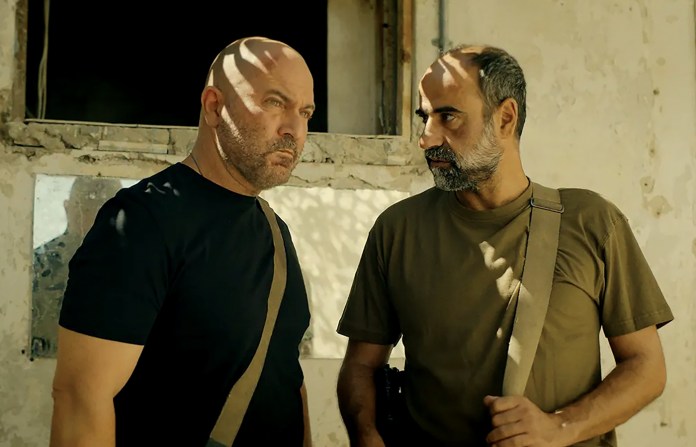
Lior Raz as Doron Kavillio and Yaakov Zada-Daniel as Eli in “Fauda.” (Courtesy of Netflix)
" data-large-file="https://www.washingtonexaminer.com/wp-content/uploads/2026/10/LA.TV_.100726.jpg?w=696" height="658" width="1024" src="https://www.washingtonexaminer.com/wp-content/uploads/2026/10/LA.TV_.100726.jpg?w=696" alt="Lior Raz as Doron Kavillio and Yaakov Zada-Daniel as Eli in "Fauda." (Courtesy of Netflix)" class="wp-image-4752826" style="width:921px;height:auto" srcset="https://www.washingtonexaminer.com/wp-content/uploads/2026/10/LA.TV_.100726.jpg 1400w, https://www.washingtonexaminer.com/wp-content/uploads/2026/10/LA.TV_.100726.jpg?resize=300,193 300w, https://www.washingtonexaminer.com/wp-content/uploads/2026/10/LA.TV_.100726.jpg?resize=768,494 768w, https://www.washingtonexaminer.com/wp-content/uploads/2026/10/LA.TV_.100726.jpg?resize=1024,658 1024w, https://www.washingtonexaminer.com/wp-content/uploads/2026/10/LA.TV_.100726.jpg?resize=150,96 150w, https://www.washingtonexaminer.com/wp-content/uploads/2026/10/LA.TV_.100726.jpg?resize=696,447 696w, https://www.washingtonexaminer.com/wp-content/uploads/2026/10/LA.TV_.100726.jpg?resize=1068,687 1068w" sizes="(max-width: 1024px) 100vw, 1024px">
Lior Raz as Doron Kavillio and Yaakov Zada-Daniel as Eli in “Fauda.” (Courtesy of Netflix)
Perhaps unsurprisingly, given their subject matter, season five’s “revenge” episodes are unshy in their politics, openly contemptuous of the self-loathing West’s embrace of Muslim migration and the Palestinian cause. Tracking their quarry to Marseille, France, for instance, our heroes are startled to find the terrorist Maher involved with a white girl. (Eli: “What’s wrong with these French women?” Doron: “Colonial guilt.”) A Marseillais policeman, happening upon yet another immigrant murder, says wistfully of his city, “One day it will be the Pearl of the Mediterranean again.”
Some American audiences will no doubt bristle at these “far-right” sentiments, even as they personally take steps to shield themselves from the consequences of Islamization. (One doesn’t see a lot of well-heeled liberals moving to Dearborn, Michigan.) What they are less likely to do, after making it through the Oct. 7 flashback episodes, is ever again downplay with any sincerity the events of that terrible day.
Fauda begins episodes 7 and 8 with trigger warnings announcing that the installments can be skipped without losing the plot’s main thread. In fact, the opposite is true: Bypass the rest of the season if you must, but consider the quasi-documentary couplet at its heart mandatory viewing. In those harrowing half-hours, mercifully among the season’s shortest entries, one glimpses not only the barbarism of the Palestinian assault but the sustained heroism of Israeli men and women. Most of these champions are Jews. Some are not. What they have in common is a determination to resist the fanatical Islamic death cult, quite literally knocking at the door.
I will give only a small sample of the episodes in question. A family locks itself inside a safe room amid the detritus of a child’s birthday party. A Palestinian gunman sneaks a bite of cake before smoking them out and dispatching them one by one. Jewish teenagers flee Arab militants, leaving behind corpses in their dozens. An Israeli kindergarten burns as men with Kalashnikovs stalk the grounds. “Slaughter the Zionists,” “Slaughter the Jews,” and “Allahu Akbar” ring out interchangeably, reminding us of the essential sameness of those pronouncements on Palestinian tongues. A frantic Doron must decide between rescuing Eli’s family and saving more of the teenagers mentioned above. Neither choice is sufficient. Even the installments’ straightforward battle scenes are anthropologically instructive: When one of their comrades falls, Israeli soldiers pause to help him, while Palestinians leave their casualties to die alone.
FUNNY AND SCARY, ‘WIDOW’S BAY’ IS A MUST-SEE
I have lived long enough to know that there is an element of propaganda in these portrayals. There is propaganda in most productions that take war as their subject. Nevertheless, it is difficult to watch Fauda’s latest season without grasping anew a fundamental moral and geopolitical reality. Israel is not America and may indeed hope to manipulate us, just as any nation tries to sway another. The Palestinians, by contrast, want to destroy the “infidels.” Today, that means the Jews. Tomorrow, it will mean Western civilization itself.
As a work of art, Fauda is undeniably moving — a worthy tribute to the victims of Oct. 7, to whom the season is dedicated “in loving memory.” If the show steels us against accepting their fate for others, it will have served a noble purpose.
Graham Hillard is the TV critic for the Washington Examiner magazine.
Continue reading...
[ H/T Washington Examiner ]
