





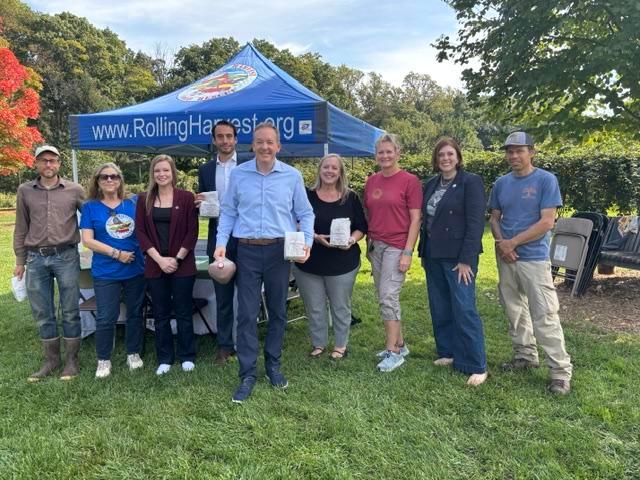
NEW HOPE, Pennsylvania — For 16 years, Rolling Harvest Food Rescue has collected fruits and vegetables that Bucks County farms cannot sell and delivered them to food pantries, senior centers, and community kitchens. On Oct. 2, Environmental Protection Agency Administrator Lee Zeldin visited one of its longtime partner farms, Solebury Orchards, to see how that system works.
Zeldin came to promote Feed It Onward, the agency’s national campaign to keep edible food out of landfills. He met with farmers and representatives of Rolling Harvest to discuss how surplus produce can reach people in need.
The goal, Zeldin said, is to make sure food “that would’ve otherwise been disposed of, sent to a landfill, is put to good use for children and families in need.”
Jamie McKnight, Rolling Harvest’s interim executive director, said she deliberately chose Solebury Orchards for the visit. She wanted the administrator to see how hard extreme weather can hit a small farm.
Feed It Onward launched publicly on Sept. 5, 2025, at Scott Air Force Base in southern Illinois. Frey Farms delivered about 40,000 pounds of watermelon, sweet corn, and pumpkins that large retailers had rejected for cosmetic reasons. Service members and their families claimed the produce within about 30 minutes.
Zeldin said some of the watermelon was not the right size or shape for grocery store shelves, “but it’s otherwise completely safe and healthy to eat.”
Since then, he said, the agency has held or participated in events in Kansas City, suburban Las Vegas, Los Angeles, Orlando, Alabama, and elsewhere. The Bucks County stop came during a week of visits that also included New Hampshire, Maine, South Carolina, Arizona, and New Mexico.
The agency estimates that more than one-third of the nation’s food goes uneaten and that food is the largest single category of material sent to U.S. landfills. What the agency has learned from its travels, Zeldin said, is that “there isn’t one size fits all model that communities use.”
Rolling Harvest’s model began with one pantry and one farm. Founder Cathy Snyder was working at a food pantry in 2010, McKnight said, and would stop at a farm stand for fresh produce on her way home. That prompted her to ask why the people who needed it most were not getting it.
Today, Rolling Harvest works with 52 farms and food producers and more than 80 hunger-relief sites, according to the organization. Its territory covers Bucks and Montgomery counties and, across the Delaware River, Mercer and Hunterdon counties in New Jersey. The group says it serves 40,000 people and has rescued 5.2 million pounds of produce since 2012.
Both Zeldin and McKnight described surplus as an inherent part of farming.
“Farmers often grow more of a crop than they believe will be needed,” Zeldin said. “They don’t want to be short on a crop. They certainly don’t want to see it end up inside of a landfill.”
McKnight put a number on it. Farmers generally plant about 25% more than they expect to need, she said, to guard against bad weather and shifting markets. Rolling Harvest gives them somewhere to send the extra.
“They call us, we come and get it,” she explained.
When a field holds more lettuce or broccoli than a farm can sell, the group sends volunteers to glean it, picking the remaining produce and taking it straight to pantries, senior centers, and community kitchens. McKnight said Rolling Harvest is the only gleaning organization in the Bucks County region.
The network reaches beyond individual farms. Rolling Harvest works with America’s Grow-a-Row and New Jersey Farmers Against Hunger, and in winter, it receives shipments from the FarmLink Project. When a full truckload is headed to the area, Rolling Harvest and New Jersey Farmers Against Hunger split it. In one case, McKnight said, that meant dividing 26 pallets.
“This whole sector, the charitable food sector, is just a bunch of partnerships all working together logistically and sharing resources to make it happen,” she said.
Zeldin said the local efforts he has seen range from “close to total vacuums of local leadership to robust networks.” He placed Bucks County among the better-organized communities but said he was struck by how young even the strongest networks are.
“I have not yet found a community where they’ve been combating food waste for 30, 40, 50 years,” he said.
McKnight, who has worked in the field for more than 15 years, agreed that food waste is an old problem.
“We’ve been speaking about it, but nobody’s listening,” she said.
Zeldin said that is where the agency comes in.
“Best practices, lessons learned are hyperlocal in nature,” he said. “It’s a story that too often goes untold, and EPA is seeking to help these local communities tell those stories.”
For McKnight, the hardest audience is not farmers. It is funders, many of whom, she said, are difficult to convince that food insecurity exists in Bucks County at all.
“People think that we’re such an affluent community, and there are pockets of Bucks County that are affluent,” said McKnight, who lives in Chalfont. “But there are so many pockets of poverty in Bucks County.”
Philabundance, the Philadelphia-based Feeding America food bank, serves nine counties in the region, including Bucks. Outside the city, however, McKnight said people often fail to recognize hunger in their communities. Rolling Harvest has chosen to stay focused on its own corner of the region.
“That’s what we’re good at,” she said.
Zeldin said finding people in need is rarely the hard part. In cities such as Los Angeles or Las Vegas, he said, enough recipients for a distribution serving 75 or 150 people can be found “in just a few square blocks.” He also pointed to schools as a way to provide children with “stigma-free opportunities” to get fresh food.
Zeldin tied Feed It Onward to the administration’s Make America Healthy Again agenda and the agency’s work with the U.S. Department of Agriculture, the Department of Health and Human Services, and the Food and Drug Administration. In March 2025, the Agriculture Department canceled two programs, Local Food for Schools and Local Food Purchase Assistance, that had provided about $1 billion for schools and food banks to buy from local farmers.
McKnight pointed to a state program that has made a concrete difference.
In 2020, during the pandemic, the Pennsylvania Department of Environmental Protection awarded the first round of its Food Recovery Infrastructure Grants, which pay for refrigeration, vehicles, and other equipment for hunger-relief groups. Rolling Harvest received $121,500 in that round. Across three rounds, in 2020, 2023, and 2026, the program has awarded nearly $18 million statewide.
“These infrastructure grants were like a godsend,” McKnight said. Most government grants, she said, are “like give your firstborn and it’s a hundred pages,” but the state’s application was “fairly simple.”
With the first grant, Rolling Harvest added an outdoor cooler that holds eight pallets, bought a refrigerated van, and repaired the lift gate on its box truck. The grant arrived when farms and distributors were offering pallets of food they had nowhere to send. State records show two later grants to the group: $49,405 in 2023 and $9,258 announced in January. McKnight said those grants paid for a second cooler at a partner farm and a smaller CoolBot cooling unit at another.
“If you don’t have the right capacity to store fresh produce, then you can’t do this,” she said.
THE NIGHT LINDEN AVENUE STOPPED FEELING SAFE
McKnight said arranging the visit took some persuading. Farmers are often reluctant to bring outsiders onto their land, she said, so she asked Snyder, who has the closest relationship with farmer Brian Smith, to make the call.
“It’s turned out really well,” McKnight said. She added that Rolling Harvest looks forward to working with Feed It Onward and seeing where the partnership leads.
Continue reading...
[ H/T Washington Examiner ]