


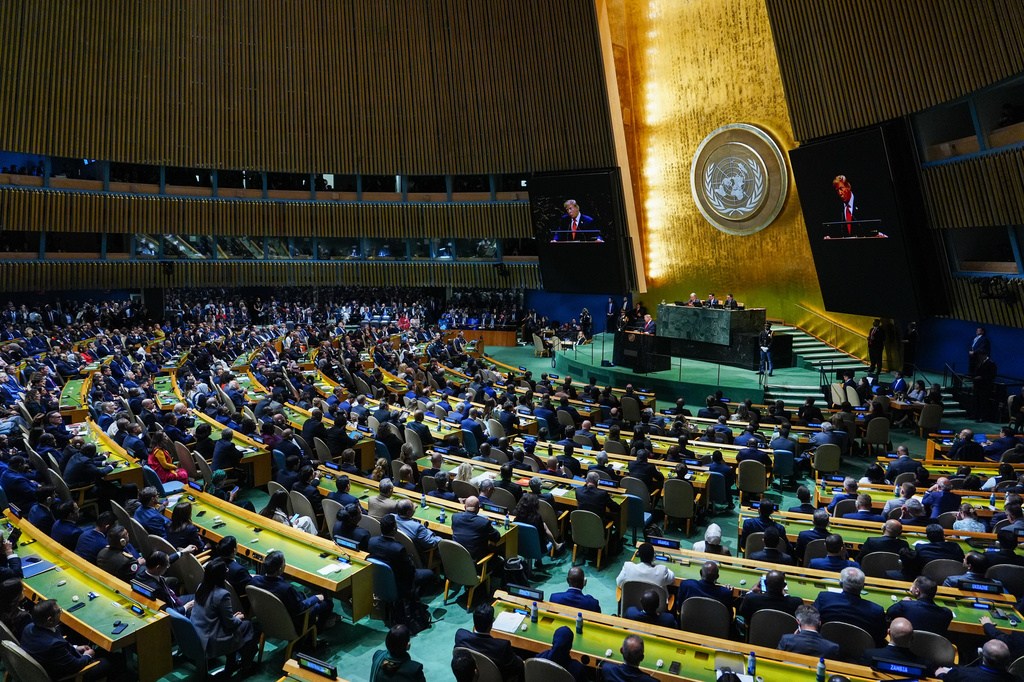
For too long, United Nations secretaries-general have preferred to virtue-signal and jet-set around the globe rather than manage their organization. Current U.N. chief Antonio Guterres has taken about 190 official trips spanning nearly 900 days — the figure would be even higher without a dip during the COVID-19 pandemic. Pair each of these trips with prep time, then throw in annual leave, and the fact is that the former Portuguese politician treated New York City as little more than a pied-à-terre; something for which ordinary New Yorkers would pay a $50,000 tax.
Several names have emerged to replace Guterres. Rumor has it former Hungarian Prime Minister Viktor Orban could throw his hat in the ring, and might even garner American, Russian, and Chinese support. There is talk that Kassym-Jomart Tokayev, Kazakhstan’s president and a former director-general of the U.N. Office at Geneva, could also be a compromise candidate. Lana Nusseibeh, a prominent Emirati diplomat, garners excitement; she speaks Arabic, English, and Hebrew and comes from a prominent Palestinian family.
Turkish President Recep Tayyip Erdogan has been pushing hard for his former interim Foreign Minister, Feridun Sinirlioglu. He believes he can overcome a French pocket veto. Sinirlioglu is elderly, though, and has been both low-energy and generally unimpressive as secretary-general of the U.N.’s Organization for Security and Cooperation in Europe. He also endorsed Erdogan’s embrace of Hamas and other extremist causes and refused to speak up against the Turkish president’s massive corruption.
Regardless, none of these candidates will succeed if they do not take an axe to the heart of U.N. corruption and the cynical hijacking of its founding ideology to the advantage of autocrats and terrorists.
The U.N. does certain things well. It provides a forum where all countries can engage. While some U.N. peacekeeping missions are cost-effective and successful — think Liberia, Sierra Leone, and Ivory Coast — most have morphed into expensive vacations and shopping trips on the American dime. Others exacerbate conflict as, like the Irish contingent in Lebanon, they willingly shield terrorists.
The two institutions that most soil the U.N.’s reputation and have no reason to exist are the United Nations Relief and Works Agency and the U.N. Human Rights Council.
UNRWA’s own internal documents recommended ending operations more than 70 years ago. Rather than resolve a refugee crisis, it perpetuates it. By the definition used everywhere else in the world, no Palestinians living in the West Bank or Gaza are refugees. While the U.N. High Commissioner for Refugees aims to reduce the world’s refugee numbers by 50% by 2035, UNRWA keeps adding people to the dole. If the world applied the UNRWA definition of refugee to the partition of India, there would be more than 300 million refugees in South Asia. It’s time for tough love for both the Palestinians and their Arab state backers.
Most Arab states are freeloaders on the refugee system, under-donating to the U.N. High Commissioner for Refugees and refusing to absorb Arab refugees from myriad Middle Eastern civil wars. There is no reason why Italy, Germany, and the United Kingdom should pick up Saudi Arabia’s slack. To debate how many Hamas members infiltrated the group misses the point — any is too much.
PROTESTERS AT BORDER WALL GET FRIENDLY PROFILE FROM CHINA-LINKED OUTLET
The Human Rights Council has become a farce. First, like the U.N. University and the U.N. ’s Tourism agency, it provides no functions that dozens of other groups do not. Worse, it has become a swamp of moral inversion that discredits serious human rights advocacy and allows autocrats from North Korea, Russia, Iran, Turkey, and Eritrea to launder their image while they enslave, murder, and rape.
The White House and State Department are right to reject business as usual. They should now throw down the gauntlet and make eliminating UNRWA and the Human Rights Council the prerequisite for any support.
Michael Rubin is director of policy analysis at the Middle East Forum, a distinguished fellow at India’s Usanas Foundation, and a contributor to Beltway Confidential.
Continue reading...
[ H/T Washington Examiner ]