

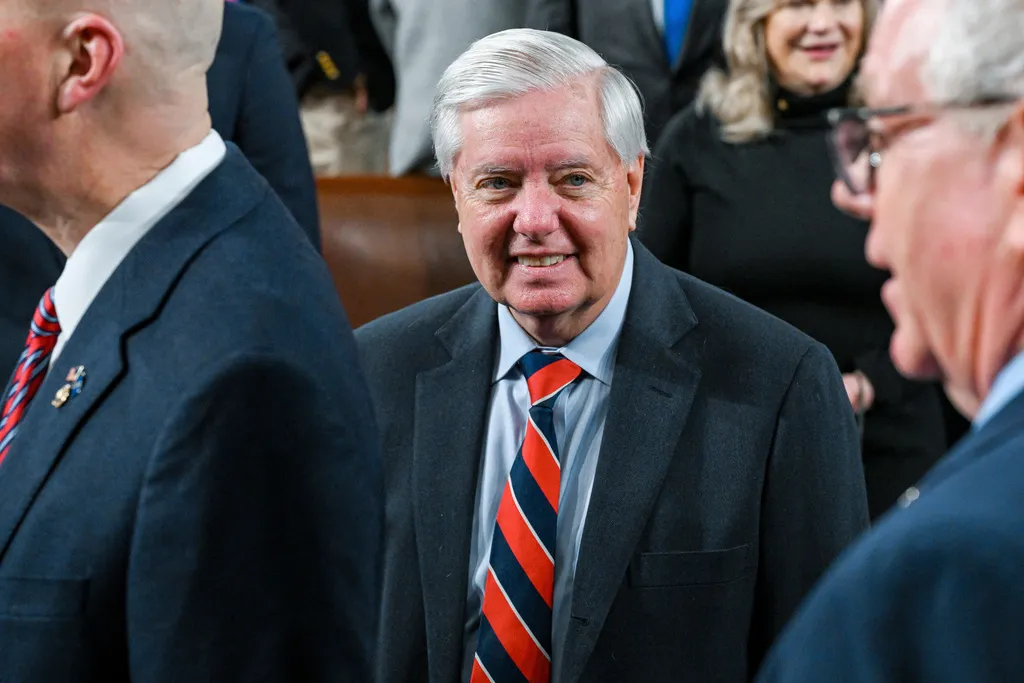
A top official in the Justice Department is warning Democratic lawmakers that their recent oversight threats may not be fully shielded from criminal subpoenas, pointing to a Supreme Court dispute involving the late Sen. Lindsey Graham.
Acting Deputy Attorney General Trent McCotter noted on Sunday that Graham was “criminally subpoenaed for investigating the 2020 election in advance of his formal vote on certification,” highlighting an October 2022 ruling from the 11th U.S. Circuit Court of Appeals.
The decision, issued by Judges Charles Wilson, Kevin Newsom, and Britt Grant, emphasized that constitutional protections for lawmakers do not extend to every activity that relates to their purported legislative business, citing Supreme Court precedent excluding conduct such as “cajoling” executive officials. McCotter cited that language as “being relevant to recent events.”
The deputy attorney general’s comment comes as the DOJ escalates warnings to incoming Democratic committee leaders, including in a new letter from a federal prosecutor in Texas accusing Sen. Elizabeth Warren (D-MA) of preparing to weaponize congressional investigations against President Donald Trump’s political allies.
Harvard Law School professor emeritus Alan Dershowitz told the Washington Examiner this week that McCotter’s invocation of the Graham case could be interpreted as a deliberate warning to Democrats, raising the prospect of a constitutional confrontation between Congress and the executive branch.
“I think they really do want to send a warning shot,” Dershowitz said when asked about the Trump DOJ official’s comment. “This could really be a major war.”
Lindsey Graham precedent resurfaces
Graham, who died in July at age 71, fought the subpoena after Fulton County District Attorney Fani Willis sought to question him about his inquiries to Georgia election officials following the 2020 election. He maintained that his conversations were legitimate legislative fact-finding ahead of Congress’s certification of the presidential election results.
Although the courts recognized a carve-out to protections for legitimate legislative inquiries, Graham’s primary argument did not work out entirely in his favor, resulting in courts rejecting his claim of blanket immunity from the subpoena. The Supreme Court ultimately declined to block his testimony, allowing prosecutors to question him about nonlegislative activities.
McCotter, notably, represented a George Mason University law school clinic that filed a Supreme Court brief supporting Graham’s effort to block the subpoena at the time.
DOJ warnings test the limits of oversight
The precedent surrounding Graham’s case has gained renewed attention as Aaron Reitz, U.S. attorney for the Southern District of Texas, has operated in an unusual fashion, sending document-preservation demands to Democratic lawmakers, including Warren and Sens. Richard Blumenthal (D-CT) and Elissa Slotkin (D-MI).
In a Sunday letter to Warren, Reitz accused her of preparing to target private individuals because of their associations with Trump, citing her promises to investigate corporate leaders and fundraising connected to the president.
The administration’s argument centers on the Supreme Court’s requirement that congressional subpoenas serve a “valid legislative purpose,” a limitation reaffirmed in its 2020 Trump v. Mazars decision.
Hans von Spakovsky, a conservative legal scholar and former Justice Department attorney, told the Washington Examiner that Democrats’ public statements about their planned investigations could become evidence in future court disputes over subpoenas.
“I think that would be primary evidence that, for example, a targeted official would use to convince the court they shouldn’t enforce a subpoena,” von Spakovsky said, referring to statements suggesting an intent to harass or intimidate administration officials.
He pointed to the Supreme Court’s 1957 decision in Watkins v. United States, which overturned a contempt conviction stemming from the House Un-American Activities Committee’s questioning of a witness about his past political associations.
The court recognized limits on congressional investigations intended primarily to expose private individuals without a valid legislative purpose, a precedent von Spakovsky said could help Trump officials.
“There is no real standard test that has been set to try to figure this out,” he said.
Dershowitz, however, questioned how meaningful the distinction between legitimate oversight and partisan investigations would be in practice.
“It’s a fake distinction,” Dershowitz said, arguing that Congress can generally identify a legislative justification even when its underlying motivations are political.
“The courts are selective in when they’ll look at motive,” he added. “They’ll more likely look at motive when it deals with race and gender than when it deals with politics.”
Conservative attorney Jesse Binnall offered a more aggressive assessment, arguing that prosecutors could pursue cases against lawmakers despite anticipated constitutional defenses.
“Speech and debate immunity is very limited,” Binnall wrote on X, suggesting that if Reitz’s Texas office pursued a viable criminal case, the resulting litigation could eventually test congressional immunity before the 5th U.S. Circuit Court of Appeals, a court that has been greatly shaped by appointees of Republican presidents.
White House tightens control over congressional testimony
The legal warnings have also been reinforced by White House counsel Will Scharf, who said on Fox News Sunday that Democrats would face a “vigorous response” if they sought to intimidate administration personnel.
Scharf singled out incoming House oversight committee Chairman Robert Garcia (D-CA), who recently joked that “pettiness is a thing” when discussing his motivations for investigating the administration.
“Pettiness is not a valid purpose to conduct oversight under our Constitution and under our laws,” Scharf said.
The White House on Monday took another step toward controlling its response to congressional investigators, issuing a new memorandum requiring federal agencies to obtain approval from both the White House counsel’s office and Office of Legislative Affairs before employees agree to testify before congressional committees.
The administration maintained that it would cooperate with what it deems as “reasonable” oversight requests, while the directive said “further guidance regarding other engagements with Congress is forthcoming.”
Democrats have rejected the administration’s warnings as intimidation, maintaining that their investigations will focus on alleged corruption and misconduct.
Could Democrats revive contempt powers?
Dershowitz suggested lawmakers could respond to administration resistance by reviving Congress’s rarely-used power of inherent contempt, potentially allowing the House or Senate to detain officials who refuse to comply with lawful congressional demands without relying on DOJ prosecutions.
He called the mechanism a “nuclear alternative,” noting that Congress has not used the power in roughly nine decades. The Congressional Research Service identifies 1935 as the last time Congress exercised its inherent contempt authority.
“I can see that as at least a threat to the Justice Department, saying you’re not in total control here,” Dershowitz said.
But he also agreed with the more likely result that Democrats could preserve contempt findings for possible prosecution under a future administration, although any such cases would face applicable limits, such as the five-year statute of limitations. Two recent cases point to that trajectory: the contempt of Congress convictions of Steve Bannon and Peter Navarro, two first-term Trump advisers who avoided compliance with subpoenas by the former Jan. 6 committee and ended up behind bars.
Von Spakovsky suggested Trump could preempt that possibility by issuing broad pardons to administration personnel before leaving office, following a precedent established by former President Joe Biden.
“I have no doubt that before he leaves office, Donald Trump will follow the precedent set by Joe Biden,” von Spakovsky said.
On his final day in office in January 2025, Biden issued preemptive pardons to former Joint Chiefs of Staff Chairman Mark Milley, former White House medical adviser Anthony Fauci, and members and staff of the House Jan. 6 committee. He separately pardoned several family members, citing concerns about politically motivated investigations.
WHITE HOUSE TIGHTENS GRIP ON AGENCY TESTIMONY AHEAD OF DEMOCRATIC INVESTIGATIONS
Von Spakovsky warned that Democrats’ continued escalation of oversight threats could perpetuate cycles of political retaliation regardless of which party controls Washington, and that such efforts could lead to Supreme Court intervention that could rein in Congress’s oversight abilities for both sides of the aisle.
“Unless the Supreme Court steps in and tries to put a stop to it from a constitutional standpoint, it’s just going to get worse,” he said.
Continue reading...
[ H/T Washington Examiner ]