






Democrats are almost giddy a month before the Nov. 3 elections as polls and prediction markets capture them being on the precipice of controlling Congress, but some are warning the party to pump the brakes, as a premature victory lap could depress turnout in key races and limit victories.
With four weeks until the midterm elections, Democrats are trying to walk a fine line between confidence and ensuring their voters do not become complacent, with some reminding the party that polling have been historically bad in the Trump era.
Democratic strategist Andrew Bates advised members of his party that it is “a dangerous mistake to count November chickens in October.”
“Polls have had a bad decade and a worse 2026,” Bates, the former Biden White House aide, told the Washington Examiner. “And Republicans have far more money behind them. So while candidates like Roy Cooper are running strong campaigns, it’s critical for volunteers and donors to play like we’re 20 points down.”
Another Democratic strategist granted anonymity agreed that the polling and prediction markets are “definitely driving a little too much optimism among the very tuned-in class of [Democrats] that are really bullish and excited.”
That source, however, added that that data should have less of an effect on “less tuned-in voters” who tend to decide elections.
“These types of folks are really not the same people that are tracking the polls, but I think it’s really important that every campaign and every donor doesn’t think we’re all set here because there’s a lot that can change in the last month,” the person said. “It’s really important that nobody thinks that we have it in the bag because we don’t. I mean there’s some positive stuff, but it’s certainly all within the margin of error.”
Democratic strategist Mary Anne Marsh agreed, too, that “polling tells you what’s possible,” but “you still have to make the calls, do the doors, and get people to Election Day.”
“You never want to take anything for granted,” Marsh told the Washington Examiner.
Election prognosticators have repeatedly reported that Democrats have the advantage in, for example, North Carolina and Georgia’s Senate races, with the Senate Leadership Fund, a Republican super PAC, last week pausing its ad campaign for North Carolina GOP nominee Michael Whatley.
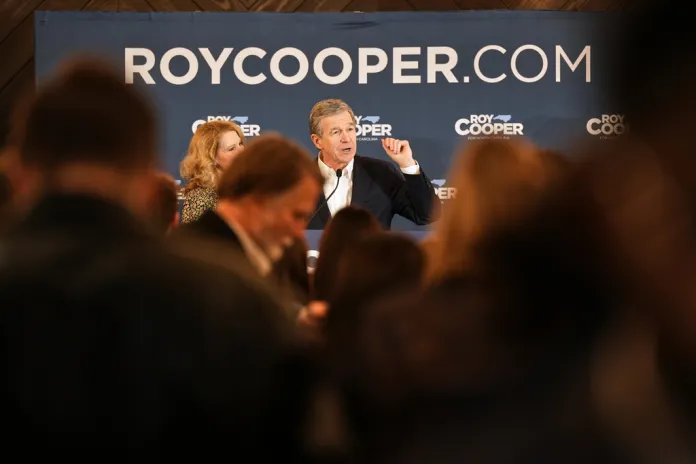
Some campaigns aren’t slowing down, though. Jeff Allen, the campaign manager for North Carolina Democratic Senate nominee Roy Cooper, reiterated that “a Democrat has not won statewide federal office here in nearly two decades.”
“We’re building a campaign to earn every vote and make sure North Carolinians know that Roy Cooper will fight for them, while Michael Whatley will continue to enrich himself at their expense,” Allen told the Washington Examiner.
A spokesperson for Sen. Jon Ossoff (D-GA) told the Washington Examiner Georgia is a battleground state and that the Ossoff campaign is “laser-focused on reaching every Georgian possible to earn their vote between now and Election Day.”
Still, Democrats seem to be in the driver’s seat. The party has an average 8-point lead in generic congressional ballot polling, according to RealClearPolitics.
That is in addition to Polymarket, for instance, recording a 93% chance that Democrats take the House and a 66% chance they take the Senate as of Monday.
The polling and prediction markets have created complications for the campaigns because, in the words of Democratic strategist Stefan Hankin, “you don’t want giddy,” nor do you want to say “the sky is falling” if it is not.
“You have to balance it,” Hankin told the Washington Examiner. “There’s not just the short-term problem, but there’s also long-term credibility.”
But Democratic strategist Matthew Corridoni was less concerned about the expectations game, contending voters prefer to “feel like they’re on a winning team.”
“For [the] other side, [it] could suppress their vote: people feeling defeated,” Corridoni told the Washington Examiner.
Other Democrats, like pollster Celinda Lake, disputed the notion that the era of good feelings for Democrats would harm them at the polls, given their dissatisfaction with President Donald Trump.
“Good polling and the sense Democrats can win helps boost turnout,” Lake told the Washington Examiner.
Democratic strategist Garry South was similarly unconcerned because Democrats are “mad as hell, and aren’t going to take it anymore.”
“Remember Trump’s exhortation to pretend he’s on the ballot?” South asked the Washington Examiner. “It’ll be Democrats acting on that, not Republicans.”
Republican National Committee press secretary Natalie Baldassarre countered that “whether it’s complacency or a lack of excitement to vote for far-left extremists, Democrats are already hedging their losses.”
“Republicans are united, on offense, and are hammering the campaign trail over the next 30 days to lay out the stakes and drive our voters to the polls,” Baldassarre told the Washington Examiner.
TRUMP’S ADMISSION OF A ‘PUBLIC RELATIONS’ PROBLEM TESTS CLAIM HE’S HIS OWN BEST MESSENGER
But Democratic National Committee deputy press secretary Nina Raneses remained adamant that “Democrats are confident but not complacent.”
“With less than a month until Election Day, we’re expanding the map and organizing everywhere to reach voters and win elections all across the country,” Raneses told the Washington Examiner.
Continue reading...
[ H/T Washington Examiner ]

