






The Washington, D.C., City Council has a new plan to tackle the city’s persistent rat problem, and it comes with a distinctly rodent-themed name.
The council recently passed the “Ratnibus,” a package combining two measures designed to curb the district’s rodent population. One of the bills, the Rodent Education and Management Yields Results Amendment Act, is known as REMY, a nod to the rodent chef in the 2007 animated film Ratatouille.
The legislation calls for better trash containers, expanded public education, and tighter restrictions on certain rat poisons, reflecting an effort to address the conditions that allow rodents to thrive rather than relying primarily on extermination.
But Holly Gerberich, an anthropozoologist who co-leads the DC Rat Ranger walks, said the city’s efforts will only go so far if residents continue providing rats with easy access to food.
“It’s also we who sustain them,” Gerberich told the Washington Examiner. “When I think about rats and rodent control, it’s really about responsibilities on both sides and how they interact.”
Anthropozoology examines the relationship between humans and animals. In Gerberich’s work, that means looking beyond rats as a nuisance and studying how human behavior creates the conditions for urban rat populations to flourish.
The district ranked seventh on pest control company Terminix’s 2026 list of the 50 U.S. cities with the most rodent-related service activity, which was based on customer demand in 2025. New York City, Los Angeles, Philadelphia, San Francisco, Houston, and Chicago occupied the other top six spots.
A separate study led by a University of Richmond researcher found that rat numbers increased significantly in 11 of 16 cities examined, including Washington. The researchers linked rising rat numbers to factors including warming temperatures, urbanization, and human population density.
Gerberich said overflowing dumpsters, poorly maintained trash containers, and inconsistent garbage collection are among the biggest contributors to the district’s problem.
Household trash cans, known as toters, are particularly vulnerable because rats can chew through the plastic to reach food waste. Older public trash cans also provide easy access to rodents.
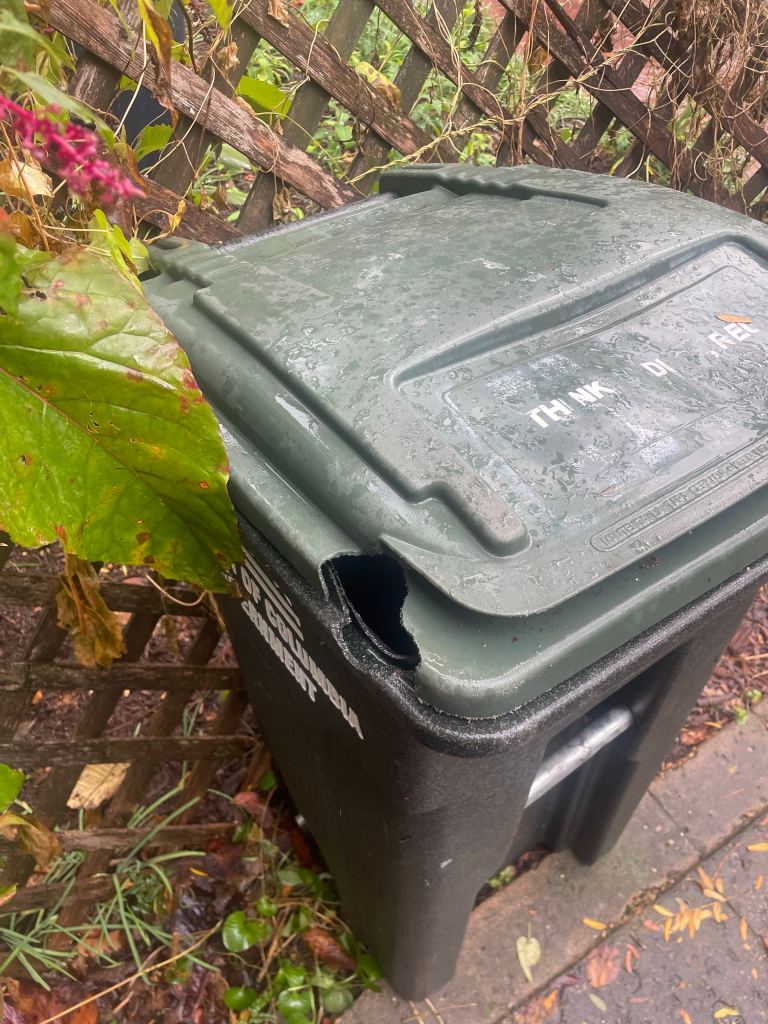
Washington, D.C., trash can that was damaged by rats. (Rena Rowe/Washington Examiner)
“I’ve seen quite a few of them with holes in them,” she said, adding that researchers and municipal officials have struggled to find a truly rat-proof household trash container.
The problem is not limited to residents leaving garbage out. Gerberich said commercial establishments and apartment buildings often have overflowing dumpsters, sometimes because private waste haulers do not collect trash regularly.
One of her recommendations is surprisingly simple: wait until the morning of garbage collection to put trash outside, rather than leaving it out overnight.
“The longer I spend in alleys, the more I realize that they know our schedules,” she said. “They know when it’s trash night and when the food is going into cans the night before.”
Gerberich also recommends keeping food waste out of regular garbage through composting, using metal trash cans that rats cannot chew through, and storing household trash in secure enclosures until pickup.
The new legislation seeks to address some of those problems. It creates grant programs to help businesses and commercial corridors purchase rodent-resistant waste containers and trash compactors, directs the Department of Health to expand public education, and establishes a system to track rat activity, treatments, and abatement requests.
It also restricts the use of certain anticoagulant rodenticides to certified pest control operators, an effort supporters say will reduce the risk of poisoning pets and wildlife.
The legislation comes amid growing concern about the unintended consequences of rat poison. A report from the coalition DC Responsible Rat Management documented more than 100 reports of suspected rodenticide poisoning across the district, including more than 20 reports involving pets. Poison can also pass through the food chain when predators eat poisoned rodents.
Gerberich said the district needs a more coordinated approach among the many agencies involved in sanitation, building inspections, waste collection, and rodent control.
“Almost every agency probably has a role in rodent control,” she said.
The district is also exploring alternatives to traditional extermination. Over the summer, Health Director Ayanna Bennett announced plans to use birth control and lethal bait in Adams Morgan, a neighborhood identified as a rat hot spot.
“We’re going to get the rat population down, and then we’re going to come back in three weeks to see if any of those babies survived and get them too,” Bennett said, while warning residents against leaving food and trash outside. New York and Chicago have also rolled out similar “rat birth control” initiatives.
Gerberich said fertility control is an interesting area of research, but she cautioned that there are not yet scientifically proven products she would feel comfortable recommending. A separate neighborhood birth-control project in Kingman Park has also been suspended.
Through the Rat Ranger program, Gerberich and former D.C. Health rodent-control program manager Gerard Brown led residents and local officials on educational walks through alleys to examine rat activity and identify human practices that attract rodents.
The goal, she said, is not to teach people how to kill rats but to explain their ecology and how communities can prevent infestations in the first place.
TRUMP OPEN TO HUANG BEING REINSTATED AT NVIDIA: ‘THAT CERTAINLY ISN’T A BAD IDEA’
Gerberich said she hopes eventually to conduct a study examining whether intensive sanitation and changes in residents’ behavior can reduce rat populations more effectively than a heavy reliance on poison.
For now, she said, the district’s best chance of getting ahead of its rat problem may start with something less complicated than a new extermination strategy: keeping the garbage out of reach.
Continue reading...
[ H/T Washington Examiner ]