








WHAT’S HAPPENING TODAY: Good afternoon and happy Friday, readers! Members of the House began to flee D.C. for their summer recess yesterday, but the upper chamber is still working. The Senate won’t be breaking for two more weeks, and there’s a lot to get done. Could we see text on permitting? Movement on the Fix Our Forests Act? Stick with us to find out.
 The White House is hosting an event celebrating the administration’s efforts to bolster the nuclear energy industry and develop advanced reactors. We’ll be tuning in!
 All-of-the-above energy has truly been on display in Texas, as the Lone Star State’s grid saw record-breaking demand during an extreme heat wave. Keep reading to find out how renewables propped up the state’s grid.
Welcome to Daily on Energy, written by Washington Examiner energy and environment writers Callie Patteson (@CalliePatteson) and Maydeen Merino (@MaydeenMerino). Email cpatteson@washingtonexaminer dot com or mmerino@washingtonexaminer dot com for tips, suggestions, calendar items, and anything else. If a friend sent this to you and you’d like to sign up, click here. If signing up doesn’t work, shoot us an email, and we’ll add you to our list.
QUOTE OF THE WEEK:
Democrat Gov. Kathy Hochul of New York earlier this week explained her decision to impose a one-year statewide ban on data centers amid growing criticism from Republicans.
“[T]o those who think that by rejecting data centers for the year while we’re doing this thoughtful process means we’re rejecting innovation, that’s just a false, false narrative,” Hochul told NBC News.
“You don’t have to have the data centers here to be successful, but that doesn’t mean we won’t welcome them at the right time and place under really different conditions than exist right now,” she added. “So we’re just being thoughtful about this. And people are happy we’re doing this.”
TRUMP TO CELEBRATE NUCLEAR ENERGY AGENDA:
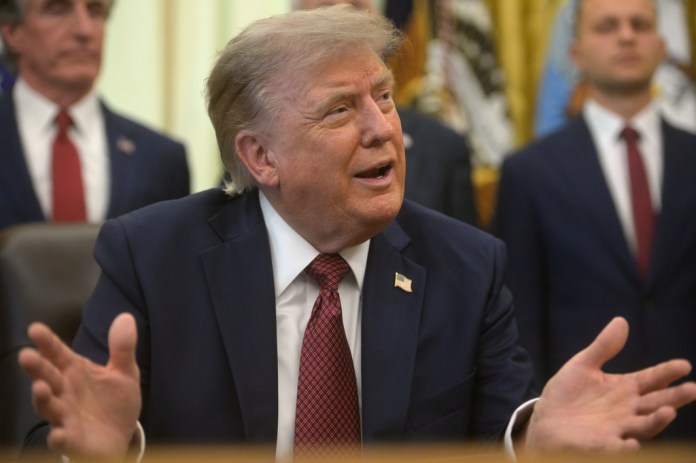
President Donald Trump is hosting an event at the White House celebrating efforts to develop and deploy new nuclear energy, as the administration races to secure enough energy to power its race for artificial intelligence.
A White House official confirmed to Daily on Energy this morning that Trump would be hosting several nuclear energy company executives to celebrate “the historic accomplishment of the President’s four executive orders to advance nuclear energy.”
Antares Nuclear CEO Jordan Bramble, Deployable Energy CEO Bobby Gallagher, Aalo Atomics CEO Matt Loszak, and Valar Atomics CEO Isaiah Taylor were all expected to be in attendance. The event was scheduled to start at 3 p.m. EDT.
Quick reminder: In May 2025, Trump signed four executive orders that called for overhauling and simplifying the regulatory processes for approving new nuclear energy projects, facilitating the construction of 10 large new reactors, while also boosting domestic mining and enrichment of uranium, to reduce reliance on foreign nations such as China and Russia.
Developing new reactors: One of the orders also set an ambitious target of having at least three new advanced small nuclear reactors hit “criticality” by the Fourth of July this year.
Reaching criticality means a reactor is perfectly stable and its nuclear chain reaction is self-sustaining. This means the atoms splitting in the core of the nuclear reactor are able to produce enough neutrons to continue sustaining additional reactions that produce energy.
Four reactors developed by Antares, Deployable, Aalo, and Valar hit the deadline, with Aalo’s reaching criticality in the early hours of the 4th of July.
Some background: Republicans and Democrats have been turning to nuclear power as a source of power crucial to meet soaring energy demands driven by AI and manufacturing, as to not sacrifice energy reliability or efforts to decarbonize.
While the Biden administration took some action to build out new nuclear energy – cutting regulatory fees, approving subsidies for existing facilities, and allocating federal funds to restart the decommissioned Palisades Nuclear Plant in Michigan – Trump took it a step further last year with the four executive orders. He also called for the U.S. to quadruple its nuclear energy capacity by 2050.
“President Trump has done more than any other president in history to advance civilian nuclear energy development, innovation, and technology,” White House spokeswoman Taylor Rogers told Daily on Energy.
Stay tuned for Callie’s coverage on this afternoon’s event.
TEXAS GRID LEANS ON DIVERSE ENERGY MIX:
Texas’s energy grid faced record-breaking demand this week amid an extreme heat wave but remained strong due to a diverse mix of power generation, including renewables.
Texas’ power demand went beyond 91 gigawatts on Wednesday, breaking the previous record of 85.5 GW in August 2023. Texas, which is known for its oil and gas industry, was able to maintain peak demand by using a mix of power that included solar and battery storage.
Energy analyst Doug Lewin said on X that, as the sun set, batteries discharged over 10 GW of power. He noted that, the day before, solar reached record generation of 34.6 GW, allowing the grid to fulfill demand.
Solar Energy Industries Association Texas director Daniel Giese said in a statement that, since 2021, the state has added 46 GW of solar and now has over 26 GW-hours of grid-scale battery storage.
“Texas exemplifies how market-driven solar and storage growth contributes to grid security, economic prosperity, and energy affordability,” Giese said.
Gov. Greg Abbott of Texas touted the state’s power grid for being able to sustain the record-breaking demand, saying that the state has “never been stronger,” adding that it had an extra 20 GW of power, enough to power about 4 million homes.
However, University of Houston energy fellow Ed Hirs told Maydeen that the real challenge would come during the winter, because the state lacks sufficient battery storage and dispatchable power plants.
“The battery fleet is now 21 gigawatts. That’s a short-term battery. A long, hard, cold night with freezing precipitation, like we had in 2021 … there will be rolling blackouts again,” Hirs said.
In response to Abbott’s claim that the grid is fixed, Hirs said “it is fixed like a horse race.”
Hirs said that, despite the number of power plants that have been weatherized, there are still not enough to meet demand. He said solar and wind have been carrying the energy growth in the state, which has “blossomed incredibly over the last three years.”
All the rest
AMERICANS THINK GAS PRICES ARE HIGHER THAN THEY ACTUALLY ARE: A new poll released by Politico found that three in five Americans believe gas prices have risen higher than they actually have, signalling that Republicans may have a more difficult job than they realize to keep the majority during the midterm elections.
With Republicans in control of Congress and the White House, voters may be quick to blame the GOP for soaring prices at the pump – especially if they think their wallets have been hit harder. At least 46% of Americans polled said the change in gas prices will impact how they vote.
The new polling found that one in four Americans said gasoline in their area had risen by $3 or more. However, not a single zip code analyzed by Politico had seen that dramatic increase in price on average since Trump took office.
In early July, gasoline was on average $0.67 higher per gallon compared to the day before Trump took office. In some areas, gasoline had risen by $1.35 a gallon.
Where are prices now? As of today, the average price of gasoline was $4.105 a gallon. Diesel was well over $5, selling at an average price of $5.24 a gallon.
OIL AND RIG COUNT DIP SLIGHTLY: Market analysts are taking a more optimistic view over the hike in oil prices seen this week, saying the jump is likely to be short-lived.
Despite the escalation in the Red Sea, oil prices began to see some relief this afternoon. It could be a sign that the markets are hopeful that the renewed fighting will bring Iran and the U.S. to the negotiating table once again. Reuters also reported that Pakistan is considering a pathway to restoring peace talks between the two governments.
Around 2:30 p.m. EDT, Brent crude was down 3.96% and was priced at $96.70 a barrel. West Texas Intermediate also dipped 3.30%, selling at $89.15 a barrel.
Rig count also slips: For the first time in more than a month, the number of active oil and gas drilling rigs fell in the U.S. Data released by Baker Hughes this afternoon found that the rig count dropped by just one this past week, bringing the total to 587.
While technically down for the week, the total number of active rigs is still 45 more than the amount active this time last year.
Broken down further, the number of rigs located on land or in inland waters remain unchanged. The number of offshore rigs fell by one. Baker Hughes also found that the number of oil rigs fell by two, while the number of gas rigs increased by one.
BP PREPARES TO SHED SOLAR BUSINESS: British oil major BP is reportedly in discussions about selling its solar power business Lightsource to a group backed by Kuwait’s sovereign wealth fund.
It is the latest move from BP to shed its investments in renewable energy alternatives and shift its focus back to oil and gas production.
Several people familiar with the matter confirmed the deal to the Financial Times, saying BP is considering selling Lightsource to the green private equity firm Qualitas Energy and Kuwait’s Wren House. The deal would help BP offload billions of dollars in debt attached to its solar arm.
The deal is not expected to result in a big payout for BP, and the transaction has yet to be finalized.
JPMORGAN WARNS THAT SUPER EL NINO COULD RAISE INFLATION: The super El Niño weather pattern, along with high energy prices, could add 0.3% percentage points to global inflation next year, according to JPMorgan economists, Reuters reports.
JPMorgan said that the super El Niño would raise global food inflation by about 0.7 percentage points at its peak. But the Iran war, which has raised fuel costs, could make global food inflation jump to 1.3 to 1.5 percentage points.
Countries like India, Indonesia, Brazil, and Colombia are particularly vulnerable to the food-price shocks, it noted.
ICYMI – STATES SUE FEMA OVER WITHHOLDING FUNDS: Nearly 25 states sued the Federal Emergency Management Agency and Department of Homeland Security for withholding hundreds of millions of dollars in disaster-preparedness grants.
The lawsuit filed yesterday by Rhode Island argued that the administration required states to change the way they conduct elections and assist DHS in enforcing immigration law. The states argued that placing conditions to receive appropriated funding violates the Administrative Procedure Act and the Constitution’s spending clause.
Rhode Island Attorney General Peter Neronha said, “[C]ongress allocated these funds to the states for preparing for and responding to emergencies including counterterrorism and natural disasters, and the executive branch has no legal say in the matter.”
“Federal emergency funding cannot and will not be held hostage from states who are lawfully resisting the President’s illegal attempts to force them into compliance. We’ll make sure of it,” he continued.
RUNDOWN
Politico Fusion is Ready. Is Trump’s Washington?
Canary Media Solar is having its best summer yet in Europe
Associated Press Brazil uses forensic science to trace gold’s origin and tackle illegal mining in the Amazon
Continue reading...
[ H/T Washington Examiner ]