


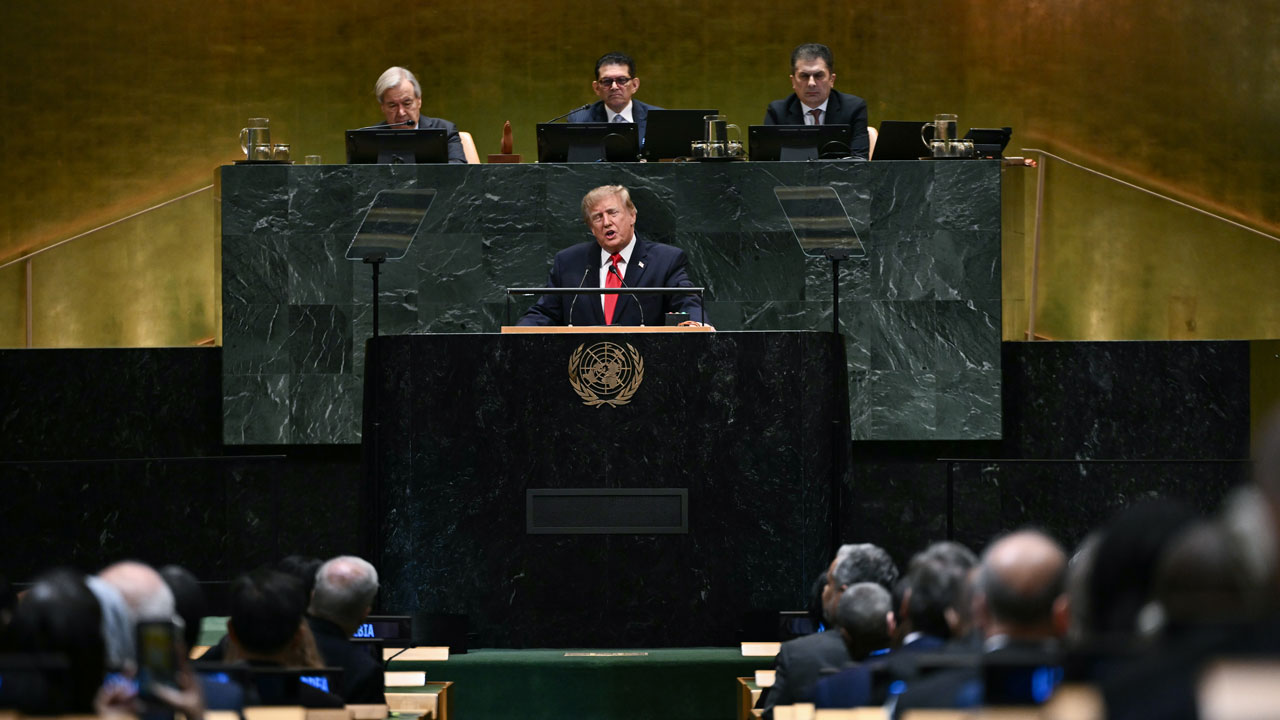
As world leaders gather in New York City this week for the opening of the U.N. General Assembly, over forty countries—representing some 2 billion people worldwide—have pledged their support to the Geneva Consensus Declaration in defense of life, family, and national sovereignty.
Launched in 2020 under U.S. leadership, the Geneva Consensus Declaration brought together nations committed to supporting women’s health, protecting the family, affirming the dignity of every human life, and preserving the sovereign right of countries to make their own laws regulating abortion.
Today, that mission is more important than ever.
Contrary to the claims of activists and bureaucrats, abortion is not a human right under international law. Abortion advocates have spent decades attempting to create such a right through increasingly expansive interpretations of existing treaties, nonbinding U.N. resolutions, and the recommendations of U.N. experts and treaty-monitoring bodies. Yet repetition does not create law, especially in the absence of consensus.
Nevertheless, efforts to normalize and institutionalize abortion as an international right continue across the U.N. system.
Debates routinely center on the phrase “sexual and reproductive health and rights,” a term that U.N. agencies and advocacy groups use to advance abortion policy while avoiding direct reference to abortion itself. These negotiations are often presented as discussions about women’s equality, but too often they become vehicles for promoting ideological agendas that many nations reject.
This is why the Geneva Consensus Declaration matters. The document provides a framework for cooperation among countries that reject the notion that international bureaucracies should dictate abortion policy to sovereign nations. It creates a platform through which governments can speak with a united voice in U.N. negotiations, resist attempts to manufacture new international norms, and reaffirm what member states have actually agreed to in international law.
But the GCD will only be effective if the growing coalition of countries that have signed it put it to work. Its members can advance the GCD principles in U.N. fora by coordinating as a voting bloc to defend national sovereignty over abortion policy. Their diplomats can oppose the inclusion of language in any U.N. document that implies an international right to abortion. Members can promote resolutions that strengthen the family as the “natural and fundamental group unit of society,” and anchor their positions in the text of the declaration, which already comes from previously agreed U.N. language.
The United States can and should play a critical role in this effort. With American leadership, other countries will gain confidence to resist pressure from well-funded advocacy groups[DS1] [GM2] , European governments, and U.N. agencies seeking to redefine human rights through procedural maneuvering and soft-law mechanisms. The U.S. can help ensure that discussions about women’s health focus on genuine health needs, maternal care, poverty reduction, educational opportunity, and other priorities that unite countries rather than divide them.
Sadly, U.N. agencies cannot be trusted to do that.
For example, the World Health Organization is now celebrating September as “World Sexual and Reproductive Health Month.” Its website describes abortion as “a simple healthcare intervention,” but abortion remains one of the world’s most contested social and political issues.
Public opinion varies substantially across countries and circumstances, and multinational surveys find significant disagreement over abortion’s legality. Most countries continue to regulate abortion by limiting access under specific conditions or gestational ages, or both. Worldwide, it is hardly considered a “simple healthcare intervention.”
The coming years will present significant challenges. International abortion advocates increasingly seek to portray their policy preferences as settled questions of international law. If left unchallenged, those claims risk hardening into perceived norms that are then cited by courts, international institutions, and activists around the world. The best response is not silence, but coordinated engagement.
The Geneva Consensus Declaration offers precisely that opportunity. Its member countries should work together at the United Nations, defend the integrity of international law, and insist that new “rights” cannot be invented by bureaucratic interpretation. They should reaffirm that sovereign nations retain the authority to determine their own abortion policies and that the international human rights system must remain grounded in the texts that governments have actually negotiated and ratified.
Coalition member countries are not alone in this endeavor: a growing network of pro-life and pro-family civil society organizations from dozens of countries are working to support the GCD priorities at the national level and within the U.N.
The United States helped launch this coalition. It is good that it has now resumed leading the Secretariat. At a moment when the meaning of human rights is increasingly contested, the Geneva Consensus Declaration provides a necessary reminder: international law should be shaped by sovereign nations acting transparently and consensually, not by unelected officials attempting to create rights that governments never agreed to recognize.
Continue reading...
[ H/T The Daily Signal ]