






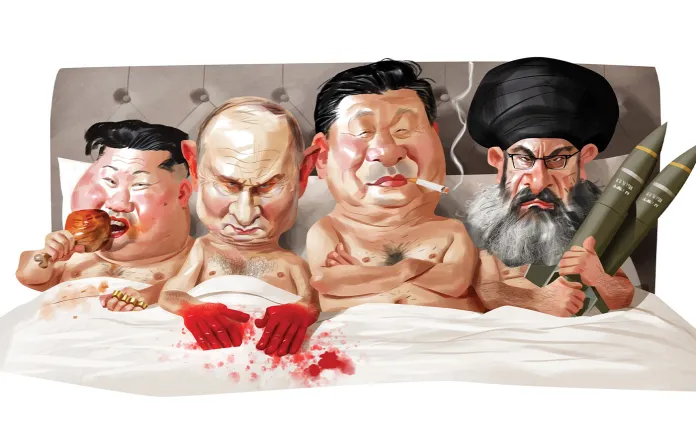
Extraordinarily sensitive to criticism, the Chinese Communist Party protests that all it wants from the world is “win-win cooperation.” This is fine rhetoric. The problem is that China’s actions conflict with its words. And while the United States is imperfect, one key measure of a nation is the friends it keeps. On that basis, America is overwhelmingly defined by enduring partnerships with democracies and governments that favor peaceful cooperation.
Not so with China.
The world’s second-largest economy seeks to maintain strong, if export-prime, trading relationships with nations the world over. But it has very poor taste in friends.
Beijing’s primary allies are Russia, North Korea, and Iran. The result of this choice is that even as China leverages economic engagement to build foreign relationships, it simultaneously invites a suppurating wound to its international credibility. China would abandon Russia, North Korea, and Iran were it truly serious about building a “win-win” relationship with the international community. It speaks volumes that Beijing chooses instead to believe it can balance its foreign relations without cost.
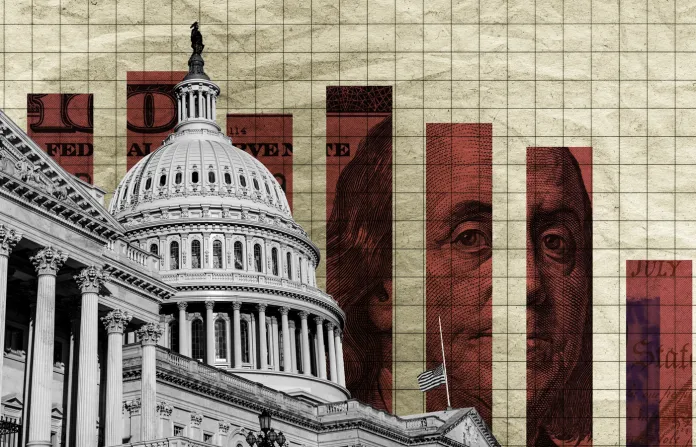
(Illustration by Dean MacAdam for the Washington Examiner)
" data-large-file="https://www.washingtonexaminer.com/wp-content/uploads/2026/10/Feat.China_.101426.jpg?w=696" height="658" width="1024" src="https://www.washingtonexaminer.com/wp-content/uploads/2026/10/Feat.China_.101426.jpg?w=696" alt="China regimes" class="wp-image-4762459" style="width:796px;height:auto" srcset="https://www.washingtonexaminer.com/wp-content/uploads/2026/10/Feat.China_.101426.jpg 1400w, https://www.washingtonexaminer.com/wp-content/uploads/2026/10/Feat.China_.101426.jpg?resize=300,193 300w, https://www.washingtonexaminer.com/wp-content/uploads/2026/10/Feat.China_.101426.jpg?resize=768,494 768w, https://www.washingtonexaminer.com/wp-content/uploads/2026/10/Feat.China_.101426.jpg?resize=1024,658 1024w, https://www.washingtonexaminer.com/wp-content/uploads/2026/10/Feat.China_.101426.jpg?resize=150,96 150w, https://www.washingtonexaminer.com/wp-content/uploads/2026/10/Feat.China_.101426.jpg?resize=696,447 696w, https://www.washingtonexaminer.com/wp-content/uploads/2026/10/Feat.China_.101426.jpg?resize=1068,687 1068w" sizes="(max-width: 1024px) 100vw, 1024px">
(Illustration by Dean MacAdam for the Washington Examiner)
This is not to say that a China detached from Russia, North Korea, and Iran would suddenly become a positive Western partner. It is the CCP’s nature to seek maximal gain, even at the obvious expense of others.
Complaints from CCP Chairman and Chinese President Xi Jinping that China is unfairly criticized stand utterly at odds with what the country does. Those complaints are at odds with China’s vast global economic espionage campaign. Those complaints are at odds with China’s militarized seizure of international waters in the East and South China seas. Those complaints are at odds with China’s capricious breach of its treaty commitments to uphold Hong Kong’s democratic rule of law until the year 2047. And those complaints are patently absurd when measured against China’s support for the world’s worst regimes.
China’s relationship with Iran is its most obviously counterproductive in this regard.
Iran might have been able to sell cheap oil to China until the current U.S. naval blockade of Iranian ports. Still, Iran’s missile and drone attacks in the Strait of Hormuz have held the global economy hostage for months now. And while the strait is gradually reopening under U.S. Navy protection, Iran’s wanton aggression has driven up household and business energy prices globally. Foreign governments are rightly angry. And this is to say nothing of Iran’s fanatical support for regional and, indeed, international terrorism. By so callously remaining centered as Iran’s key partner, China has associated itself with Iran’s malfeasance. Put simply, Beijing has shown the rest of the world that it cares nothing for their plight, just as long as cheap oil keeps flowing to its ports.
This policy has also undermined China’s position with its erstwhile Middle Eastern partners.
Israeli Prime Minister Benjamin Netanyahu once prized relations with China so greatly that he was willing to sacrifice U.S. national security by granting China access to Israel’s high-tech sector. Similarly, Saudi Arabia and the other Sunni monarchies had come to view China as a reliable and predictable trade and investment partner. Refusing to pressure Iran heavily even as Tehran’s hostility endured over many months, however, China has undermined these governments’ top economic and security interests. Xi now appears dangerously duplicitous.
Then there’s Russia.
It’s now been nearly five years since Vladimir Putin commenced the largest, bloodiest European war since World War II. This war has destabilized the European continent while causing grave harm to innocent civilians. It has also underlined the capricious incompetence of the Kremlin and its military. A war that was supposed to be over in a matter of days has now cost approximately 500,000 Russian soldiers. And in return for only marginal seizures of Ukrainian territory. Ukraine’s defensive action has turned the front lines into death zones. Ukraine’s offensive drone and missile campaign is bringing the war to Moscow, Saint Petersburg, and other major Russian cities.
Still, China continues to provide Russia with an irreplaceable economic lifeline through Beijing’s imports of Russian energy and its exports of sanctioned goods to Russia. As they do with Iran, Chinese banks play a crucial role in generating foreign capital for Moscow. Yet, as Russia now exports terrorism across Europe, China has the gall to screech that European governments are treating it unfairly by complaining about its support for Russia, and its rampant trade dumping.
At a practical level, China’s investment in an economically decrepit, demographically imploding, militarized Russia isn’t exactly a masterpiece of statecraft. It forces European powers and a bipartisan mainstream of the U.S. national security community to view Beijing as fundamentally averse to Western security. In turn, it limits room for new cooperation by framing China as untrustworthy.
Similar is China’s relationship with North Korea.
Under Kim Jong Un, North Korea has significantly advanced its nuclear ballistic missile program. Russian technical support has been crucial here, shared with Kim in return for North Korea’s military deployments and arms support against Ukraine. But North Korea’s missile advances pose a direct threat to the security of American cities and those of all U.S. allies in the Pacific. China’s enabling of that threat via its economic and diplomatic support for North Korea encapsulates the limits of its “win-win cooperation” narrative. After all, no serious American or U.S. allied policymaker will consider intimate relations with China as long as it enables a paranoid regime’s potential nuclear holocaust.
China gains little from North Korea for enduring these diplomatic costs. Beijing hopes its North Korean partner can help restrain and deter the U.S. from challenging its claims over Taiwan and the South China Sea, and Beijing’s threats to Japan. But were North Korea ever to undertake major military action against U.S. interests, Kim’s regime would almost certainly be forced out of power. A war with North Korea would be bloody and brutal, but the outcome would be near certain. It would end with a pro-Western government right on China’s border.
THE US MAKES A NMESIS MISSILE MESS FOR CHINA
Beijing’s relationships with these who’s-who of the world’s worst regimes aligns with its oft self-defeating diplomatic rhetoric. Yet, as long as China deludes itself that it can secure global hegemony alongside its maintained alliances with enemies of global stability, Beijing will face an immovable ceiling for its ambitions.
Much of the rest of the world might be desperate for Chinese investments. But facing the reality and looming specter of war, an artificial intelligence arms race, and the grotesque nature of Beijing’s chosen friends, Xi will only be able to dream of global dominance.
Tom Rogan (@TomRTweets) is a national security writer and editor for the Washington Examiner.
Continue reading...
[ H/T Washington Examiner ]