


Can Robotaxis Save The Economy?
Tesla began rolling out version 15 of its "FSD Supervised" system over the weekend, with deployments already in its pilot "Robotaxi" service and on Cybercabs in Texas and Florida. What has everyone talking is the video game-style visualization on the infotainment screen, resembling a virtual world like Grand Theft Auto VI.
However, the claimed 25-fold improvement in the critical intervention rate is the biggest update yet, potentially bringing FSD closer to Tesla's stated goal of exceeding human safety levels.
Take this example...
Safer autonomous driving could also generate substantial public savings, according to Jefferies analysts Laurence Alexander and Charles Boakye, by reducing crashes and the associated losses in economic output.
In their note titled "Public Savings Could Justify A Perpetual Subsidy," the analysts explained their case where governments could justify paying 4 to 7 cents per autonomous mile, potentially indefinitely, if robotaxis and driverless cars deliver a dramatic reduction in crashes and free up parking lots for housing.
"A recurring response to our robotaxi series has been that governments will prevent widespread adoption," the analysts wrote.
However, they added: "If autonomous cars cut crashes by >95% and parking lots can be upgraded, governments could sustain a $0.04-$0.07/mile subsidy. The broader economic gain, we estimate, could run ~$0.13/mile, rising >$0.50 when avoided deaths and injury are valued at typical benchmarks. The incentive for governments to favor adoption is likely higher than generally appreciated."
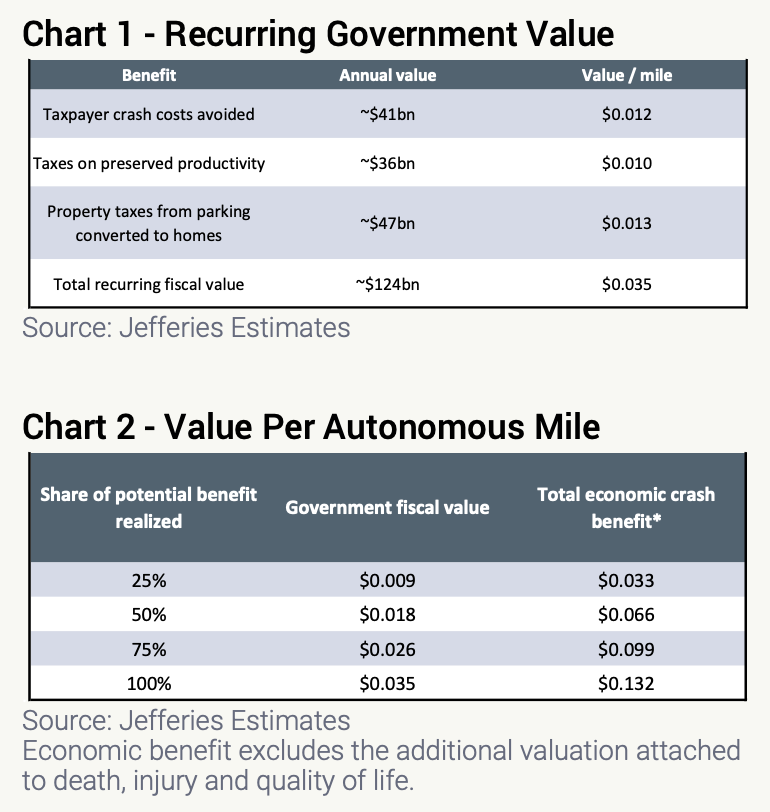
Here's their breakdown:
Jefferies analysts make a compelling case for the potential public savings from robotaxis. The big question is whether governments will embrace those benefits or bury driverless cars under the kinds of regulatory restrictions that have complicated the rollout of shared Lime scooters and other similar services.
Tyler Durden Tue, 11/24/2026 - 21:00
Continue reading...
[ H/T ZeroHedge ]
Tesla began rolling out version 15 of its "FSD Supervised" system over the weekend, with deployments already in its pilot "Robotaxi" service and on Cybercabs in Texas and Florida. What has everyone talking is the video game-style visualization on the infotainment screen, resembling a virtual world like Grand Theft Auto VI.
However, the claimed 25-fold improvement in the critical intervention rate is the biggest update yet, potentially bringing FSD closer to Tesla's stated goal of exceeding human safety levels.
Take this example...
Safer autonomous driving could also generate substantial public savings, according to Jefferies analysts Laurence Alexander and Charles Boakye, by reducing crashes and the associated losses in economic output.
In their note titled "Public Savings Could Justify A Perpetual Subsidy," the analysts explained their case where governments could justify paying 4 to 7 cents per autonomous mile, potentially indefinitely, if robotaxis and driverless cars deliver a dramatic reduction in crashes and free up parking lots for housing.
"A recurring response to our robotaxi series has been that governments will prevent widespread adoption," the analysts wrote.
However, they added: "If autonomous cars cut crashes by >95% and parking lots can be upgraded, governments could sustain a $0.04-$0.07/mile subsidy. The broader economic gain, we estimate, could run ~$0.13/mile, rising >$0.50 when avoided deaths and injury are valued at typical benchmarks. The incentive for governments to favor adoption is likely higher than generally appreciated."
Here's their breakdown:
Jefferies analysts make a compelling case for the potential public savings from robotaxis. The big question is whether governments will embrace those benefits or bury driverless cars under the kinds of regulatory restrictions that have complicated the rollout of shared Lime scooters and other similar services.
Tyler Durden Tue, 11/24/2026 - 21:00
Continue reading...
[ H/T ZeroHedge ]