





Please note that SCOTUS Outside Opinions constitute the views of outside contributors and do not reflect the opinions of SCOTUSblog or its staff.
***
As Democrats have taken control in Congress, we can expect calls for court packing to intensify. One especially prominent proposal has been to expand the court to 13 justices. In the last few months, we have seen former Vice President Kamala Harris say the Supreme Court should be increased to this number. In August, Rep. James Clyburn, a longtime Democratic leader in the House, endorsed this proposal on Meet the Press. Just in the past few weeks, Hillary Clinton said the party “should seriously look at expanding the court while the Democrats are in power.” Potential presidential candidate Pete Buttigieg has advocated increasing the number of justices to 13 as well.
Some of these calls come with superficially plausible justifications. Take Hillary Clinton’s proposal, for instance. “It used to be that you’d have one justice for each circuit,” Clinton explained. “We now have 13 circuits, we should have 13 justices.” Buttigieg has also argued for modifying the size of the court on that basis. But the symmetry argument is pretextual: It is no mere coincidence that the reintroduction of a one-to-one justice to circuit relationship under Democratic control would produce exactly the four seats needed to transform the current six-to-three conservative majority into a seven-to-six liberal one. Such a proposal then allows advocates to cover their desire for change to the court’s size in the language of a seemingly neutral principle.
It is true that the Constitution doesn’t fix the number of justices. And changes to the court’s size have not always been made for partisan reasons. In many cases there have been administrative and logistical needs that made changes to the size of the court practically useful, and even necessary. For that reason, we do not oppose changing the court’s size as such. Rather, we only oppose court packing, which we define as changing the court’s size for partisan reasons.
So how can one tell the difference?
As we argue in a recent paper, and as already noted above, a key distinction when evaluating proposed changes to the court’s size is whether that change is constrained by some sort of even-handed principle or whether the change is driven by partisan advantage. Throughout American history, legitimate changes to the court’s size have answered practical problems, such as those accompanying the logistics of circuit-riding. A defining feature of court packing, by sharp contrast, is that it changes the court’s size primarily to benefit a particular political coalition without recourse to some prior rule or norm.
Political coalitions can always claim a pretextual justification for adding justices, allowing the political benefit to be presented as secondary to pressing administrative reasons. But the stated rationale for a proposed change cannot be enough to legitimize the change. Instead, a legitimate proposal must respond to a genuine institutional need. The grounds for change must, in other words, predate the political conflict rather than be identified retroactively to manufacture a justification for changing the court’s size.
The 13-justice proposal, from this historical perspective, utterly fails the test. The one-circuit, one-justice rule previously existed because justices actually rode circuit, traveling to hear cases in the lower courts. In those days each new circuit needed a justice to staff it. As the country grew westward, Congress added justices to staff new circuits (one in 1807, two in 1837, one in 1863). While, admittedly, those changes benefited the party in power, few treated them as a way to assert partisan control over the court.
But circuit-riding ended more than a century ago. Today the number of circuits has no practical connection with the performance of the justices. For example, when Congress carved the U.S. Court of Appeals for the 10th Circuit out of the 8th in 1929, circuits first outnumbered justices, and Congress did not add a seat. Nor did it add one when it split the overburdened U.S. Court of Appeals for the 5th Circuit to create the 11th in 1980, and there were not calls to do so. And when the specialized U.S. Court of Appeals for the Federal Circuit was added as the 13th Circuit in 1982, no one argued for a corresponding increase to the court. Rather, arguments for reestablishing the proportionality between circuits and seats on the Supreme Court have resurfaced only now after a string of decisions particularly unpopular with Democrats (most notably Dobbs).
Timing also reveals the motive behind these assertions. If the rationale for increasing the court’s size was merely or even primarily procedural and administrative, then there would be no reason to delay. But instead, as Clinton has stated, the court’s size should only be increased “while the Democrats are in power.” Nor, for that matter, have proponents named any administrative problem that four more justices would solve.
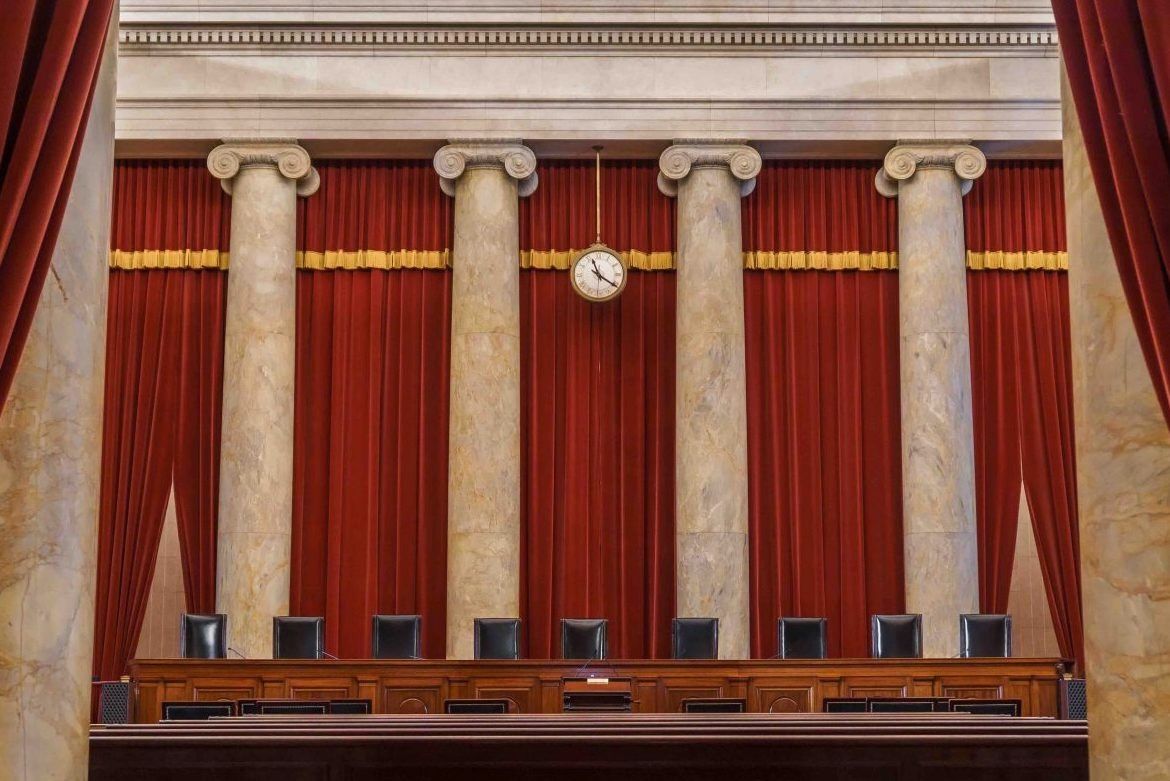
To clarify intentions let us explore a simple thought experiment. If Democrats believed the court needs four more justices, they could prove it by passing legislation to add two seats now, to be filled by President Donald Trump, and two more in 2029, to be filled by whoever wins the 2028 election. Accordingly, the court would get its 13 justices and achieve circuit symmetry. Democrats will undoubtedly not offer that deal, however, because under this scenario there would remain a three-seat conservative majority. This shows, of course, that the case for 13 justices is not, in fact, about the number 13 at all – it is about who gets to appoint the four.
Finally, history makes clear the consequences of changing the court’s size for partisan advantage. In 1801, lame-duck Federalists passed a law shrinking the court at its next vacancy in an attempt to deny Thomas Jefferson an appointment on it. The Republicans repealed this act, turning the judiciary into an object of partisan action and reaction, a conflict that culminated in the impeachment of Justice Samuel Chase in 1804. In 1866, Republicans shrank the court by attrition to keep Andrew Johnson from making appointments, defeating his pending nominee and leaving the circuit courts understaffed in the process. In 1869, with Republican Ulysses Grant elected, Congress set the number of justices at nine, contracting the court under a hostile president and expanding it under an allied one. Grant’s appointees then helped reverse a major ruling on paper money, a change that could arguably be seen as the product of Congress’ manipulation rather than constitutional reasoning.
The allure of court packing for partisan purposes will only continue to grow over the next two years. With Trump in office until January 2029, a Democratic Congress cannot expand the court on its own, so court packing will likely become a standard talking point leading to the 2028 Democratic presidential primary and the subsequent general election. As that debate continues to unfold, voters should remember one question to ask of these proposals: is the proposed change answering a legitimate, administrative problem with the court’s functioning, or is it a partisan reaction to the rulings themselves? Only the first should be understood as legitimate grounds to consider changes to the size of the nation’s highest court. Anything else risks escalating partisan retribution and destruction of the judiciary’s ability to act independently, a role that John Adams rightly identified as foundational for “the stability of government, in all its branches, the morals of the people, and every other blessing of society and social institutions.”
Continue reading...
[ H/T SCOTUSblog ]