








The proposed billionaire wealth tax that California voters will consider on the Nov. 3 midterm elections ballot will likely not raise as much as expected. And it could, in fact, lead to the state losing revenue over time, according to a new study.
The analysis, written by Stanford University economists Benjamin Jaros and Joshua Rauh and circulated as a working paper by the National Bureau of Economic Research, examines California Proposition 40. If approved, the measure would establish the first major tax on general wealth in modern U.S. history.
IF CALIFORNIA WEALTH TAX PASSES, OTHER BLUE STATES MAY ADOPT SIMILAR MEASURES
Proponents of the one-time 5% tax on a net worth exceeding $1 billion argue that it could raise the Golden State some $100 billion in revenue. The ballot measure’s sponsors, SEIU United Healthcare Workers West, say the money would be used to shield the state’s healthcare system from projected federal funding cuts.
But the study by Jaros and Rauh finds that revenue estimates are being grossly oversold. And that California’s treasury could take an overall hit if the wealth tax leads billionaires to flee the state, thereby depriving it of years of their income tax payments.
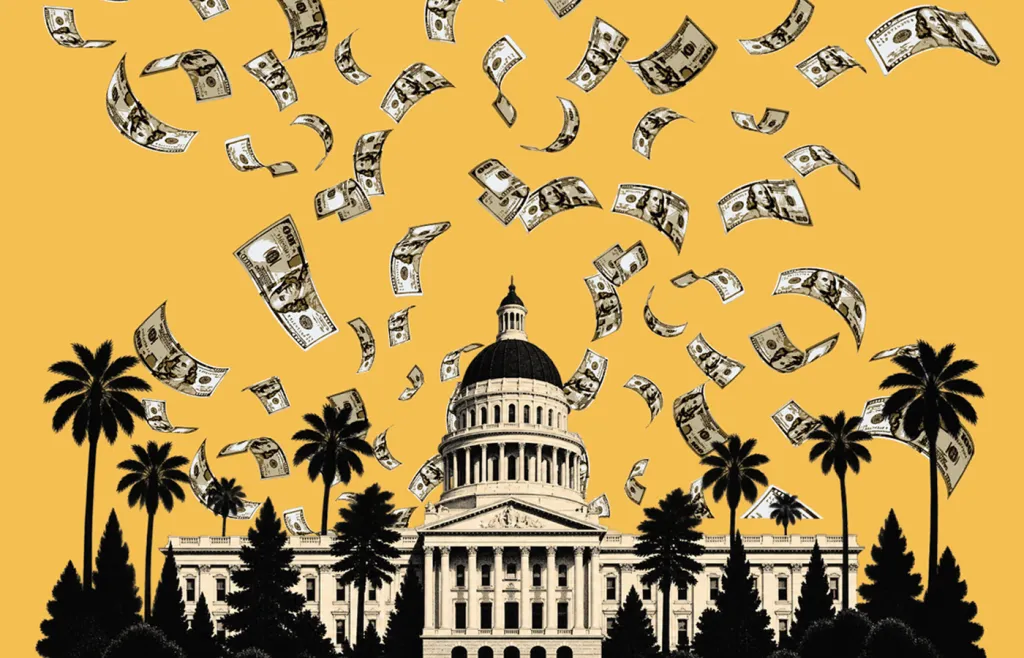
(Washington Examiner Illustration/Getty Images)
" data-large-file="https://www.washingtonexaminer.com/wp-content/uploads/2026/10/Biz.Cover_.102826.jpg?w=1024" height="658" width="1024" src="https://www.washingtonexaminer.com/wp-content/uploads/2026/10/Biz.Cover_.102826.jpg?w=1024" alt="california wealth taxes" class="wp-image-4776910" srcset="https://www.washingtonexaminer.com/wp-content/uploads/2026/10/Biz.Cover_.102826.jpg 1400w, https://www.washingtonexaminer.com/wp-content/uploads/2026/10/Biz.Cover_.102826.jpg?resize=300,193 300w, https://www.washingtonexaminer.com/wp-content/uploads/2026/10/Biz.Cover_.102826.jpg?resize=768,494 768w, https://www.washingtonexaminer.com/wp-content/uploads/2026/10/Biz.Cover_.102826.jpg?resize=1024,658 1024w" sizes="(max-width: 1024px) 100vw, 1024px">
(Washington Examiner Illustration/Getty Images)
The authors, who are affiliated with the right-of-center Hoover Institution, argue that the $100 billion figure is not accurate because it assumes that all of the wealth of California billionaires will be successfully taxed. Instead, they write, the tax is likely to be undermined by legal challenges.
The authors also account for billionaires who have already announced they left the state, including Google co-founders Larry Page and Sergey Brin, as well as investor Peter Thiel. Such departures have already eliminated 30% of the measure’s wealth tax base, they find.
In other words, the wealth tax is likely a leaky bucket. The bucket is intended to scoop up the wealth of all of California’s estimated 200 billionaires. But, as it is imposed, much of that wealth is likely to trickle out as billionaires establish residency elsewhere or avoid the tax through the courts.
Proposition 40 is meant to address the problem of billionaires leaving the state to avoid the tax by making it retroactive and applying it to all taxpayers residing in the state as of Jan. 1, 2026. But that provision is legally questionable.
The Washington Examiner spoke to Jaros about the research. He said courts have allowed some retroactivity for property taxes at the state level and for changes to existing taxes at the federal level, but that there is little precedent for applying a new one-time wealth tax.
Jaros suggested it was fair to assume that legal challenges would cut expected revenue by about half.
“Here’s how I view this litigation risk framework,” Jaros said. “I think you’re safer taking a 50% haircut on everything, rather than taking the position the state’s going to bat 1.000 on 212 residency cases, or it’s going to bat zero on them.”
“They probably win some and lose some, and then it depends on how much in net worth the people they win on have,” he added.
Jared Walczak, a senior fellow at the Tax Foundation, said that many think court challenges might be successful.
“There are several different possibilities for what it would mean to be challenged in court; it could be that anyone who left in 2026 doesn’t owe wealth tax at all,” Walczak told the Washington Examiner. “It may mean that they can pursue as-applied challenges to the apportionment and pay significantly less, but not nothing.”
The Stanford researchers estimate that the billionaire tax will collect about $30 billion, with a range of $28 billion to $36 billion.
That could easily be outweighed by the loss of income taxes from the billionaires who decamped to Florida or Texas.
“But then they’re also looking at those departures and estimating how much income tax would be foregone from them for the rest of their lives, and they’re doing a net present value calculation of that to say what is the value right now of not having that income tax revenue in the future,” Walczak said of the study.
In the study, the researchers estimate that California’s billionaires contribute between $3.3 billion and 5.8 billion annually in state income taxes. They project that if the measure is enacted and billionaires continue to leave the state, the present value of permanently lost income tax collections would offset the one-time wealth tax by nearly $39 billion in today’s dollars.
In 100,000 simulations under different assumptions, 85% of outcomes yielded a “negative net present value of state revenues,” the study found.
“The long run is important here,” Walczak said. “Essentially, what the Hoover study is exploring is the long-term effects of a loss of income tax revenue from those who depart the state compared to the one-time revenue from the wealth tax.”
Proponents of Proposition 40, including socialists, see it as a trial balloon for wealth taxes in other states and at the federal level. Some on the Left have long pushed for wealth taxes on billionaires and hope this California referendum could boost the broader movement.
Six Nobel Prize-winning economists wrote an open letter arguing that the move could “kickstart” a movement for higher taxes on the wealthy across the U.S. The six economists — Daron Acemoglu, Abhijit Banerjee, Peter Diamond, Esther Duflo, Paul Krugman, and Joseph Stiglitz — have all supported taxing the wealthy more.
“California is the right place to take this historic step,” the group wrote in the letter of support.
Likewise, Sen. Bernie Sanders (I-VT) has called Proposition 40 “a model that should be emulated throughout the country.”
Republicans are vehemently against such a plan, and many Democrats have come out against it as well, most notably Gov. Gavin Newsom (D-CA). Newsom is seen as a top Democratic contender in the 2028 presidential election.
Newsom has argued that such a law would cause billionaires to move to other states, which would hurt the economy and tax base. This latest study could be used as ammunition for Newsom and opponents of the ballot measure.
If the wealth tax passed, its revenue would fund Medi-Cal, California’s Medicaid program, and similar healthcare programs for low-income Californians.
Service Employees International Union-United Healthcare Workers West has been the ballot initiative’s biggest supporter. The Washington Examiner reached out to SEIU UHW for comment about the research, but didn’t receive a response.
Polling indicates that the provision might have trouble passing into law.
FLORIDA LEADS PROPERTY TAX REVOLT ON BALLOTS IN NOVEMBER
Fewer than half of likely voters, 45%, said they support the ballot measure, according to the University of California, Berkeley, Citrin Center for Public Opinion Research-Politico poll from September. That is a decline from February.
Bettors in prediction markets see passage as unlikely. Kalshi has implied odds of 76% that Proposition 40 will fail.
Zach Halaschak (@zhalaschak) is the economics reporter for the Washington Examiner.
Continue reading...
[ H/T Washington Examiner ]