









BofA Downplays China's DUV Tool Production Report, Sees Only "Modest Threat" To ASML
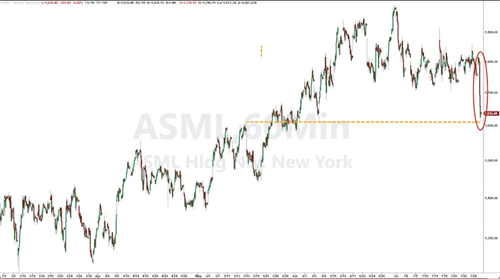
ASML Holding NV shares in Amsterdam suffered their steepest decline in more than a year, breaking below the crucial 50-day moving average after The Information reported that a Chinese state-backed company had begun producing immersion deep-ultraviolet (DUV) lithography machines.
The Information did not cite the Shanghai-based company that plans to manufacture about five DUV machines this year and roughly 20 in 2027. The firm reportedly assembled teams from other Chinese chip-equipment firms, including Shanghai Yuliangsheng Technology.
ASML builds lithography machines that print transistor patterns onto silicon wafers. Its DUV machines are considered the workhorses of the semiconductor industry, producing highly advanced chips ranging from DRAM and NAND memory to logic and AI chips, as well as smartphone and automotive processors.
Only three weeks ago, we reported that China's leading memory-chip companies are quickly closing the technology gap with their South Korean chip-producing rivals faster than expected, raising concerns that expanding Chinese production could eventually spark a global memory glut.
China's largest memory company, CXMT, is reportedly testing a pilot line for bonded DRAM in Hefei (the heart of China's semiconductor industry), a technology that manufactures memory cells and peripheral circuitry on separate wafers before joining them. This process could deliver higher density and performance using older deep-ultraviolet lithography equipment, allowing China to reduce its dependence on advanced EUV machines restricted by US export controls.
The company is also developing HBM3 and HBM3E products, pursuing next-generation CXL memory, and preparing for a potential Shanghai listing. Its reported share of the global DRAM market reached 8% during the first quarter of 2026, and Apple is said to be considering CXMT as a supplier.
The US has been probing ASML for many months out of concern that one of its lithography machines ended up in Chinese hands despite US-led export controls.
Bank of America analyst Didier Scemama commented on The Information's report, telling clients:
Scemama continued:
Domestic DUV machines could eventually increase DRAM and NAND production in China, strengthening suppliers such as CXMT and YMTC while helping alleviate the global memory crunch. The report also suggests that ASML's long-term competitive position could face growing pressure, while the leverage exerted by US and Western export controls over China's access to advanced chips and chipmaking equipment could erode.
Tyler Durden Mon, 07/27/2026 - 15:30
Continue reading...
[ H/T ZeroHedge ]
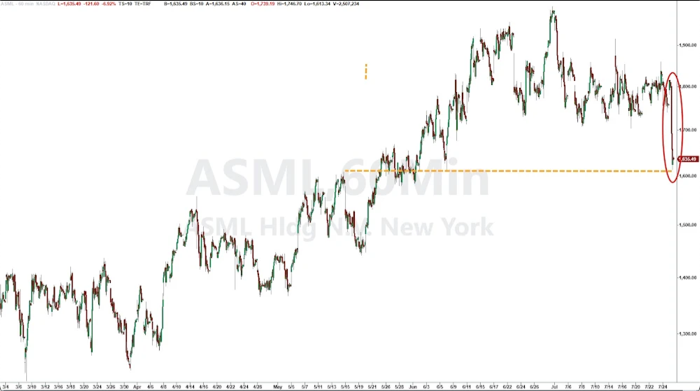
ASML Holding NV shares in Amsterdam suffered their steepest decline in more than a year, breaking below the crucial 50-day moving average after The Information reported that a Chinese state-backed company had begun producing immersion deep-ultraviolet (DUV) lithography machines.
The Information did not cite the Shanghai-based company that plans to manufacture about five DUV machines this year and roughly 20 in 2027. The firm reportedly assembled teams from other Chinese chip-equipment firms, including Shanghai Yuliangsheng Technology.
ASML builds lithography machines that print transistor patterns onto silicon wafers. Its DUV machines are considered the workhorses of the semiconductor industry, producing highly advanced chips ranging from DRAM and NAND memory to logic and AI chips, as well as smartphone and automotive processors.
Only three weeks ago, we reported that China's leading memory-chip companies are quickly closing the technology gap with their South Korean chip-producing rivals faster than expected, raising concerns that expanding Chinese production could eventually spark a global memory glut.
China's largest memory company, CXMT, is reportedly testing a pilot line for bonded DRAM in Hefei (the heart of China's semiconductor industry), a technology that manufactures memory cells and peripheral circuitry on separate wafers before joining them. This process could deliver higher density and performance using older deep-ultraviolet lithography equipment, allowing China to reduce its dependence on advanced EUV machines restricted by US export controls.
The company is also developing HBM3 and HBM3E products, pursuing next-generation CXL memory, and preparing for a potential Shanghai listing. Its reported share of the global DRAM market reached 8% during the first quarter of 2026, and Apple is said to be considering CXMT as a supplier.
The US has been probing ASML for many months out of concern that one of its lithography machines ended up in Chinese hands despite US-led export controls.
Bank of America analyst Didier Scemama commented on The Information's report, telling clients:
Scemama continued:
Domestic DUV machines could eventually increase DRAM and NAND production in China, strengthening suppliers such as CXMT and YMTC while helping alleviate the global memory crunch. The report also suggests that ASML's long-term competitive position could face growing pressure, while the leverage exerted by US and Western export controls over China's access to advanced chips and chipmaking equipment could erode.
Tyler Durden Mon, 07/27/2026 - 15:30
Continue reading...
[ H/T ZeroHedge ]