









When you think of the NBA’s all-time greatest power forwards, Tim Duncan, Charles Barkley, Karl Malone, and Kevin Garnett usually come to mind first. But it was the oft-overlooked Bob Pettit who paved the way for all of them. Pettit, who died on Sept. 24 at the age of 93, was the prototype for Malone: a 6-foot-9 forward who had the shooting touch of a shooting guard, the rebounding prowess of a center, and the body of an Olympian weightlifter.
People like to tell the somewhat apocryphal story about Michael Jordan not making his high school basketball team. That is not entirely correct. Jordan missed the cut of his varsity team while he was still on the junior varsity squad. Still astonishing in retrospect, but Jordan was on his high school basketball team. Pettit, who was named one of the NBA’s 50 Greatest Players in 1996, actually did not make his — at least initially.
Robert Lee Pettit Jr. was born on Dec. 12, 1932, in Baton Rouge, Louisiana. At Baton Rouge High, he was cut as a freshman and again as a sophomore. He improved by playing in a church league, practicing for hours on a backyard basketball hoop. A five-inch growth spurt didn’t hurt either. He finally made the team when he was a junior. As a senior, he led the squad to a state championship. “My ambition in high school after I got cut as a sophomore,” he said years later, “was to win a letter by the time I was a senior. That’s all I wanted.”
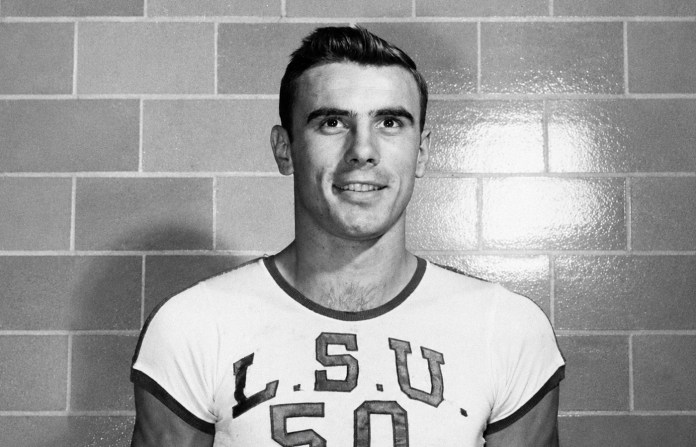
Bob Pettit. (AP Photo)
" data-large-file="https://www.washingtonexaminer.com/wp-content/uploads/2026/10/Obit.100726.jpg?w=696" height="658" width="1024" src="https://www.washingtonexaminer.com/wp-content/uploads/2026/10/Obit.100726.jpg?w=696" alt="Bob Pettit" class="wp-image-4751389" style="width:895px;height:auto" srcset="https://www.washingtonexaminer.com/wp-content/uploads/2026/10/Obit.100726.jpg 1400w, https://www.washingtonexaminer.com/wp-content/uploads/2026/10/Obit.100726.jpg?resize=300,193 300w, https://www.washingtonexaminer.com/wp-content/uploads/2026/10/Obit.100726.jpg?resize=768,494 768w, https://www.washingtonexaminer.com/wp-content/uploads/2026/10/Obit.100726.jpg?resize=1024,658 1024w, https://www.washingtonexaminer.com/wp-content/uploads/2026/10/Obit.100726.jpg?resize=150,96 150w, https://www.washingtonexaminer.com/wp-content/uploads/2026/10/Obit.100726.jpg?resize=696,447 696w, https://www.washingtonexaminer.com/wp-content/uploads/2026/10/Obit.100726.jpg?resize=1068,687 1068w" sizes="auto, (max-width: 1024px) 100vw, 1024px">
Bob Pettit. (AP Photo)
He got more than a letter. At Louisiana State University, he led the SEC in scoring in each of his three varsity seasons and carried the Tigers to their first Final Four in 1953. The Milwaukee Hawks took him with the second pick of the 1954 draft. Skeptics thought the 205-pound All-American was too slight for the pros. He won Rookie of the Year anyway, averaging 20.4 points and 13.8 rebounds, packed on 30-40 pounds of muscle through weightlifting, and never missed an All-Star Game in 11 seasons.
In 1956, he became the first winner of the NBA’s MVP award, leading the league in scoring and rebounding. He won the MVP again in 1959. He was a 10-time All-NBA First Team selection, a two-time scoring champion, and a four-time All-Star Game MVP — a mark later matched only by Kobe Bryant. When he retired after the 1964-65 season, he was the first player to score 20,000 points and stood second all-time in rebounds. He never averaged fewer than 20 points in a season. His rebounding average remains third in league history, behind only two guys you may’ve heard of: Wilt Chamberlain and Bill Russell.
Speaking of one of those hallowed names, Pettit belonged to the generation that had to go through Russell’s Boston Celtics if they wanted a championship, and almost no one did. The Hawks were the NBA’s Buffalo Bills of the 1950s. They reached the Finals four times in five years but kept coming up short in their quest for a title. In 1958, everything changed. In Game 6, Pettit had one of the all-time great close-out games in NBA Finals history, scoring 50 points, including 19 of the Hawks’ last 21 (what we Knicks fans might now call “pulling a Jalen Brunson”), to clinch the franchise’s only title. It was the only championship anyone wrested from Russell’s Celtics during their 13-year reign.
Russell, who knew the difference between talent and will, later said Pettit “made ‘second effort’ a part of the sports vocabulary.” Pettit described rebounds almost as if he were talking in analytics-speak before its time. Offensive rebounds, he estimated, were worth 8 to 12 points a night. “I played as hard as I could play every minute I was in the game. I never took time off. Every time my teammate shot, I went after the ball. Not once, not twice, every time.”
JON KYL, 1942-2026
He was enshrined in the Naismith Memorial Basketball Hall of Fame in Springfield, Massachusetts, in 1971, and later named to all four of the league’s anniversary teams. LSU retired his No. 50. The Hawks retired his No. 9. A bronze statue of him stands outside the Pete Maravich Assembly Center beside Shaquille O’Neal. After basketball, he went into banking in Louisiana and, unlike many of his peers, liked the second act. “I enjoyed my life after basketball,” he said. “Not a lot of players can say that.”
The kid who only wanted a varsity letter became the original modern power forward, the first MVP, and the man who punched a hole in the greatest dynasty American team sports has produced. He never pretended the work was glamorous. He just kept going to the glass. “I maximized every ounce of ability that I had,” Pettit once said. On the evidence, that was quite a few ounces more than a cut high school sophomore was supposed to possess.
Daniel Ross Goodman (@DanRossGoodman) is a Washington Examiner contributing writer and teaches theology and religious studies at St. John’s University. His next book, Dante’s Guide to Life: How The Divine Comedy Can Change Our Fortunes, Our World, and Ourselves, will be published this fall by Angelico Press.
Continue reading...
[ H/T Washington Examiner ]
