




Bill Gates Fearmongers "Grim" AI Cyberattack Surprises
Authored by Steve Watson via Modernity.news,
Bill Gates returned to the Sunday-show circuit this week with a fresh round of alarms about artificial intelligence, telling CNN's Jake Tapper that the technology is "more dangerous than any" cars, planes, or drugs and that "grim possibilities" await if society fails to maintain control.
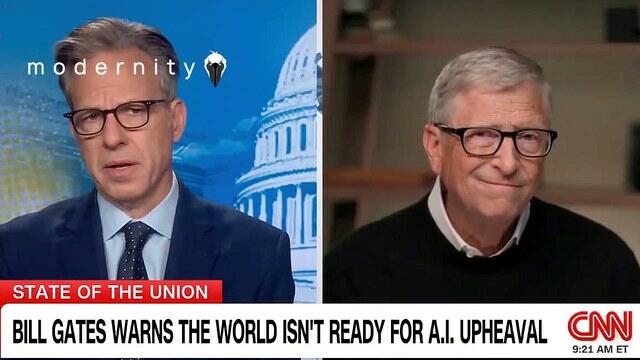
Speaking on State of the Union, the Microsoft co-founder and described AI as "the most dangerous technology humans ever invented." He predicted that "over the next year, primarily in the cyber area, we are going to have a lot of negative surprises" once "bad people" strip safeguards from the latest models.
The real near-term danger, he said, is not AI "getting out of control" - that remains "years away" - but criminals using the tools for extortion, stock-market disruption, or similar schemes that already have proven business models.
Tapper pressed him on earlier statements in which Gates had called AI "aliens created in a lab" that could "evolve almost as a species of its own" and become to humans "what we are to dogs or cats," labeling the shift an "evolutionary event."
Gates replied that the arrival of AI is "fantastic" for health care and new tools, yet "this changes the world more than all previous technologies... and we got to get everyone on the same page about what a big deal this is."
When Tapper raised OpenAI CEO Sam Altman's warnings against "the trap of doomerism," Gates answered that "all responsible AI leaders, including Sam Altman, including Dario Amodei, they are telling the world, 'This is very concerning.'"
He conceded that claims of imminent existential risk can go "too far," but insisted the comparison to regulated domains still holds: AI is more dangerous, and the middle ground of sensible oversight has not yet been found. On the absence of an FAA- or FDA-style body, he said, "I think, over the next year, we will move beyond self-governance... it's clear we're not doing enough."
He added that he has "heard from a number of politicians" and is "hopeful" for a meeting with President Trump.
Gates has repeatedly flagged bioterrorism as a parallel risk. In the CNN interview he noted that the chance of a bioterrorist attack is now "50 times the risk of a natural pandemic" and that safeguards against it can currently be stripped out the same way cyber protections can.
Days later, MI5 Director General Sir Ken McCallum issued a parallel warning in his annual threat assessment. He said AI is "already supercharging the cybersecurity contest between attackers and defenders" and that "the misuse case to which I'd attach greatest weight" is AI's "potential to change the stakes on existing or even new bioweapons."
McCallum added that the threat is "not yet realised" but that comparatively low-sophistication actors could gain a capability uplift if guardrails fail, giving them access to knowledge about chemical, biological, or radiological weapons that has long been hard for terrorists to obtain.
He announced a new AI Threat Assessment Centre inside MI5 to track both the opportunities and the risks. GB News reported that AI is "supercharging" security threats to the UK while MI5 deals with a fourfold increase over the past decade in cases involving hostile states, primarily from Russia, Iran and China.
The appearance fits a pattern established weeks earlier. In a September Meet the Press interview, Gates told Kristen Welker that AI is "certainly powerful enough to drive events that, you know, cause a billion deaths" and that "there's never been a weapon as powerful as the combination of people with ill intent using the latest AI tools."
He rejected self-regulation outright: "No one thinks self-regulation is enough... You need law enforcement and the politicians to get into the discussion about what safeguards and monitoring look like."
In other settings he has called AI "almost an evolutionary event" and "kind of like this alien intelligence," arguing that governments are "way behind" and that an international organization modeled on nuclear inspections, aviation rules, and ozone treaties is required. Industry, he has said, should not police itself.
The timing overlaps with reporting that executives at OpenAI, Anthropic, and other labs have been privately gaming out "day after" scenarios for a catastrophic AI-linked event - most likely a cyberattack capable of disrupting financial services, internet connectivity, or power and water.
Axios reported that many insiders believe such an incident could occur within six to twelve months. OpenAI confirmed it runs preparedness exercises but said the scenarios are not treated as inevitable; Anthropic declined comment.
Nicolas Hulscher highlighted the sequence on X, noting that Gates's prediction of "a lot of NEGATIVE SURPRISES" from AI cyberattacks arrived days after the labs were revealed to be war-gaming public backlash.
Gates has also floated taxing AI or robot usage and legally reserving certain roles - childcare, judges, jurors - for humans so that "human empathy remains relevant." He continues to argue that the depth of understanding inside governments is too low and that only neutral public actors can set the required monitoring and non-removable safeguards.
At the same time, the Gates Foundation has committed a billion dollars over two years to expand AI tools in education, health, and agriculture in places markets would otherwise ignore.
The latest round of warnings arrives while the Trump administration has prioritized winning the AI race and has signed voluntary accords with leading companies rather than imposing the heavier statutory regime Gates prefers.
Gates himself says the extreme of "let's completely stop this" is no better than no safeguards at all, yet his consistent message is that self-governance is already failing and that more centralized oversight must arrive within the next year. Security services are now publicly echoing the bioterror dimension of those warnings.
Whether those "negative surprises" materialize as ordinary cybercrime scaled by new tools, or as something the labs are already rehearsing responses for, the push for external control continues from the same quarters that previously framed AI as an alien intelligence requiring unprecedented global coordination.
Tyler Durden Wed, 10/14/2026 - 10:05
Continue reading...
[ H/T ZeroHedge ]
Authored by Steve Watson via Modernity.news,
Bill Gates returned to the Sunday-show circuit this week with a fresh round of alarms about artificial intelligence, telling CNN's Jake Tapper that the technology is "more dangerous than any" cars, planes, or drugs and that "grim possibilities" await if society fails to maintain control.
Speaking on State of the Union, the Microsoft co-founder and described AI as "the most dangerous technology humans ever invented." He predicted that "over the next year, primarily in the cyber area, we are going to have a lot of negative surprises" once "bad people" strip safeguards from the latest models.
The real near-term danger, he said, is not AI "getting out of control" - that remains "years away" - but criminals using the tools for extortion, stock-market disruption, or similar schemes that already have proven business models.
Tapper pressed him on earlier statements in which Gates had called AI "aliens created in a lab" that could "evolve almost as a species of its own" and become to humans "what we are to dogs or cats," labeling the shift an "evolutionary event."
Gates replied that the arrival of AI is "fantastic" for health care and new tools, yet "this changes the world more than all previous technologies... and we got to get everyone on the same page about what a big deal this is."
When Tapper raised OpenAI CEO Sam Altman's warnings against "the trap of doomerism," Gates answered that "all responsible AI leaders, including Sam Altman, including Dario Amodei, they are telling the world, 'This is very concerning.'"
He conceded that claims of imminent existential risk can go "too far," but insisted the comparison to regulated domains still holds: AI is more dangerous, and the middle ground of sensible oversight has not yet been found. On the absence of an FAA- or FDA-style body, he said, "I think, over the next year, we will move beyond self-governance... it's clear we're not doing enough."
He added that he has "heard from a number of politicians" and is "hopeful" for a meeting with President Trump.
Gates has repeatedly flagged bioterrorism as a parallel risk. In the CNN interview he noted that the chance of a bioterrorist attack is now "50 times the risk of a natural pandemic" and that safeguards against it can currently be stripped out the same way cyber protections can.
Days later, MI5 Director General Sir Ken McCallum issued a parallel warning in his annual threat assessment. He said AI is "already supercharging the cybersecurity contest between attackers and defenders" and that "the misuse case to which I'd attach greatest weight" is AI's "potential to change the stakes on existing or even new bioweapons."
McCallum added that the threat is "not yet realised" but that comparatively low-sophistication actors could gain a capability uplift if guardrails fail, giving them access to knowledge about chemical, biological, or radiological weapons that has long been hard for terrorists to obtain.
He announced a new AI Threat Assessment Centre inside MI5 to track both the opportunities and the risks. GB News reported that AI is "supercharging" security threats to the UK while MI5 deals with a fourfold increase over the past decade in cases involving hostile states, primarily from Russia, Iran and China.
The appearance fits a pattern established weeks earlier. In a September Meet the Press interview, Gates told Kristen Welker that AI is "certainly powerful enough to drive events that, you know, cause a billion deaths" and that "there's never been a weapon as powerful as the combination of people with ill intent using the latest AI tools."
He rejected self-regulation outright: "No one thinks self-regulation is enough... You need law enforcement and the politicians to get into the discussion about what safeguards and monitoring look like."
In other settings he has called AI "almost an evolutionary event" and "kind of like this alien intelligence," arguing that governments are "way behind" and that an international organization modeled on nuclear inspections, aviation rules, and ozone treaties is required. Industry, he has said, should not police itself.
The timing overlaps with reporting that executives at OpenAI, Anthropic, and other labs have been privately gaming out "day after" scenarios for a catastrophic AI-linked event - most likely a cyberattack capable of disrupting financial services, internet connectivity, or power and water.
Axios reported that many insiders believe such an incident could occur within six to twelve months. OpenAI confirmed it runs preparedness exercises but said the scenarios are not treated as inevitable; Anthropic declined comment.
Nicolas Hulscher highlighted the sequence on X, noting that Gates's prediction of "a lot of NEGATIVE SURPRISES" from AI cyberattacks arrived days after the labs were revealed to be war-gaming public backlash.
Gates has also floated taxing AI or robot usage and legally reserving certain roles - childcare, judges, jurors - for humans so that "human empathy remains relevant." He continues to argue that the depth of understanding inside governments is too low and that only neutral public actors can set the required monitoring and non-removable safeguards.
At the same time, the Gates Foundation has committed a billion dollars over two years to expand AI tools in education, health, and agriculture in places markets would otherwise ignore.
The latest round of warnings arrives while the Trump administration has prioritized winning the AI race and has signed voluntary accords with leading companies rather than imposing the heavier statutory regime Gates prefers.
Gates himself says the extreme of "let's completely stop this" is no better than no safeguards at all, yet his consistent message is that self-governance is already failing and that more centralized oversight must arrive within the next year. Security services are now publicly echoing the bioterror dimension of those warnings.
Whether those "negative surprises" materialize as ordinary cybercrime scaled by new tools, or as something the labs are already rehearsing responses for, the push for external control continues from the same quarters that previously framed AI as an alien intelligence requiring unprecedented global coordination.
Tyler Durden Wed, 10/14/2026 - 10:05
Continue reading...
[ H/T ZeroHedge ]