












Data centers are quickly becoming the drivers of key economic sectors, and in some cases, they are making up more than half the market.
Depending on the source, the U.S. already has somewhere between 1,200 and 4,600 data centers, and with many more in the pipeline, they will continue to bring good tidings to their surrounding areas.
'So much investment is financed by the free cash flow of hyperscalers.'
The question remains as to whether or not these data centers become a permanent fixture in the U.S. economy; if they don't, cutting the cord could have devastating effects.
First and foremost, the country's GDP has been greatly affected by data center construction. The Apollo Academy reported last May that data center construction had added one percentage point to GDP growth in Q1 2025.
By March 2026, ABC Carolinas had attributed approximately 0.2% all of GDP growth in 2025 to data center construction, citing Goldman Sachs. In a $32 trillion economy, that fraction of a percentage actually equates to more than $60 billion.
Narrowing the scope, much of the boost comes from the massive investment in these projects. So much so that breaking ground on data centers has risen to $50.7 billion seasonally adjusted annual rate, based on U.S. Census Bureau data.
This makes data centers the main driver of and the biggest chunk of all office construction. In fact, if construction on data centers suddenly halted, half of the industry would disappear overnight.
RELATED: America needs an artificial intelligence coalition, not an AI fortress
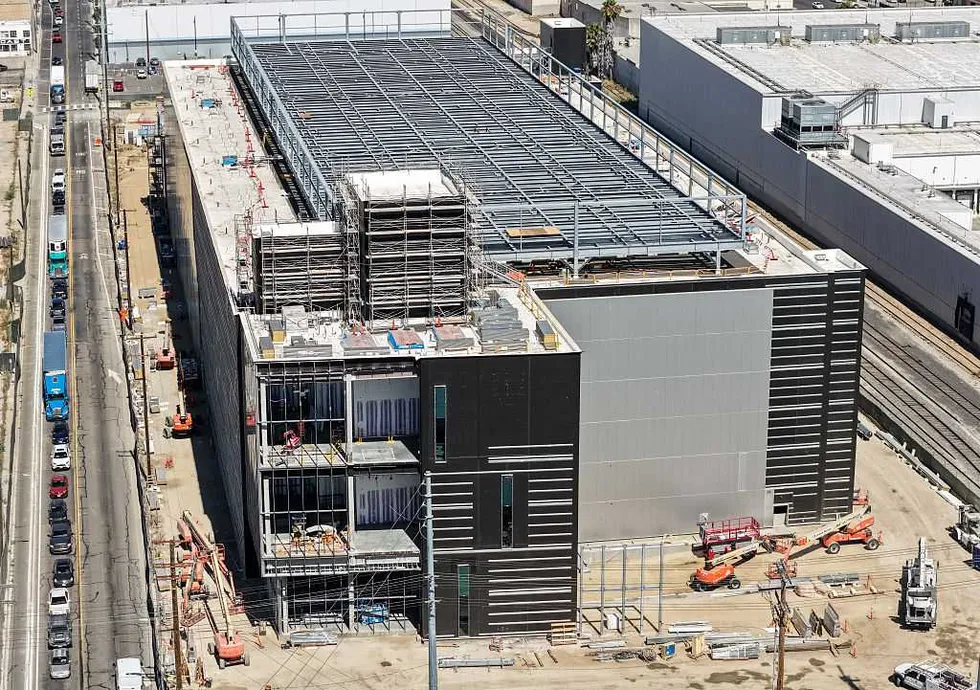
General office construction was $43.8 billion SAAR at the same time in April and is still a smaller figure than data center construction even when combined with other categories, such as financial offices.
Total private office construction spending is a reported $97.4 billion SAAR, meaning data centers account for about 52%. In fact, Bloomberg reported in June that data centers are responsible for 2.3% of all construction spending in the United States.
Anirban Basu, chief economist at Associated Builders and Contractors, told outlet Data Center Knowledge that unlike other sectors, data center construction is not nearly as impacted by high materials costs or borrowing because "so much investment is financed by the free cash flow of hyperscalers, who are desperately pursuing global AI dominance."
"The fact that data center construction spending exceeds that of traditional office spending reflects both the magnitude of the artificial intelligence investment supercycle and a lagging office market hampered by still pervasive remote work and elevated project financing costs," Basu said.
RELATED: The electric vehicle market is out of gas — you can guess who's freaking out

Research from Brookings in May showed that data centers have a large impact on local jobs as well. The report claimed that counties see private employment increase by 4% to 5% in five to six years after their first large data center.
This also causes an increase in construction employment at 11% and a 22% increase in IT jobs. Workers also see modest wage gains of about 3% to 4%, while at the same time, there is no significant effect on the costs of homes.
However, the study stated that while job creation certainly does happen, it is less than the industry claims, by about three times.
Like Blaze News? Bypass the censors, sign up for our newsletters, and get stories like this direct to your inbox. Sign up here!
Continue reading...
[H/T Blaze Media]


