








Kickball during gym class and Nerf basketball in your friend’s basement are where you expect a ball in play to hit the roof. Cul-de-sac Wiffle ball is where the outfielder needs to adjust when a fly ball hits a wire.
Now you can add playoff baseball to these lists.
In two separate Major League playoff games over the course of three days, high fly balls were deflected by the roof structures of two different stadiums. In both cases, an outfielder deftly judged the diverted ball and caught it for an out. These high-altitude caroms sparked cries to ban indoor baseball.
Baseball is supposed to be played outdoors, on real grass. The traditionalists are correct about that. But in the vast geographical expanse that is North America, there is so much climatic variation that nearly a dozen Major League clubs have put roofs over their fields at some point.
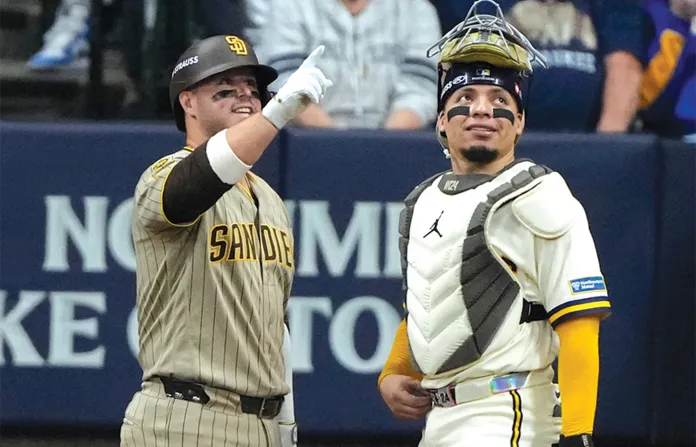
San Diego Padres’s Ty France talks to Milwaukee Brewers’s William Contreras about hitting a cable near the roof in Game 1 of a National League Divisional playoff series Oct. 4 in Milwaukee. (Chris Carlson/AP)
" data-large-file="https://www.washingtonexaminer.com/wp-content/uploads/2026/10/YL.Roofball.101426.jpg?w=696" height="658" width="1024" src="https://www.washingtonexaminer.com/wp-content/uploads/2026/10/YL.Roofball.101426.jpg?w=696" alt="San Diego Padres’s Ty France talks to Milwaukee Brewers’s William Contreras about hitting a cable near the roof in Game 1 of a National League Divisional playoff series Oct. 4 in Milwaukee. (Chris Carlson/AP)" class="wp-image-4760554" style="width:742px;height:auto" srcset="https://www.washingtonexaminer.com/wp-content/uploads/2026/10/YL.Roofball.101426.jpg 1400w, https://www.washingtonexaminer.com/wp-content/uploads/2026/10/YL.Roofball.101426.jpg?resize=300,193 300w, https://www.washingtonexaminer.com/wp-content/uploads/2026/10/YL.Roofball.101426.jpg?resize=768,494 768w, https://www.washingtonexaminer.com/wp-content/uploads/2026/10/YL.Roofball.101426.jpg?resize=1024,658 1024w, https://www.washingtonexaminer.com/wp-content/uploads/2026/10/YL.Roofball.101426.jpg?resize=150,96 150w, https://www.washingtonexaminer.com/wp-content/uploads/2026/10/YL.Roofball.101426.jpg?resize=696,447 696w, https://www.washingtonexaminer.com/wp-content/uploads/2026/10/YL.Roofball.101426.jpg?resize=1068,687 1068w" sizes="(max-width: 1024px) 100vw, 1024px">
San Diego Padres’s Ty France talks to Milwaukee Brewers’s William Contreras about hitting a cable near the roof in Game 1 of a National League Divisional playoff series Oct. 4 in Milwaukee. (Chris Carlson/AP)
The Houston Astros, not wanting to subject their fans or players to summer humidity, opened the Astrodome in 1965, where AstroTurf made its debut.
Toronto, with the opposite problem — snow and frigid weather in April and October — built the first retractable dome. Many other teams have followed suit, including the Tampa Bay Rays with a dome over Tropicana Field (which feels like a large, soulless warehouse), and the retractable dome at Milwaukee’s American Family Field.
Domes for soccer and football don’t pose the same problem they do for baseball: In baseball, you see, balls are often hit very high in the air.
Hall of Famer Mike Schmidt was the first major leaguer to hit a ball off the roof in a game, according to most accounts. More precisely, Schmidt’s fly ball hit a speaker hanging from the roof of the Astrodome. It bounced to the ground, and he got a single.
Different stadiums over time have had different ground rules. For instance, when Mets slugger Darryl Strawberry hit the Olympic Stadium roof in Montreal in 1988, it was ruled a home run.
On Saturday evening, Oct. 3, it was below 60 degrees in Milwaukee with light rain in the forecast, and so the Brewers had their dome closed for the first game of their playoff series against the Padres. Ty France of the Padres came up in the ninth inning with a chance to be a hero — the tying run was on first base, and he was the potential go-ahead run.
France hit a sky-high bomb to left field, which looked like it might go out. That’s when it hit a wire and dropped toward shallow left, where the Brewers’ Jackson Churio made the catch. Under the ground rules, the ball was live off the wire, and so France was out. The next batter made the final out, and the Brewers won by one.
PENNSYLVANIA’S VICE ECONOMY
The Monday night event in Tampa was a bit weirder but less momentous. The Yankees’ Spencer Jones hit a pop-up that landed on a catwalk 142 feet off the ground. Had it stayed up there, Jones would have had a ground-rule double, but after rattling around a bit, the ball came down in shallow center, where Rays right fielder Victor Mesa had come over to help and recorded the out.
It’s quite the trade-off: Fewer rainouts. Fewer 100-degree or 30-degree days. But more fly balls that are more befitting of fifth grade gym class than world-class playoff games.
Continue reading...
[ H/T Washington Examiner ]