

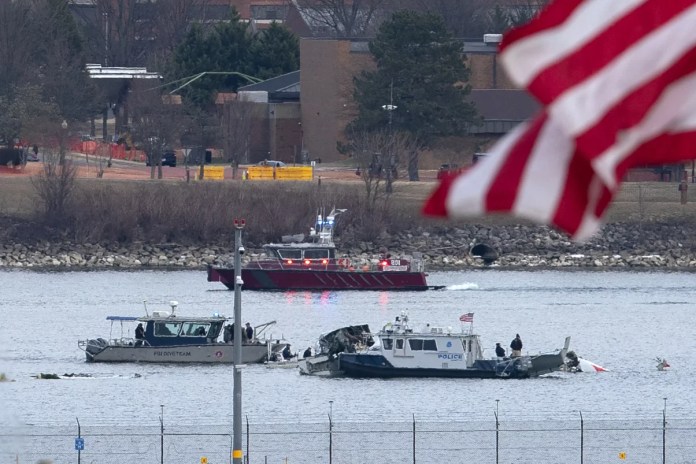
An Army investigation concluded that systemic breakdowns created the conditions that resulted in the tragic midair collision in Washington, D.C. last year between a Black Hawk helicopter and a commercial aircraft.
The January 2025 mid-air collision near Reagan National Airport between a UH-60L Black Hawk and an American Airlines jet killed 67 people, making it one of the deadliest air disasters in recent U.S. history.
The crew on the Black Hawk helicopter “encountered broken radio communications, instrumentation inaccuracies, intense urban lighting while operating under night vision goggles, and gusty winds with turbulence,” the report, of which the Washington Examiner obtained a copy, said. “The combination of these effects significantly impacted the crew’s ability to visually identify and maintain separation from AA5342,” which is a reference to the American Airlines flight involved in the collision.
“Simultaneously, the layers of structural, procedural, and technical risk mitigation failed to prevent a collision,” the report aded.
The lieutenant general who authored the report told the Associated Press, “breakdowns across all layers of conflict management caused this accident,” but “the most salient contributing factor was the two broken radio transmissions” that kept the Black Hawk crew from identifying commercial aircraft. The pilots on the helicopter were wearing night vision goggles at the time of the crash, which limited their field of vision and likely made it difficult to spot the plane.
The airspace around Ronald Reagan Washington National Airport, known as DCA, is extraordinarily congested compared to most other domestic airports. On the specific routes the aircraft and helicopter were using on the night of the deadly crash, investigators found that there was as little as only 75 feet of vertical separation between them.
Officials from Sikorsky, the manufacturer of the Black Hawk helicopter, and the Army testified last year that the Black Hawk’s barometric altimeter can be off by as much as 130 feet — well within the 75 foot range of vertical separation expected between helicopters, which are directed to maintain a maximum altitude of 200 feet, and the precision approach path indicator (PAPI) path for runway 33 at DCA — especially at low altitudes and high speeds, or when carrying external fuel tanks. The Black Hawk that was involved in the crash was carrying extra fuel tanks.
Another part of the Army’s report states that the Automatic Dependent Surveillance-Broadcast (ADSB), which helps aircraft track exact locations of other aircraft in its vicinity, “failed to transmit during the flight due to an incorrect time Source Reference Code (SRC) configuration.”
This report largely reinforces the points of concern raised in the National Transportation Safety Board investigation as well.
The government and Army response has frustrated the families of people who were killed in the crash, who have called for aviation reform to prevent similar tragedies.
NEW HEGSETH COUNTER-DRONE HOMELAND SECURITY MEMO SAYS ‘ACCEPT PRUDENT RISKS’ BUT DON’T ‘CUT CORNERS’
“We have waited long enough. We waited for the NTSB. We waited for the Army. Both investigations are complete, and both make clear that collision avoidance technology must be part of the solution. There is nothing left for Congress to wait for,” the Families of Flight 5342 said in a statement.
“While this report examines systemic causes, it does not assign individual leadership accountability for the cascading failures that caused this catastrophe. That is why we again call for the Army Inspector General to perform the independent audit formally requested by 24 U.S. Senators well over a year ago,” they said. “It’s time to do your job.”
Continue reading...
[ H/T Washington Examiner ]