







Apple Flat After Mixed Results: Strong iPhone Sales Offset By Weak China Revenue, Declining Margins And Buybacks
As we previewed earlier, today's AAPL earnings report will be the first for Apple with new CEO John Ternus in charge. He technically has shared responsibility over the quarter, with his start date taking place on Sept. 1. But the quarter actually began several weeks before then when Tim Cook, now executive chairman, was still in the CEO’s office. We’ll be paying close attention to Ternus’s opening statement, when he’ll have his first extended chance to make an impression on Wall Street.
As we also noted, some of the key things to pay attention to will be: how much of the call is led by Ternus, how many questions he answers, how much he hands off to CFO Kevan Parekh and if COO Sabih Khan will be on the call ( which would be a first). As BBG notes, when Steve Jobs was CEO, Tim Cook - then COO - partook and led most of the company’s earnings calls. Given Ternus’s lack of business, financial and sales experience, it’s worth watching who handles what moving forward.
As for the numbers, Wall Street expects growth to slow. Apple forecast Q4 revenue growth of between 9% and 11%. Wall Street is looking for a number around $113.4 billion, which would land it on the high end of that range. Keep in mind that the period would only include a couple of weeks of new iPhone sales.
Naturally, the big concern is holiday quarter guidance. As Bloomberg's Mark Gurman notes, few people can buy an iPhone Duo right now. There is no regular iPhone 18. There is no new iPhone Air. The iPhone 18 Pro and iPhone 18 Pro Max are worthless year-over-year upgrades for iPhone 17 buyers. The iPhone 17 Pro and iPhone 17 Pro Max were blockbuster upgrades. The comparables for Q1 2027 are going to be extremely challenging. Wall Street is looking for Q1 revenue that’s north of $152 billion. It’ll be hard. We’ll soon see what the company is forecasting.
The highlight will be the iPhone Duo, which has been basically impossible to find since it went on sale on launch day (perhaps because so many show screen defects). Pre-orders placed soon after launch aren’t arriving until the end of January, and new inventory is thin at retail stores. AI bots are buying units within 30 to 60 seconds of them hitting the company’s online reservation portal, so getting this thing has been a huge challenge, assuming the demand is as lively as the narrative suggests.
“Apple’s ability to fulfill surging demand for its first foldable smartphone, Duo, will likely be central to its fiscal 4Q26 earnings call,” says Anurag Rana, senior analyst at Bloomberg Intelligence. “If supply constraints persist, consensus 1Q27 iPhone growth of 6% appears doable, with a larger sales boost shifting into subsequent quarters.”
“Long delivery times suggest robust Duo uptake,” according to Rana, “and our revised scenario points to 14-16 million units in the first 12 months, up from 10-14 million previously.”
Besides the Duo, Apple has launched many other new products this fall, but many aren’t going on sale until deep into the holiday period. They include the M6 iMac and MacBook Pro, the revamped touch-screen MacBook Pro, the new Apple TV box, OLED iPad mini and the HomeView. But none of those products are huge sellers. It all comes down to the iPhone Duo’s performance in the period, and it seems murky right now due to supply.
With that in mind, here is what AAPL just reported for its fiscal Q4 ended Sept 30:
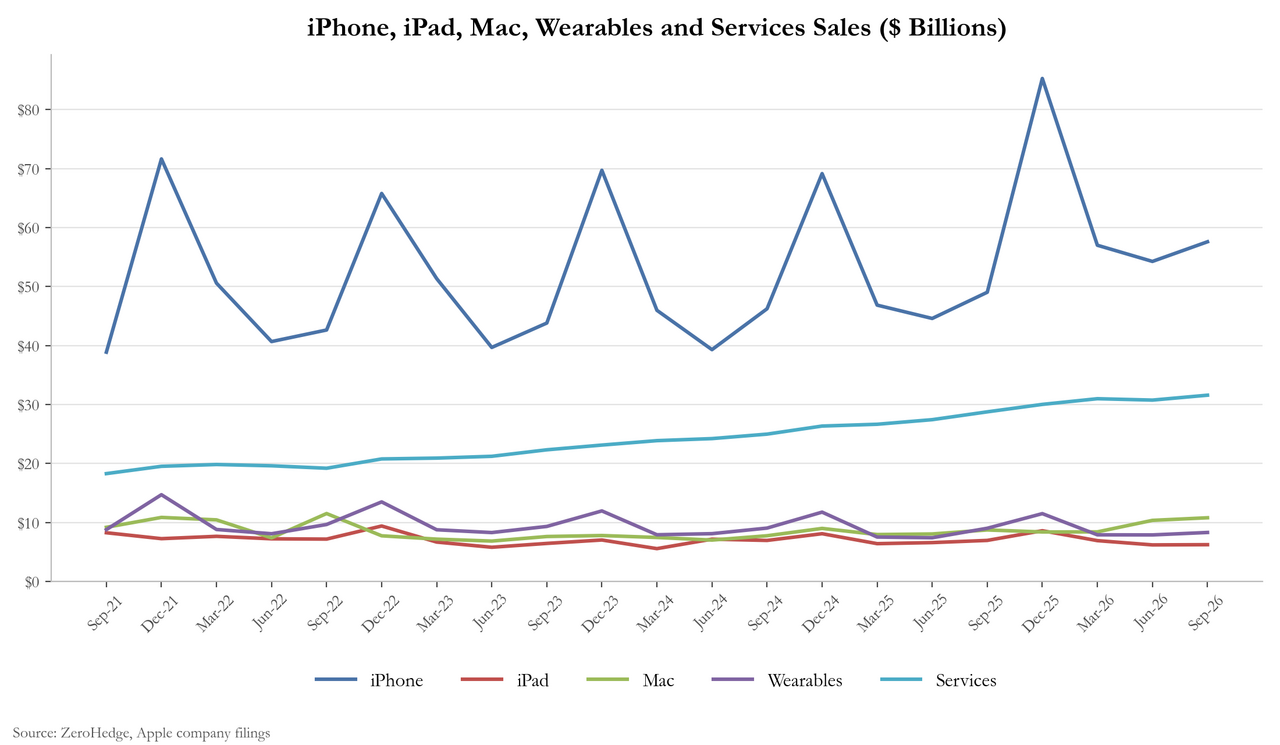
Here is revenue broken down by product:
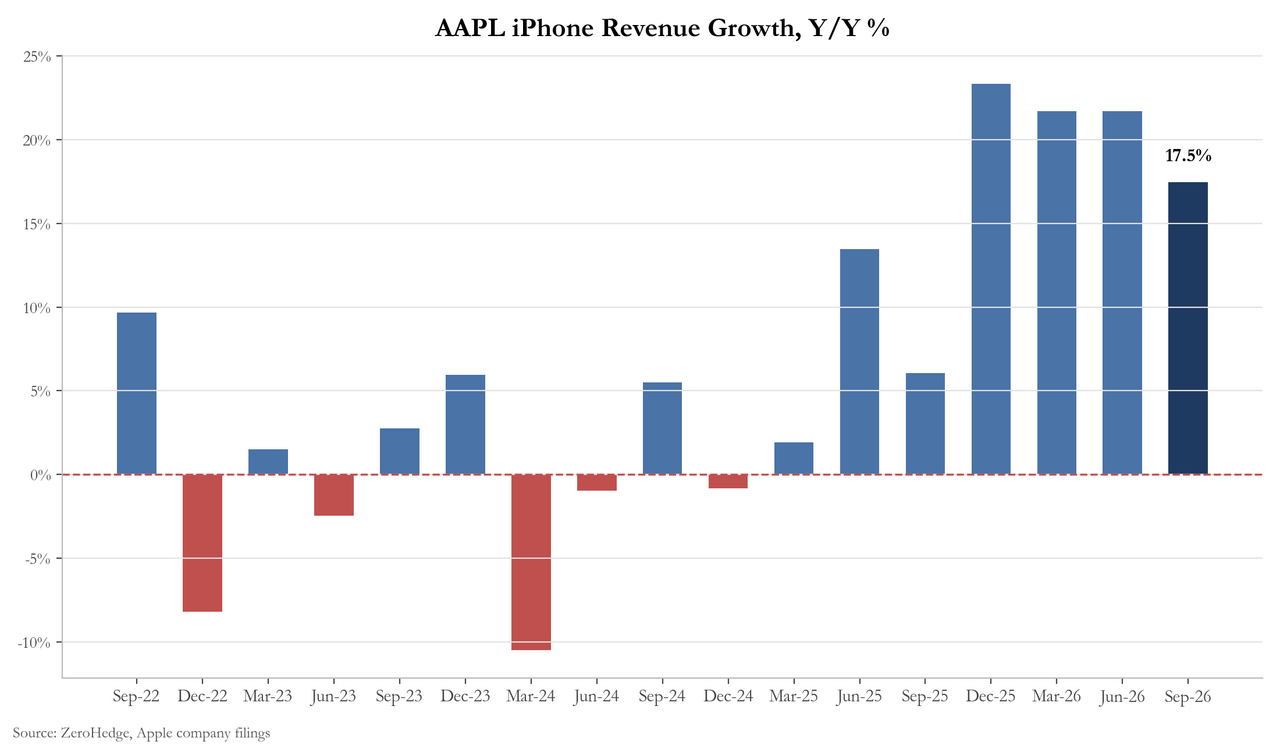
And focusing on the iPhone we see revenue growth is also slowing:
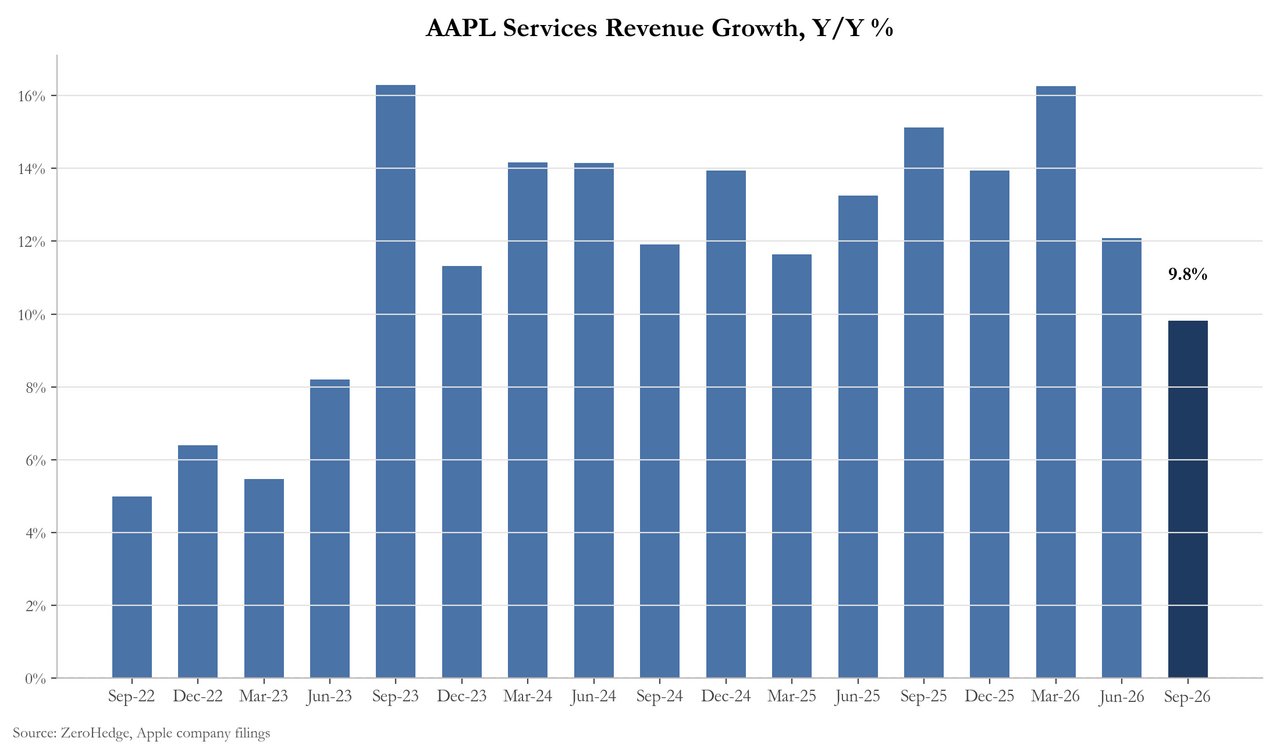
While product were mostly good - thanks to iPhone - despite misses in iPads and Wearables, services revenue of $31.57 billion, +9.8% y/y, just missed estimates of $31.58 billion. Services revenue growth of 9.8% was the lowest since the second quarter of 2023 and the first one below 10% in three years.
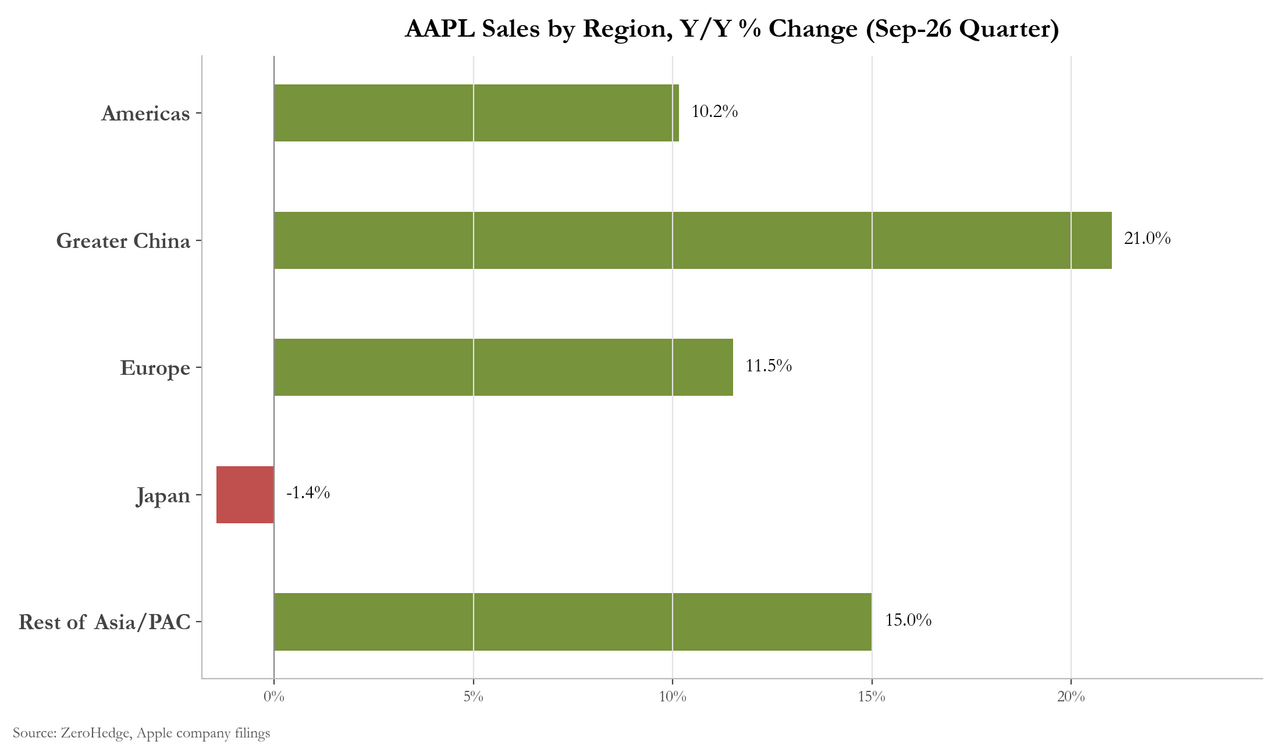
There were more surprises on a geographic breakdown, where solid US and Europe revenues were offset by big misses in China and Japan:
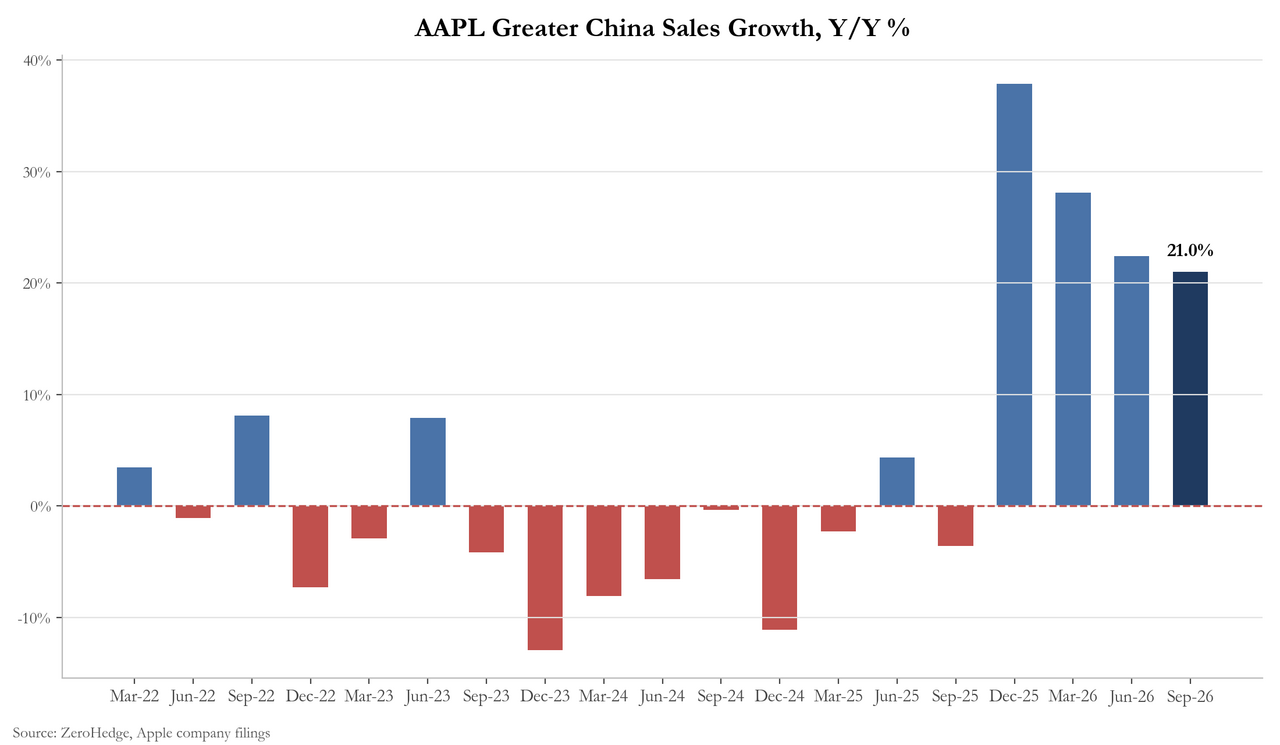
China revenues missed as revenue YoY growth of 21.0% was the lowest in the past year.
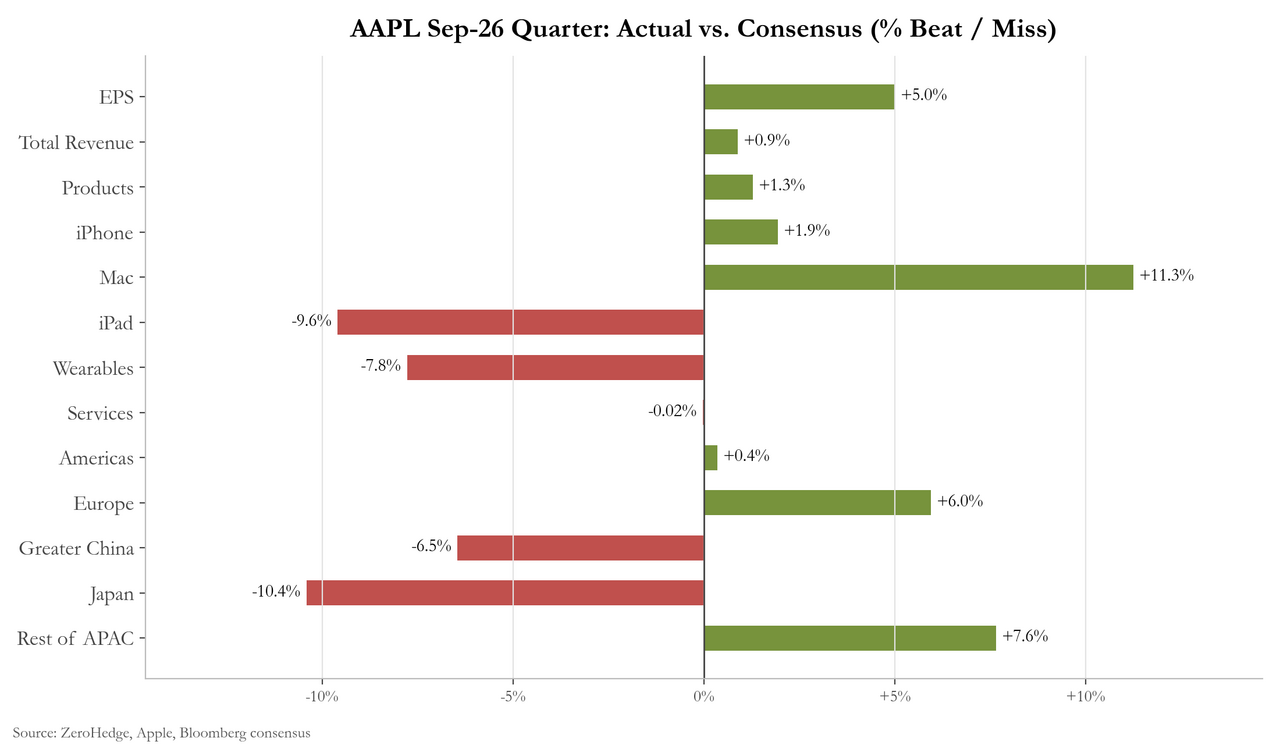
A beat/miss snapshot shows that while most product lines and geographies beat, there were clear misses in iPad, Wearables, Greater China and Japan:
Going down the income statement, margins dropped but were good enough to beat estimates. First, expenses:
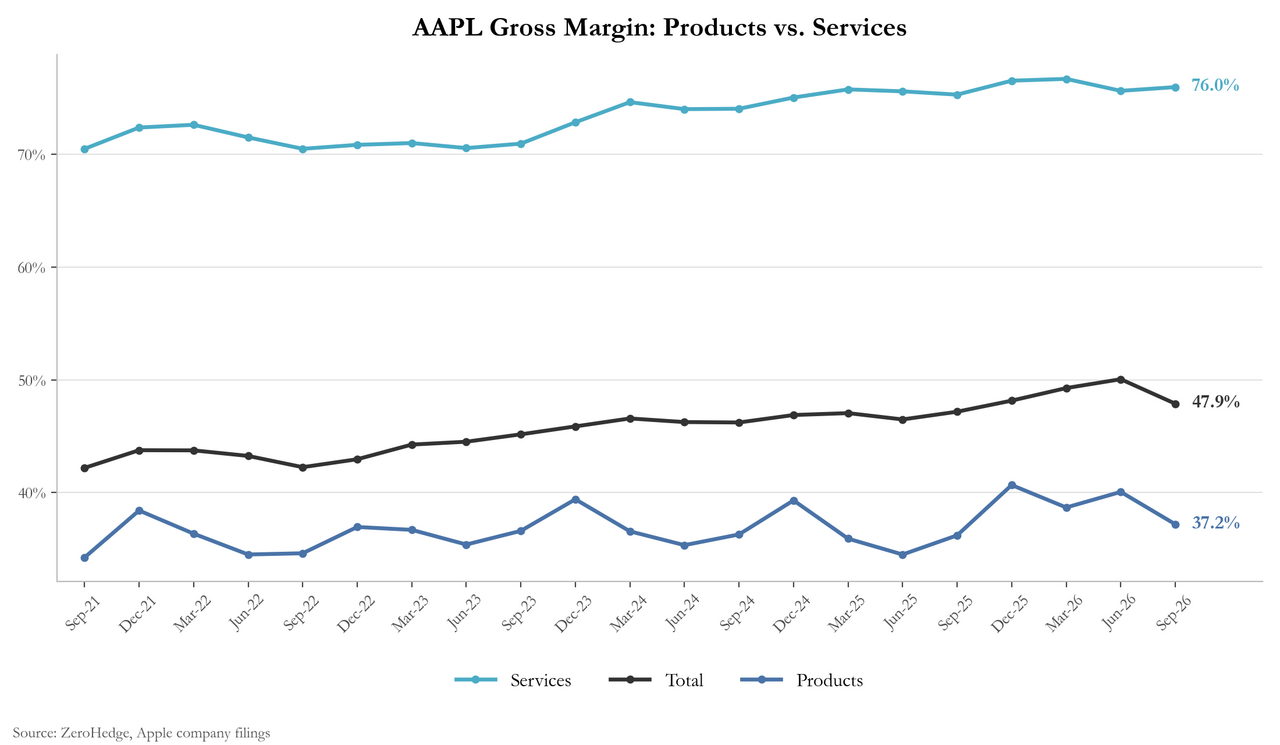
Which brings us to Gross Margin:
While Services margins remained rock-solid, Products dropped to a 1 year low, dragging overall margin to 47.9%, also a one year low.
Commenting on the quarter, Apple's new CEO said that that “today, Apple is proud to report a September quarter revenue record of $114.5 billion, up 12 percent from a year ago, with iPhone reaching a September quarter record and Services reaching an all-time high, capping off our best fiscal year ever."
Ternus continued: “Apple delivered September quarter records for net income and EPS. Our record September quarter capped off a strong fiscal 2026, with all-time record revenue of $479 billion and double-digit EPS growth,” said Kevan Parekh, Apple’s CFO. “We generated $28 billion in operating cash flow during the quarter, allowing us to return $28 billion to shareholders. Thanks to our very high levels of customer satisfaction and loyalty, our installed base of active devices reached a new all-time high across all major product categories and geographic segments.”
Some other items:
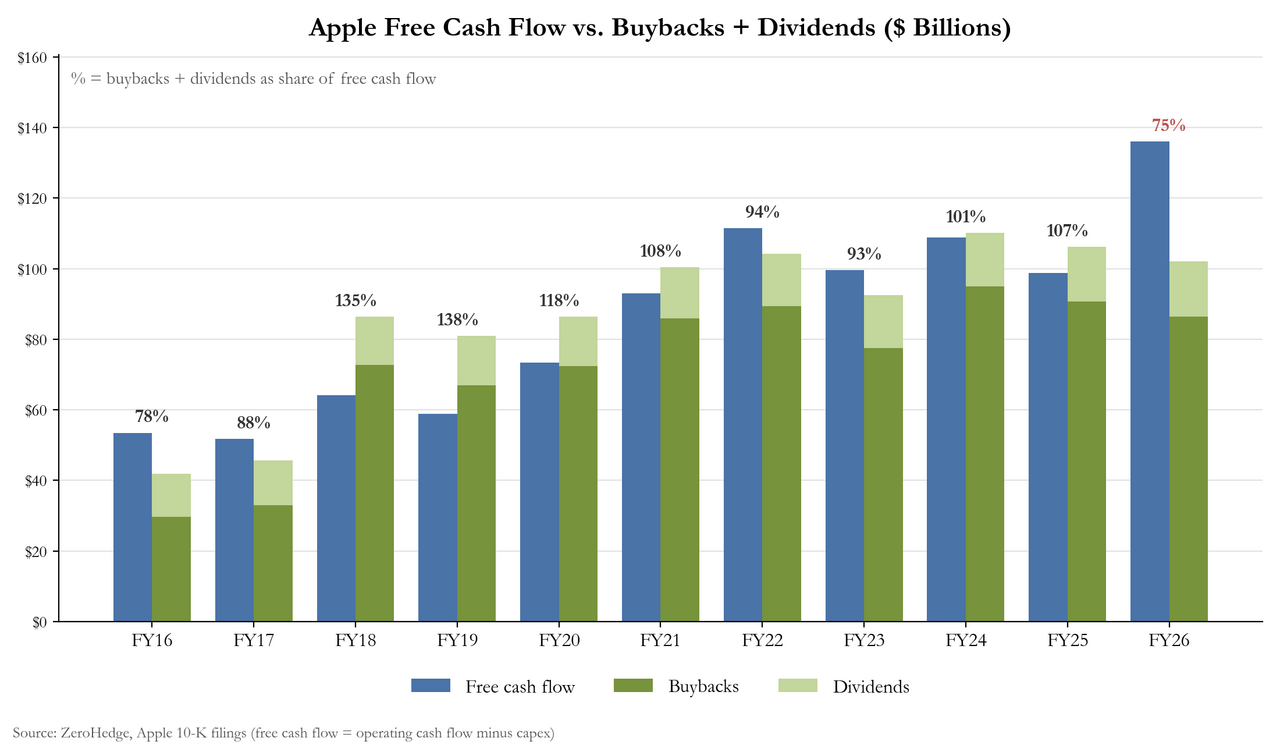
Looking at the company's full year operating cash flow, it rose 30% to $145.1bn. At the same time, capex fell to $9.0bn from $12.7bn, which leaves free cash flow of about $136bn, up roughly 38%.
Still, despite the surge in cash flow, buybacks shrank: Apple repurchased $86.4bn of stock vs. $90.7bn in FY25. Dividends were $15.7bn.
Total shareholder returns of about $102bn were only about 75% of free cash flow; this is notable since in past years Apple returned more than it generated, as part of its push toward a net-zero cash position.
The declining buyback meant that net cash rose to about $57bn from about $34bn a year ago. Cash plus marketable securities was $136.9bn, against total debt of $80.1bn. Apple paid down about $18bn of debt: term debt fell to $78.1bn from $90.7bn, and commercial paper fell to $2.0bn from $8.0bn.
So net cash is growing again, while buybacks shrink and R&D jumps 32%; hardly the stuff to make shareholders too excited.
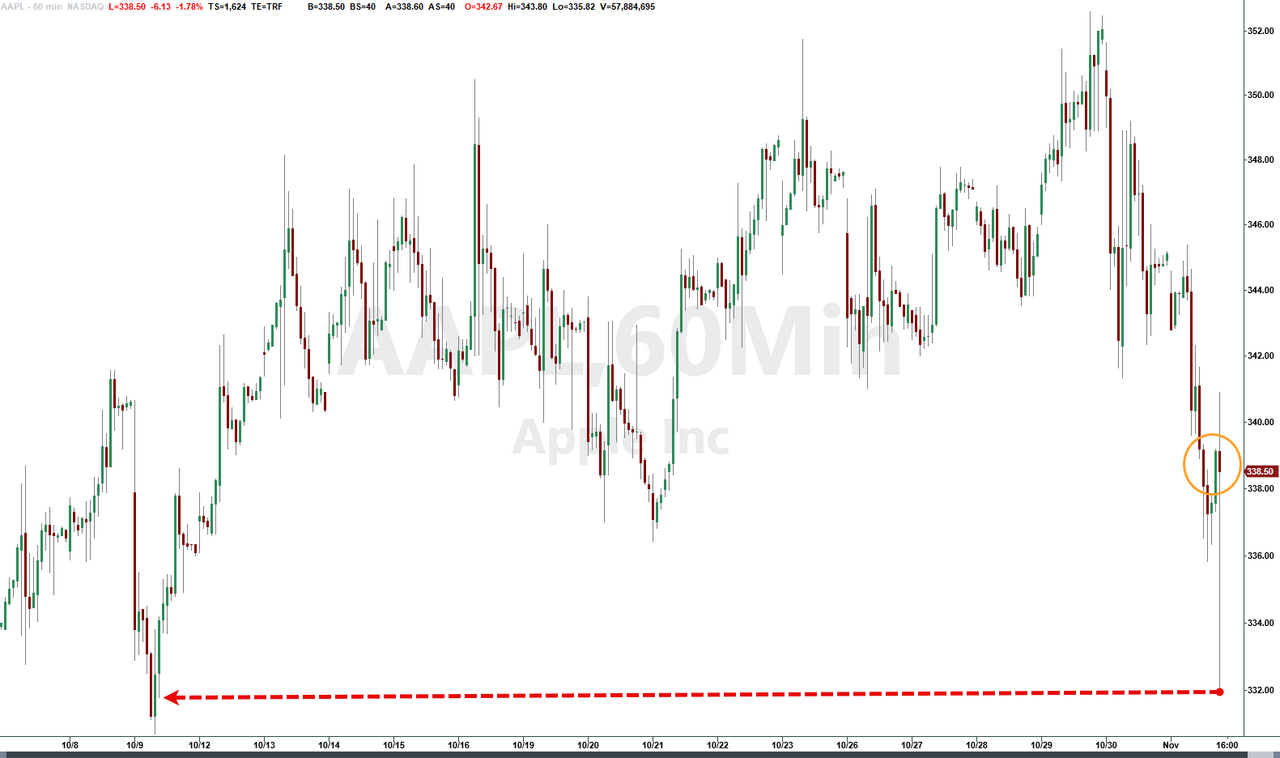
And sure enough, whether it was the sporadic misses across product lines, or the big miss in Chinese revenue growth, AAPL stock initially kneejerked lower before rising to roughly unchanged.
Expect a bigger move once the call begins.
Tyler Durden Mon, 11/02/2026 - 16:54
Continue reading...
[ H/T ZeroHedge ]
As we previewed earlier, today's AAPL earnings report will be the first for Apple with new CEO John Ternus in charge. He technically has shared responsibility over the quarter, with his start date taking place on Sept. 1. But the quarter actually began several weeks before then when Tim Cook, now executive chairman, was still in the CEO’s office. We’ll be paying close attention to Ternus’s opening statement, when he’ll have his first extended chance to make an impression on Wall Street.
As we also noted, some of the key things to pay attention to will be: how much of the call is led by Ternus, how many questions he answers, how much he hands off to CFO Kevan Parekh and if COO Sabih Khan will be on the call ( which would be a first). As BBG notes, when Steve Jobs was CEO, Tim Cook - then COO - partook and led most of the company’s earnings calls. Given Ternus’s lack of business, financial and sales experience, it’s worth watching who handles what moving forward.
As for the numbers, Wall Street expects growth to slow. Apple forecast Q4 revenue growth of between 9% and 11%. Wall Street is looking for a number around $113.4 billion, which would land it on the high end of that range. Keep in mind that the period would only include a couple of weeks of new iPhone sales.
Naturally, the big concern is holiday quarter guidance. As Bloomberg's Mark Gurman notes, few people can buy an iPhone Duo right now. There is no regular iPhone 18. There is no new iPhone Air. The iPhone 18 Pro and iPhone 18 Pro Max are worthless year-over-year upgrades for iPhone 17 buyers. The iPhone 17 Pro and iPhone 17 Pro Max were blockbuster upgrades. The comparables for Q1 2027 are going to be extremely challenging. Wall Street is looking for Q1 revenue that’s north of $152 billion. It’ll be hard. We’ll soon see what the company is forecasting.
The highlight will be the iPhone Duo, which has been basically impossible to find since it went on sale on launch day (perhaps because so many show screen defects). Pre-orders placed soon after launch aren’t arriving until the end of January, and new inventory is thin at retail stores. AI bots are buying units within 30 to 60 seconds of them hitting the company’s online reservation portal, so getting this thing has been a huge challenge, assuming the demand is as lively as the narrative suggests.
“Apple’s ability to fulfill surging demand for its first foldable smartphone, Duo, will likely be central to its fiscal 4Q26 earnings call,” says Anurag Rana, senior analyst at Bloomberg Intelligence. “If supply constraints persist, consensus 1Q27 iPhone growth of 6% appears doable, with a larger sales boost shifting into subsequent quarters.”
“Long delivery times suggest robust Duo uptake,” according to Rana, “and our revised scenario points to 14-16 million units in the first 12 months, up from 10-14 million previously.”
Besides the Duo, Apple has launched many other new products this fall, but many aren’t going on sale until deep into the holiday period. They include the M6 iMac and MacBook Pro, the revamped touch-screen MacBook Pro, the new Apple TV box, OLED iPad mini and the HomeView. But none of those products are huge sellers. It all comes down to the iPhone Duo’s performance in the period, and it seems murky right now due to supply.
With that in mind, here is what AAPL just reported for its fiscal Q4 ended Sept 30:
- EPS $2.10, vs $1.85 yoy, beating estimates of $2.00
- Revenue $114.48 billion, +12% y/y, beating estimates of $113.47 billion
- Products revenue $82.90 billion, +12% y/y, beating estimate $81.85 billion
- IPhone revenue $57.58 billion, +17% y/y, beating estimates of $56.49 billion
- Mac revenue $10.79 billion, +24% y/y, beating estimates of $9.7 billion
- IPad revenue $6.23 billion, -10% y/y, missing estimates of $6.89 billion
- Wearables, home and accessories $8.30 billion, -7.9% y/y, missing estimates of $9 billion
Here is revenue broken down by product:
And focusing on the iPhone we see revenue growth is also slowing:
While product were mostly good - thanks to iPhone - despite misses in iPads and Wearables, services revenue of $31.57 billion, +9.8% y/y, just missed estimates of $31.58 billion. Services revenue growth of 9.8% was the lowest since the second quarter of 2023 and the first one below 10% in three years.
There were more surprises on a geographic breakdown, where solid US and Europe revenues were offset by big misses in China and Japan:
- Americas rev. $48.68 billion, +10% y/y, beating estimates of $48.51 billion
- Europe revenue $32.01 billion, +12% y/y, beating estimates of $30.21 billion
- Rest of Asia Pacific revenue $9.71 billion, +15% y/y, estimate $9.02 billion
- Greater China rev. $17.54 billion, +21% y/y, missing estimate $18.75 billion
- Japan revenue $6.54 billion, -1.4% y/y, missing estimate $7.3 billion
China revenues missed as revenue YoY growth of 21.0% was the lowest in the past year.
A beat/miss snapshot shows that while most product lines and geographies beat, there were clear misses in iPad, Wearables, Greater China and Japan:
Going down the income statement, margins dropped but were good enough to beat estimates. First, expenses:
- Cost of sales $59.66 billion, +10% y/y, estimate $59.55 billion
- Total operating expenses $19.19 billion, +21% y/y, estimate $19.19 billion
- Research and development operating expenses $11.73 billion, +32% y/y, estimate $11.63 billion
- SG&A operating expense $7.46 billion, +5.8% y/y, estimate $7.65 billion
Which brings us to Gross Margin:
- Gross margin $54.82 billion, +13% y/y, estimate $53.93 billion
While Services margins remained rock-solid, Products dropped to a 1 year low, dragging overall margin to 47.9%, also a one year low.
Commenting on the quarter, Apple's new CEO said that that “today, Apple is proud to report a September quarter revenue record of $114.5 billion, up 12 percent from a year ago, with iPhone reaching a September quarter record and Services reaching an all-time high, capping off our best fiscal year ever."
Ternus continued: “Apple delivered September quarter records for net income and EPS. Our record September quarter capped off a strong fiscal 2026, with all-time record revenue of $479 billion and double-digit EPS growth,” said Kevan Parekh, Apple’s CFO. “We generated $28 billion in operating cash flow during the quarter, allowing us to return $28 billion to shareholders. Thanks to our very high levels of customer satisfaction and loyalty, our installed base of active devices reached a new all-time high across all major product categories and geographic segments.”
Some other items:
- Cash and cash equivalents $36.31 billion, +1% y/y, missing the estimate $46.79 billion
- Total current assets $173.86 billion, +18% y/y, estimate $163.56 billion
- Total current liabilities $169.92 billion, +2.6% y/y, estimate $158.95 billion
Looking at the company's full year operating cash flow, it rose 30% to $145.1bn. At the same time, capex fell to $9.0bn from $12.7bn, which leaves free cash flow of about $136bn, up roughly 38%.
Still, despite the surge in cash flow, buybacks shrank: Apple repurchased $86.4bn of stock vs. $90.7bn in FY25. Dividends were $15.7bn.
Total shareholder returns of about $102bn were only about 75% of free cash flow; this is notable since in past years Apple returned more than it generated, as part of its push toward a net-zero cash position.
The declining buyback meant that net cash rose to about $57bn from about $34bn a year ago. Cash plus marketable securities was $136.9bn, against total debt of $80.1bn. Apple paid down about $18bn of debt: term debt fell to $78.1bn from $90.7bn, and commercial paper fell to $2.0bn from $8.0bn.
So net cash is growing again, while buybacks shrink and R&D jumps 32%; hardly the stuff to make shareholders too excited.
And sure enough, whether it was the sporadic misses across product lines, or the big miss in Chinese revenue growth, AAPL stock initially kneejerked lower before rising to roughly unchanged.
Expect a bigger move once the call begins.
Tyler Durden Mon, 11/02/2026 - 16:54
Continue reading...
[ H/T ZeroHedge ]