


This week, the second and final one of the October sitting, the justices heard two oral arguments and added three cases to the oral argument docket while continuing to manage emergency applications. We’re expecting an order list on Monday, but, after that, things should be a little quieter at One First Street until the November sitting begins on Nov. 2.
At the Court This Week
Today, the justices will meet in a private conference to discuss cases and vote on petitions for review. Orders from today’s conference are expected on Monday at 9:30 a.m. EDT.
In an emergency application that was publicly docketed on Thursday, three cities and a group that provides legal services to immigrants asked the Supreme Court to pause an agreement between Texas and the Department of Justice that prevents enforcement of a Biden-era rule allowing immigration judges to pause certain deportation proceedings. For more on the dispute, see the On Site section below.
On Wednesday, the Supreme Court granted a request from the Federal Communications Commission to block a ruling by a federal appeals court that would have required the FCC to rule quickly on a challenge to its “public notice” extending favorable advertising rates to political parties and joint fundraising committees. Justices Sonia Sotomayor and Ketanji Brown Jackson indicated, without explanation, that they would have denied the application.
Also on Wednesday, the justices heard oral argument in Salazar v. Paramount Global, on whether and how the 1988 Video Privacy Protection Act, which was enacted after the Washington City Paper reported on Supreme Court nominee Robert Bork’s video rental history, applies in the internet era. Here are the links to our Case Preview and Argument Analysis.
On Tuesday, the justices heard argument in Beaird v. United States, on the degree of deference that courts owe to the U.S. Sentencing Commission’s commentary on applying federal sentencing guidelines. Here is the link to our Case Preview.
Also on Tuesday, the court released a list of orders from the justices’ Oct. 9 conference, announcing, among other things, that it had added three new cases to the oral argument docket for the 2026-27 term. The cases address what kinds of orders trial courts can issue in disputes over access to government information from organizations such as the U.S. Department of Government Efficiency, whether working as a cook in a camp run by a terrorist group qualifies as providing “material support” for terrorism under federal immigration law, and whether a certificate of appealability may be granted to a prisoner whose claim is foreclosed by his own circuit’s precedent but would be allowed to proceed in a different circuit.
On Sept. 28, the Trump administration asked the Supreme Court to clear the way for the Federal Bureau of Prisons to implement its new policy on healthcare and accommodations for transgender inmates, which would prevent such inmates from obtaining gender-transition surgeries, hormone therapy, and “social accommodations.” The dispute is now fully briefed, and the court’s decision could come at any time.
Morning Reads
Legal Battle Over Use of Student IDs to Vote in NH Heads to U.S. Supreme Court
Zach Laird, InDepthNH
A dispute over “the use of student IDS to vote” in New Hampshire has arrived on the Supreme Court’s interim docket after the U.S. Court of Appeals for the 1st Circuit declined to pause a district-court ruling allowing use of student IDs for establishing a voter’s identity during voter registration, according to InDepthNH. The case addresses New Hampshire’s “House Bill 323 – which made student IDs a no longer valid form of identification to obtain a ballot” – and follow-up guidance from Secretary of State David M. Scanlan on how to implement HB 323, which said “that student IDs cannot be used as proof of ID when registering to vote, requesting an absentee ballot, or checking in to vote in an election.” Scanlan has asked the justices to clear the way for the guidance to take full effect and prevent student IDs from being used during voter registration.
GOP Senators Push Supreme Court to Review Eastman’s Disbarment
Olivia Alafriz, Bloomberg Law
Last month, attorney John Eastman filed a petition for review with the Supreme Court, asking the justices “to review his disbarment over his role in efforts to overturn the 2020 presidential election.” On Wednesday, “Sen. Mike Lee (R-Utah) and Sen. Ted Cruz (R-Texas), both lawyers and members of the Senate Judiciary Committee,” filed a friend-of-the-court brief in support of Eastman’s petition, telling the court that “Eastman’s disbarment stemmed from the weaponization of the bar disciplinary process by political activists,” according to Bloomberg Law. “Lee and Cruz wrote that malpractice and court sanctions already protect clients from deficient counsel” and “also argued that ‘ideological attorney discipline’ could have a chilling effect and burden clients’ ability to find willing, independent counsel.” Bloomberg Law noted that, although the Supreme Court “has reversed disbarments in the past, intervention in state bar proceedings is rare.”
The 3rd Circuit Upholds the Gun Rights of a Man Who Committed a Nonviolent Misdemeanor 2 Decades Ago
Jacob Sullum, Reason
In the early 2000s, Edward Williams was twice convicted of driving under the influence. About a decade later, he realized that, as a result of the second of these convictions, he was barred from owning a gun under 18. U.S.C. 922(g)(1), which prohibits firearm possession by anyone convicted of “a crime punishable by imprisonment for a term exceeding one year.” Williams then filed a lawsuit over 922(g)(1), contending it was unconstitutional as applied to him. This week, the U.S. Court of Appeals for the 3rd Circuit agreed, holding that applying the statute to Williams “was not ‘consistent with this Nation’s historical tradition of firearm regulation,’” according to Reason. The ruling deepened a disagreement between the federal courts of appeals over the Second Amendment rights of “people with nonviolent felony records.” Reason noted that “
A Houseboat Vacation and a Failed Courtship
Ed Whelan, Confirmation Tales
In a post for his Substack, Ed Whelan began exploring the unusual circumstances surrounding President Ronald Reagon’s nomination of Sandra Day O’Connor to the Supreme Court. “Chief Justice Warren E. Burger deserves the lion’s share of the credit” for getting O’Connor on Reagan’s radar, according to Whelan, who noted that Burger became her friend and advocate after meeting her during a “houseboat vacation” on Utah’s Lake Powell. Former White House counsel Fred Fielding told Whelan that Burger spoke to him about O’Connor soon after Reagan took office. “He mentioned having met a most interesting state court jurist on a houseboat trip, Sandra O’Connor, and having been with her at a legal conference in London. It was obvious to me he was trying to plant her name in my mind,” Fielding said.
Hard Questions About Court Expansion
Steve Vladeck, One First (paywalled)
In a post for his Substack, Steve Vladeck pushed back against the idea that “expanding the Supreme Court is the only Court reform worth pursuing,” calling this contention “deeply unhelpful and unfortunate.” Expansion, he contended, “not only won’t do anything to solve the underlying problem (the Court’s complete lack of accountability), but it will almost certainly produce some (to my mind) deeply undesirable, if not disastrous, medium- and long-term effects along the way.” Among other things, Vladeck urged proponents of this type of court reform to consider how to avoid “touching off a race to the bottom, where each time one party controls the House, Senate, and presidency, it expands the Court to ensure an ideologically and politically sympathetic majority.”
On Site This Week
Court News
Challengers ask court to pause agreement between Texas and the DOJ on deportation proceedings
Three cities and a group that provides legal services to immigrants have asked the justices to pause an agreement between Texas and the Department of Justice that they described as the product of “egregious collusion.” A ruling in the challengers’ favor would temporarily restore a Biden-era regulation that allows immigration judges to suspend some deportation proceedings – when, for example, a crime victim or witness is seeking immigration relief, such as asylum – while the challengers’ appeal in the lower federal courts is ongoing.
From the SCOTUSblog Team
The immigration term
Since late April, the court has granted review in seven immigration-related cases. One of those was dismissed as moot last month, but six remain, meaning that around one-fifth of the cases currently on the oral argument docket involve immigration. What’s more, the justices will soon consider several more high-profile petitions for review in this area.
Contributor Corner
The Tribal Supreme Court Project
In his Indigenous Docket column, Matthew L.M. Fletcher offered a brief history of the Tribal Supreme Court Project, which was launched 25 years ago with the goal of establishing “an infrastructure that would allow tribal interests to reach better outcomes in Supreme Court litigation.” As a result of this project, “[t]ribal interests that were floundering, often embarrassed by unanimous decisions untempered by a dissenting opinion, now stand a much more sporting chance before the court.”
Contributor Corner
The Second Amendment and AR-15s: an unexplained betrayal of originalism?
In his SCOTUSCrim column, Rory Little highlighted Justice Antonin Scalia’s use of the phrase “in common use at the time” in a major Second Amendment case from 2008, District of Columbia v. Heller, exploring how this potential limitation on gun rights has been abandoned over time and the implications this has for whether possession of AR-15s is constitutionally protected by the Second Amendment.
Relist Watch
Hooch, hardball, and Halloween
In his Relist Watch column on Wednesday, John Elwood explored six petitions for review that will get a second look from the justices at their private conference today, including two addressing the federal ban on home distilling.
Contributor Corner
A snapshot of the Supreme Court's 2025-26 interim relief docket – and some surprises on it
In her In the Interim column on Tuesday, Taraleigh Davis shared key takeaways from the Interim Relief Docket Stat Pack for the recently concluded 2025-26 term, highlighting, among other things, the decrease in emergency applications from the Trump administration.
Court News
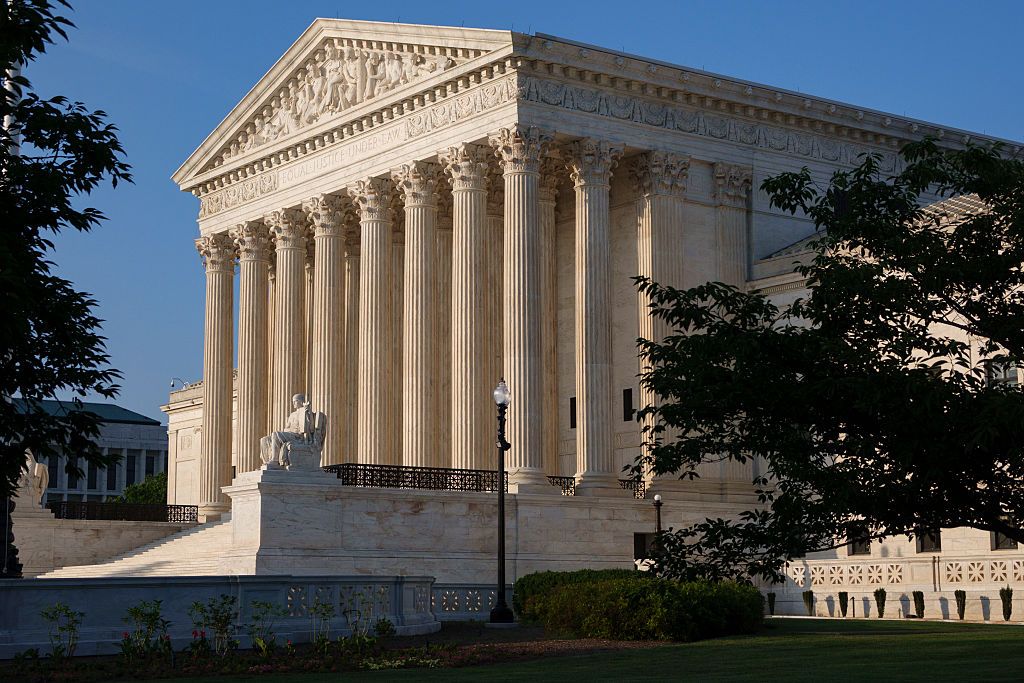
Court grants cases on DOGE data dispute, prisoners’ rights, and what qualifies as “material support” for terrorism
The Supreme Court on Tuesday added three new cases to its oral argument docket for the 2026-27 term. The cases include U.S. DOGE Service v. U.S. District Court for the District of Columbia, on what types of discovery orders are appropriate in disputes over access to government information.
Podcasts
Advisory Opinions
The Secrecy in Courts Dilemma
Sarah Isgur and David French are joined by Vince Chhabria, a judge for the U.S. District Court for the Northern District of California, and Stanford Law School Professor Nora Engstrom to discuss the incredibly high number of motions granted to seal documents and the line between secrecy and protecting the public interest. They also discuss three new cases that SCOTUS added to its oral argument docket on Tuesday.
A Closer Look
Justice Philip Pendleton Barbour
The only justice to serve as Speaker of the House and a Supreme Court justice, Justice Philip Barbour served on the court less than five years, a tenure many have deemed too brief to have “a true impact.” We’ll let you be the judge.
Barbour was born in May 1783 in Virginia, though exactly where is disputed – one account places him near Orange County, while Justice Lewis Powell’s account puts him in Williamsburg. (Powell wrote a law review article about all the justices from Virginia, identifying Barbour as the third associate justice from there.) After briefly practicing law in Kentucky, Barbour returned to Virginia in 1802. He and his wife (also his first cousin) had seven children, apparently naming the youngest three boys Quintus, Sextus, and Septimus.
Powell described Barbour’s political ascent as “meteoric,” with Barbour elected to the Virginia House of Delegates in 1812 and to the U.S. House of Representatives in 1814. His older brother, James, served as governor of Virginia while the younger Barbour was in the Virginia House, and served in the Senate when Philip was in Congress. But while James aligned with Henry Clay’s “postwar nationalism,” Philip committed to “agrarian, strict construction, states’ rights.” As part of this, Philip opposed the national bank and protective tariffs, and by one account, was the “first major political figure” to argue that such a tariff was unconstitutional, rather than merely unjust. Both Barbour brothers argued that proposed restrictions on Missouri as a condition of statehood were unconstitutional.
In 1821, Barbour was one of the lawyers for Virginia in Cohens v. Virginia, and argued the position that the Supreme Court had no authority to review a criminal case out of a Virginia state court. Virginia lost on this point; Chief Justice John Marshall held in a unanimous decision that the Supreme Court had appellate jurisdiction to review the Virginia state court’s ruling, writing that “[t]he Constitution and laws of a State, so far as they are repugnant to the Constitution and laws of the United States, are absolutely void.” That December, Barbour replaced the incumbent House Speaker John Taylor of New York, whose antislavery views during the Missouri Compromise debates had cost him support from the South. As the first Speaker of the House from Virginia, Barbour served for the 17th Congress from 1821 to 1823.
When, due to illness, former President James Monroe resigned as president of Virginia’s 1829 convention to revise its constitution, delegates unanimously chose Barbour to succeed him. Barbour was also discussed as a cabinet pick for President Andrew Jackson but was instead given a recess appointment to the federal district court in eastern Virginia in October 1830. Not everyone was a fan of Barbour – former President John Quincy Adams said in 1831 that if Marshall retired, his replacement would be “some shallow-pated wild-cat like Philip P. Barbour fit for nothing but to tear the Union to rags and tatters.”
Southerners, unhappy with Martin Van Buren as Jackson’s vice-presidential nominee, pushed to swap him for Barbour in 1832. Barbour took his name out of the running, allowing Jackson to keep his preferred vice-presidential candidate, Van Buren (while also helping Barbour to get in Jackson’s good graces). Jackson nominated Barbour to the court in December 1835 to take Justice Gabriel Duvall’s seat, and the Senate confirmed him 30-11 on March 15, 1836 – the same day they confirmed Roger Taney as chief justice. Barbour was one of six Jackson appointees to the court, more than any other 19th-century president.
Perhaps Barbour’s most significant opinion came in 1837’s New York v. Miln, which upheld a New York law that regulated ships bringing in immigrants as a valid use of the state’s police power. Barbour used the case to press for a more narrow reading of Congress’ commerce authority and a broader one of state police power, which he described as “unqualified and exclusive.” “[P]ersons,” he wrote, “are not the subject of commerce.”
Barbour dissented only twice on the bench, writing about a dozen opinions and voting most often with his fellow Southerners, Justice John Catron (97.8%) and Taney (97.4%). Joseph Gordon Hylton, who penned Barbour’s encyclopedia entry, wrote that a longer life would almost certainly have made Barbour as fervent a states’ rights champion as his successor, Justice Peter Daniel. (Daniel voted with the majority in Dred Scott v. Sandford.)
Barbour died in his sleep in February 1841 at age 57 from heart disease. This was in the middle of oral arguments in The Amistad Case, which the court decided 7-1 in favor of persons kidnapped illegally from Africa, holding that they were not lawfully enslaved under Spanish law and thus were free individuals.
Justice Joseph Story praised Barbour as “a very conscientious, upright, and laborious judge, whom we all respected for his talents and virtues, and his high sense of duty.” Powell noted that “Barbour’s tenure there was short. ... He wrote few opinions, and consistently voted with Chief Justice Roger B. Taney.”
SCOTUS Quote
Continue reading...
[ H/T SCOTUSblog ]