





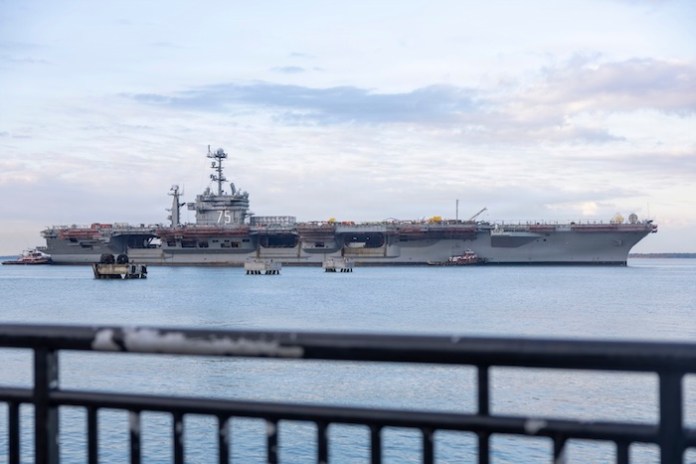
The aircraft carrier USS Harry S. Truman is set to begin its multiyear midlife overhaul, which will set the vessel up for the second half of its 50-year service life.
The giant aircraft carrier, which was commissioned in 1998, departed Naval Station Norfolk on Wednesday and arrived the same day at HII’s Newport News Shipbuilding, where it will begin its Refueling and Complex Overhaul. This week, the Navy announced it awarded HII a fixed-ceiling incentive contract for the RCOH worth up to slightly more than $5.1 billion for the renovations.
“Winning in combat begins with winning in the shipyard,” said Capt. Dan Prochazka, Truman’s commanding officer. “Everything we do during RCOH is ultimately about ensuring Harry S. Truman is ready to fight and win when our nation calls.”
“The work ahead may look different from operations at sea, but it demands the same discipline, teamwork and commitment to mission,” he added. “Our Sailors and shipyard partners are laying the foundation for Truman’s next decades of service, and every production milestone we achieve brings this warship one step closer to returning to the fleet stronger, more capable and ready for combat.”
It had been at home port in Norfolk since June 2025, after it returned from the Middle East following a difficult 251-day deployment that included the U.S. war against the Iranian-backed, Yemen-based Houthis. A couple of months later, the Truman began its former Smart Start period in preparation for the overhaul that’s set to begin.
“Our team has been diligently working to get ahead on this critical engineering and construction project that will prepare USS Harry S. Truman for the second half of her service life,” said Bryan Caccavale, NNS vice president of program management. “When the ship arrives at NNS, we’ll apply that same diligence to working with our suppliers and Navy partners to ensure a successful recapitalization of CVN 75.”
The RHOC accounts for almost a third of all the maintenance and modernization work that an aircraft carrier will need over its service life.
The USS Truman will undergo major upgrades to its propulsion plant and combat systems, and will “include refueling the ship’s reactors, as well as extensive modernization work in thousands of compartments and tanks, as well as on most ship systems,” an HII press release said.
260930-N-KH255-4628 NORFOLK, Va. (Sept. 30, 2026) The Nimitz-class aircraft carrier USS Harry S. Truman (CVN 75) transits the Elizabeth River while departing Naval Station Norfolk for Newport News Shipbuilding to begin the shipyard phase of its Refueling and Complex Overhaul (RCOH). Truman began its formal RCOH Smart Start period in November 2025, preparing the ship and crew for the multi-year maintenance and modernization effort. (U.S. Navy photo by Mass Communication Specialist Seaman Apprentice Stryker Cole)
" data-image-caption="
260930-N-KH255-4628 NORFOLK, Va. (Sept. 30, 2026) The Nimitz-class aircraft carrier USS Harry S. Truman (CVN 75) transits the Elizabeth River while departing Naval Station Norfolk for Newport News Shipbuilding to begin the shipyard phase of its Refueling and Complex Overhaul (RCOH). Truman began its formal RCOH Smart Start period in November 2025, preparing the ship and crew for the multi-year maintenance and modernization effort. (U.S. Navy photo by Mass Communication Specialist Seaman Apprentice Stryker Cole)
" data-large-file="https://www.washingtonexaminer.com/wp-content/uploads/2026/10/USS-Harry-S-Truman.jpg?w=696" src="https://www.washingtonexaminer.com/wp-content/uploads/2026/10/USS-Harry-S-Truman.jpg" alt="The Nimitz-class aircraft carrier USS Harry S. Truman (CVN 75) transits the Elizabeth River while departing Naval Station Norfolk for Newport News Shipbuilding to begin the shipyard phase of its Refueling and Complex Overhaul." class="wp-image-4751976" srcset="https://www.washingtonexaminer.com/wp-content/uploads/2026/10/USS-Harry-S-Truman.jpg 700w, https://www.washingtonexaminer.com/wp-content/uploads/2026/10/USS-Harry-S-Truman.jpg?resize=300,200 300w, https://www.washingtonexaminer.com/wp-content/uploads/2026/10/USS-Harry-S-Truman.jpg?resize=150,100 150w, https://www.washingtonexaminer.com/wp-content/uploads/2026/10/USS-Harry-S-Truman.jpg?resize=696,464 696w" sizes="(max-width: 700px) 100vw, 700px">
260930-N-KH255-4628 NORFOLK, Va. (Sept. 30, 2026) The Nimitz-class aircraft carrier USS Harry S. Truman (CVN 75) transits the Elizabeth River while departing Naval Station Norfolk for Newport News Shipbuilding to begin the shipyard phase of its Refueling and Complex Overhaul (RCOH). (U.S. Navy photo by Mass Communication Specialist Seaman Apprentice Stryker Cole)
There were four incidents during the Truman’s most recent deployment, which included what Vice Chief of Naval Operations Adm. Jim Kilby described as “52 days of 24/7 sustained combat operations” against the Houthis, that luckily did not result in any significant injuries, even though naval investigators acknowledged there could’ve been “catastrophic” outcomes.
During the deployment, the carrier collided with a merchant vessel near the Suez Canal, shot down one of its own fighter aircraft, and lost two others overboard.
One of the FA-18 Super Hornets went over the edge as the carrier made a maneuver trying to evade an incoming Houthi-fired ballistic missile, while the other was sent overboard when an arresting cable failed as the pilot attempted to land on the carrier.
“A small change in the timing of the collision or the angle of impact could have caused catastrophic results,” the investigation into the collision with the M/V Besiktas-M said. “Had the collision occurred 100 ft forward, the impact would have likely pierced a berthing compartment with 120 sleeping Sailors,” and, “As it was, there were eight Sailors in a space less than 10 ft from the impact locations; a 1-degree change in trajectory could have destroyed the space and caused eight fatalities.”
This image provided by the U.S. Navy shows exterior damage of the USS Harry S. Truman, viewed from a ship’s rigid-hull inflatable boat following a collision with merchant vessel Besiktas-M, Feb. 12, 2025, while operating in the vicinity of Port Said, Egypt. (Cody Beam/U.S. Navy via AP)
" data-large-file="https://www.washingtonexaminer.com/...Harry-S-Truman-Carrier-Strike-Group.jpg?w=696" src="https://www.washingtonexaminer.com/...Harry-S-Truman-Carrier-Strike-Group.jpg?w=696" alt="This image provided by the U.S. Navy shows exterior damage of the USS Harry S. Truman, viewed from a ship's rigid-hull inflatable boat following a collision with merchant vessel Besiktas-M, Feb. 12, 2025, while operating in the vicinity of Port Said, Egypt. (Cody Beam/U.S. Navy via AP)" class="wp-image-3907749" srcset="https://www.washingtonexaminer.com/...25/12/Harry-S-Truman-Carrier-Strike-Group.jpg 700w, https://www.washingtonexaminer.com/...ruman-Carrier-Strike-Group.jpg?resize=300,200 300w, https://www.washingtonexaminer.com/...ruman-Carrier-Strike-Group.jpg?resize=150,100 150w, https://www.washingtonexaminer.com/...ruman-Carrier-Strike-Group.jpg?resize=696,464 696w" sizes="auto, (max-width: 700px) 100vw, 700px">
This image provided by the U.S. Navy shows exterior damage of the USS Harry S. Truman, viewed from a ship’s rigid-hull inflatable boat following a collision with merchant vessel Besiktas-M, Feb. 12, 2025, while operating in the vicinity of Port Said, Egypt. (Cody Beam/U.S. Navy via AP)
The Navy has heavily relied on its 11 aircraft carriers in recent years since Hamas’s Oct. 7, 2023, attack in Israel prompted various but intertwined conflicts throughout the region. The average Navy strike group deployment since then is eight and a half months.
In addition to the difficult Truman deployment, the USS Gerald R. Ford broke the record this year for the longest post-Vietnam aircraft carrier deployment at 326 days, while the USS Abraham Lincoln — which has been at the forefront of the U.S.-Israel war against Iran — is nearing that record on the way back to its home port currently.
The war in Iran stretched Navy supply lines following attacks on a key U.S. Navy base in Bahrain early in the war. As a result, the navy was forced to rely on getting resupplied and restocked from a tiny island in the Indian Ocean called Diego Garcia, much further away.
INSIDE THE ROOM FOR HEGSETH’S ‘STATE OF THE FORCE’ ADDRESS
Concerning conditions aboard the Lincoln during the deployment received media attention and scrutiny. While Pentagon officials acknowledged the difficulty of their deployment, they also downplayed the media reports.
The USS George H.W. Bush and USS George Washington carrier strike groups are currently in the Middle East. The USS Theodore Roosevelt departed its homeport of San Diego this week for the Pacific, though reports indicate it could head to the Middle East as well, though it’s unclear if it would be to add firepower or replace one of the two carriers currently there.
Continue reading...
[ H/T Washington Examiner ]