






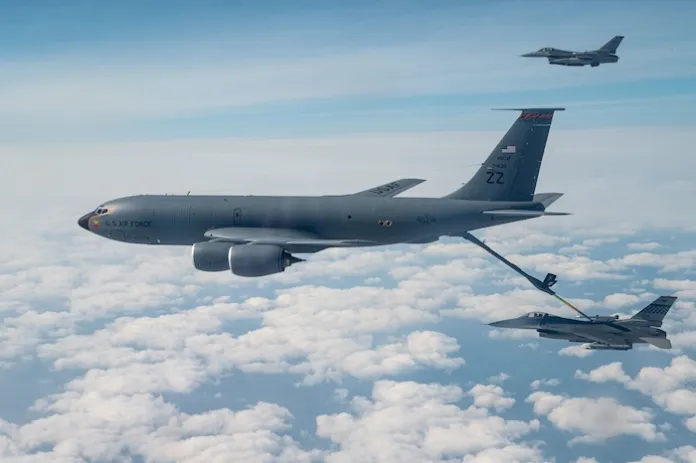
Air Force Undersecretary Matthew Lohmeier provided a bleak assessment of the service’s current readiness outlook, calling it “older, smaller, and less ready than it needs to be to defend the homeland and deter aggression in the Pacific.”
The undersecretary’s warning about the dangers of the service’s chronic underinvestment came during his keynote address on Monday, during the opening day of Life Cycle Industry Days 2026.
“I believe in order to fix a problem, we must first define it and be honest about the state of the situation we’re facing,” he said.
While the Air Force has fielded new platforms such as the F-15EX, F-35, B-21, and the first sixth-generation F-47, “the problem is not capability; it’s the rate of production and our ability to sustain the capability that we already have,” Lohmeier said, according to National Defense. “We’re losing ground on aircraft age and fleet size and are forced to extend some aircraft to the very last year of their engineered lifespan — and in some cases, we aren’t.”
Nearly half of the Air Force fleet is more than 40 years old, and more than 60% of its aircraft are more than 30 years old. There are 10 types of aircraft still in service in the fleet that first flew more than 50 years ago.
Even during peacetime, the service spends billions of dollars annually to ensure maintainers have everything they need to keep aircraft safe and mission-ready, but there have been multiple government reports about delays, backlogs at depots, and more.
In fiscal 2019, 31% of aircraft maintenance ran into delays based on their original target dates, which more than doubled to 73% in fiscal 2024, according to a recent Government Accountability Office report. There was a high degree of variance in the maintenance delays for each type of aircraft.
Lohmeier said roughly 1 in 8 Air Force aircraft is currently not mission-capable due to a shortage of spare parts.
In an attempt to resolve these issues, the Air Force announced a new acquisition transformation strategy last year, which essentially is a part of the department’s broader effort to get the defense industrial base onto a wartime footing.
“We have incredible systems, platforms, and munitions … but we need more of just about everything,” Lohmeier explained. “We have to keep the quality, increase the quantity, decrease the cost, and accelerate delivery.”
The Air Force has been heavily involved in the U.S. war in Iran, which could exacerbate the issues that have been problems in the past.
There have been at least 42 U.S. aircraft lost or damaged during Operation Epic Fury, a Congressional Research Service report from May revealed, though that number has increased since then by an unknown amount.
A major part of the Pentagon’s efforts to expand the defense industrial base includes replacing and increasing U.S. stockpiles of critical munitions, which have also been heavily used during the war.
TRUMP ADMINISTRATION DENIES INTERCEPTOR SHORTAGE LED TO PAUSE IN IRAN WAR AS PENTAGON ANNOUNCES NEW CONTRACTS
Administration officials have maintained that that stockpiles are not at critical levels and that the U.S. military still has the inventory it needs to carry out any mission approved by the president, though Gen. Dan Caine, the chairman of the Joint Chiefs of Staff, reportedly warned President Donald Trump that resuming major combat operations against Iran could dangerously deplete U.S. missile interceptor stockpiles, according to the New York Times.
Trump had publicly discussed a possible military escalation last week, but it appears he has held off for now. Last Friday was the first day in two weeks the United States did not carry out strikes on Iran, though it continues to impose a naval blockade of Iranian ports.
Continue reading...
[ H/T Washington Examiner ]