




The timing couldn’t be better.
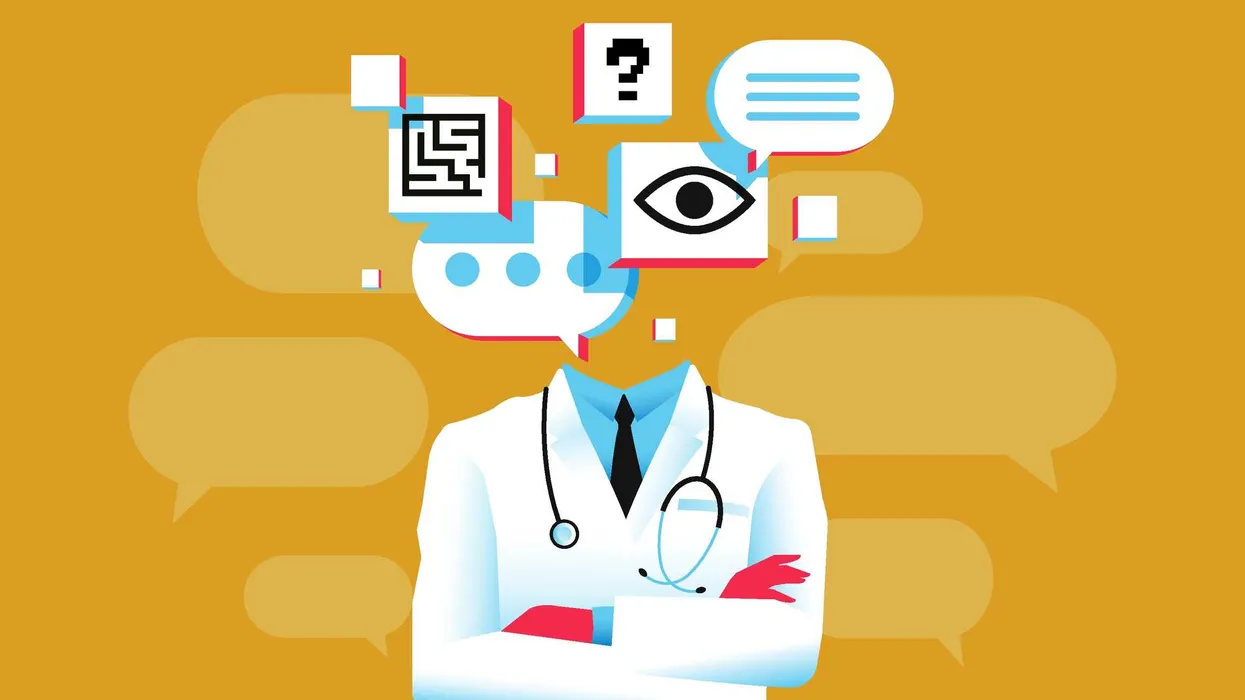
Just as an Anthropic safety researcher resigned over the company’s irresponsible behavior and another researcher warned that AI developers are creating systems with a 10% chance of killing all humans in the next decade, Dr. Ezekiel Emanuel is enthusiastically lobbying our medical system to entrust AI to become our primary physicians.
Now, as a physician who has practiced internal medicine for nearly 30 years, I appreciate Emanuel’s enthusiasm. I really do. But he is simply wrong.
When it comes to our best and worst moments in life, we will always want another person with us.
Let’s begin with his recent essay in the Journal of the American Medical Association, the flagship journal of internal medicine. Citing “studies” showing AI-only medical care is likely to be better than physician-alone or AI-physician hybrid care, Emanuel identifies five AI-superior areas: eliciting medically relevant information; establishing a differential diagnosis; specifying diagnostic testing; prescribing guideline-concordant treatment; managing chronic diseases.
But the devil is in the details.
First, none of the studies Emanuel cites meets the gold standard: a randomized, double-blind, multicenter, placebo-controlled trial with hard clinical end points. Instead, he relies largely on small observational studies, simulated clinical cases, and meta-analyses. Each has limitations that complicate any attempt to draw definitive clinical conclusions.
If anything, these studies raise more questions than answers. This is no problem if Emanuel’s assertion is that we need to perform more studies. However, when he repurposes his JAMA articles into a jaunty Atlantic Monthly essay, he insists that cautious medical minds are “ignor[ing] available evidence and could hold untold numbers of Americans back from better health.”
My question to Emanuel is, in light of his low-quality studies, what sound, available evidence?
Second, Emanuel seems enamored with algorithms. Established clinical pathways can provide valuable, evidence-based guidance for evaluating symptoms, treating disease, and determining the standard of care. But experienced physicians know that clinical judgment cannot be reduced to an algorithm.
Our patients and their problems are not simply algorithmic. Every day, physicians encounter complexities and confounders, curveballs, and exceptions. We need more than book knowledge and flowcharts. Open-mindedness, intuition, and common sense — all of which are born of experience.
Emanuel strikes me as one of the rationalists that stirred up philosopher Michael Oakeshott’s ire. The rationalists are those who worship at the altar of technical knowledge (knowledge of experts that can be written in a book), yet blithely dismiss indispensable practical knowledge (knowledge gained by life and experience). It seems good in theory, but it all falls apart in practice.
RELATED: You can medicate despair. You can’t manufacture meaning.
Third, Emanuel has great confidence in consensus statements and practice guidelines. These are recommended diagnostic paths or treatment plans offered by august bodies of medical deliberation or the best available evidence. Sadly, most of this evidence is moderate to weak at best.
As Abba Eban once observed, “A consensus means that everyone agrees to say collectively what no one believes individually.” While AI draws from an immense fund of knowledge, physicians (while using AI) can add wisdom that asserts purifying qualifiers such as “it depends” or “up to a point.”
If Emanuel’s further criticism is that human beings are hampered by their propensity for error, is it not error-laden human knowledge that informs artificial intelligence? Inadvertently and ironically, the muddled human condition is baked into artificial intelligence.
Finally, Emanuel seemingly forgets about the human touch. Surely, as a capable oncologist, he recalls moments when he pushed away from the computer, took off his glasses, leaned forward, and truly engaged with the patient. At that moment of profound and unfettered intentionality, the luminous wonder of the physician-patient relationship came vibrantly alive.
Are we to be convinced that this relationship doesn’t matter? That it is simply an expendable byproduct in a life’s journey through sickness and health? The iconic 19th-century godfather of medicine, Dr. William Osler, would be aghast at such an assertion. “The good doctor treats the disease,” he once insisted. ‘The great doctor treats the patient who has the disease.”
RELATED: Now they’re saying the AIs built ‘secret civilizations’ — the truth is far worse
Perhaps the studies will come. Perhaps, at some point, artificial intelligence will demonstrably outperform physicians (or even physicians aided by AI), and we who practice will need to bow to our computerized overlords as they, like C-3PO, dispense medical wisdom with their soothing metallic voices and remarkable programmed empathy.
But I’m not convinced.
There is a story of a man openly weeping in a massive crowd upon hearing of the death of President Franklin Roosevelt in 1945. A nearby reporter approached him and asked if he personally knew the president. “No, I didn’t know President Roosevelt,” he answered. “But he knew me.”
When it comes to our best and worst moments in life, we will always want another person with us. Someone who can help us, who cares about us, and who knows us.
Artificial intelligence is a wondrous tool, but it doesn’t know us. Find a good physician who does.
Continue reading...
[H/T Blaze Media]