




A Bumpy Ride
Via Rabobank,
Following the slightly hotter US CPI print on Wednesday – headline inflation was in line with expectations, but core accelerated a bit more than anticipated - producer price inflation accelerated significantly more than expected. Last month, US producer prices rose 1.3% m/m. Yet, rates were down on the day, not up.
Maybe traders found some comfort in the fact that most of the inflationary pressure remains concentrated in energy prices. Or, perhaps, the PPI print underscored the pressure on US producers. If they are unable to pass higher energy costs on to consumers, margins should come under pressure.
Yesterday’s retail sales suggest that energy prices may be eroding some consumer demand. Headline sales rose 0.8% on the month, but much of that increase was due to petrol sales – or, rather, prices. Excluding autos and gas, underlying sales printed a weaker-than-expected 0.1% m/m increase.
But more importantly, perhaps, are the recent wobbles in the AI trade. Rising rates were already complicating the funding required for the sector’s huge investment plans. And investors are perhaps getting apprehensive about the large sums that AI-related companies are asking for. Concerns about competition from China added to that mix this week, after CXMT claimed it has made a breakthrough in memory chip technology.
So, AI-related stocks have had a tough few days, CoreWeave’s bonds made headlines for not exactly the best reasons, and the FT writes that investor are “dumping data centre bonds” more broadly. With so much of economic growth currently riding on the AI boom, those wobbles were probably the main reason for the fall in Treasury yields: a flight to safety, and perhaps revised estimates of how strong demand and therefore growth and inflationary pressures will be going forward.
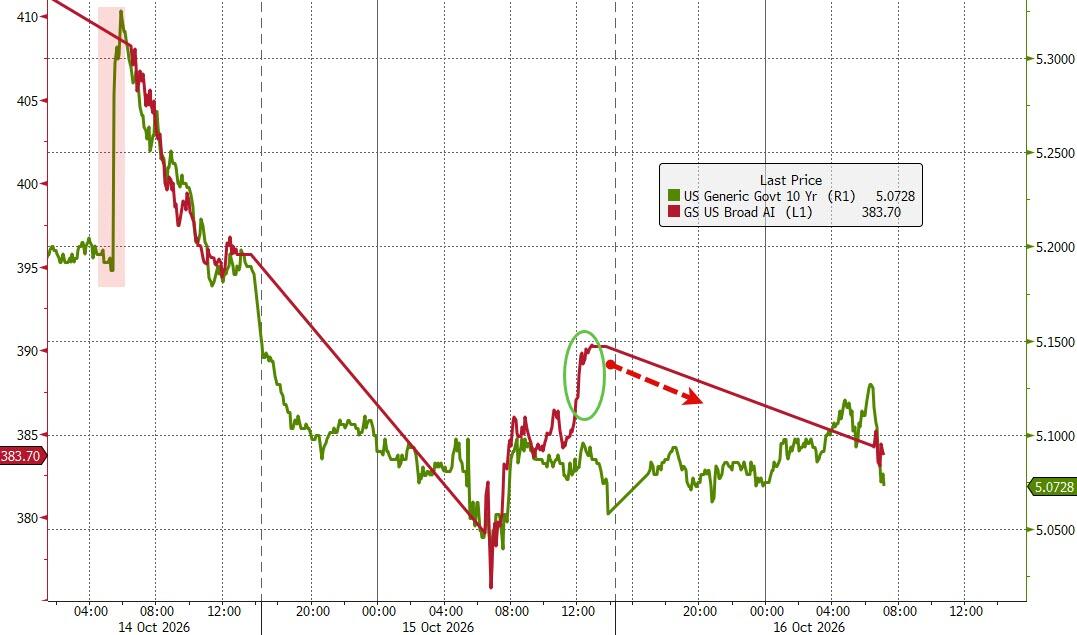
Despite these growing pains, Fed Chair Warsh remains an AI believer. At the IMF’s annual meeting, the Fed Chair repeated that investments in artificial intelligence are a huge benefit to the US economy. Even if the path is will be “very bumpy,” it will ultimately be “very good” for wealth in the US and other countries that adopt AI. This optimism, and the lack of any hints that the Fed may need to hike rates again in October, provide some support for equities today.

AI investors are not the only ones worried about Chinese competition. Trade data released this week suggest that China’s exports to Europe have risen sharply. That particularly relates to cars and AI-related electronics. The EU reached an agreement with China last week that would limit the export of hybrid cars into the bloc, and the European Commission may take further steps to protect its own industry.
Bloomberg reports that Brussels is scrutinizing trade data to detect surges in imports. That would be a first step towards new import quotas on goods being shipped from China or other countries. Bloomberg’s source notes that the EU will probably use the agreement it reached with China on hybrid vehicles as a blueprint for other sectors – which means that any new quota on sectors or goods would be set at a high-enough level to limit the risk of retaliation. Having said that, Beijing has already warned the EU against “new tricks” with respect to its trade policy.
The news fits with our conclusion that structural forces are pushing the EU and China towards greater confrontation on trade, as China’s economic reliance on exports clashes with Europe’s determination to protect strategic industries. However, as my colleagues note in their report, both China and the EU possess significant leverage in their bilateral trade relationship, even as their power rests on different foundations and operates over different time horizons. We therefore believe that a US-style conflict is less likely than a managed escalation that includes negotiations, de-risking, and selective retaliation.
The final estimate of the Eurozone HICP statistics confirmed that headline inflation ran at 3.8% in September, and that core inflation continues to run at 2.5% – keeping the ECB on track for additional tightening, but probably not until December.
The ECB’s Wunsh confirmed that the recent rise in longer-dated yields does not necessarily prevent some further rate hikes. The rise in long-term yields has tightened financial conditions, but Wunsh argues that it has had limited effect on Eurozone financing, which is shorter-term. While wage developments remain “benign,” the policymaker argues that the ECB cannot wait for visible second-round effects before acting.
Indeed, that would mean the central bank has fallen behind the curve, and policymakers will be wary of making a similar mistake as the previous energy shock. Yet, acting more forcefully before such evidence materializes would meaningfully increase the risk that the ECB errs on the side of too tight monetary policy.
Tyler Durden Fri, 10/16/2026 - 10:40
Continue reading...
[ H/T ZeroHedge ]
Via Rabobank,
Following the slightly hotter US CPI print on Wednesday – headline inflation was in line with expectations, but core accelerated a bit more than anticipated - producer price inflation accelerated significantly more than expected. Last month, US producer prices rose 1.3% m/m. Yet, rates were down on the day, not up.
Maybe traders found some comfort in the fact that most of the inflationary pressure remains concentrated in energy prices. Or, perhaps, the PPI print underscored the pressure on US producers. If they are unable to pass higher energy costs on to consumers, margins should come under pressure.
Yesterday’s retail sales suggest that energy prices may be eroding some consumer demand. Headline sales rose 0.8% on the month, but much of that increase was due to petrol sales – or, rather, prices. Excluding autos and gas, underlying sales printed a weaker-than-expected 0.1% m/m increase.
But more importantly, perhaps, are the recent wobbles in the AI trade. Rising rates were already complicating the funding required for the sector’s huge investment plans. And investors are perhaps getting apprehensive about the large sums that AI-related companies are asking for. Concerns about competition from China added to that mix this week, after CXMT claimed it has made a breakthrough in memory chip technology.
So, AI-related stocks have had a tough few days, CoreWeave’s bonds made headlines for not exactly the best reasons, and the FT writes that investor are “dumping data centre bonds” more broadly. With so much of economic growth currently riding on the AI boom, those wobbles were probably the main reason for the fall in Treasury yields: a flight to safety, and perhaps revised estimates of how strong demand and therefore growth and inflationary pressures will be going forward.
Despite these growing pains, Fed Chair Warsh remains an AI believer. At the IMF’s annual meeting, the Fed Chair repeated that investments in artificial intelligence are a huge benefit to the US economy. Even if the path is will be “very bumpy,” it will ultimately be “very good” for wealth in the US and other countries that adopt AI. This optimism, and the lack of any hints that the Fed may need to hike rates again in October, provide some support for equities today.
AI investors are not the only ones worried about Chinese competition. Trade data released this week suggest that China’s exports to Europe have risen sharply. That particularly relates to cars and AI-related electronics. The EU reached an agreement with China last week that would limit the export of hybrid cars into the bloc, and the European Commission may take further steps to protect its own industry.
Bloomberg reports that Brussels is scrutinizing trade data to detect surges in imports. That would be a first step towards new import quotas on goods being shipped from China or other countries. Bloomberg’s source notes that the EU will probably use the agreement it reached with China on hybrid vehicles as a blueprint for other sectors – which means that any new quota on sectors or goods would be set at a high-enough level to limit the risk of retaliation. Having said that, Beijing has already warned the EU against “new tricks” with respect to its trade policy.
The news fits with our conclusion that structural forces are pushing the EU and China towards greater confrontation on trade, as China’s economic reliance on exports clashes with Europe’s determination to protect strategic industries. However, as my colleagues note in their report, both China and the EU possess significant leverage in their bilateral trade relationship, even as their power rests on different foundations and operates over different time horizons. We therefore believe that a US-style conflict is less likely than a managed escalation that includes negotiations, de-risking, and selective retaliation.
The final estimate of the Eurozone HICP statistics confirmed that headline inflation ran at 3.8% in September, and that core inflation continues to run at 2.5% – keeping the ECB on track for additional tightening, but probably not until December.
The ECB’s Wunsh confirmed that the recent rise in longer-dated yields does not necessarily prevent some further rate hikes. The rise in long-term yields has tightened financial conditions, but Wunsh argues that it has had limited effect on Eurozone financing, which is shorter-term. While wage developments remain “benign,” the policymaker argues that the ECB cannot wait for visible second-round effects before acting.
Indeed, that would mean the central bank has fallen behind the curve, and policymakers will be wary of making a similar mistake as the previous energy shock. Yet, acting more forcefully before such evidence materializes would meaningfully increase the risk that the ECB errs on the side of too tight monetary policy.
Tyler Durden Fri, 10/16/2026 - 10:40
Continue reading...
[ H/T ZeroHedge ]