







Guest Post by John Walter
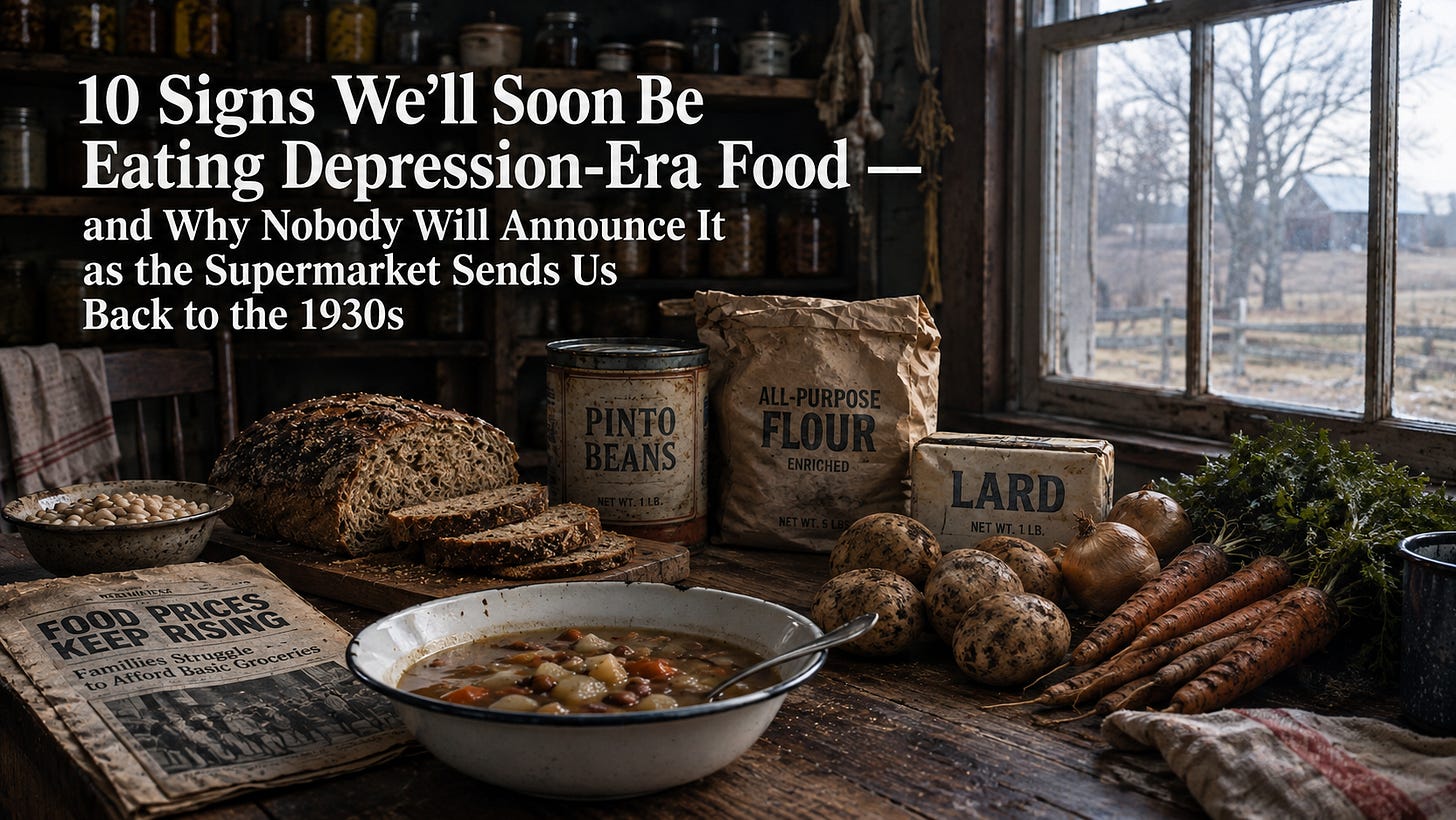
Beef has become an occasion, the packages keep shrinking, and the old cheap staples are creeping back onto the plate. The grocery aisle has been telling this story for years — in small print, and almost nobody has been listening.
Editor’s Note
Nobody will announce it. No president will stand at a podium and explain that the country has begun to eat differently, that the weekly shop has become a negotiation, that the meat counter is now a place where decisions get made rather than taken for granted. It will simply happen, the way most things happen here — one smaller bag, one cheaper cut, one modest substitution at a time — until the food on the table resembles what people ate in 1935 and nobody quite remembers when the change began.
What started this was small, a box of pasta that no longer weighed what it used to, and the argument widened from there. The drift runs back toward the habits of the Great Depression: meat rarer and cheaper, beans and potatoes and bread returning to the center of the plate, fat and preserving back in the kitchen, cooking once more from scratch, substitutions accepted as normal. Hunger is not the problem. The difficulty is more like a slow erosion of standards, and erosion is much harder to notice than famine. (In this video, we’ll go over a tool for this community that can mean the difference between life and death.)
Length is part of the point. Read it the way such changes arrive: slowly, and with attention.
A grocery aisle rewards close reading. Turn a box over and study the small print on the back, where prices are set in large type because they are meant to be read and net weights in small type because they are meant to be missed. Pasta that once came in a sixteen-ounce box now comes in a twelve-ounce box, while the shelf tag sits unchanged. Everything visible stays where it was; the figure nobody checks is the one that moves.
Learn to read the second number on a price tag, the cost per ounce, and the store rearranges itself before your eyes. Crackers turn out to cost more by weight than the cheese beside them. The jumbo pack is frequently the worse bargain. Coffee sheds a few ounces while keeping its bag, its shelf, and its place in the morning routine. None of this gets a press release; the adjustment travels through the packaging, in a font nobody studies.
Groceries that once filled two bags now fill one and a half, and even that fact is not alarming on its own. A family that used to buy three pounds of ground beef buys two and stretches them. Chicken has grown bonier. Steak has moved to a shelf that used to belong to wine. Nobody loses a job, the shelves stay full, and no reporter is sent to cover it. You pay roughly what you paid before for somewhat less food, you adjust, and the adjustment is small enough to forget.
Decline in a rich country takes a shape like this. Catastrophe would at least be legible, forcing attention and demanding a response. What arrives instead is a run of small, reasonable, forgettable decisions, each defensible on its own, each pushing the dinner table a little further back in time. Between 1929 and the early 1940s, a generation learned the same lesson under harsher conditions, and the food of that period was the food of survival: beans, potatoes, bread, cornmeal, lard, cheap cuts, bones, anything that could be stretched. That list is returning now, in pieces, to families who would never describe themselves as poor.
Nothing has collapsed, which is precisely the problem. The menu of the 1930s is not breaking down the front door. It is coming in through the back, one smaller box at a time.
Before the ten signs, it helps to name the conditions underneath them. Six of them run through the whole story, and everything that follows leans on one or another. Individually each is modest, almost boring. Together they explain why a country that still looks rich has started shopping as though it were not.
◆ 1 — Protein is getting expensive. Beef, above all, has started behaving less like a staple and more like a luxury good, climbing faster than wages, so that a family which once ate it three times a week now plans it like an occasion.
◆ 2 — Packages keep shrinking. Squeezed between rising input costs and the shopper’s stubborn memory of a normal price, manufacturers reduce what you get rather than what you pay, hollowing out the value of a grocery bag while the receipt holds flat.
◆ 3 — Cheap calories are returning. When money tightens, the plate tilts toward whatever fills a stomach most cheaply and reliably, which in the developed world has always meant beans, rice, potatoes, cornmeal, and bread, the same fuel that carried the 1930s.
◆ 4 — Food lines are growing. Charity feeding, once a seasonal curiosity, is hardening into a permanent feature of the economy, as working households, not only the unemployed, queue at pantries for what the market no longer makes affordable.
◆ 5 — Fat is being forgiven. The cheapest fats, demonized for decades by diet advice, are crawling back onto the counter because they are what poor kitchens have always used: lard, tallow, drippings, butter cut with something cheaper.
◆ 6 — Homes are becoming small factories. As trust in the supply chain wobbles, households start producing what they used to buy, digging up lawns, buying canning jars, keeping a starter alive, rebuilding the domestic infrastructure that abundance let us forget.
Read them again and notice how unremarkable they sound. None is a crisis. Each is a tilt, the kind of thing you could explain away over dinner, the kind of thing a confident person would laugh off. Catastrophes announce themselves. Downgrades whisper.
Ten sections follow, an attempt to catch the whisper — one sign to a section, small on its own, easy to dismiss, all of them pointing the same way. Take them as symptoms rather than verdicts. A symptom tells you the body is fighting something; it does not say who wins. It does say the fight has started.
Not long ago, a steak was a Tuesday decision. You passed the counter, saw a decent ribeye, thought little about it, and bought it. No planning, no arithmetic; the price was a number, not an obstacle. The era is closing, and closing in the dullest possible way — the number keeps climbing, and nobody marks the day it becomes unaffordable.
Read the meat case the way you would read a gauge, paying attention to the small print on the labels, and the shape of the problem becomes clear. Family packs have shrunk into small family packs. Ground beef is no longer always pure; lean gets blended with something cheaper, and the word “blend” turns up where it never used to. The democratic meat, the cut that fed the working class through every boom and bust of the past century, is being thinned out. Taste has little to do with it. Arithmetic has everything to do with it.
Behind the price sits a herd problem, and herds move slowly. A cow takes years to become a steak, and the national herd has been shrinking for a while now, for the usual reasons: expensive feed, thin margins, ranchers leaving a business that is hard to re-enter. Feed costs track grain, which tracks weather, fuel and geopolitics. Demand does not fall when the price rises, because beef is what people buy when they want to feel that things are fine. Supply shrinks, appetite holds, the price climbs, then climbs again, and in a good year merely stops climbing, which everyone calls relief.
In the kitchen, the effect is to reorganize the week. Meat stops anchoring the plate and becomes a seasoning, which is advice you have heard before from frugal cooks and diet columnists and have probably rolled your eyes at. Choosing to treat meat as a seasoning is a different experience from being forced to, and the difference is felt in the hands rather than the mind. When a pound of beef costs what a small book used to cost, you cut it smaller, stretch it further, and hide it inside sauces and stews and rice until the family sits down to a beef dinner in which the beef is a memory and the dinner is mostly something else.
Depression cookbooks are full of recipes built on that trick, preserving the idea of meat inside a dish that contains almost none. Meatloaf was a necessity of the period, a way to make half a pound of ground beef behave like a pound and a half by bulking it with breadcrumbs, oats, rice, whatever the cupboard surrendered. Meatballs got stretched with bread, stews with potatoes and carrots until the meat became a garnish, and Sloppy Joes existed to make a little ground beef cover a lot of bread. None of it was cuisine, and all of it was survival dressed as dinner.
One detail here should unsettle you more than the price. Beef in the Depression was not merely scarce; it was displaced. Once the price of a good rises far enough, the market stops waiting politely for people to afford it again. Substitutes appear, the substitutes improve, they become ordinary, and by the time the original returns everyone has forgotten what they were missing. Expensive beef is therefore a danger less because you will eat less of it this year than because a generation grows up believing a steak belongs to anniversaries and that a normal dinner is made from cheaper animals.
Poultry tells a version of the story one rung down. Chicken, once the poor man’s meat, became the middle-class default, and now the price pressure is pushing even chicken upward, so that genuinely cheap protein migrates toward eggs, toward beans, toward the old peasant foods that seventy years of prosperity taught us to look down on. A hierarchy exists, and the country is sliding down it, politely, without a headline to mark the descent.
Economics is only part of it. A roast on Sunday, a steak on a birthday, a bird at a holiday — these mean more than their calories, and once they turn occasional instead of routine, the household calendar shifts with them. Meat used to mark time. It announced the good days, the visits, the small celebrations that broke up an ordinary month; shrink the meat and you shrink the punctuation. Families that eat chicken on a Tuesday and roast twice a year have a different relationship to the week from the ones that ate meat without thinking, and the difference surfaces in ways that are hard to name and easy to feel.
Watch the video below to see how some families are preparing for a future where access to food may not always be guaranteed.

Supply deserves a closer look. The price of beef is not a single number rising in one direction; it is the visible tip of a system with almost no slack. Drought shrinks pasture, expensive grain shrinks feedlots, and the whole chain, tuned for efficiency rather than resilience, has little room to absorb a shock. Trouble somewhere travels as a price rather than an empty shelf, which is why the customer meets it as a smaller package and a heavier receipt rather than as an absence. Absence is legible. Price is not.
Which leaves the family at the counter doing the only thing it can: buy the cheaper cut, learn to braise it, discover that the tough parts of an animal can be made delicious with time, and rebuild a kind of cooking that two generations of convenience had nearly abandoned. Braised short rib, slow-cooked shank, a pot of chili built from a little beef and a lot of beans — good meals, often better than the pale, fast, overpriced steak they replace. The direction still runs down the animal, down the hierarchy, down the price list, and the destination, if it holds, is the cheap protein of the Depression dressed up as rediscovery.
If you want to feel the squeeze without consulting a statistic, weigh a box of cereal. Nobody does, which is exactly why the trick works. Cartons look identical on the shelf, and so do the tags beneath them. Contents, meanwhile, have been cut by ten, fifteen, sometimes twenty percent while the package kept its size. You are not paying more; you are getting less, and the difference between those two facts has become a business model.
Economists have a word for it, shrinkflation, ugly enough to suit its subject, and it has moved from curiosity to strategy. Facing higher input costs, a manufacturer can take one of two roads: raise the price, which shoppers notice and resent, or shrink the product, which shoppers mostly do not, since who weighs crackers? The second road serves the business and harms the customer, so it wins, again and again, until the shelves fill with packaging that is mostly promise and very little payload.
Walk the middle aisles, the long corridors of processed food at the heart of any store, and the hollowing happens in front of you. A bag of chips holds more air than chip. Chocolate bars have been slimmed by grams nobody measured. Ice cream cartons, once a proud half-gallon, hide behind a number that rounds down. Paper towels have thinner sheets, toilet paper narrower tubes, coffee lighter cans. Pasta, where a pound used to be sacred, has begun to crack, with “family size” and “value pack” language covering for the fact that the standard size is no longer standard.
Middle aisles matter more than the irritation suggests, because that is where working and middle-class households do most of their eating. Fresh produce rings the edges, an expensive band of freshness you must be able to afford and have time to cook. Calories stay cheap down the center, where the food is shelf-stable and convenient, built for busy homes and tight budgets. When the center hollows, the people who depend on it most feel it first. A shrinking cereal box is nothing to a wealthy family that can buy fresh instead; for a tired parent it is the slow erosion of the one aisle she could trust.
Shoppers of the 1930s would recognize the pattern, if not the packaging. Those years were the golden age of processed food, not because processing was new but because it was cheap and it kept. Canned everything, boxed macaroni, powdered milk, a philosophy that prized shelf life over freshness — a family unable to waste a single bite needed food that would not spoil. What is happening now is the second act of that logic, with a twist. Processing in the 1930s was a genuine bargain, a way to buy more calories per dollar. Today it is often the expensive option dressed as the cheap one, and shrinkflation is the tell that the bargain is coming apart.
Look at the store through the eyes of someone feeding four on a fixed sum. Produce, beautiful and mostly out of reach, rings the edges; the center is affordable and shrinking; frozen food, once the bridge between the two, is being colonized by value lines that are cheaper only because they contain less of the thing and more filler. Everywhere the store offers a smaller version of what it used to offer and calls it the same, and the customer, with no time to weigh boxes and no power to negotiate, absorbs the loss in silence, one slimmer bag at a time.
Shrinkflation does more damage than a price rise because it splits the shopper’s attention. Prices are single numbers, easy to compare, easy to remember, easy to resent. Weights are hidden variables, printed small, rarely memorized, different for every product. So the shopper keeps a mental list of prices, feels reassured that nothing has gone up, and stays blind to the food evaporating from inside the box. The deception is rarely deliberate; it is just the path of least resistance for companies that would rather avoid the confrontation of a higher sticker.
Shrinking packages change how people cook, too. A recipe built around a pound of pasta comes out slightly thin, a box of cake mix that used to fill a pan leaves it shallow, a bag of flour that used to last a month runs out days early. None of it is serious by itself, and all of it together chips away at the reliability of the kitchen, leaving the cook to buy more often, substitute more loosely, and absorb a cost the recipe never anticipated. Packaging is never only packaging. It is a promise about how much food a meal requires, and when the promise shrinks, the meal shrinks with it.
The burden does not fall evenly. Wealthy families escape shrinkflation by moving up, buying the premium line, the fresh version, the product that has not been hollowed because its price was never the selling point. Poor families cannot escape, since the whole reason they bought the value product was that it was the one they could afford. Where the budget is thinnest, then, the squeeze lands hardest. The rich feel inflation as a number; the poor feel it as a smaller dinner.
On every continent, in every century, poor people have eaten the same short list of foods, and there is a reason for it. Beans, rice, potatoes, corn, lentils, bread. Nobody chose these for elegance. They won an ancient contest on the only terms that ever mattered to a hungry family: calories per acre, per dollar, per hour of labor. A field of potatoes feeds more people than a field of nearly anything else; a sack of dried beans sits in a cupboard for a year without complaint and delivers, once cooked, a density of protein and energy no fresh vegetable can match. Lentils cook fast and cheap, rice is the most reliable calorie on earth where it grows, and cornmeal keeps, stretches and fills. This is the survival menu of the species, and shoppers who would never call themselves poor are rediscovering it right now.
Reclaim is the right word. These foods never vanished from the modern diet; they were demoted. The abundance of the twentieth century shoved them aside and reframed them as sides, as peasant fare, as what you ate when you could not afford the good stuff. A potato became a garnish beside a steak, beans became a soup course before the real meal, rice became the bed something expensive sat on. Nutrition had little to do with the hierarchy. Status had everything to do with it, and status, in a rising economy, is a persuasive chef.
Now the demotion reverses. Potatoes climb back toward the center of the plate, no longer a side but a base, the thing that carries the meal. Beans migrate from the soup pot to the main course, rebranded by food writers as plant protein and by budgets as the only affordable protein left. Lentils, food of monks and peasants, turn up in recipes that once called for ground beef; cornmeal returns as polenta and grits, humble dishes dressed up as rustic. Rebranding is genuine, but the engine underneath is not fashion. The same engine has always herded the poor toward that short list.
Arithmetic makes this more than nostalgia. Dried beans cost a fraction of what meat costs and deliver comparable protein once cooked, with fiber thrown in and time demanded as the penalty. A bag of potatoes feeds a family for days for the price of one chicken breast. Where the grocery budget is the first thing to strain when rent rises, those advantages are decisive. When the numbers turn, the plate turns, and it turns faster than anyone admits, since nobody wants to be first to say aloud that they have begun eating like their great-grandparents.
Survivors of the Depression knew these foods as the backbone of survival, and their memoirs are full of them, often with a weariness that shades into hatred. People who ate beans every day for years developed a complicated relationship with the bean, a mixture of gratitude and loathing that only makes sense if you have eaten the same thing, day after day, with no money to change it. Studs Terkel, gathering testimony decades later for Hard Times (1970), let people describe the exact texture of the bread and the exact monotony of the stew. That monotony is coming back, not yet as hardship but for now as choice, as virtue, as something to photograph.
Nutrition is where the real cost shows up, and it takes years to see. Staples are cheap because they are efficient, and efficiency has a price. A diet built on beans, rice and potatoes can nourish, but only if it varies, and variety costs money. The very foods that keep a family from hunger can, eaten too narrowly for too long, deliver a diet technically filling and quietly deficient, short on the micronutrients the expensive fresh foods used to supply. The Depression’s poor were mostly not starving, though many were malnourished in ways that surfaced years later, in stunted growth, in weak teeth, in a slow erosion of health that nobody connected to the dinner table until long after.
Monotony deserves its own paragraph, because it is not only a matter of boredom. Food carries emotional weight, and a diet that repeats itself week after week flattens more than the palate; it flattens the sense of occasion. When every dinner is a variation on the same three ingredients, the week loses its texture, and the small pleasures that used to be scattered through a month — a Sunday chicken, a Friday fish, a cake for a birthday — start to feel like events rather than habits. The Depression generation learned to live inside that flatness and to find comfort in reliability rather than variety. A country sliding toward its staples will relearn that posture.
Staples also demand something the modern kitchen has been trained to avoid: patience. A pot of dried beans takes hours, a stew rewards a long low simmer, polenta asks to be stirred, rice asks to be watched. None of it is difficult, but all of it is slow, and slowness is the first casualty of a busy household. A family can save money by cooking beans or save time by buying them canned, and the choice between the two is a choice between money and hours. Cheap food is only cheap if you have the time to cook it, and time, like money, is unevenly distributed.
For an honest reading of the economy, skip the stock exchange and find a food pantry’s parking lot at six in the morning. A few years ago that lot sat nearly empty, a corner of the safety net most people never touched. Charity feeding existed, certainly, but it was understood as a backstop for the very poor, the unlucky, the temporarily broken. Then the lines grew and the composition of the lines changed. Teachers appeared, then nurses, then people with jobs, cars, smartphones, the outward markers of a stable life, standing in a queue their parents would have associated with a different kind of person altogether. Once you have seen a working household queue for groceries, you cannot unsee it.
Follow such a line and notice what no statistic captures. Dignity, first, in the way people dress as if for an errand rather than for charity, because that is what it has become. Brisk efficiency among the volunteers, mostly retirees, who have turned the distribution of boxes into a small logistics operation with clipboards and folding tables and a rhythm born of repetition. Then the food itself: crates of canned goods, sacks of potatoes, drums of rice, frozen chicken in shrink-wrapped blocks. No glamour. The same beans and rice and root vegetables the Depression put on the national table, now handed through a car window in a suburban church lot.
A food line counts as a sign, not merely a sad fact, because it is the economy’s early warning system, more sensitive than any indicator analysts watch. Unemployment figures lag. Inflation figures average out the pain. Pantry queues respond in real time to the pressure households feel first, the gap between what a family earns and what a family must spend to eat. When that gap opens, the line grows, and it grows before the official data admits anything is wrong.
Comparing the two eras is almost too neat, and the comparison deserves a caution. The breadlines of the 1930s were iconic, photographed and mythologized, and the decade even produced its own soundtrack, with Yip Harburg and Jay Gorney’s “Brother, Can You Spare a Dime?” (1932) becoming the anthem of the queue. Those lines, though, belonged to a specific moment, a nation with no food-assistance infrastructure to speak of, where a man who lost his job lost his ability to eat within weeks. Today’s net is thicker, pantries more numerous, logistics better. What we are seeing is not the desperate queue of 1932. Something subtler is happening: the country has decided, without ever saying so, that a growing share of its food will be distributed by charity rather than by wages. Charity, however generous, is not a paycheck.
Queues also hide themselves. Poverty is visible when it is dramatic, when a family is evicted or a factory closes, but a pantry queue is suburban and easy to miss. Its members do not look poor: they drive, they work, they own the appliances of the middle class, and their presence in it is precisely what makes it shocking once noticed. A nation can convince itself that everything is fine for a long time, because the people who are struggling are indistinguishable from the people who are not.
Charity does something to a family’s psychology over time. Receiving food as a gift differs from buying it, even when the food is the same and the need is equally real. Buying is an act of sovereignty: you choose, you pay, you own the decision. To receive places you on the other side of a transaction, grateful and slightly reduced, no matter how kind the volunteers are. Once a working household starts supplementing its groceries at a pantry, it has crossed a line it did not choose to cross, and the crossing, repeated weekly, reshapes how it thinks about itself.
Reliance, though, cuts both ways. If the pantry falters, if the food runs short, if the volunteers age out or the donations dry up, the household is exposed in a way it was not before. Charity, for all its warmth, has no obligation to continue, and a country that increasingly feeds itself through charity has outsourced part of its food security to goodwill. Goodwill is generous and fragile in equal measure, and neither quality shows up in the morning light of a parking lot.
Kitchen fats tell the truth more reliably than anything else in the room. Compromises hide there. Good fat, the kind that comes from animals and costs accordingly, is the first thing a tight budget reaches for and the last thing it lets go, because fat is flavor, fat is energy, fat is the thing that makes a cheap meal feel like a meal at all. Rich countries fill their kitchens with butter and olive oil and call animal fats old-fashioned. Poorer ones bring the animal fats back, since they are cheap, local, keep well, and do the job the expensive fats do at a price the expensive fats cannot match.
Shelves tell the story once you know how to look. A jar of lard, exiled for decades to the bottom shelf as a relic, creeps upward, often in small artisanal packaging with a label that flatters it. Tallow, rendered beef fat, appears in cooking sections and butcher counters, praised for its high smoke point and its talent for making a potato taste worth eating. Drippings, the fat left in the pan after meat is cooked, get saved again by households that used to pour them down the drain. The vocabulary of the kitchen is changing, and the change points backward, to the 1930s, when a can of drippings on the back of the stove was as ordinary as a kettle.
An irony here would make the diet industry wince. For half a century the cheapest fats were also the demonized ones, blamed for heart disease and banished in favor of seed oils and margarine, which were manufactured, marketed and affordable. Depression cooks used lard because it was what they had. Post-war cooks used margarine because it was modern and cheap. Contemporary cooks are being pushed back toward lard and tallow not by a nutrition revolution but by the same force that has always settled these questions: price. Nutrition science has softened its old verdicts, which helps, but the shelf is doing most of the work.
Fat has everything to do with Depression food, because the era’s cuisine rested on it. Fat was the cheapest way to make a little food feel like enough. Bread with lard and salt is a meal. A potato fried in drippings is a feast. Beans with a spoon of bacon fat taste like they were made with love, when in fact they were made with thrift. When a household can no longer afford good cuts of meat, it leans harder on fat to carry the flavor the meat used to provide, and lard’s return is less a trend than a budget adjusting itself.
Class lines split along the fat question too. Wealthy families buy butter and olive oil and call them staples. Poor families buy lard, shortening and margarine and call them practical, and between those two kitchens lies the gap between two economies, widening in a way most people feel but few name. When your neighbor’s kitchen starts smelling of rendered beef fat and yours still smells of butter, you are looking at one country through two price points.
Of everything on this list, fat makes the sharpest indicator, because it sits at the exact point where nutrition, cost and flavor collide, and a household cannot fudge the choice. A smaller package can be pretended into sameness; a cheaper cut can be waved through. But reaching for fat is an open decision about what the kitchen can afford, since fat is the one ingredient whose absence is felt immediately in the mouth. Butter tastes like butter. Lard tastes like lard. No label hides that.
Practicalities the food writers skip are worth noting. Animal fats behave differently from seed oils, and kitchens that use them cook differently. Lard and tallow hold up to high heat, which suits the frying and roasting that cheap ingredients need to become appealing. Both solidify, which makes them easy to store and easy to measure, and both can be rendered at home from scraps, meaning the fat in a poor kitchen can be produced rather than bought. A household that learns to render its own fat has moved one step further from the store.
Halfway through the signs, it pays to step back and look at the machinery. The six conditions named at the start describe what is happening. Five forces, listed below, attempt something different: they describe why. Those two lists touch and overlap without being identical, and the difference matters, because a country can often see what is happening long before it understands what drives it. Symptoms are visible. Causes are buried.
• Cost pressure at the base. The price of the inputs that make food — fuel, fertilizer, feed, labor, land — has been rising faster than the price of food itself, which means someone in the chain absorbs the difference, and that someone is almost always the shopper, through higher prices or smaller portions.
• The squeeze on the middle. Households in the middle of the income distribution, too rich for the deepest safety nets and too poor to ignore prices, feel the downgrade most sharply, and their behavior — their substitutions, their shrinkflation awareness, their return to staples — sets the tone for the whole market.
• The fragility of the chain. A food system built for efficiency carries almost no slack, and a system without slack transmits shocks, so a drought in one hemisphere or a war in another reaches your table within months, arriving as a price rather than an absence.
• The memory of the cheap. Every society keeps a folk memory of how to eat when money is tight, and when pressure returns that memory reactivates, not through study but through the shelves themselves, which fill with the foods the pressure demands.
• The loss of trust. Once shoppers stop believing prices will come back down, they change behavior permanently, buying in bulk, learning to preserve, teaching themselves to cook the old way, and a permanent change in behavior is how a temporary squeeze becomes a lasting culture.
Seen together, the five form a pattern. Each is gentle, each is deniable, each has a reasonable explanation a confident person could offer over dinner; yet all five point the same direction, and when five gentle forces point the same way the direction stops being coincidence. It becomes a current, and the country is already in it, with the shore somewhere behind.
A country makes a particular sound when it starts to distrust the supply chain, and the sound is a spade going into a lawn. For most of the last century the suburban lawn was a decorative object, a green rectangle kept alive for appearance, mowed on Saturdays, otherwise ignored. It produced nothing and served as pure status, a patch of ground announcing that you had arrived somewhere and could afford to grow grass instead of food. Then the wartime generation, prompted by a government campaign, dug up their lawns and planted vegetables, and the victory garden was born, and for a few years the suburbs fed a meaningful share of the country from their own backyards. When the war ended, lawns returned, vegetables retreated, and the whole experiment was filed away as a curiosity. That file is reopening.
Any neighborhood with older houses, larger yards and younger residents than the houses will show it. Raised beds on the sunny side. Tomato cages sprouting in the flower border. A trellis of beans where a shrub used to be. Herbs in pots by the door, then herbs in the ground, then a whole corner of the yard turned over to something that used to be lawn and is now unmistakably a vegetable patch. The people doing this are not farmers; they are office workers and teachers and nurses, and they do it for reasons that mix pleasure with premonition so thoroughly that the two cannot be untangled. Gardening is pleasant, and it is also what you do when you are unsure the store will always have what you need.
In the Depression, a backyard garden was a lifeline rather than a hobby. Millions of households grew at least some of their own food, often in plots the size of a small room, and the difference between a family that gardened and one that did not was the difference between a hard winter and a hungry one. A garden was the household’s insurance policy, the one asset that could not be foreclosed and did not need cash. That insurance logic returns now, softened by affluence into something that looks like a lifestyle, though beneath it sits the same old arithmetic: a row of potatoes in the yard hedges against the price of potatoes in the store.
Gardens change as the pressure grows. It begins with tomatoes, the gateway vegetable, easy, rewarding, delicious enough to justify the effort. From there it spreads to crops that actually save money, potatoes and onions and beans and greens, the ones that carry a meal rather than garnish it. Eventually it reaches things that keep, winter squash and root vegetables and cabbage, the crops that fill a cellar and feed a household through months when the garden sleeps.
Soil does something to a person, too. Grow a potato once and you look at a potato differently. Eat a tomato you picked an hour ago and the supermarket tomato becomes an insult. Keep a garden through a season and you understand, in the body rather than the mind, that food comes from somewhere, that the somewhere can fail, and that a yard is not decoration but capacity. A lawn symbolized arrival; a garden symbolizes something older and less confident, a quiet admission that the good times may not last and that a wise household prepares while preparing is still cheap.
Labor deserves honest treatment, because a garden is not free. It costs time, water, tools, seed and attention, and it fails often, sometimes completely, and a household that has never gardened tends to underestimate how much of the work happens before anything edible appears. Preparing soil, building beds, hauling compost, watering through a dry spell, fighting pests and weeds and weather — none of it is glamorous, and the first year usually produces less than the household hoped. Which is why the garden is such a good sign of seriousness. Planting tomatoes on a whim is a gesture; keeping at it after the first disappointing harvest is a commitment.
A subtle difference separates gardening to save money from gardening to feel secure, and the two motives can look identical from the street while leading to different decisions. Saving money pushes a household toward calorie-dense, high-value crops, the potatoes and beans and squash that genuinely reduce a grocery bill. Feeling secure pushes toward whatever makes the household less dependent, which may be the same crops or may be something else entirely. In practice the two braid together, and the household that starts by wanting to feel less dependent often ends by saving real money, while the household that starts by wanting to save money often ends by feeling more in control.
Gardens carry a social life that lawns never had. A lawn is private, silent and identical to every other one. Gardens invite comment, offer surplus, and create small economies of exchange: a neighbor’s zucchini for your tomatoes, a shared seed order, a borrowed tool. A street full of gardens is a street that knows itself in a way a street full of lawns does not, and that knowing is itself a form of security, because a neighborhood that trades food is a neighborhood with a cushion.
Nothing announces preparation for trouble quite like a shelf of jars. A canning jar is one of the strangest objects in a modern kitchen: heavy, breakable, expensive to buy in quantity, and requiring hours of labor to fill, it produces food objectively no better than what the store sells for a modest price. By any rational measure, home canning is a bad deal. Yet every time the country grows nervous about food the jars sell out, the kitchen shops go bare, and people who have never canned anything start watching tutorials on processing tomatoes in a water bath.
Current supply problems date the wave. Jars, lids and rings have become seasonal scarcities, the way they were in the pandemic’s first year, and the scarcity comes not from a shortage of glass but from a surge of demand by households that have decided to put food by. The lid is the tell: a single-use item, a small metal disc that seals a jar and cannot be reused. Buying lids in bulk is not dabbling but committing, and the household that does it has decided the pantry will be its buffer and is buying the raw materials of that decision by the crate.
Depression food security rested on exactly this. Home canning was infrastructure, not hobby. Households canned tomatoes, peaches, beans, pickles, jams and sauces by the dozen, in jars reused year after year, and the pantry shelf was the family’s savings account, denominated in food. A stocked pantry meant a winter without fear; an empty one meant a winter of thin soup. Government, understanding this, ran canning programs and distributed jars and instructions, since a country that cans its own food needs less help in a crisis. Abundance dismantled the infrastructure, and it is being rebuilt now, jar by jar, by households that have never lived through a real shortage but can feel one coming.
Canning is also irreversible in a way most habits are not. You cannot half-can: spend a Saturday filling twenty jars and you have committed time and shelf space that will persist for years, and those jars sit there, heavy and visible, a reminder that the household chose the old way. Skills, once learned, resist forgetting, and someone who has canned a hundred jars of tomatoes will can a hundred more, because buying them starts to feel like a failure of nerve. The canning habit reinforces itself, and it is spreading through a population that mostly does not need it yet, which is precisely the behavior that precedes a shortage rather than follows one.
Visit the pantry shelves in the houses around you, the basements and closets and spare corners where jars accumulate, and notice the small quiet pride a full shelf produces in a household that has never gone hungry. That pride is not irrational. It is the body’s memory of a time when a full shelf decided whether a winter went well, and the body, unlike the mind, has not forgotten.
A jar really represents a transfer of time. Canning is a way of spending a cheap, abundant moment to buy security in an expensive, scarce one. When tomatoes are in season they are nearly free; when they are out of season they are dear, and the jar lets a household move value across that boundary, converting a glut into a reserve. This is why canning survives even when it is not strictly economical. It is a hedge against the calendar, a way of telling the future that you have already eaten.
Costs the tutorials skip are real, though. Canning is hot, heavy and exacting, a mistake in processing can spoil a batch or worse, and the equipment takes space that a small kitchen may not have. The jars are heavy to store and heavier to move, and the whole enterprise competes for the same hours a tired household would rather spend resting. So canning is not for everyone, and the households that take it up are usually the ones with a little spare time, a little spare room, and a disposition toward planning. That disposition is itself the thing being measured. A country where canning spreads is a country where a meaningful share of households has decided that the future is worth preparing for, and that decision, made in kitchens rather than in parliaments, is often the earliest sign of a change in mood.
A full pantry also changes how a household deals with the store. Families that can no longer shop only for the week shop for the year instead, timing purchases to the harvest, buying in quantity when prices fall, treating the store as a supplier rather than a lifeline. Moving from a weekly rhythm to a seasonal one is among the deepest changes a kitchen can make, because it replaces the store’s clock with the calendar’s, and the calendar is older and less forgiving.
Eating only the middle of the animal is the most expensive way to eat meat. Eating all of it is the cheapest. For fifty years the rich world has eaten the middle: chicken breast rather than the whole bird, steak and roast rather than the shank and the tail and the cheek, ground beef but not the bones and offal the ground beef was cut from. Convenience, uniformity and easy cooking made that middle the part everyone wanted, which means it commands the highest price and absorbs the most inflation. The rest, the parts our grandparents knew how to use, got quietly relegated to pet food, stock, and the occasional adventurous restaurant. That relegation is ending.
Watch the geography of a butcher counter shift. Bones, sold for pennies a few years ago, now come packaged and priced as a premium item, marketed for stock and broth. Oxtail, once the cheapest cut in the shop, has grown expensive enough to inspire resentment among those who remember when it was cheap. Shank, cheek, tongue, liver, heart, and the great forgotten cuts climb back into the case, often with a note of rediscovery that flatters them, as though they had been found rather than remembered. The whole animal is returning to fashion, and the fashion is driven not by chefs but by prices, since the whole animal is simply a cheaper animal per pound of edible food.
In the 1930s the whole animal got eaten because there was no choice. The middle belonged to the butcher’s best customers; everyone else made do with the rest, which stopped being a hardship once you knew how to cook it. Bone broth, today’s wellness staple, was Depression soup stock, made from bones that cost almost nothing and simmered for hours to draw out the last of the flavor and nutrition. Liver was a weekly dinner, cheap and dense. Oxtail and shank went into long braises that turned the toughest cuts tender. Eating the whole animal was not a philosophy then; it was the only way to afford meat at all.
Economics here are starker than they look. When beef grows expensive, demand for the expensive cuts falls while demand for the cheap cuts rises, and the two pressures meet in the middle, so cheap cuts grow less cheap and expensive cuts grow less demanded. Over time the price hierarchy flattens, the whole animal costs roughly the same per pound, and the savvy shopper switches from the middle to the edges. The switch is already underway. Broth bones are already scarce, oxtail is already a luxury, and a household that learns to cook the whole animal before everyone else does will eat well when the middle grows unaffordable.
Buried in this sign is a point about waste. A middle-of-the-animal diet is wasteful by design, discarding parts perfectly good to eat, and waste is a luxury of abundance. Thin the abundance and the waste thins with it, and the cuisine relearns the parts it threw away. The return of the whole animal therefore changes a culture’s relationship to the animal, from selective consumption to complete use, and the change repeats the 1930s, for the same reason and with the same result: a diet cheaper, more varied and harder to cook.
Cooking is the barrier here, and it deserves honesty. The middle of the animal is forgiving; the rest is demanding. A chicken breast can be cooked badly and still eaten. A shank needs hours. Liver turns to shoe leather in a minute and to velvet in three. Offal has textures that a palate raised on boneless skinless familiarity may find strange at first. Learning to cook the whole animal is a project rather than a purchase, and it rewards patience in a way the modern kitchen has not always trained. But the reward is real: a household that masters the cheap cuts has access to a whole tier of the butcher counter that everyone else ignores, and it eats richly on money that its neighbors spend on the bland middle.
A knowledge dimension makes this sign different from the others. Most of the items on this list can be adopted by buying differently. You can eat more beans by buying beans, more potatoes by buying potatoes. Eating the whole animal requires knowing what to do with it, and that knowledge lives in a place the last two generations largely abandoned: the old cookbooks, the grandmothers, the immigrant kitchens, the farm tables. The households that carry that memory, often the ones closest to a rural or immigrant past, find themselves at an advantage, and the whole animal rewards the families that never fully forgot.
Beneath the practicalities sits a quieter idea. To eat the whole animal is to accept that meat comes from a body, and a body is not a set of tidy rectangles. The middle-of-the-animal diet hides the body; the whole-animal diet confronts it. A household that cooks liver and tongue and bone knows, in a way the supermarket obscures, what it is eating and what it cost to produce, and that knowledge is not sentimental but grounding. Grounding is the quality that abundance erodes first.
Want to know how a household is doing? Look at what it puts in the middle of the table. A confident family sets down a roast, a whole bird, a leg of lamb, a piece of meat that announces itself. A tightening family sets down a casserole, one dish that combines meat and starch and vegetable into a single mass, feeds everyone from one pan, stretches whatever protein it holds across the whole table, and costs a fraction of the roast it replaces. That dish is the meal of a stretched budget, the meal of a household that has stopped pretending, and it is returning to the center of the table with an inevitability the food writers have already noticed and mislabeled as comfort.
No single dish defines a casserole; the method does, and the method is the message. Take a little of something expensive, add a lot of something cheap, bind it with a sauce, cover it with a crust or a crumb, bake it, serve it from the pan. The formula varies endlessly and costs little, and it is the same formula the Depression used to feed a country: tuna noodle casserole, green bean casserole, chicken and rice, shepherd’s pie wearing a British accent, macaroni and cheese in which the expensive ingredient is a memory and the dish is mostly pasta. Each is a Depression invention or a Depression staple, and each is climbing back into the weeknight rotation of households that never thought of themselves as poor.
The sign is reliable because a casserole is a behavior rather than a product. You cannot buy one the way you buy a steak; you have to make it, which means several decisions precede it. The household has chosen to cook rather than order, to plan rather than improvise, to feed many from little, the central discipline of a frugal kitchen. A casserole is the visible result of a series of invisible choices, and when those choices grow common the casserole grows common, and the weeknight table starts to resemble the weeknight table of 1935.
Monotony is the real risk, and the Depression knew it. A household living on casseroles will eat the same three or four for years, in rotation, until the family can recite the recipe from memory and the smell of the oven brings not hunger but resigned familiarity. That monotony is the price of the method, and the price is being paid again in kitchens rediscovering the casserole not as a retro curiosity but as the most efficient way to feed a family on a shrinking budget.
Concealment is the casserole’s real talent. A roast announces its size; a casserole hides it. When the protein in the pan is small, the sauce and the starch and the vegetable cover the shortfall, and the family eats a filling meal without ever calculating how little meat it contained. That concealment lets a household stretch without embarrassment, because nothing on the table looks stretched. A stew announces its poverty in every floating cube of carrot; a casserole disguises it under a golden crust. The disguise has social value, since it lets a family eat poor food and still set a table that looks generous, and in a country where status lives partly on the plate, the ability to look generous while spending little is worth a great deal.
A generational rhythm runs through the casserole. Each generation inherits the form, abandons it, and rediscovers it under pressure. The Depression invented it; the post-war boom replaced it with the roast and the grill; later decades mocked it, revived it as nostalgia, and let it fade again. Now it returns a third or fourth time, not as nostalgia but as necessity, and the necessity strips away the irony the food writers had attached to it. A casserole eaten because it is quaint is a different dish from a casserole eaten because it is cheap, even when the recipe is identical.
A casserole also teaches something larger. A household that has learned to cook one pan of food and feed everyone from it has learned the central skill of the frugal kitchen, which is making a little go a long way without the family noticing. That skill transfers, showing up in the stew, the soup, the grain bowl, the fried rice, the frittata, the whole family of dishes that share the casserole’s logic even when they lack its name.
The last sign hides best, because it has no single form. Substitution happens when a household stops buying what it wants and starts buying what it can afford, then, over time, stops noticing the difference. It begins with a swap at the shelf — a cheaper brand, a smaller cut, a different animal — then deepens from swapping brands to swapping categories, beef for chicken, chicken for beans, butter for margarine, fresh for frozen for canned for dried. Then it goes further, into imitation, the substitute that does not pretend to be the original but offers a cheaper version and asks you to accept it. At the end of that road the household is eating a diet its grandparents would recognize instantly, because it is the diet of people who cannot afford the real thing and have made peace with the copy.
No era loved substitutes the way the 1930s did. Cookbooks of the period teem with recipes for mock everything — mock chicken, mock crab, mock apple pie, mock cream — the word doing the honest work of telling the cook that what she was making stood in for something better. Coffee was cut with chicory and roasted grain. Butter was stretched with lard or replaced by oleomargarine, often colored at home with a yellow dye packet because the margarine came white. Sugar was rationed and replaced with honey, molasses and corn syrup, and meat was extended with breadcrumbs and rice. The whole cuisine was a long exercise in making do, and the substitutions were named rather than hidden, an honesty the modern food industry has largely lost.
That honesty is what makes substitution so telling now. A manufacturer who replaces an ingredient without saying so keeps the substitution invisible and cheats the household. A household substituting on purpose does it in the open and stays in control. The difference between the two is the difference between being downgraded and choosing to downgrade, and a country that starts choosing has started to prepare. Watch for the moment the swaps become conscious, when a shopper stops reaching for the old product and reaches for the substitute deliberately, when a family recipe gets quietly rewritten with a cheaper ingredient and nobody complains because the cheaper version is now the recipe.
What gets substituted most profoundly is not an ingredient but an expectation. A household that expects steak weekly and gets it monthly has substituted a standard rather than a food, and the standard shapes the next generation. Children of the 1930s grew up expecting little, and their expectations shaped the abundance that followed. Children of the 2020s are growing up expecting less than their parents did, and their expectations will shape whatever comes next. The plate is being rewritten in the minds of children who will one day cook for their own families, and they will cook the way they were taught, which is to say the way the pressure taught them.
Of all ten signs, substitution is the hardest to reverse, which is what makes it more than a symptom. The other nine can be undone by money. If beef grew cheap again, people would eat beef. If packages grew fat again, shoppers would notice and be glad. Substitution rewrites the recipe, though, and a recipe once rewritten tends to stay rewritten, because the household has learned to prefer the cheaper version or has simply forgotten the original. A family that has spent three years stretching ground beef with oats does not go back to pure beef when the price falls; it has come to like the texture, or at least to accept it, and the oats stay.
A quiet moral cost sits underneath. Substitution forces a household to choose, again and again, between what it wants and what it can have, and that choosing wears on people in a way a single large sacrifice does not. A family that gives up a holiday is heroic for a week. One that substitutes a cheaper cheese every week for two years is simply tired, and the tiredness accumulates without a story to attach to it. This is the emotional texture of the Depression that the photographs rarely capture: not the drama of loss but the dull, persistent, unglamorous labor of choosing the lesser option every single time.
Finally, substitution mirrors the whole argument of this article. A country does not decide to eat worse; it substitutes, one small thing at a time, and each substitution is reasonable, and none is memorable, and together they amount to a new diet. Nobody votes. Nothing is announced. No household wakes up one morning having decided to eat like the 1930s. Families simply keep choosing the affordable option, week after week, until the affordable option has become the only option they remember.
The list ends here, and the question that has been forming since the first sign is finally due an answer. Will we be eating Depression-era food? In fragments we already are, in ways small enough to dismiss and consistent enough to matter. The subject has less to do with beans and casseroles and the price of beef than with what a society becomes when its abundance stops expanding and starts contracting, and whether it can contract without too much damage.
Remember that the Depression did not happen to a poor country. It happened to a country that had been rich, briefly, that had learned to expect plenty, and that then watched the plenty recede. That is the shape of the risk now, and the reason the comparison holds. Franklin Roosevelt, taking office in March 1933, offered the nation a line it has quoted ever since, that “the only thing we have to fear is fear itself,” and the line has aged well because it described the mood rather than the money. Famine is not the danger. The danger is the slow adjustment of expectations, the demotion of the familiar, the shrinking of the everyday, until one day a family realizes it is eating like its great-grandparents and nobody ever announced the change.
None of this is automatically a tragedy. A country eating more beans and less beef is not a country in decline by any measure that matters to the body. The Depression diet was in many ways more honest than the diet that replaced it, closer to the ground, less dependent on the industrial magic that turned cheap calories into expensive habits. A household that learns to cook the whole animal, keep a garden, fill a pantry and stretch a meal gains something even as it loses something, and what it gains is resilience, the one asset abundance lets you forget and scarcity forces you to remember.
Outcomes remain unsettled, because a downgrade becomes a disaster only when met without preparation, without memory, without a plan. The households that will do well in the years ahead are not the ones with the most money. They are the ones that started paying attention while paying attention was cheap, the ones who learned to cook before they had to, planted before seed prices rose, filled a shelf before the jars sold out, read the signs, dismissed them, then quietly changed a habit or two anyway, just in case.
Go back once more to the six conditions and the five forces. Every one is still in motion: protein still climbs, packages still shrink, staples still return, lines still grow, fats still come back, gardens still get dug. Nothing is stopping, and nothing is accelerating enough to make the news, and the whole thing simply continues, which is the most unsettling thing a trend can do, because a trend that continues has no ending in sight and a country waiting for the ending will wait a long time.
For all it suffered, the Depression generation was not a broken one. It was a generation that learned to be careful, and that carefulness shaped the rest of its life, often for the better, in ways its children found both admirable and maddening. Habits of scarcity do not leave easily, and they carry a kind of dignity, the dignity of a household that knows how to take care of itself. If the coming years push us back toward the Depression table, they will also push us back toward the Depression character, and that character, at its best, is not a thing to fear.
How the country takes the adjustment matters as much as the adjustment itself. A nation that treats cheaper eating as a humiliation will suffer more than one that treats it as a skill. The first clings to the old menu past the point of affordability, buying the expensive thing out of pride and feeling poorer for it. The second learns the cheaper way, masters it, and discovers that it can eat well on less, which is a form of wealth the boom years never taught. Depression survivors did both, in different households and different temperaments, and the difference between them was often the difference between a family that came out of the decade embittered and one that came out of it capable.
One lesson outlasts the specific foods. Each sign, taken alone, is small enough to ignore, and that is exactly why the whole list matters: a country does not change because of one decision but because of a million small decisions that nobody coordinated and nobody recorded. The shrinkflation, the substitutions, the gardens, the jars, the cheaper cuts, the longer lines — each is a private choice made in a private kitchen by a household solving its own problem, and together they amount to a national shift that no government ordered and no newspaper declared. This is how most large changes actually happen, in the ordinary course of getting dinner on the table, and the Depression was not planned any more than its return is.
Keep the list, then. Read the small print, weigh the box, learn the cheap cut, plant the yard, save the drippings, fill a shelf. None of it is dramatic, none of it will make the news, and all of it is the same thing the 1930s taught a generation that thought it was only getting through the week. Signs like these are already on the shelves, and have been for a while. All that is left is to read them, and then, quietly, to do something about it.
The argument here leans on a small number of sources, most of them named in passing and all of them worth reading in full. The richest single account of Depression-era eating and its psychology is Studs Terkel’s Hard Times: An Oral History of the Great Depression (Pantheon, 1970), which lets ordinary people describe, in their own words, the monotony of the stew and the texture of the bread. Roosevelt’s line about fear comes from his First Inaugural Address, delivered on March 4, 1933, and the queue’s soundtrack — “Brother, Can You Spare a Dime?” — was written by Yip Harburg and Jay Gorney in 1932. The wartime push to grow food at home, which briefly turned the suburbs into a producer of vegetables, was run as a national campaign, and its modern echo is visible in any neighborhood where a lawn has become a garden. The rest — the shrinking box, the returning lard, the selling-out of jars — is written on the shelves themselves, and needs no citation beyond a walk down an aisle.
Tweet
Continue reading...
[ H/T The Burning Platform ]
Beef has become an occasion, the packages keep shrinking, and the old cheap staples are creeping back onto the plate. The grocery aisle has been telling this story for years — in small print, and almost nobody has been listening.
Editor’s Note
Nobody will announce it. No president will stand at a podium and explain that the country has begun to eat differently, that the weekly shop has become a negotiation, that the meat counter is now a place where decisions get made rather than taken for granted. It will simply happen, the way most things happen here — one smaller bag, one cheaper cut, one modest substitution at a time — until the food on the table resembles what people ate in 1935 and nobody quite remembers when the change began.
What started this was small, a box of pasta that no longer weighed what it used to, and the argument widened from there. The drift runs back toward the habits of the Great Depression: meat rarer and cheaper, beans and potatoes and bread returning to the center of the plate, fat and preserving back in the kitchen, cooking once more from scratch, substitutions accepted as normal. Hunger is not the problem. The difficulty is more like a slow erosion of standards, and erosion is much harder to notice than famine. (In this video, we’ll go over a tool for this community that can mean the difference between life and death.)
Length is part of the point. Read it the way such changes arrive: slowly, and with attention.
What the Grocery Store Already Knows
A grocery aisle rewards close reading. Turn a box over and study the small print on the back, where prices are set in large type because they are meant to be read and net weights in small type because they are meant to be missed. Pasta that once came in a sixteen-ounce box now comes in a twelve-ounce box, while the shelf tag sits unchanged. Everything visible stays where it was; the figure nobody checks is the one that moves.
Learn to read the second number on a price tag, the cost per ounce, and the store rearranges itself before your eyes. Crackers turn out to cost more by weight than the cheese beside them. The jumbo pack is frequently the worse bargain. Coffee sheds a few ounces while keeping its bag, its shelf, and its place in the morning routine. None of this gets a press release; the adjustment travels through the packaging, in a font nobody studies.
Groceries that once filled two bags now fill one and a half, and even that fact is not alarming on its own. A family that used to buy three pounds of ground beef buys two and stretches them. Chicken has grown bonier. Steak has moved to a shelf that used to belong to wine. Nobody loses a job, the shelves stay full, and no reporter is sent to cover it. You pay roughly what you paid before for somewhat less food, you adjust, and the adjustment is small enough to forget.
Decline in a rich country takes a shape like this. Catastrophe would at least be legible, forcing attention and demanding a response. What arrives instead is a run of small, reasonable, forgettable decisions, each defensible on its own, each pushing the dinner table a little further back in time. Between 1929 and the early 1940s, a generation learned the same lesson under harsher conditions, and the food of that period was the food of survival: beans, potatoes, bread, cornmeal, lard, cheap cuts, bones, anything that could be stretched. That list is returning now, in pieces, to families who would never describe themselves as poor.
Nothing has collapsed, which is precisely the problem. The menu of the 1930s is not breaking down the front door. It is coming in through the back, one smaller box at a time.
Before the ten signs, it helps to name the conditions underneath them. Six of them run through the whole story, and everything that follows leans on one or another. Individually each is modest, almost boring. Together they explain why a country that still looks rich has started shopping as though it were not.
◆ 1 — Protein is getting expensive. Beef, above all, has started behaving less like a staple and more like a luxury good, climbing faster than wages, so that a family which once ate it three times a week now plans it like an occasion.
◆ 2 — Packages keep shrinking. Squeezed between rising input costs and the shopper’s stubborn memory of a normal price, manufacturers reduce what you get rather than what you pay, hollowing out the value of a grocery bag while the receipt holds flat.
◆ 3 — Cheap calories are returning. When money tightens, the plate tilts toward whatever fills a stomach most cheaply and reliably, which in the developed world has always meant beans, rice, potatoes, cornmeal, and bread, the same fuel that carried the 1930s.
◆ 4 — Food lines are growing. Charity feeding, once a seasonal curiosity, is hardening into a permanent feature of the economy, as working households, not only the unemployed, queue at pantries for what the market no longer makes affordable.
◆ 5 — Fat is being forgiven. The cheapest fats, demonized for decades by diet advice, are crawling back onto the counter because they are what poor kitchens have always used: lard, tallow, drippings, butter cut with something cheaper.
◆ 6 — Homes are becoming small factories. As trust in the supply chain wobbles, households start producing what they used to buy, digging up lawns, buying canning jars, keeping a starter alive, rebuilding the domestic infrastructure that abundance let us forget.
Read them again and notice how unremarkable they sound. None is a crisis. Each is a tilt, the kind of thing you could explain away over dinner, the kind of thing a confident person would laugh off. Catastrophes announce themselves. Downgrades whisper.
Ten sections follow, an attempt to catch the whisper — one sign to a section, small on its own, easy to dismiss, all of them pointing the same way. Take them as symptoms rather than verdicts. A symptom tells you the body is fighting something; it does not say who wins. It does say the fight has started.
1. Beef Turns Into an Occasion
Not long ago, a steak was a Tuesday decision. You passed the counter, saw a decent ribeye, thought little about it, and bought it. No planning, no arithmetic; the price was a number, not an obstacle. The era is closing, and closing in the dullest possible way — the number keeps climbing, and nobody marks the day it becomes unaffordable.
Read the meat case the way you would read a gauge, paying attention to the small print on the labels, and the shape of the problem becomes clear. Family packs have shrunk into small family packs. Ground beef is no longer always pure; lean gets blended with something cheaper, and the word “blend” turns up where it never used to. The democratic meat, the cut that fed the working class through every boom and bust of the past century, is being thinned out. Taste has little to do with it. Arithmetic has everything to do with it.
Behind the price sits a herd problem, and herds move slowly. A cow takes years to become a steak, and the national herd has been shrinking for a while now, for the usual reasons: expensive feed, thin margins, ranchers leaving a business that is hard to re-enter. Feed costs track grain, which tracks weather, fuel and geopolitics. Demand does not fall when the price rises, because beef is what people buy when they want to feel that things are fine. Supply shrinks, appetite holds, the price climbs, then climbs again, and in a good year merely stops climbing, which everyone calls relief.
In the kitchen, the effect is to reorganize the week. Meat stops anchoring the plate and becomes a seasoning, which is advice you have heard before from frugal cooks and diet columnists and have probably rolled your eyes at. Choosing to treat meat as a seasoning is a different experience from being forced to, and the difference is felt in the hands rather than the mind. When a pound of beef costs what a small book used to cost, you cut it smaller, stretch it further, and hide it inside sauces and stews and rice until the family sits down to a beef dinner in which the beef is a memory and the dinner is mostly something else.
Depression cookbooks are full of recipes built on that trick, preserving the idea of meat inside a dish that contains almost none. Meatloaf was a necessity of the period, a way to make half a pound of ground beef behave like a pound and a half by bulking it with breadcrumbs, oats, rice, whatever the cupboard surrendered. Meatballs got stretched with bread, stews with potatoes and carrots until the meat became a garnish, and Sloppy Joes existed to make a little ground beef cover a lot of bread. None of it was cuisine, and all of it was survival dressed as dinner.
One detail here should unsettle you more than the price. Beef in the Depression was not merely scarce; it was displaced. Once the price of a good rises far enough, the market stops waiting politely for people to afford it again. Substitutes appear, the substitutes improve, they become ordinary, and by the time the original returns everyone has forgotten what they were missing. Expensive beef is therefore a danger less because you will eat less of it this year than because a generation grows up believing a steak belongs to anniversaries and that a normal dinner is made from cheaper animals.
Poultry tells a version of the story one rung down. Chicken, once the poor man’s meat, became the middle-class default, and now the price pressure is pushing even chicken upward, so that genuinely cheap protein migrates toward eggs, toward beans, toward the old peasant foods that seventy years of prosperity taught us to look down on. A hierarchy exists, and the country is sliding down it, politely, without a headline to mark the descent.
Economics is only part of it. A roast on Sunday, a steak on a birthday, a bird at a holiday — these mean more than their calories, and once they turn occasional instead of routine, the household calendar shifts with them. Meat used to mark time. It announced the good days, the visits, the small celebrations that broke up an ordinary month; shrink the meat and you shrink the punctuation. Families that eat chicken on a Tuesday and roast twice a year have a different relationship to the week from the ones that ate meat without thinking, and the difference surfaces in ways that are hard to name and easy to feel.
Watch the video below to see how some families are preparing for a future where access to food may not always be guaranteed.
Supply deserves a closer look. The price of beef is not a single number rising in one direction; it is the visible tip of a system with almost no slack. Drought shrinks pasture, expensive grain shrinks feedlots, and the whole chain, tuned for efficiency rather than resilience, has little room to absorb a shock. Trouble somewhere travels as a price rather than an empty shelf, which is why the customer meets it as a smaller package and a heavier receipt rather than as an absence. Absence is legible. Price is not.
Which leaves the family at the counter doing the only thing it can: buy the cheaper cut, learn to braise it, discover that the tough parts of an animal can be made delicious with time, and rebuild a kind of cooking that two generations of convenience had nearly abandoned. Braised short rib, slow-cooked shank, a pot of chili built from a little beef and a lot of beans — good meals, often better than the pale, fast, overpriced steak they replace. The direction still runs down the animal, down the hierarchy, down the price list, and the destination, if it holds, is the cheap protein of the Depression dressed up as rediscovery.
2. Packages Shrink, Prices Don’t
If you want to feel the squeeze without consulting a statistic, weigh a box of cereal. Nobody does, which is exactly why the trick works. Cartons look identical on the shelf, and so do the tags beneath them. Contents, meanwhile, have been cut by ten, fifteen, sometimes twenty percent while the package kept its size. You are not paying more; you are getting less, and the difference between those two facts has become a business model.
Economists have a word for it, shrinkflation, ugly enough to suit its subject, and it has moved from curiosity to strategy. Facing higher input costs, a manufacturer can take one of two roads: raise the price, which shoppers notice and resent, or shrink the product, which shoppers mostly do not, since who weighs crackers? The second road serves the business and harms the customer, so it wins, again and again, until the shelves fill with packaging that is mostly promise and very little payload.
Walk the middle aisles, the long corridors of processed food at the heart of any store, and the hollowing happens in front of you. A bag of chips holds more air than chip. Chocolate bars have been slimmed by grams nobody measured. Ice cream cartons, once a proud half-gallon, hide behind a number that rounds down. Paper towels have thinner sheets, toilet paper narrower tubes, coffee lighter cans. Pasta, where a pound used to be sacred, has begun to crack, with “family size” and “value pack” language covering for the fact that the standard size is no longer standard.
Middle aisles matter more than the irritation suggests, because that is where working and middle-class households do most of their eating. Fresh produce rings the edges, an expensive band of freshness you must be able to afford and have time to cook. Calories stay cheap down the center, where the food is shelf-stable and convenient, built for busy homes and tight budgets. When the center hollows, the people who depend on it most feel it first. A shrinking cereal box is nothing to a wealthy family that can buy fresh instead; for a tired parent it is the slow erosion of the one aisle she could trust.
Shoppers of the 1930s would recognize the pattern, if not the packaging. Those years were the golden age of processed food, not because processing was new but because it was cheap and it kept. Canned everything, boxed macaroni, powdered milk, a philosophy that prized shelf life over freshness — a family unable to waste a single bite needed food that would not spoil. What is happening now is the second act of that logic, with a twist. Processing in the 1930s was a genuine bargain, a way to buy more calories per dollar. Today it is often the expensive option dressed as the cheap one, and shrinkflation is the tell that the bargain is coming apart.
Look at the store through the eyes of someone feeding four on a fixed sum. Produce, beautiful and mostly out of reach, rings the edges; the center is affordable and shrinking; frozen food, once the bridge between the two, is being colonized by value lines that are cheaper only because they contain less of the thing and more filler. Everywhere the store offers a smaller version of what it used to offer and calls it the same, and the customer, with no time to weigh boxes and no power to negotiate, absorbs the loss in silence, one slimmer bag at a time.
Shrinkflation does more damage than a price rise because it splits the shopper’s attention. Prices are single numbers, easy to compare, easy to remember, easy to resent. Weights are hidden variables, printed small, rarely memorized, different for every product. So the shopper keeps a mental list of prices, feels reassured that nothing has gone up, and stays blind to the food evaporating from inside the box. The deception is rarely deliberate; it is just the path of least resistance for companies that would rather avoid the confrontation of a higher sticker.
Shrinking packages change how people cook, too. A recipe built around a pound of pasta comes out slightly thin, a box of cake mix that used to fill a pan leaves it shallow, a bag of flour that used to last a month runs out days early. None of it is serious by itself, and all of it together chips away at the reliability of the kitchen, leaving the cook to buy more often, substitute more loosely, and absorb a cost the recipe never anticipated. Packaging is never only packaging. It is a promise about how much food a meal requires, and when the promise shrinks, the meal shrinks with it.
The burden does not fall evenly. Wealthy families escape shrinkflation by moving up, buying the premium line, the fresh version, the product that has not been hollowed because its price was never the selling point. Poor families cannot escape, since the whole reason they bought the value product was that it was the one they could afford. Where the budget is thinnest, then, the squeeze lands hardest. The rich feel inflation as a number; the poor feel it as a smaller dinner.
3. Cheap Staples Return to the Center of the Plate
On every continent, in every century, poor people have eaten the same short list of foods, and there is a reason for it. Beans, rice, potatoes, corn, lentils, bread. Nobody chose these for elegance. They won an ancient contest on the only terms that ever mattered to a hungry family: calories per acre, per dollar, per hour of labor. A field of potatoes feeds more people than a field of nearly anything else; a sack of dried beans sits in a cupboard for a year without complaint and delivers, once cooked, a density of protein and energy no fresh vegetable can match. Lentils cook fast and cheap, rice is the most reliable calorie on earth where it grows, and cornmeal keeps, stretches and fills. This is the survival menu of the species, and shoppers who would never call themselves poor are rediscovering it right now.
Reclaim is the right word. These foods never vanished from the modern diet; they were demoted. The abundance of the twentieth century shoved them aside and reframed them as sides, as peasant fare, as what you ate when you could not afford the good stuff. A potato became a garnish beside a steak, beans became a soup course before the real meal, rice became the bed something expensive sat on. Nutrition had little to do with the hierarchy. Status had everything to do with it, and status, in a rising economy, is a persuasive chef.
Now the demotion reverses. Potatoes climb back toward the center of the plate, no longer a side but a base, the thing that carries the meal. Beans migrate from the soup pot to the main course, rebranded by food writers as plant protein and by budgets as the only affordable protein left. Lentils, food of monks and peasants, turn up in recipes that once called for ground beef; cornmeal returns as polenta and grits, humble dishes dressed up as rustic. Rebranding is genuine, but the engine underneath is not fashion. The same engine has always herded the poor toward that short list.
Arithmetic makes this more than nostalgia. Dried beans cost a fraction of what meat costs and deliver comparable protein once cooked, with fiber thrown in and time demanded as the penalty. A bag of potatoes feeds a family for days for the price of one chicken breast. Where the grocery budget is the first thing to strain when rent rises, those advantages are decisive. When the numbers turn, the plate turns, and it turns faster than anyone admits, since nobody wants to be first to say aloud that they have begun eating like their great-grandparents.
Survivors of the Depression knew these foods as the backbone of survival, and their memoirs are full of them, often with a weariness that shades into hatred. People who ate beans every day for years developed a complicated relationship with the bean, a mixture of gratitude and loathing that only makes sense if you have eaten the same thing, day after day, with no money to change it. Studs Terkel, gathering testimony decades later for Hard Times (1970), let people describe the exact texture of the bread and the exact monotony of the stew. That monotony is coming back, not yet as hardship but for now as choice, as virtue, as something to photograph.
Nutrition is where the real cost shows up, and it takes years to see. Staples are cheap because they are efficient, and efficiency has a price. A diet built on beans, rice and potatoes can nourish, but only if it varies, and variety costs money. The very foods that keep a family from hunger can, eaten too narrowly for too long, deliver a diet technically filling and quietly deficient, short on the micronutrients the expensive fresh foods used to supply. The Depression’s poor were mostly not starving, though many were malnourished in ways that surfaced years later, in stunted growth, in weak teeth, in a slow erosion of health that nobody connected to the dinner table until long after.
Monotony deserves its own paragraph, because it is not only a matter of boredom. Food carries emotional weight, and a diet that repeats itself week after week flattens more than the palate; it flattens the sense of occasion. When every dinner is a variation on the same three ingredients, the week loses its texture, and the small pleasures that used to be scattered through a month — a Sunday chicken, a Friday fish, a cake for a birthday — start to feel like events rather than habits. The Depression generation learned to live inside that flatness and to find comfort in reliability rather than variety. A country sliding toward its staples will relearn that posture.
Staples also demand something the modern kitchen has been trained to avoid: patience. A pot of dried beans takes hours, a stew rewards a long low simmer, polenta asks to be stirred, rice asks to be watched. None of it is difficult, but all of it is slow, and slowness is the first casualty of a busy household. A family can save money by cooking beans or save time by buying them canned, and the choice between the two is a choice between money and hours. Cheap food is only cheap if you have the time to cook it, and time, like money, is unevenly distributed.
4. Food Lines Stop Looking Temporary
For an honest reading of the economy, skip the stock exchange and find a food pantry’s parking lot at six in the morning. A few years ago that lot sat nearly empty, a corner of the safety net most people never touched. Charity feeding existed, certainly, but it was understood as a backstop for the very poor, the unlucky, the temporarily broken. Then the lines grew and the composition of the lines changed. Teachers appeared, then nurses, then people with jobs, cars, smartphones, the outward markers of a stable life, standing in a queue their parents would have associated with a different kind of person altogether. Once you have seen a working household queue for groceries, you cannot unsee it.
Follow such a line and notice what no statistic captures. Dignity, first, in the way people dress as if for an errand rather than for charity, because that is what it has become. Brisk efficiency among the volunteers, mostly retirees, who have turned the distribution of boxes into a small logistics operation with clipboards and folding tables and a rhythm born of repetition. Then the food itself: crates of canned goods, sacks of potatoes, drums of rice, frozen chicken in shrink-wrapped blocks. No glamour. The same beans and rice and root vegetables the Depression put on the national table, now handed through a car window in a suburban church lot.
A food line counts as a sign, not merely a sad fact, because it is the economy’s early warning system, more sensitive than any indicator analysts watch. Unemployment figures lag. Inflation figures average out the pain. Pantry queues respond in real time to the pressure households feel first, the gap between what a family earns and what a family must spend to eat. When that gap opens, the line grows, and it grows before the official data admits anything is wrong.
Comparing the two eras is almost too neat, and the comparison deserves a caution. The breadlines of the 1930s were iconic, photographed and mythologized, and the decade even produced its own soundtrack, with Yip Harburg and Jay Gorney’s “Brother, Can You Spare a Dime?” (1932) becoming the anthem of the queue. Those lines, though, belonged to a specific moment, a nation with no food-assistance infrastructure to speak of, where a man who lost his job lost his ability to eat within weeks. Today’s net is thicker, pantries more numerous, logistics better. What we are seeing is not the desperate queue of 1932. Something subtler is happening: the country has decided, without ever saying so, that a growing share of its food will be distributed by charity rather than by wages. Charity, however generous, is not a paycheck.
Queues also hide themselves. Poverty is visible when it is dramatic, when a family is evicted or a factory closes, but a pantry queue is suburban and easy to miss. Its members do not look poor: they drive, they work, they own the appliances of the middle class, and their presence in it is precisely what makes it shocking once noticed. A nation can convince itself that everything is fine for a long time, because the people who are struggling are indistinguishable from the people who are not.
Charity does something to a family’s psychology over time. Receiving food as a gift differs from buying it, even when the food is the same and the need is equally real. Buying is an act of sovereignty: you choose, you pay, you own the decision. To receive places you on the other side of a transaction, grateful and slightly reduced, no matter how kind the volunteers are. Once a working household starts supplementing its groceries at a pantry, it has crossed a line it did not choose to cross, and the crossing, repeated weekly, reshapes how it thinks about itself.
Reliance, though, cuts both ways. If the pantry falters, if the food runs short, if the volunteers age out or the donations dry up, the household is exposed in a way it was not before. Charity, for all its warmth, has no obligation to continue, and a country that increasingly feeds itself through charity has outsourced part of its food security to goodwill. Goodwill is generous and fragile in equal measure, and neither quality shows up in the morning light of a parking lot.
5. Lard and Tallow Come Back to the Counter
Kitchen fats tell the truth more reliably than anything else in the room. Compromises hide there. Good fat, the kind that comes from animals and costs accordingly, is the first thing a tight budget reaches for and the last thing it lets go, because fat is flavor, fat is energy, fat is the thing that makes a cheap meal feel like a meal at all. Rich countries fill their kitchens with butter and olive oil and call animal fats old-fashioned. Poorer ones bring the animal fats back, since they are cheap, local, keep well, and do the job the expensive fats do at a price the expensive fats cannot match.
Shelves tell the story once you know how to look. A jar of lard, exiled for decades to the bottom shelf as a relic, creeps upward, often in small artisanal packaging with a label that flatters it. Tallow, rendered beef fat, appears in cooking sections and butcher counters, praised for its high smoke point and its talent for making a potato taste worth eating. Drippings, the fat left in the pan after meat is cooked, get saved again by households that used to pour them down the drain. The vocabulary of the kitchen is changing, and the change points backward, to the 1930s, when a can of drippings on the back of the stove was as ordinary as a kettle.
An irony here would make the diet industry wince. For half a century the cheapest fats were also the demonized ones, blamed for heart disease and banished in favor of seed oils and margarine, which were manufactured, marketed and affordable. Depression cooks used lard because it was what they had. Post-war cooks used margarine because it was modern and cheap. Contemporary cooks are being pushed back toward lard and tallow not by a nutrition revolution but by the same force that has always settled these questions: price. Nutrition science has softened its old verdicts, which helps, but the shelf is doing most of the work.
Fat has everything to do with Depression food, because the era’s cuisine rested on it. Fat was the cheapest way to make a little food feel like enough. Bread with lard and salt is a meal. A potato fried in drippings is a feast. Beans with a spoon of bacon fat taste like they were made with love, when in fact they were made with thrift. When a household can no longer afford good cuts of meat, it leans harder on fat to carry the flavor the meat used to provide, and lard’s return is less a trend than a budget adjusting itself.
Class lines split along the fat question too. Wealthy families buy butter and olive oil and call them staples. Poor families buy lard, shortening and margarine and call them practical, and between those two kitchens lies the gap between two economies, widening in a way most people feel but few name. When your neighbor’s kitchen starts smelling of rendered beef fat and yours still smells of butter, you are looking at one country through two price points.
Of everything on this list, fat makes the sharpest indicator, because it sits at the exact point where nutrition, cost and flavor collide, and a household cannot fudge the choice. A smaller package can be pretended into sameness; a cheaper cut can be waved through. But reaching for fat is an open decision about what the kitchen can afford, since fat is the one ingredient whose absence is felt immediately in the mouth. Butter tastes like butter. Lard tastes like lard. No label hides that.
Practicalities the food writers skip are worth noting. Animal fats behave differently from seed oils, and kitchens that use them cook differently. Lard and tallow hold up to high heat, which suits the frying and roasting that cheap ingredients need to become appealing. Both solidify, which makes them easy to store and easy to measure, and both can be rendered at home from scraps, meaning the fat in a poor kitchen can be produced rather than bought. A household that learns to render its own fat has moved one step further from the store.
Five Forces Behind the Shift
Halfway through the signs, it pays to step back and look at the machinery. The six conditions named at the start describe what is happening. Five forces, listed below, attempt something different: they describe why. Those two lists touch and overlap without being identical, and the difference matters, because a country can often see what is happening long before it understands what drives it. Symptoms are visible. Causes are buried.
• Cost pressure at the base. The price of the inputs that make food — fuel, fertilizer, feed, labor, land — has been rising faster than the price of food itself, which means someone in the chain absorbs the difference, and that someone is almost always the shopper, through higher prices or smaller portions.
• The squeeze on the middle. Households in the middle of the income distribution, too rich for the deepest safety nets and too poor to ignore prices, feel the downgrade most sharply, and their behavior — their substitutions, their shrinkflation awareness, their return to staples — sets the tone for the whole market.
• The fragility of the chain. A food system built for efficiency carries almost no slack, and a system without slack transmits shocks, so a drought in one hemisphere or a war in another reaches your table within months, arriving as a price rather than an absence.
• The memory of the cheap. Every society keeps a folk memory of how to eat when money is tight, and when pressure returns that memory reactivates, not through study but through the shelves themselves, which fill with the foods the pressure demands.
• The loss of trust. Once shoppers stop believing prices will come back down, they change behavior permanently, buying in bulk, learning to preserve, teaching themselves to cook the old way, and a permanent change in behavior is how a temporary squeeze becomes a lasting culture.
Seen together, the five form a pattern. Each is gentle, each is deniable, each has a reasonable explanation a confident person could offer over dinner; yet all five point the same direction, and when five gentle forces point the same way the direction stops being coincidence. It becomes a current, and the country is already in it, with the shore somewhere behind.
6. Lawns Become Gardens Again
A country makes a particular sound when it starts to distrust the supply chain, and the sound is a spade going into a lawn. For most of the last century the suburban lawn was a decorative object, a green rectangle kept alive for appearance, mowed on Saturdays, otherwise ignored. It produced nothing and served as pure status, a patch of ground announcing that you had arrived somewhere and could afford to grow grass instead of food. Then the wartime generation, prompted by a government campaign, dug up their lawns and planted vegetables, and the victory garden was born, and for a few years the suburbs fed a meaningful share of the country from their own backyards. When the war ended, lawns returned, vegetables retreated, and the whole experiment was filed away as a curiosity. That file is reopening.
Any neighborhood with older houses, larger yards and younger residents than the houses will show it. Raised beds on the sunny side. Tomato cages sprouting in the flower border. A trellis of beans where a shrub used to be. Herbs in pots by the door, then herbs in the ground, then a whole corner of the yard turned over to something that used to be lawn and is now unmistakably a vegetable patch. The people doing this are not farmers; they are office workers and teachers and nurses, and they do it for reasons that mix pleasure with premonition so thoroughly that the two cannot be untangled. Gardening is pleasant, and it is also what you do when you are unsure the store will always have what you need.
In the Depression, a backyard garden was a lifeline rather than a hobby. Millions of households grew at least some of their own food, often in plots the size of a small room, and the difference between a family that gardened and one that did not was the difference between a hard winter and a hungry one. A garden was the household’s insurance policy, the one asset that could not be foreclosed and did not need cash. That insurance logic returns now, softened by affluence into something that looks like a lifestyle, though beneath it sits the same old arithmetic: a row of potatoes in the yard hedges against the price of potatoes in the store.
Gardens change as the pressure grows. It begins with tomatoes, the gateway vegetable, easy, rewarding, delicious enough to justify the effort. From there it spreads to crops that actually save money, potatoes and onions and beans and greens, the ones that carry a meal rather than garnish it. Eventually it reaches things that keep, winter squash and root vegetables and cabbage, the crops that fill a cellar and feed a household through months when the garden sleeps.
Soil does something to a person, too. Grow a potato once and you look at a potato differently. Eat a tomato you picked an hour ago and the supermarket tomato becomes an insult. Keep a garden through a season and you understand, in the body rather than the mind, that food comes from somewhere, that the somewhere can fail, and that a yard is not decoration but capacity. A lawn symbolized arrival; a garden symbolizes something older and less confident, a quiet admission that the good times may not last and that a wise household prepares while preparing is still cheap.
Labor deserves honest treatment, because a garden is not free. It costs time, water, tools, seed and attention, and it fails often, sometimes completely, and a household that has never gardened tends to underestimate how much of the work happens before anything edible appears. Preparing soil, building beds, hauling compost, watering through a dry spell, fighting pests and weeds and weather — none of it is glamorous, and the first year usually produces less than the household hoped. Which is why the garden is such a good sign of seriousness. Planting tomatoes on a whim is a gesture; keeping at it after the first disappointing harvest is a commitment.
A subtle difference separates gardening to save money from gardening to feel secure, and the two motives can look identical from the street while leading to different decisions. Saving money pushes a household toward calorie-dense, high-value crops, the potatoes and beans and squash that genuinely reduce a grocery bill. Feeling secure pushes toward whatever makes the household less dependent, which may be the same crops or may be something else entirely. In practice the two braid together, and the household that starts by wanting to feel less dependent often ends by saving real money, while the household that starts by wanting to save money often ends by feeling more in control.
Gardens carry a social life that lawns never had. A lawn is private, silent and identical to every other one. Gardens invite comment, offer surplus, and create small economies of exchange: a neighbor’s zucchini for your tomatoes, a shared seed order, a borrowed tool. A street full of gardens is a street that knows itself in a way a street full of lawns does not, and that knowing is itself a form of security, because a neighborhood that trades food is a neighborhood with a cushion.
7. Canning Jars Sell Out
Nothing announces preparation for trouble quite like a shelf of jars. A canning jar is one of the strangest objects in a modern kitchen: heavy, breakable, expensive to buy in quantity, and requiring hours of labor to fill, it produces food objectively no better than what the store sells for a modest price. By any rational measure, home canning is a bad deal. Yet every time the country grows nervous about food the jars sell out, the kitchen shops go bare, and people who have never canned anything start watching tutorials on processing tomatoes in a water bath.
Current supply problems date the wave. Jars, lids and rings have become seasonal scarcities, the way they were in the pandemic’s first year, and the scarcity comes not from a shortage of glass but from a surge of demand by households that have decided to put food by. The lid is the tell: a single-use item, a small metal disc that seals a jar and cannot be reused. Buying lids in bulk is not dabbling but committing, and the household that does it has decided the pantry will be its buffer and is buying the raw materials of that decision by the crate.
Depression food security rested on exactly this. Home canning was infrastructure, not hobby. Households canned tomatoes, peaches, beans, pickles, jams and sauces by the dozen, in jars reused year after year, and the pantry shelf was the family’s savings account, denominated in food. A stocked pantry meant a winter without fear; an empty one meant a winter of thin soup. Government, understanding this, ran canning programs and distributed jars and instructions, since a country that cans its own food needs less help in a crisis. Abundance dismantled the infrastructure, and it is being rebuilt now, jar by jar, by households that have never lived through a real shortage but can feel one coming.
Canning is also irreversible in a way most habits are not. You cannot half-can: spend a Saturday filling twenty jars and you have committed time and shelf space that will persist for years, and those jars sit there, heavy and visible, a reminder that the household chose the old way. Skills, once learned, resist forgetting, and someone who has canned a hundred jars of tomatoes will can a hundred more, because buying them starts to feel like a failure of nerve. The canning habit reinforces itself, and it is spreading through a population that mostly does not need it yet, which is precisely the behavior that precedes a shortage rather than follows one.
Visit the pantry shelves in the houses around you, the basements and closets and spare corners where jars accumulate, and notice the small quiet pride a full shelf produces in a household that has never gone hungry. That pride is not irrational. It is the body’s memory of a time when a full shelf decided whether a winter went well, and the body, unlike the mind, has not forgotten.
A jar really represents a transfer of time. Canning is a way of spending a cheap, abundant moment to buy security in an expensive, scarce one. When tomatoes are in season they are nearly free; when they are out of season they are dear, and the jar lets a household move value across that boundary, converting a glut into a reserve. This is why canning survives even when it is not strictly economical. It is a hedge against the calendar, a way of telling the future that you have already eaten.
Costs the tutorials skip are real, though. Canning is hot, heavy and exacting, a mistake in processing can spoil a batch or worse, and the equipment takes space that a small kitchen may not have. The jars are heavy to store and heavier to move, and the whole enterprise competes for the same hours a tired household would rather spend resting. So canning is not for everyone, and the households that take it up are usually the ones with a little spare time, a little spare room, and a disposition toward planning. That disposition is itself the thing being measured. A country where canning spreads is a country where a meaningful share of households has decided that the future is worth preparing for, and that decision, made in kitchens rather than in parliaments, is often the earliest sign of a change in mood.
A full pantry also changes how a household deals with the store. Families that can no longer shop only for the week shop for the year instead, timing purchases to the harvest, buying in quantity when prices fall, treating the store as a supplier rather than a lifeline. Moving from a weekly rhythm to a seasonal one is among the deepest changes a kitchen can make, because it replaces the store’s clock with the calendar’s, and the calendar is older and less forgiving.
8. Bones and Offal Return to the Block
Eating only the middle of the animal is the most expensive way to eat meat. Eating all of it is the cheapest. For fifty years the rich world has eaten the middle: chicken breast rather than the whole bird, steak and roast rather than the shank and the tail and the cheek, ground beef but not the bones and offal the ground beef was cut from. Convenience, uniformity and easy cooking made that middle the part everyone wanted, which means it commands the highest price and absorbs the most inflation. The rest, the parts our grandparents knew how to use, got quietly relegated to pet food, stock, and the occasional adventurous restaurant. That relegation is ending.
Watch the geography of a butcher counter shift. Bones, sold for pennies a few years ago, now come packaged and priced as a premium item, marketed for stock and broth. Oxtail, once the cheapest cut in the shop, has grown expensive enough to inspire resentment among those who remember when it was cheap. Shank, cheek, tongue, liver, heart, and the great forgotten cuts climb back into the case, often with a note of rediscovery that flatters them, as though they had been found rather than remembered. The whole animal is returning to fashion, and the fashion is driven not by chefs but by prices, since the whole animal is simply a cheaper animal per pound of edible food.
In the 1930s the whole animal got eaten because there was no choice. The middle belonged to the butcher’s best customers; everyone else made do with the rest, which stopped being a hardship once you knew how to cook it. Bone broth, today’s wellness staple, was Depression soup stock, made from bones that cost almost nothing and simmered for hours to draw out the last of the flavor and nutrition. Liver was a weekly dinner, cheap and dense. Oxtail and shank went into long braises that turned the toughest cuts tender. Eating the whole animal was not a philosophy then; it was the only way to afford meat at all.
Economics here are starker than they look. When beef grows expensive, demand for the expensive cuts falls while demand for the cheap cuts rises, and the two pressures meet in the middle, so cheap cuts grow less cheap and expensive cuts grow less demanded. Over time the price hierarchy flattens, the whole animal costs roughly the same per pound, and the savvy shopper switches from the middle to the edges. The switch is already underway. Broth bones are already scarce, oxtail is already a luxury, and a household that learns to cook the whole animal before everyone else does will eat well when the middle grows unaffordable.
Buried in this sign is a point about waste. A middle-of-the-animal diet is wasteful by design, discarding parts perfectly good to eat, and waste is a luxury of abundance. Thin the abundance and the waste thins with it, and the cuisine relearns the parts it threw away. The return of the whole animal therefore changes a culture’s relationship to the animal, from selective consumption to complete use, and the change repeats the 1930s, for the same reason and with the same result: a diet cheaper, more varied and harder to cook.
Cooking is the barrier here, and it deserves honesty. The middle of the animal is forgiving; the rest is demanding. A chicken breast can be cooked badly and still eaten. A shank needs hours. Liver turns to shoe leather in a minute and to velvet in three. Offal has textures that a palate raised on boneless skinless familiarity may find strange at first. Learning to cook the whole animal is a project rather than a purchase, and it rewards patience in a way the modern kitchen has not always trained. But the reward is real: a household that masters the cheap cuts has access to a whole tier of the butcher counter that everyone else ignores, and it eats richly on money that its neighbors spend on the bland middle.
A knowledge dimension makes this sign different from the others. Most of the items on this list can be adopted by buying differently. You can eat more beans by buying beans, more potatoes by buying potatoes. Eating the whole animal requires knowing what to do with it, and that knowledge lives in a place the last two generations largely abandoned: the old cookbooks, the grandmothers, the immigrant kitchens, the farm tables. The households that carry that memory, often the ones closest to a rural or immigrant past, find themselves at an advantage, and the whole animal rewards the families that never fully forgot.
Beneath the practicalities sits a quieter idea. To eat the whole animal is to accept that meat comes from a body, and a body is not a set of tidy rectangles. The middle-of-the-animal diet hides the body; the whole-animal diet confronts it. A household that cooks liver and tongue and bone knows, in a way the supermarket obscures, what it is eating and what it cost to produce, and that knowledge is not sentimental but grounding. Grounding is the quality that abundance erodes first.
9. Casseroles Take Over the Weeknight
Want to know how a household is doing? Look at what it puts in the middle of the table. A confident family sets down a roast, a whole bird, a leg of lamb, a piece of meat that announces itself. A tightening family sets down a casserole, one dish that combines meat and starch and vegetable into a single mass, feeds everyone from one pan, stretches whatever protein it holds across the whole table, and costs a fraction of the roast it replaces. That dish is the meal of a stretched budget, the meal of a household that has stopped pretending, and it is returning to the center of the table with an inevitability the food writers have already noticed and mislabeled as comfort.
No single dish defines a casserole; the method does, and the method is the message. Take a little of something expensive, add a lot of something cheap, bind it with a sauce, cover it with a crust or a crumb, bake it, serve it from the pan. The formula varies endlessly and costs little, and it is the same formula the Depression used to feed a country: tuna noodle casserole, green bean casserole, chicken and rice, shepherd’s pie wearing a British accent, macaroni and cheese in which the expensive ingredient is a memory and the dish is mostly pasta. Each is a Depression invention or a Depression staple, and each is climbing back into the weeknight rotation of households that never thought of themselves as poor.
The sign is reliable because a casserole is a behavior rather than a product. You cannot buy one the way you buy a steak; you have to make it, which means several decisions precede it. The household has chosen to cook rather than order, to plan rather than improvise, to feed many from little, the central discipline of a frugal kitchen. A casserole is the visible result of a series of invisible choices, and when those choices grow common the casserole grows common, and the weeknight table starts to resemble the weeknight table of 1935.
Monotony is the real risk, and the Depression knew it. A household living on casseroles will eat the same three or four for years, in rotation, until the family can recite the recipe from memory and the smell of the oven brings not hunger but resigned familiarity. That monotony is the price of the method, and the price is being paid again in kitchens rediscovering the casserole not as a retro curiosity but as the most efficient way to feed a family on a shrinking budget.
Concealment is the casserole’s real talent. A roast announces its size; a casserole hides it. When the protein in the pan is small, the sauce and the starch and the vegetable cover the shortfall, and the family eats a filling meal without ever calculating how little meat it contained. That concealment lets a household stretch without embarrassment, because nothing on the table looks stretched. A stew announces its poverty in every floating cube of carrot; a casserole disguises it under a golden crust. The disguise has social value, since it lets a family eat poor food and still set a table that looks generous, and in a country where status lives partly on the plate, the ability to look generous while spending little is worth a great deal.
A generational rhythm runs through the casserole. Each generation inherits the form, abandons it, and rediscovers it under pressure. The Depression invented it; the post-war boom replaced it with the roast and the grill; later decades mocked it, revived it as nostalgia, and let it fade again. Now it returns a third or fourth time, not as nostalgia but as necessity, and the necessity strips away the irony the food writers had attached to it. A casserole eaten because it is quaint is a different dish from a casserole eaten because it is cheap, even when the recipe is identical.
A casserole also teaches something larger. A household that has learned to cook one pan of food and feed everyone from it has learned the central skill of the frugal kitchen, which is making a little go a long way without the family noticing. That skill transfers, showing up in the stew, the soup, the grain bowl, the fried rice, the frittata, the whole family of dishes that share the casserole’s logic even when they lack its name.
10. Substitution Becomes the Recipe
The last sign hides best, because it has no single form. Substitution happens when a household stops buying what it wants and starts buying what it can afford, then, over time, stops noticing the difference. It begins with a swap at the shelf — a cheaper brand, a smaller cut, a different animal — then deepens from swapping brands to swapping categories, beef for chicken, chicken for beans, butter for margarine, fresh for frozen for canned for dried. Then it goes further, into imitation, the substitute that does not pretend to be the original but offers a cheaper version and asks you to accept it. At the end of that road the household is eating a diet its grandparents would recognize instantly, because it is the diet of people who cannot afford the real thing and have made peace with the copy.
No era loved substitutes the way the 1930s did. Cookbooks of the period teem with recipes for mock everything — mock chicken, mock crab, mock apple pie, mock cream — the word doing the honest work of telling the cook that what she was making stood in for something better. Coffee was cut with chicory and roasted grain. Butter was stretched with lard or replaced by oleomargarine, often colored at home with a yellow dye packet because the margarine came white. Sugar was rationed and replaced with honey, molasses and corn syrup, and meat was extended with breadcrumbs and rice. The whole cuisine was a long exercise in making do, and the substitutions were named rather than hidden, an honesty the modern food industry has largely lost.
That honesty is what makes substitution so telling now. A manufacturer who replaces an ingredient without saying so keeps the substitution invisible and cheats the household. A household substituting on purpose does it in the open and stays in control. The difference between the two is the difference between being downgraded and choosing to downgrade, and a country that starts choosing has started to prepare. Watch for the moment the swaps become conscious, when a shopper stops reaching for the old product and reaches for the substitute deliberately, when a family recipe gets quietly rewritten with a cheaper ingredient and nobody complains because the cheaper version is now the recipe.
What gets substituted most profoundly is not an ingredient but an expectation. A household that expects steak weekly and gets it monthly has substituted a standard rather than a food, and the standard shapes the next generation. Children of the 1930s grew up expecting little, and their expectations shaped the abundance that followed. Children of the 2020s are growing up expecting less than their parents did, and their expectations will shape whatever comes next. The plate is being rewritten in the minds of children who will one day cook for their own families, and they will cook the way they were taught, which is to say the way the pressure taught them.
Of all ten signs, substitution is the hardest to reverse, which is what makes it more than a symptom. The other nine can be undone by money. If beef grew cheap again, people would eat beef. If packages grew fat again, shoppers would notice and be glad. Substitution rewrites the recipe, though, and a recipe once rewritten tends to stay rewritten, because the household has learned to prefer the cheaper version or has simply forgotten the original. A family that has spent three years stretching ground beef with oats does not go back to pure beef when the price falls; it has come to like the texture, or at least to accept it, and the oats stay.
A quiet moral cost sits underneath. Substitution forces a household to choose, again and again, between what it wants and what it can have, and that choosing wears on people in a way a single large sacrifice does not. A family that gives up a holiday is heroic for a week. One that substitutes a cheaper cheese every week for two years is simply tired, and the tiredness accumulates without a story to attach to it. This is the emotional texture of the Depression that the photographs rarely capture: not the drama of loss but the dull, persistent, unglamorous labor of choosing the lesser option every single time.
Finally, substitution mirrors the whole argument of this article. A country does not decide to eat worse; it substitutes, one small thing at a time, and each substitution is reasonable, and none is memorable, and together they amount to a new diet. Nobody votes. Nothing is announced. No household wakes up one morning having decided to eat like the 1930s. Families simply keep choosing the affordable option, week after week, until the affordable option has become the only option they remember.
What the Signs Add Up To
The list ends here, and the question that has been forming since the first sign is finally due an answer. Will we be eating Depression-era food? In fragments we already are, in ways small enough to dismiss and consistent enough to matter. The subject has less to do with beans and casseroles and the price of beef than with what a society becomes when its abundance stops expanding and starts contracting, and whether it can contract without too much damage.
Remember that the Depression did not happen to a poor country. It happened to a country that had been rich, briefly, that had learned to expect plenty, and that then watched the plenty recede. That is the shape of the risk now, and the reason the comparison holds. Franklin Roosevelt, taking office in March 1933, offered the nation a line it has quoted ever since, that “the only thing we have to fear is fear itself,” and the line has aged well because it described the mood rather than the money. Famine is not the danger. The danger is the slow adjustment of expectations, the demotion of the familiar, the shrinking of the everyday, until one day a family realizes it is eating like its great-grandparents and nobody ever announced the change.
None of this is automatically a tragedy. A country eating more beans and less beef is not a country in decline by any measure that matters to the body. The Depression diet was in many ways more honest than the diet that replaced it, closer to the ground, less dependent on the industrial magic that turned cheap calories into expensive habits. A household that learns to cook the whole animal, keep a garden, fill a pantry and stretch a meal gains something even as it loses something, and what it gains is resilience, the one asset abundance lets you forget and scarcity forces you to remember.
Outcomes remain unsettled, because a downgrade becomes a disaster only when met without preparation, without memory, without a plan. The households that will do well in the years ahead are not the ones with the most money. They are the ones that started paying attention while paying attention was cheap, the ones who learned to cook before they had to, planted before seed prices rose, filled a shelf before the jars sold out, read the signs, dismissed them, then quietly changed a habit or two anyway, just in case.
Go back once more to the six conditions and the five forces. Every one is still in motion: protein still climbs, packages still shrink, staples still return, lines still grow, fats still come back, gardens still get dug. Nothing is stopping, and nothing is accelerating enough to make the news, and the whole thing simply continues, which is the most unsettling thing a trend can do, because a trend that continues has no ending in sight and a country waiting for the ending will wait a long time.
For all it suffered, the Depression generation was not a broken one. It was a generation that learned to be careful, and that carefulness shaped the rest of its life, often for the better, in ways its children found both admirable and maddening. Habits of scarcity do not leave easily, and they carry a kind of dignity, the dignity of a household that knows how to take care of itself. If the coming years push us back toward the Depression table, they will also push us back toward the Depression character, and that character, at its best, is not a thing to fear.
How the country takes the adjustment matters as much as the adjustment itself. A nation that treats cheaper eating as a humiliation will suffer more than one that treats it as a skill. The first clings to the old menu past the point of affordability, buying the expensive thing out of pride and feeling poorer for it. The second learns the cheaper way, masters it, and discovers that it can eat well on less, which is a form of wealth the boom years never taught. Depression survivors did both, in different households and different temperaments, and the difference between them was often the difference between a family that came out of the decade embittered and one that came out of it capable.
One lesson outlasts the specific foods. Each sign, taken alone, is small enough to ignore, and that is exactly why the whole list matters: a country does not change because of one decision but because of a million small decisions that nobody coordinated and nobody recorded. The shrinkflation, the substitutions, the gardens, the jars, the cheaper cuts, the longer lines — each is a private choice made in a private kitchen by a household solving its own problem, and together they amount to a national shift that no government ordered and no newspaper declared. This is how most large changes actually happen, in the ordinary course of getting dinner on the table, and the Depression was not planned any more than its return is.
Keep the list, then. Read the small print, weigh the box, learn the cheap cut, plant the yard, save the drippings, fill a shelf. None of it is dramatic, none of it will make the news, and all of it is the same thing the 1930s taught a generation that thought it was only getting through the week. Signs like these are already on the shelves, and have been for a while. All that is left is to read them, and then, quietly, to do something about it.
Sources and Notes
The argument here leans on a small number of sources, most of them named in passing and all of them worth reading in full. The richest single account of Depression-era eating and its psychology is Studs Terkel’s Hard Times: An Oral History of the Great Depression (Pantheon, 1970), which lets ordinary people describe, in their own words, the monotony of the stew and the texture of the bread. Roosevelt’s line about fear comes from his First Inaugural Address, delivered on March 4, 1933, and the queue’s soundtrack — “Brother, Can You Spare a Dime?” — was written by Yip Harburg and Jay Gorney in 1932. The wartime push to grow food at home, which briefly turned the suburbs into a producer of vegetables, was run as a national campaign, and its modern echo is visible in any neighborhood where a lawn has become a garden. The rest — the shrinking box, the returning lard, the selling-out of jars — is written on the shelves themselves, and needs no citation beyond a walk down an aisle.
Tweet
Continue reading...
[ H/T The Burning Platform ]