
.jpg)



No institution in American life has perpetuated “systemic racism” quite as effectively as the big-city public school system. And no institution has fought harder to preserve segregated communities more than teachers unions.
In a fascinating New York Times essay, “In Fighting for Every Black Child, Did I Betray My Own?” Nikole Hannah-Jones, one of the authors of the pseudohistorical 1619 Project, is thrown into this system, witnesses its inequities, wrestles with its problems, and still lands on the most convenient, prefabricated ideological answer imaginable: racism.
When their daughter Najya was entering pre-K, Hannah-Jones and her husband decided to send her to a low-achieving Brooklyn school where the majority of students from low-income families were black.
“I felt an obligation to make educational decisions based on the collective good and not just our individual advantage,” she wrote.
I’m sorry, but the first and best thing you can do for the “collective good” is to take care of yourself and your children.
There is nothing immoral about prioritizing your children. Indeed, that’s one of the jobs of a parent. As a journalist over the past 30 years, I have moved often. And each time, my wife, a stay-at-home mother, and I picked the most affordable and/or smallest house in the best neighborhood we could get into, even though it would mean sacrificing elsewhere. We did it for the schools.
Feeling guilty about doing what’s best for your children is self-destructive and useless. One of the constant refrains I heard as a reporter from heartbroken, low-income Hispanic Denver parents trying to escape failing public schools was that their children had only had a few precious years before they were left behind. Students simply didn’t have the luxury of waiting around for reforms that might never materialize, much less participate in fixing schools for the next generation.
Nor should they be expected to.
Parental participation supports a child’s academic success. But every district has a gaggle of highly paid public school administrators whose only job is figuring out how to teach children. They’ve been at it for over a century now.
No sane person says to themselves, ‘Hey, we should shop at the closest but crappiest supermarket so we can help improve the place for shoppers in the future.’ They choose the one that meets their needs. It has always seemed perplexing that people who enjoy an inconceivable array of choices in virtually every area of their lives, from food to entertainment to cars to electronics, are content sending their most precious possessions to failing institutions.
But when it comes to education, the parents who need the most help have the fewest choices. And school systems, really giant bureaucracies, where firing subpar employees is usually impossible and merit-based pay rarely exists, there’s no incentive to improve or modernize.
Hannah-Jones contends this is all a manifestation of racism.
“As long as we continue to rescue our own children from the failing schools where we allow other people’s children to languish simply because those children have been born Black and poor in a nation of racism and riches,” she wrote, “there is no absolution here.”
The notion that most white people want black children to fail is a racialist delusion. Hannah-Jones, for instance, argues that schools with poor and black students are underfunded. That isn’t true and hasn’t been true for a long time. Schools with low-income and nonwhite populations spend more per pupil.
According to Daniel DiMartino of the Manhattan Institute, PS 307, the school Hannah-Jones sent her daughter to, spends $52,000 per student each year. The student-teacher ratio is 9 to 1. Teachers at the school make, on average, over $100,000 a year for nine months of work. PS 307 does all the things that leftists have been imploring us to make schools successful. More money. Smaller class sizes. Good pay.
We now spend nearly $1 trillion every year on K-12 schools nationally. We are at a historic high of $17,619 per pupil in 2025, which is more per K-12 student than any other country in the world. New York lays out around $42,000 per student on average, double the taxes paid by the average city household.
Yet, in over 900 New York City public schools, the majority of students, somewhere around 400,000 right now, can’t pass a simple state reading and math test. How much more money does New York City need to teach fourth graders basic reading and arithmetic?
If a person only studied charts comparing educational spending and attainment, they might come away believing that expenditures negatively correlate to achievement. The more we spend, the less we accomplish.
It’s not the money. Take Mississippi, not only the nation’s poorest state but one with a high minority population. It spends approximately $12,000 per student. It has experienced a dramatic rise in national reading and math scores for elementary students over the past decade, rising from 49th in reading to the top 10. It did it by overhauling early literacy education, retraining teachers, and implementing academic accountability.
Yet, the word “union” doesn’t appear once in Hannah-Jones’s essay, though it is the organization that stands against most reforms, not to mention any choice. What does a teachers union do for the “collective good?” It funnels taxpayer dollars to the political campaigns of allies who, when elected, return the favor by protecting union monopolies and supporting higher taxes that fund unions and ultimately political campaigns. In any other arena, this would be called “racketeering.”
But so goes the cycle, decade after decade, one failed student after the next.
Schools feed segregation in other ways, as well. Whenever I’ve moved and opened Zillow to scope out a new area, it has become immediately evident where the school boundaries are set. Many middle- and working-class families are priced out of areas with good schools because of inflated home values directly tied to schools. Conversely, better-off families, who might otherwise choose to live in more diverse areas where they could improve neighborhoods, are kept out because of failing schools. This dynamic is driven by the antiquated notion that the best way to educate children is by throwing them in the closest government building.
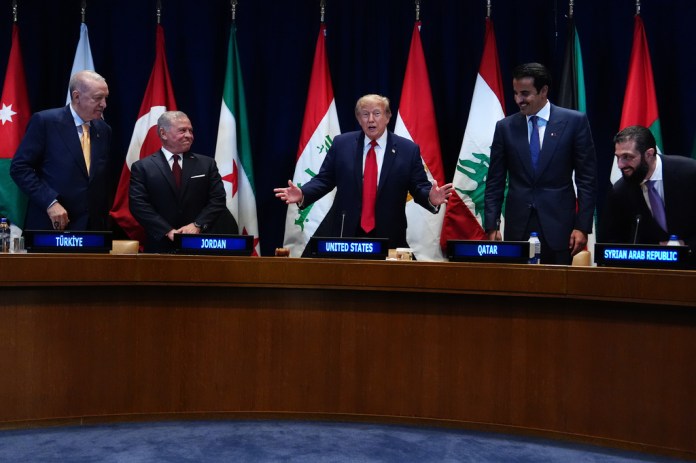
TRUMP DEFENDS WAR IN SUBDUED ADDRESS TO WORLD LEADERS
There is no panacea, of course. Wealthy people will always have excellent schools, whether public or private. Though educational failures are not a matter of money, let’s not kid ourselves. Affluent parents also raise lots of funds that give their children all kinds of perks — a music teacher or another school trip, etc. None of that, however, excuses the fact that schools with multimillion-dollar budgets fail to teach elementary students fundamental reading.
Hannah-Jones’s instinct to sacrifice her child’s education speaks of an overpoliticized mind. And her insistence on confirming her identitarian priors, despite all available evidence, tells us she didn’t really learn much from the experience.
Continue reading...
[ H/T Washington Examiner ]