

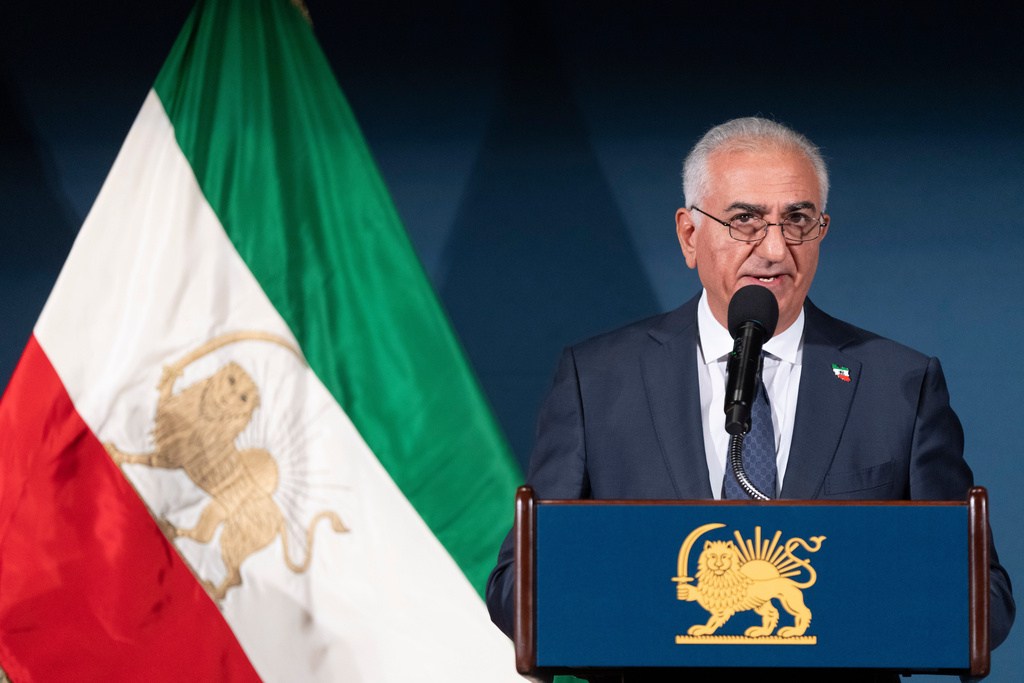
This year, the Friedrich Naumann Foundation is awarding its “Freedom Prize” to the “Iranian people,” with Crown Prince Reza Pahlavi — the heir to Iran’s monarchy and a popular, influential, respected, and credible Iranian figure — accepting on their behalf. The announcement immediately unleashed intrigue, smear campaigns, controversy, and toxic propaganda from a familiar triangle known as the Red-and-Black Reaction, a fusion of Islamic Marxism.
Bloodthirsty, power-hungry vultures in Iran’s fractured opposition began venting their resentment and hostility. To them, anyone opposing this sinister, corrupt triangle (the Islamic regime, the People’s Mojahedin Organization of Iran (MEK), and fascist separatist organizations) is naive, misguided, a traitor, an agent, or an emissary. The regime’s propaganda apparatus, the MEK, and Kurdish separatist organizations display striking coordination, sharing a penchant for physical and character assassination. This spectacle of depravity is all too familiar in modern history.
Participants in the 1979 uprising allied with Khomeini, then Saddam Hussein. Each had a history of crimes. Ghassemlou, formerly of the Tudeh Party and Kurdistan Provincial Committee (KAK), abruptly returned from Europe to promote communism in Kurdistan, teaching Soviet Communist Party history to Kurdish-speaking communists Jalil Gadani, Soleiman Moeini, and Ahmad Tofiq. Tofiq, who considered himself leader of the Democratic Party of Iranian Kurdistan and was close to Barzani, maneuvered to remove Ghassemlou as a rival. He suspected Ghassemlou of collaborating with SAVAK; Iranian communists, including Bijan Jazani, likewise described him in their writings as an agent. With Mustafa Barzani’s help, Tofiq expelled Ghassemlou from Iraq, leaving him with a lasting grudge.
YES, JD VANCE: LOSING THE MIDTERMS WAS ‘WORTH IT’ TO PREVENT A NUCLEAR IRAN
Later, Barzani stripped Ahmad Tofiq of authority, exiled him to Barzan village, and brutally killed several senior Democratic Party of Iranian Kurdistan leaders to deceive SAVAK. Years later, Tofiq was murdered under mysterious circumstances amid internal party disputes and a Kurdish-Ba’athist conspiracy. Ghassemlou remained silent and indifferent about his death. In fact, aided by the Ba’ath Party and its intelligence service, Ghassemlou laid the groundwork for Tofiq’s elimination. Barzani, meanwhile, had no interest in Ghassemlou’s political ambitions. Four months before Khomeini arrived in Iran in 1979, Ghassemlou mocked Talabani’s group in Paris for planning to visit Khomeini in Neauphle-le-Château. He insisted the monarchy would never fall, vowing to cut off his right hand if it did. Yet during Khomeini’s uprising, Ghassemlou abruptly returned to Iran, met Khomeini in Qom, presented his party’s platform and bylaws, cited years of political activity, and cast himself as anti-American. In Feb. 1979, Kayhan reported that the Democratic Party of Iranian Kurdistan had become publicly active. A former SAVAK officer stationed in Iraqi Kurdistan who spent time in post-revolutionary Iran called him “a complete opportunist and a deceiver.”
The Barzanis, meanwhile, were the Islamic Republic’s first allies. Through a conspiracy involving Idris Barzani, the Revolutionary Guards, Khalkhali, and the Barzanis killed Kurds in Iranian Kurdistan, ending Ghassemlou’s honeymoon with Tehran’s regime. After 1958, SAVAK organized a Kurdish armed uprising against Abd al-Karim Qasim, choosing Barzani to execute the covert plan. The movement — falsely portrayed as a nationalist or Kurdish uprising — was engineered by SAVAK and continued until the 1975 Algiers Agreement. SAVAK, the CIA, and Mossad each exploited it differently.
From 1981 to 1989, Ghassemlou’s eight-year dictatorship centered on retaining his position as secretary-general. He received Ba’ath Party funding and weapons. Disputes over war spoils and ties to Hussein sparked a civil war and widespread armed clashes between Komala and the Democratic Party of Iranian Kurdistan, known as the fratricidal war. From Nov. 15, 1984, to April 22, 1988, more than 1,200 Kurds killed one another amid bloody confrontations, sporadic clashes, and fierce ideological disputes. Ghassemlou sought media attention, exploited political trends, and manipulated public opinion. His self-centered leadership caused a split at the party’s fourth congress. He pursued funding by any means, even selling British and Polish prisoners. In the 1980s, Ghassemlou and Rajavi were the only figures among Iran’s notorious opposition forces to meet Hussein. Washington opposed Ghassemlou’s visit to the United States, regarding him as a communist close to Moscow.
Ghassemlou was assassinated in Vienna on July 13, 1989. Of the terrorists posing as Tehran’s representatives — Mostafavi, Bozorgian, and Jafari Sahraroudi — one was related to Barzani and hid in a bathroom. His killing, the author contends, was another internal party conspiracy aided by Tehran and Barzani to eliminate him. Komala and the People’s Mojahedin Organization of Iran (MEK) issued statements calling Ghassemlou a compromiser tied to Tehran’s regime.
Such criminal cults therefore have no right to invoke “freedom and an open and democratic society in Iran”; their histories offer nothing to celebrate. Kurdish political parties are cult-like organizations with lifelong secretaries-general, repeatedly splintering into rival factions. They treat Kurds and Kurdistan as commodities for sale, exploiting the identity and emotions of Kurdish communities while ignoring internal murders, the killing of fellow Kurds, betrayal, and other crimes.
After Mahsa Amini’s killing, Iranians protested religious tyranny nationwide, from Tehran to cities across the country. Yet these Kurdish organizations tried to hijack the national movement and exaggerate their influence, despite a different reality. The women’s movement gained support from the Islamic Left, including reformists and factions linked to Rafsanjani and Khatami. Barzani was the first to call the murdered young woman’s father, seeking to calm the situation, yet never wrote a line condemning the mullahs’ crimes. Later, instead of the Iranian national flag, Mahsa’s father displayed a Barzani-associated flag on Instagram — one unrelated to Kurdistan’s or Iran’s history.
This sinister triangle vies in its hostility toward the Pahlavi dynasty, spreading lies about Iran’s former patriotic king while concealing its alliance with the bloodthirsty mullahs in the 1979 upheaval, when it called Khomeini its Imam. It ignores the money received from the Soviet Union and Hussein, friendships with terrorists like Yasser Arafat, and hostility toward Israel and America. Nor will it accept that Iranians have despised this triangle throughout the decades since the Iran–Iraq War. Remarkably, these Kurdish organizations have never sought regime change in Tehran. Over the past decade, they have repeatedly advocated negotiations with the regime, packaging them as “the rights of Kurds and Kurdistan” to sell deception. Iranian society has no faith or trust in terrorists, Marxists, separatists, or stateless, anti-national thugs.
These desperate cults falsely and shamelessly claim to be trusted representatives of Iran’s ethnic minorities, though its ethnic communities form the nation’s very fabric. They seek to endure the painful birth of a new Iran, preserve its territorial integrity and independence, navigate the rocky path to democracy, and achieve freedom through regime change. Patriotism — not separatism or terrorism — prevails in Iranian society. Over the past decade of protests, Iranians have shown no affinity for this sinister triangle, moving beyond these obstacles to democracy. Kurds, Baluchis, Turks, Lors, Arabs, and others are not regarded as minorities but as pillars of the Iranian nation.
This sinister triangle’s propaganda machine falsely claims the Shah “repressed the Kurds” and banned Kurdish clothing, books, media, and language. Yet SAVAK itself established Kurdish-language radio and the Kurdistan newspaper, while leading Kurdish-region singers, poets, and writers published in Kurdish. Under the Shah, two Kurdish-speaking prisoners, Ghani Bolourian and Aziz Yousefi, were arrested solely for alleged Tudeh Party ties, unrelated to their Kurdish identity or Kurdistan. Today, 8 million of Iran’s 80 million people speak Kurdish, yet these organizations have done nothing to advance Kurdish culture, language, or art — only spread empty, baseless, malicious claims.
This sinister triangle, with its history of terrorism, bloody score-settling, and service to foreign powers — and still armed — now preaches freedom while accusing Pahlavi supporters of aggression. The People’s Mojahedin Organization of Iran (MEK), a cult allied with the Democratic Party of Iranian Kurdistan and Komala under Hussein, still has a lifelong secretary-general and president. Its followers cannot even choose their headscarf colors, red or blue. These criminal, terrorist cults resent Pahlavi’s popularity among younger Iranians. Jealousy and bitterness blind them to reality; most are camera-ready paper heroes without standing or support inside Iran. To this sinister triangle, dissent warrants character assassination or murder. “Long Live the Shah!” makes them tremble. Lacking patriotism, they reject the Shah as a symbol of the homeland. They would rather Tehran’s regime survive another century than see the Pahlavi name rise or the regime born in 1979 collapse.
THE WORLD STILL NEEDS TRUMP
These delusional liars stayed silent when Trump sent weapons for Kurds to carry across the border into Iran, only for Barzani — a Quds Force ally — to seize them in Erbil. This sinister triangle refused to condemn its ally, even when Barzani held a memorial for Qassem Soleimani and they attended Khamenei’s funeral. In London in the 2000s, Komala’s and the Democratic Party’s lifelong secretaries-general met and embraced the Crown Prince, then tried to lure him to Koya, Iraq, falsely promising a Kurdish welcome. The CIA and FBI thwarted the plan, whose aim was to deliver him to the Quds Force.
These illegitimate, delusional cults embrace a hollow ideology of partitioning multiethnic Iran. Calling themselves the opposition in exile, they merely seek a share of power. Deeply hostile to the Pahlavi dynasty, Israel, and America, they imagine themselves Iran’s future leaders while seeking to plunge the country into civil war.
Erfan Fard is a counterterrorism analyst and Middle East studies researcher based in Washington, with a particular focus on Iran, Islamic terrorism, and ethnic conflicts in the region.
Continue reading...
[ H/T Washington Examiner ]