


When Basilio Ramos and his co-conspirators issued the Plan of San Diego in January 1915, they ordered a race war to seize Texas, New Mexico, Arizona, California, and Colorado and establish a republic that would later rejoin Mexico. Their manifesto specifically directed the execution of every Anglo male over 16 and mandated the formation of a “Liberating Army of Races and Peoples.” Armed Mexican and Tejano raiders immediately began striking irrigation works, railroads, and ranches across the lower Rio Grande, continuing their campaign until Texas Rangers and U.S. forces finally crushed the uprising in 1916. Today, a contemporary, low-key nationalism in these same former Mexican territories revives that historic territorial claim — relying on demography, dual loyalty, and an open rejection of federal authority rather than overt warfare.
American Community Survey and Migration Policy Institute data document this modern demographic shift, estimating that approximately 40 million people of Mexican origin live within U.S. sovereignty today. California and Texas alone hold the large majority of both Mexican immigrants and their U.S.-born descendants. This concentration has sustained deep cultural ties; Pew Research Center surveys have recorded that 52% of Mexican-origin adults identified first as “Mexican” or “Mexicano,” while 32% of even third-generation respondents retained that primary self-description. Capitalizing on this permanent base, Mexico’s government has rapidly accelerated dual-nationality registrations. U.S. consulates processed 126,060 cases in 2025 alone — a staggering 153% jump from the previous year. By formalizing these ties, Mexico successfully retains the institutional allegiance of millions living within American borders — effectively leveraging historical and geographical proximity to project its own sovereign influence deep into the U.S. electorate.
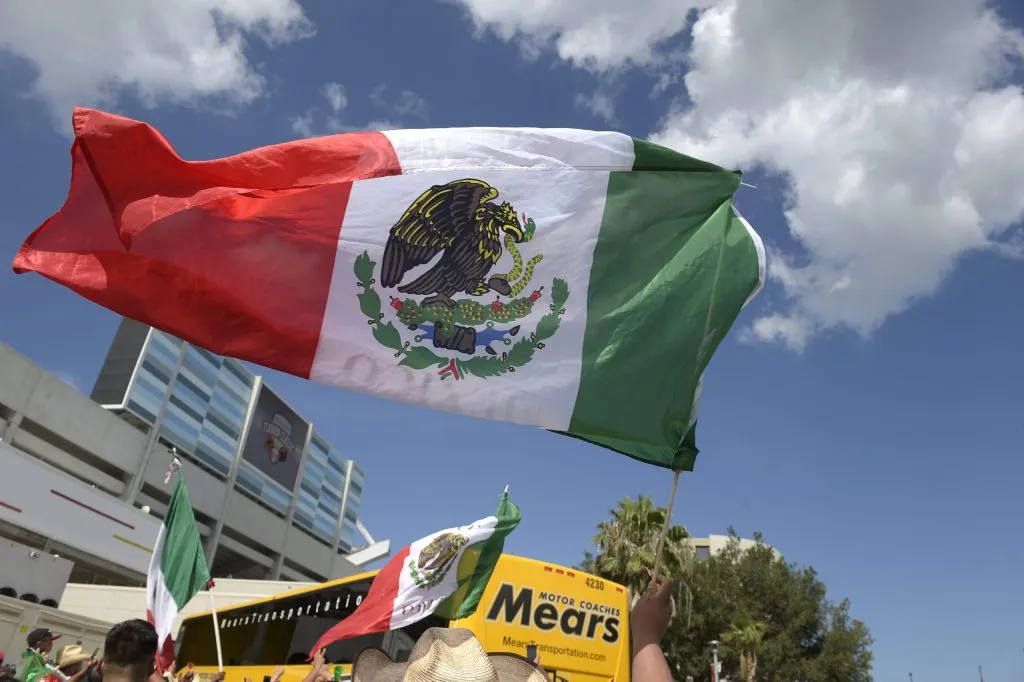
The volatile reality of this friction surfaced vividly in June 2025, when protesters in Los Angeles waved Mexican flags while setting Waymo vehicles ablaze, hurling rocks at California Highway Patrol officers, and clashing outside federal detention facilities during ICE operations. Federal prosecutors later charged multiple individuals with violence against officers and property, but the perpetrators had already sent the underlying cultural message. These open displays of pro-Mexican and anti-enforcement sentiment confirm patterns of incomplete loyalty that earlier European immigrant cohorts largely abandoned within one or two generations. Because of this shifting landscape, both major political parties now face clear electoral incentives to treat the southwest as a distinct demographic bloc whose preferences can decide national outcomes. This political pandering raises the distinct probability that organized demands for autonomy, or even formal reunion with Mexico, will emerge within a generation.
Indeed, legal barriers to such a fracture remain high. Texas v. White declared in 1869 that the Constitution created “an indestructible Union, composed of indestructible States,” rendering unilateral secession void except through revolution or the consent of the states. Yet these legal barriers have never prevented political actors on either end of the spectrum from accommodating nationalist nostalgia when it delivers votes. America succeeded as a cohesive nation because earlier European immigrants accepted English as the public language, adopted shared civic institutions, and built common practices while retaining their private cultural traditions. That traditional integration model produced high intermarriage rates, total English dominance, and a foundational allegiance to the constitutional order. By contrast, current anti-American and separatist ideologies among substantial segments of Mexican Americans — compounded by emerging anti-white cultural currents in certain urban black American communities — explicitly reject that historic bargain.
To reverse this trajectory, policymakers must immediately adopt three concrete measures. First, Congress must finally implement mandatory English proficiency as a strict condition of citizenship, naturalization, and public employment to ensure English remains the sole language of civic and economic life. Second, public schools in America must require a curriculum that severs primary emotional attachment to ancestral homelands and replaces it with exclusive loyalty to the United States and its institutions. Finally, federal and state authorities must enforce immigration, voting, and criminal law uniformly, completely eliminating the ethnic exemptions or selective non-enforcement that currently rewards hostile dual allegiance.
CIA AND MOSSAD MUST ELIMINATE GHALIBAF TO BREAK IRAN’S CONTINUITY MACHINE
The severe dangers of failing to implement these steps are already visible abroad. France’s banlieues confirm the exact consequences of failed integration. Unemployment among recent North African and other non-European immigrants and their descendants runs several points above the national rate, and the 2023 and 2026 riots produced arrest data showing a heavy overrepresentation of Moroccan, Algerian, and related-origin youth.
Parallel societies are the inevitable result of states that subsidize cultural separation and tolerate adversarial dual allegiances. Decisive political action can still compel integration, but continued drift will guarantee the very fracture that the Plan of San Diego once sought to achieve by force.
Jose Lev Alvarez is an American–Israeli scholar specializing in international security policy. A multilingual veteran of the IDF special forces and the U.S. Army, he holds three master’s degrees and is completing a Ph.D. in Intelligence and Global Security in the Washington, D.C., area.
Continue reading...
[ H/T Washington Examiner ]