

Welcome to Friday’s edition of Washington Secrets. If a friend sent you this and you’d like to sign up, CLICK HERE. As usual, today we run the rule over the president’s week with two political strategists. Plus, who did the chief executive of Anthropic label as “Benedict Arnolds?”
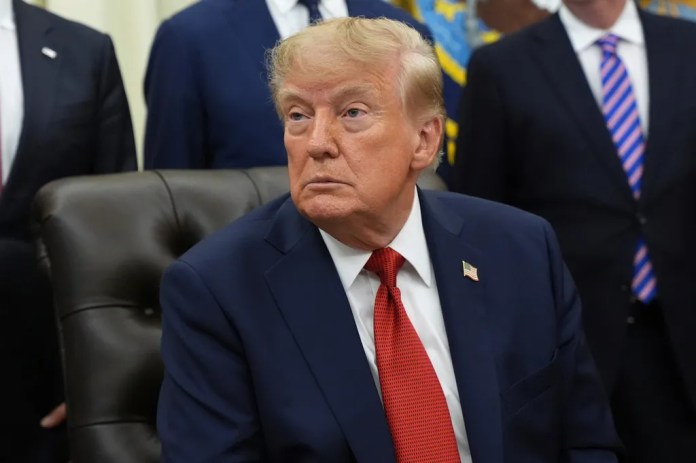
As so often, you can rely on President Donald Trump to say the quiet part aloud.
“We will not be attacking Iran at any time prior to the Midterm Elections to be held in the United States on November 3rd,” he posted on Truth Social on Thursday.
The president’s approval rating has sunk from about 48% to somewhere around 35% (depending on which polls you read) today since he launched the war with Iran. And the issue is a vote-loser in the midterm elections. It is no wonder that he wants the war to sink into a low-level confrontation and blockade so that Americans can forget all about it.
That reckons without the Iranians, unfortunately. Oil prices surged on Thursday, and stock markets fell after at least eight tankers were attacked as they transited the Strait of Hormuz. At the same time, escalating exchanges between Houthis and Saudi Arabia have only added to the difficulties of exporting energy from the region.
It is almost as if Iran is deliberately increasing pressure on Trump during the final month of midterm campaigning.
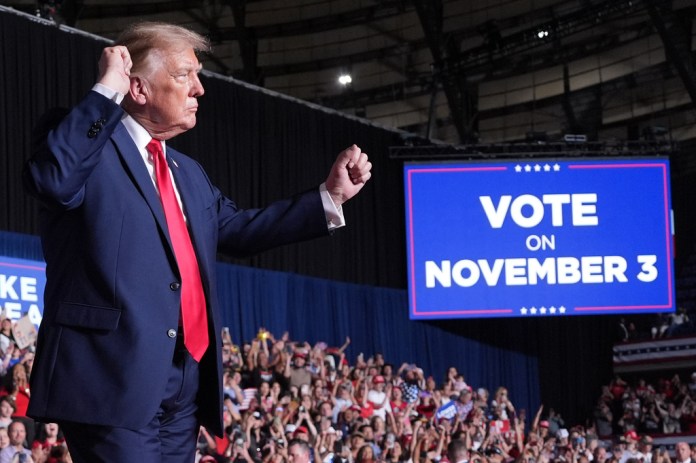
For his part, the president had another busy week hopping around red states.
On Monday, it was Nebraska for a rally with Sen. Pete Ricketts (R-NE) and Gov. Jim Pillen (R-NE). He used the occasion to sign an executive order designed to reduce the price of diesel fuel, but the headlines were all about what he said on Iran.
“They can take out a city. Let them take out Los Angeles. Let them take out San Diego,” he said, apparently in an effort to justify the war, but drew sharp pushback from Gov. Gavin Newsom and California local mayors.
On Tuesday, it was Sparrows Point, Maryland, near Baltimore, to publicize a $3.7 billion Anduril Industries investment to build nuclear-submarine components at a shipyard on the site of the shuttered Bethlehem Steel mill.
The next day, he flew to San Antonio to try to shore up Republican candidates in Texas. Such is the panic in Republican circles that they are worried about Gov. Greg Abbott‘s (R-TX) reelection chances, let alone Ken Paxton‘s Senate race.
The president stayed at the White House on Thursday for a splashy “Golden Age of American Innovation Summit.” He awarded National Medals of Science to Tesla founder Elon Musk, Google co-founder Sergey Brin, Nvidia chief executive Jensen Huang, and Advanced Micro Devices chief executive Lisa Su.
“We live in an age of American wonders and technological marvels, and with the help of the brilliant men and women here today, we will always be on top,” Trump said. Some commentators said the event sat awkwardly alongside the administration’s cuts to federal research funding and the fact that most of the honorees are major Trump or GOP donors.
Trump heads to Syracuse, New York, later on Friday, for a campaign rally. On Saturday, the destination is Clarksville, Tennessee, followed by Tuscaloosa, Alabama, for the Georgia-Alabama football game.
So what do our two strategists make of it all?
John Zogby: F
“Frantic” and “panic” are words to associate with Trump this week. He’s reading the polls (both public and private) and sensing that the GOP is on the ropes this fall. His approval rating remains at or near its lowest level, and it is underwater in 47 of 50 states.
He is traveling from red state to red state to shore up his base, but in normal times that would be seen as non-productive.
These are not normal times, and he is meeting boos and jeers from previous Trump voters at every stop.
The president is attempting to plug some leaks among his supporters while more and more candidates are running away from him, including in Texas and Florida. Voters have been angry in several cycles over the last 40 years, and hopeful at other times. But this year, we are experiencing a politics of disappointment.
The history of desperate presidents bouncing from state to state is fraught with risk. Abraham Lincoln’s successor, Andrew Johnson, tried his “swing around the circle” in 1866 to fend off a radical Republican ascendancy with his more generous plan to bring the Confederate states into the fold. Reports that he was drunk and combative with crowds led to a massive Republican wave and veto-proof Congress — and impeachment.
Woodrow Wilson, against the advice of pretty much everyone, took to the whistle-stop approach to campaign for his League of Nations. He lost it and suffered a stroke, which debilitated him physically and shut him off from the public in the last months of his incumbency.
The only successful campaign was Harry Truman’s in 1948. He faced a fractured Democratic Party with a candidate from the left (former VP Henry Wallace) and the right (segregationist Strom Thurmond). Still unknown to many Americans, he got to show off a midwestern everyman authenticity that was missing from his effete GOP opponent, Thomas Dewey.
Trump is no Truman. He is talking about how life in the U.S. is better, how Iran is on the ropes, prices are coming down, and Americans need to sacrifice a little longer for things to get better. All of this while he is not sacrificing anything at all as he continues to talk about a new presidential retreat at his golf club near Mar-a-Lago, an arch that will bear his name, an overly extravagant ballroom, and so on.
His own MAGA folks are not even buying it. Nor are they in sync with a man who has chosen to embrace data centers. F is for frantic.
John Zogby (@ZogbyStrategies) is the founder of the Zogby Survey and senior partner at John Zogby Strategies. His latest book is Beyond the Horse Race: How to Read Polls and Why We Should. His podcast with son, managing partner, and pollster Jeremy Zogby, can be heard here.
Jed Babbin: B-
It was a pretty dull week around the White House.
Secretary of State Marco Rubio threw a few Iranians out of the country who had overstayed their United Nations welcome. The president, as usual, didn’t get the Nobel Peace Prize, but he said he wouldn’t attack Iran again before the midterms. That may or may not be a wise move because he also let it be known that Iran might attack several U.S. cities. In which case, we’d have to blow them out of the water.
Rubio made an epic speech in Athens about how our democracy is connected to the ancient Greeks. If he were running for president in 2028, that speech would mark the first page of his campaign. Rubio has said that he won’t run if JD Vance does, and Vance appears to be running hard. Rubio would be a much better candidate.
The fact that Trump didn’t get the Nobel Peace Prize is no surprise, but the Nobel committee awarded it to some U.N. flunkey who wrote a report saying that Israel had committed genocide in the Gaza Strip. That’s a bald-faced lie, but the U.N. can’t see past the end of its upturned nose.
Trump did award national science medals (the National Medal of Technology and Innovation) to Michael Dell of Dell Computers and Elon Musk of SpaceX. Both men, Dell especially, have donated many millions to Trump-supported charities.
Jed Babbin (@jedbabbin) is a Washington Examiner contributor and former deputy undersecretary of defense in the administration of President George H.W. Bush.
Did Dario Amodei call Trump a traitor?
Trump and his top lieutenants have called opponents “traitors,” dubbed them “enemies of the people,” or accused them of “treason.” Now it seems as if one of the world’s most important AI entrepreneurs has thrown the label back at the Trump administration.
The episode is detailed in a new book by Kevin Roose, titled The AGI Chronicles: The Inside Story of the Race to Create an Artificial Superintelligence. And it casts fresh light on the tense, contentious relationship between Dario Amodei, chief executive of Anthropic, and the Trump administration over its policy of export controls on chips.
Amodei, famous for his “AI is going to kill us all” doom-monger stance, opposed any exports to China. And made his fury clear to a colleague as the Trump administration began working towards a compromise position, as the book spells out.
Amodei also clashed with the Trump administration on export controls—the rules that restricted the sale of powerful AI chips to China and other American adversaries. Nvidia and other U.S. chipmakers had been lobbying for years to get the restrictions relaxed, and Trump’s advisers had indicated they were open to it. Amodei saw this as treasonous. ‘These people are going to be remembered as modern-day Benedict Arnolds,’ he told a colleague.
Amodei has long had a fractious relationship with the Trump administration, which has insisted it wants to push ahead with AI as fast as possible rather than adopting his proposed “guardrails.” But there were signs of a warming. The pair had Sunday dinner together at the end of September.
So, Trump will not be at all impressed that the AI nerd compared him and his administration to a general whose name is synonymous with betrayal after switching sides during the American Revolutionary War.
Lunchtime reading
A conversation with the man Putin wants dead: One of America’s biggest challenges, said Garry Kasparov, stems from the fact that so many young people no longer believe in American values, “and that more than half of those under 30 think that communism is good.”
A soccer cheating scandal has ballooned into a geopolitical problem for Britain: It was always about more than a foreign royal buying himself a plaything. But the acquisition of Manchester City Football Club raises awkward questions about an Emirati soft power grab.
Continue reading...
[ H/T Washington Examiner ]