

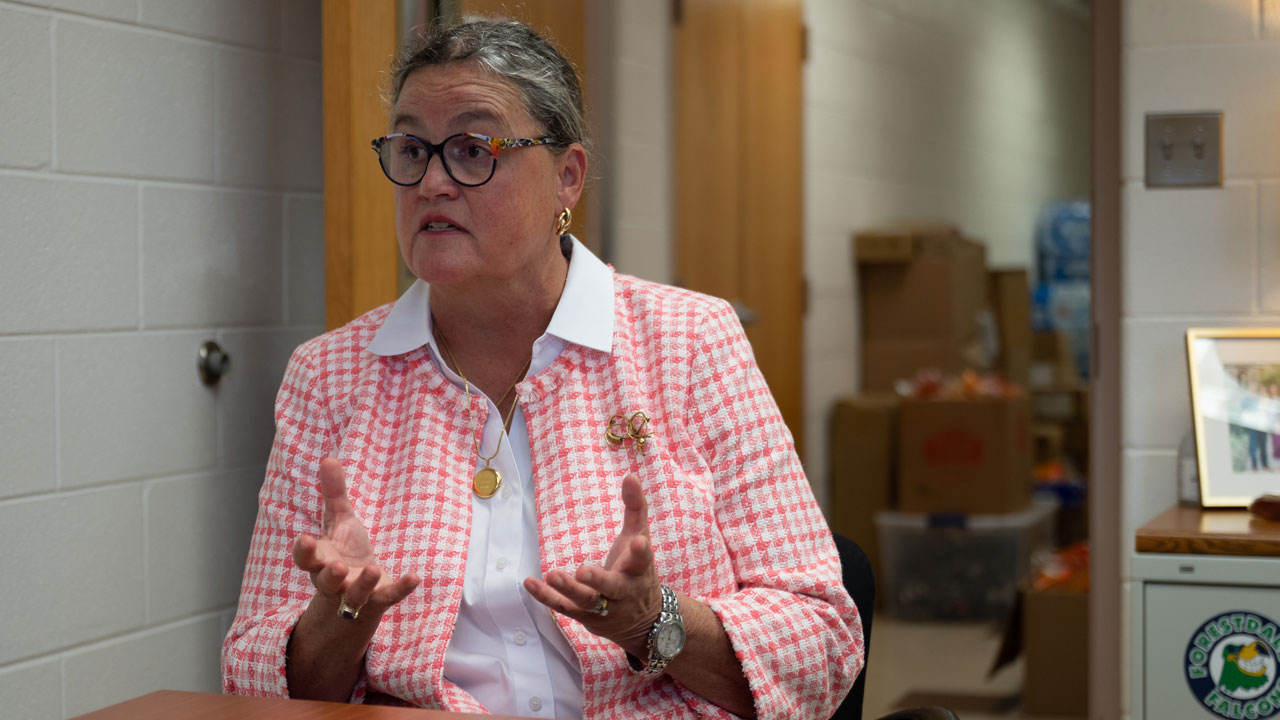
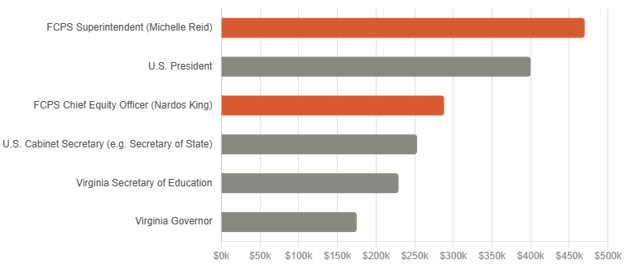
Fairfax County Public Schools Chief Equity Officer Nardos King makes $288,064 this year—more than every single member of the president’s Cabinet—Secretary of State Marco Rubio, Secretary of Defense Pete Hegseth, Secretary of the Treasury Scott Bessent, all of them—each of whom earns $253,100 to run a federal department.
King’s job is to oversee equity initiatives for one county’s school system. Virginia’s largest public school district holds “equity” at the center of its strategic plan, and King is just one of ten district “chiefs” whose salaries clear that bar. A public records request revealed that 13 Fairfax County Public School employees earn more than the U.S. Secretary of Education.
By comparison, Virginia’s Secretary of Education, Jeffery Smith, makes $229,136. In other words, it is more lucrative to be an assistant superintendent overseeing a small region of one Virginia county than to run the Virginia Department of Education.
At the top of the heap, Michelle Reid, Fairfax schools’ superintendent, is paid $469,936 a year—nearly $70,000 more than the President of the United States makes to run the executive branch, command the armed forces, and set foreign policy for 340 million people. Reid, by contrast, runs a declining school district with about 180,000 students.
Reid is the visible peak of a payroll structure that taxpayers have been quietly bankrolling for years—one that a batch of FOIA-obtained salary records shows has ballooned well past anything resembling fiscal restraint.
Indeed, the district doesn’t have just one highly paid executive, it has a small army of them. A Chief Information Technology Officer, a Chief Financial Officer, and a Division Counsel each earn $305,694. A Chief of Schools and a Chief Human Resources Officer each earn $293,824. Four more chiefs—of Facilities, Operations, Academics, and Safety and Security—make $288,064, alongside King. And ten assistant superintendents earn between $241,475 and $251,231.
Add it up, and the 71 Fairfax County positions captured in these records carry a combined annual payroll of just over $17 million—an average salary of $239,693 per position. Every single one of the 71 clears $200,000.
To put that in perspective: the top 10 highest-paid Fairfax County Public School employees alone collect $3.13 million a year in combined salary—more than the entire cost of Gov. Abigail Spanberger’s 12-member cabinet, which totals $2.78 million for the officials running education, health, transportation, agriculture, labor, and public safety for the entire Commonwealth of Virginia.
And it’s not just the schools.
Cross the street to Fairfax County’s general government, and it gets even worse. Payroll records show 42 county officials earning six figures at the top of the org chart, with a combined payroll north of $10.7 million and an average salary of $256,943—even higher than the average Fairfax County Public School salary and more than what the federal government pays its own Cabinet secretaries.
Fairfax County Government’s 10 Highest-Paid Employees (Fiscal Year 2027)
| Name | Position | Salary |
| Christina Carpenter Jackson | Chief Financial Officer | $326,241 |
| Thomas G. Arnold | Deputy County Executive | $325,592 |
| Ellicia Lynn Seard-McCormick | Deputy County Executive | $308,249 |
| Jennifer Lynn Miller | Deputy County Executive | $307,535 |
| John Seton Butler | Chief, Fire and Rescue Department | $301,547 |
| Kevin F. Davis | Chief of Police | $301,399 |
| Jaydeep Rasiklal Doshi | Director, Tax Administration | $295,656 |
| Jessica L. Werder | Deputy County Executive | $295,000 |
| William David Hicks Jr. | Director, Land Development Services | $283,156 |
| Christina Marie Peterson | Human Resources Director | $280,908 |
| Total | $3,025,283 |
Source: Fairfax County payroll records obtained via FOIA.
Twenty-four of those 42 county officials earn more than the members of President Donald Trump’s Cabinet. Six of them clear $300,000 outright, including four separate deputy county executives, a redundancy of executive layers few private employers would tolerate. The Fire Chief and the Chief of Police each earn more than $301,000—more than the salaries of Virginia’s governor and lieutenant governor put together, $175,000 and $36,321, respectively.
County officials have a ready defense: Fairfax is big, Fairfax is complex, you have to pay competitively in the D.C. metro area to attract talent.
Fine. But “competitive” cannot mean that administrators overseeing one county consistently earn more than the officials constitutionally responsible for the entire state and, in some cases, the entire country. Virginia’s Secretary of Education sets policy for every school division in the Commonwealth and is paid less than the person managing curriculum for one region of Fairfax County. That’s not a competitive labor market. That’s an inverted org chart, where the farther an administrator sits from an actual classroom, the more likely they are to be sitting on top of the pay scale.
And the headcount problem compounds the pay problem. These are just the positions that surfaced in one FOIA request—executive directors of “strategy and planning,” an “administrative hearing officer,” a “chief experience and engagement officer.” Central-office titles multiply every budget cycle, even as parents are told there’s no room to shrink class sizes.
None of this happened by accident. Every one of these salaries was approved by a school board or a board of supervisors that Fairfax County voters elected—and can unelect in November 2027. Every salary line is public record, available through FOIA, that most taxpayers never think to request because they assume someone, somewhere, is watching the budget.
Few people are watching. That’s the point.
Fairfax County and its school system have built a compensation structure that rewards layers of administration over frontline service, in a jurisdiction wealthy and complacent enough that almost no one checks the math. Before the next tax rate hearing, before the next budget vote, Fairfax County taxpayers deserve one plain answer: Why does it pay better to manage one county’s bureaucracy than to run the entire country?
We publish a variety of perspectives. Nothing written here is to be construed as representing the views of the Daily Signal.
Continue reading...
[ H/T The Daily Signal ]